

Global vs. Local Cooling Tower Manufacturers: Pros and Cons
Introduction: The $4.58 Billion Procurement Crossroads
The global cooling tower market recently reached a valuation of $5.8 Billion. The industry continues to expand rapidly. However, global supply chain volatility has transformed local availability into a premium feature. Facility managers and engineers face a complex decision when upgrading their thermal infrastructure.
Do you choose the research and development power of a global giant? Or do you prioritize the rapid-response, tariff-exempt stability of a domestic manufacturer? Your decision impacts initial capital expenditure, long-term maintenance costs, and facility uptime.
This guide provides an objective engineering analysis. We will help you determine which partner aligns with your facility’s ten-year growth plan.
Global Cooling Tower Manufacturers: The Power of Scale
Large international corporations dominate a significant portion of the thermal management market. These entities leverage massive economies of scale to produce equipment efficiently. They offer distinct advantages for specific types of industrial projects.
Driving R&D Innovation
Global conglomerates invest heavily in research and development. They employ extensive engineering teams to pioneer new technologies. You gain access to patented features like hybrid dry-wet cooling modes. These companies also lead the way in developing AI-optimized fill media that maximizes heat transfer efficiency.
Standardizing Multi-National Operations
Multi-national corporations often require standardization across their global sites. Global cooling tower manufacturers provide identical footprints and specifications for facilities located on different continents. This uniformity simplifies global procurement. It also streamlines corporate engineering standards across borders.
Utilizing Advanced Testing Facilities
Accuracy matters when calculating thermal capacity. Global manufacturers operate independent, CTI-certified laboratories. They test their equipment under strict conditions to verify performance. You receive precise, documented proof that the unit will handle your specified heat load.
Recognizing the Drawbacks of Scale
Scale does not always equate to efficiency in every aspect. Lead time volatility presents a major risk for international orders. Port congestion and international shipping delays currently force buyers to wait 12 to 16 weeks for major components. This delay can disrupt critical construction schedules.
Furthermore, transactional support often feels disconnected. Large international firms provide high-level engineering assistance. However, they may lack the localized presence necessary to understand site-specific operational nuances.
USA Cooling Tower Manufacturers: The Agility Advantage
Domestic production offers a compelling alternative to international sourcing. A USA cooling tower manufacturer prioritizes speed, accessibility, and localized expertise. These companies excel when facilities require rapid deployment and reliable lifecycle support.
Securing the Lead Time Win
Time directly influences your return on investment. Domestic sourcing often slashes delivery times by 50 percent. You completely bypass international freight bottlenecks and port delays. A localized supply chain ensures your equipment arrives exactly when the installation team needs it.
Accessing Local Cooling Tower Service
Equipment failures require immediate attention. Local cooling tower service provides on-site technical support that arrives in hours, not days. Domestic manufacturers maintain regional service networks. They dispatch qualified technicians quickly to minimize your facility downtime.
Ensuring Tariff Immunity
International trade policies shift frequently. These shifts introduce financial uncertainty to large capital projects. Domestic sourcing guarantees tariff immunity. You will not experience a surprise 25 percent import adjustment in the middle of your installation phase.
Acknowledging Niche Limitations
Smaller domestic firms sometimes operate with a niche focus. They might specialize in highly durable materials like high-density polyethylene. However, they often lack the massive variety of model configurations offered by a global conglomerate.
Additionally, domestic production involves capital expenditure premiums. The initial purchase price for a domestic unit may sit five to ten percent higher than an imported model. Fortunately, lower domestic shipping costs frequently offset this initial price difference.
The 2026 Manufacturer Comparison Matrix
When evaluating domestic vs import cooling towers, visual comparisons help clarify the best path forward. Use this matrix to weigh the core features against your facility requirements.
| Feature | Global Manufacturer (Import) | USA Manufacturer (Domestic) | Winner for ROI |
| Average Lead Time | 12–18 Weeks | 4–8 Weeks | Local |
| Technical Innovation | High (Proprietary R&D) | Moderate (Proven Standards) | Global |
| Service Response | Remote / Scheduled | On-Site / Rapid | Local |
| Material Quality | Varied (Check Specs) | High (US Steel/Composites) | Local |
| Price (Initial CapEx) | Lower (Mass Production) | Moderate (Localized Labor) | Global |
| Tariff Risk | High | None | Local |
Decision Factors: Import vs. Domestic
You must align your procurement choice with your operational priorities. Every facility operates under a unique set of constraints. Evaluate these critical decision factors before signing a purchase order.
Evaluating the Criticality of Uptime
Downtime destroys profitability. Consider a scenario where a ten-day production delay costs your company one million dollars. Under these circumstances, a domestic cooling tower manufacturer becomes the only logical choice. Localized parts hubs and rapid service networks protect your revenue stream directly.
Aligning with Regulatory and ESG Goals
Environmental regulations vary wildly by region. Global leaders often secure impressive water-neutral corporate certifications. However, local firms excel at meeting specific state-level regulations.
For example,
California facilities require strict adherence to Title 24 energy codes. A regional partner understands these mandates intimately.
Embracing the Hybrid Approach
Many facilities adopt a hybrid strategy in 2026. They procure the primary asset from a global manufacturer to secure advanced technology. Then, they contract a local service partner to manage the equipment lifecycle. This approach blends global innovation with localized, rapid-response maintenance.
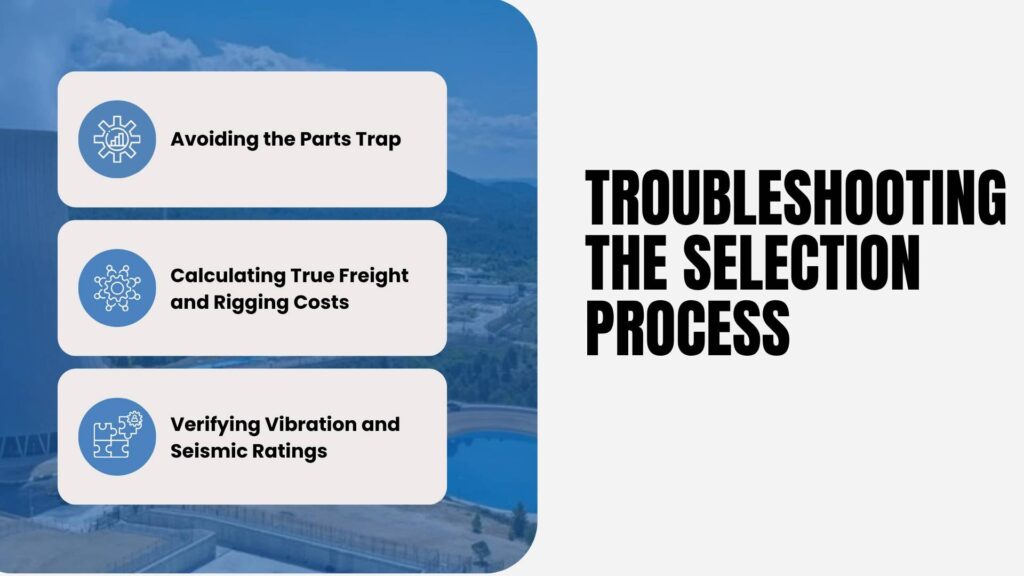
Troubleshooting the Selection Process
Procurement pitfalls hide within complex mechanical contracts. You must ask the right questions during the bidding phase. Protect your budget by identifying hidden costs before they materialize.
Avoiding the Parts Trap
Proprietary components create long-term vulnerabilities. Always ask the vendor if their equipment requires specialized parts. If you can only source a specific fan motor or drive shaft from an overseas factory, you risk massive future downtime. Prioritize units that utilize standard, readily available industrial components.
Calculating True Freight and Rigging Costs
Do not let a low sticker price deceive you. A cheap import often becomes the most expensive option. You must calculate the cost of trans-oceanic shipping, port fees, and heavy-haul trucking to your site. Domestic units carry higher initial price tags but feature vastly lower transportation expenses.
Verifying Vibration and Seismic Ratings
Structural integrity matters. Ensure your chosen equipment meets the updated 2026 building codes for your specific region. Coastal and fault-line facilities require stringent vibration and seismic certifications (specifically complying with ASCE 7-22 and IBC 2024/2027 standards). Both local and global vendors must provide certified engineering documentation to prove compliance. This includes site-specific seismic coefficients and OSHPD/HCAI pre-approval for critical infrastructure like hospitals and data centers.
Conclusion: Resilience Over Price
Supply chain resilience stands as the ultimate procurement metric in 2026. The best manufacturing partner minimizes your operational risk.
Global cooling tower manufacturers serve massive, non-urgent capital expenditure projects perfectly. They deliver exceptional technology and standardized designs. Conversely, local manufacturers dominate when supporting mission-critical, high-uptime industrial facilities. They offer unbeatable speed and localized support.
At a crossroads between a global giant and a local specialist? Consult with Industrial Cooling Solutions for a manufacturer-agnostic performance audit to find your perfect thermal fit.
Frequently Asked Questions
What are the main differences between domestic vs import cooling towers?
When comparing domestic vs import cooling towers, the biggest differences lie in supply chain speed and initial costs. Imported units often cost less upfront but carry higher tariff risks and shipping fees. Domestic models provide faster delivery and immune pricing from import taxes. We recommend evaluating your project timeline and budget constraints to determine which option serves your facility best.
Why should we choose global cooling tower manufacturers for our facility?
Global cooling tower manufacturers excel at providing standardized designs and advanced research technologies. If you operate facilities across multiple countries, these large corporations deliver identical footprints and proprietary innovations like AI-optimized fill media. While shipping takes longer, you benefit from their massive testing facilities and economies of scale, making them ideal for large, non-urgent industrial projects.
What benefits does a USA cooling tower manufacturer provide?
Partnering with a USA cooling tower manufacturer gives you a significant agility advantage. You bypass international freight bottlenecks completely, ensuring your equipment arrives exactly when your installation team needs it. Furthermore, domestic suppliers build units using high-quality local materials and comply directly with strict state-level environmental codes. This localized approach minimizes your overall supply chain risk effectively.
How does the lead time comparison look for domestic and international orders?
A standard lead time comparison reveals a massive gap between local and overseas suppliers. International orders currently average twelve to eighteen weeks due to port congestion and shipping delays. Conversely, domestic sourcing slashes this wait time to just four to eight weeks. If your facility requires critical uptime, this faster delivery schedule protects your revenue stream from extended outages.
How important is local cooling tower service for long-term maintenance?
Reliable local cooling tower service is crucial for maintaining maximum facility uptime. When equipment fails, you need technical support that arrives in hours, rather than days. Regional technicians understand site-specific operational nuances and carry standard replacement parts. This rapid response eliminates prolonged downtime, ensuring your thermal infrastructure continues operating smoothly throughout its entire lifecycle.
📌 Smart minds follow smart pages, hit follow on Tech Statar.