
How to Use an AI Text Watermark Remover to Clean ChatGPT and Gemini Outputs
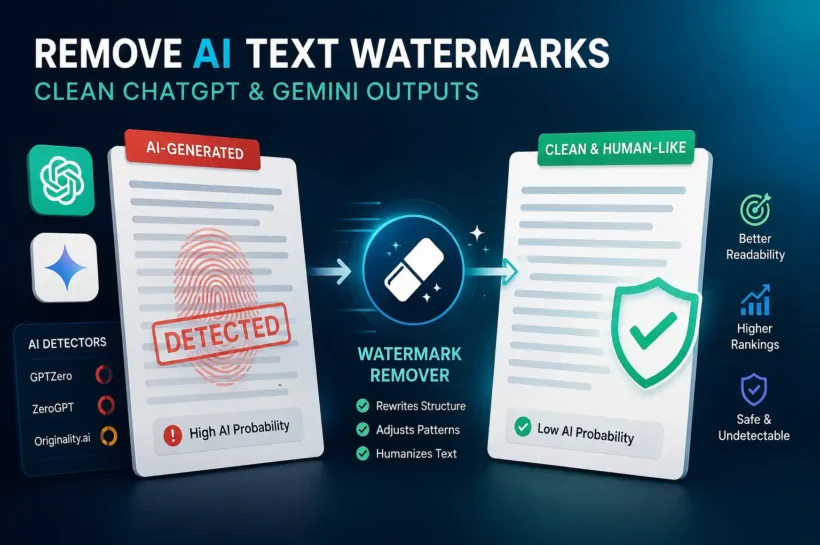
AI-generated text leaves fingerprints. Even when the writing looks human, the patterns underneath give it away, and as detection tools sharpen in 2026, those fingerprints cost writers visibility, marks, and credibility. A watermark remover strips those signals so your text reads as your own. One thing worth saying upfront, though these tools belong in the hands of writers polishing their own drafts, not students dodging assignments or anyone trying to pass off work they didn’t actually do. Used the right way, it’s about making your real writing sound less robotic. Used the wrong way, it’s just cheating with extra steps. Here is how the tools work, how to use them properly, and where they fall short.
What Is an AI Text Watermark and Why It Matters in 2026
A watermark is a statistical signal woven into text as the model generates it. The model nudges certain tokens slightly more often than chance would predict, creating a hidden pattern only a detector with the right key can recognize. You will not see it. ZeroGPT, GPTZero, and Originality.ai can. Regulators in the EU and parts of Asia now expect AI providers to mark their outputs, which is why watermarking moved from research papers into default production behavior. For students, marketers, and publishers, an unflagged document is the difference between a page that ranks and one that gets buried.
How ChatGPT and Gemini Watermark Their Outputs
The two systems take different routes, and knowing the difference matters when you pick a removal method.
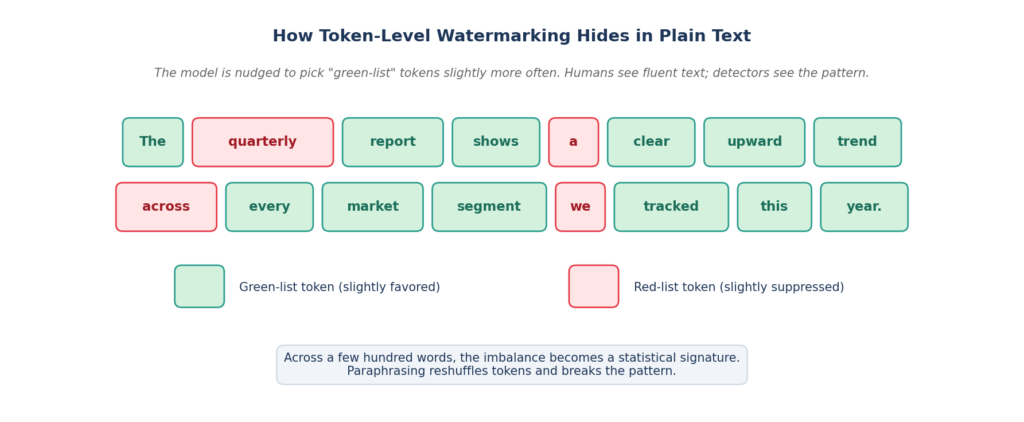
Figure 1: How token-level watermarking embeds a hidden statistical signal.
ChatGPT’s Watermarking Approach
OpenAI uses token-level probability shifts. During generation, the model splits its vocabulary into soft “green” and “red” lists at each step and slightly favors green tokens. Over a few hundred words, the green bias builds into a statistical signature. The text reads fluently, but a detector running the same key can spot the skew. Heavy paraphrasing breaks the pattern because rewriting reshuffles token choices.
Gemini’s SynthID and Invisible Token Patterns
Google built SynthID-Text into Gemini in late 2024, and it has matured since. SynthID assigns scores to candidate tokens using a pseudo-random function tied to context, then biases selection toward higher-scoring tokens. The pattern survives light editing, which is why a single synonym swap will not remove Gemini watermark traces. You need structural changes, sentence reordering, clause splitting, and voice flips before SynthID’s signal weakens enough to slip past Google’s own classifier.
Step-by-Step: How to Use an AI Text Watermark Remover
- Copy the full output. Partial sections leave detectable chunks. Work with the complete passage so the remover has enough text to restructure.
- Pick a tool that matches the model. SynthID-aware removers handle Gemini better, and general paraphrasers work fine on ChatGPT.
- Paste and set the intensity. Most tools offer light, medium, or aggressive modes. Start medium, aggressive, often mangles meaning.
- Run the pass. Processing takes seconds for short text and about a minute for long-form.
- Check against a detector. Run the output through GPTZero or Originality.ai. If the score still reads high, run a second pass or edit manually.
- Read it aloud. Any sentence that sounds robotic gets rewritten in your own voice.
- Save a clean version. Keep the original separately so you can compare and learn what the tool changed.
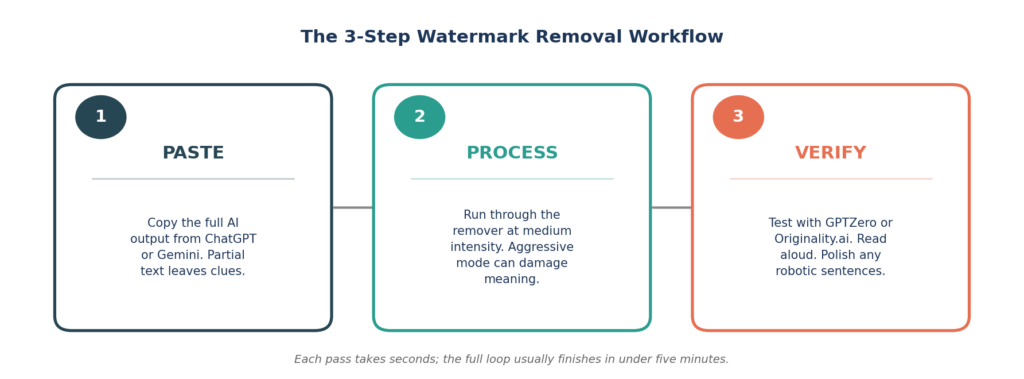
Figure 2: The three-step removal workflow at a glance.
Comparison of Popular AI Text Watermark Removal Methods
Different methods trade speed for thoroughness. The table below maps the trade-offs so you can pick the right tool for the job.
| Method | How It Works | Best For | Speed | Limitations | or Paid |
|---|---|---|---|---|---|
| Dedicated watermark removers | Statistical rewriting tuned to known watermark patterns | SynthID-heavy Gemini text | Fast | Can flatten voice | Mostly paid |
| General AI paraphrasers | Sentence-level rewording | Light ChatGPT cleanup | Fast | Misses deep patterns | Both |
| Translation cycling | Translate to another language and back | Quick small jobs | Medium | Introduces errors | |
| Manual paraphrasing | Human rewrite from scratch | High-stakes work | Slow | Time-intensive | |
| Tool passes with targeted edits | Tool pass with targeted edits | Most use cases | Medium | Requires judgment | Both |
A clean workflow typically shifts detection results sharply, as shown below.
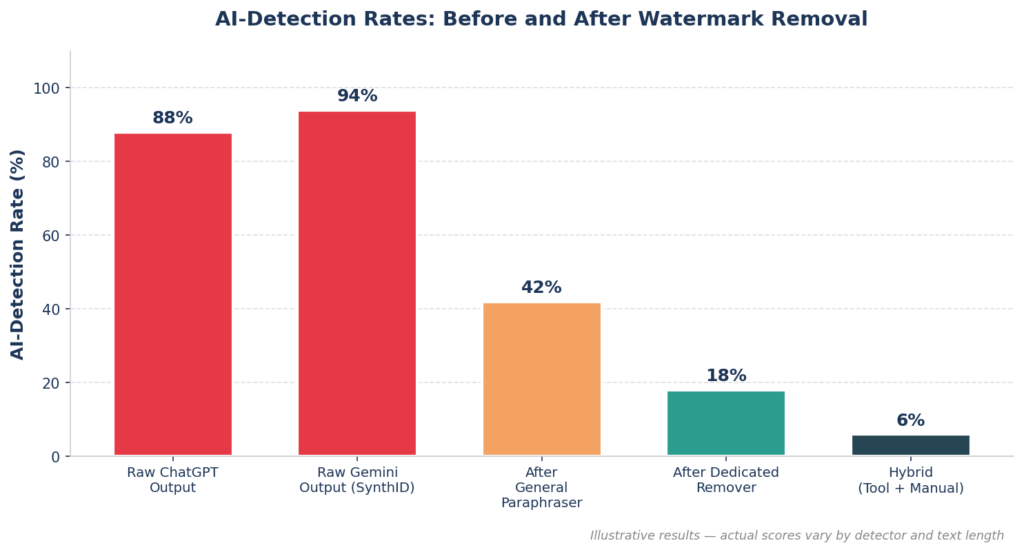
Figure 3: Drop in detection rate across removal methods.
Writing Better Prompts to Reduce Watermark Traces
Cleaner input means less work later. Vague prompts produce the most pattern-heavy output because the model falls back on its safest token paths. Specific prompts force it off-script. Ask for a defined tone, a target reader, sentence-length variation, and a few constraints, such as “no semicolons,” “use one short sentence per paragraph,” or “avoid the words leverage and unlock.” Feed the model a sample of your own writing as a style reference.
If prompt-writing is the bottleneck, an AI prompt generator can give you structured templates that bake in voice and constraint variables, which reduces the statistical regularity detectors latch onto. The output still needs cleaning, but the starting point is much closer to human-sounding.
Common Mistakes to Avoid When Removing AI Watermarks
- Trusting a single pass. One run rarely clears SynthID-class watermarks.
- Skipping the detector check. “It reads fine” is not evidence; run it through at least two detectors.
- Believing in “100 percent undetectable” marketing. No tool guarantees it across every system.
- Letting the remover destroy your voice. If every paragraph sounds the same after processing, the fix becomes the new problem.
- Ignoring formatting tells like repetitive transitions, identical sentence lengths, and the em-dash overuse common to AI drafts.
Is It Ethical and Legal to Remove AI Watermarks?
Legally, removing a watermark from text you generated for your own use is not currently restricted in most jurisdictions. The grey zones are academic submissions, journalism, and any context where you signed an honor code or content policy that bans AI assistance. Those rules apply regardless of whether a watermark is visible. Ethically, the cleanest line is honesty about the workflow. Use the tools to polish your work, not to misrepresent authorship where it matters.
Final Thoughts
Watermark removers are useful, not magic. The best results come from combining a smart prompt, a competent tool, and a final human edit. Treat the remover as one step in a workflow rather than a finish line. If you are writing anything that affects search visibility, grades, or professional reputation in 2026, test the output against at least two detectors before publishing and keep refining your prompts so cleanup gets shorter over time.
FAQs
Does removing the watermark make AI content fully undetectable?
No. Removal lowers the statistical signal, but detectors also look at perplexity, burstiness, and phrasing patterns. A hybrid approach of automated removal plus manual editing gets you closest to fully clean, natural output.
Will Google penalize content with the SynthID watermark removed?
Google’s stated guidance penalizes low-quality, unhelpful content rather than AI use specifically. Removing the watermark does not have a direct impact on ranking, but small or rewriting will still not perform regardless of detection status.
Is SynthID actually active in Gemini right now?
Yes. Google enabled SynthID-Text across Gemini models in late 2024 and expanded coverage through 2025. It runs by default on most generation endpoints and is now a standard part of Gemini output.
What is the safest removal method for important work?
The hybrid method. Run one tool pass to break the bulk of the pattern, then rewrite key sentences yourself. This protects voice, lowers detection scores, and keeps your meaning intact.
This is just the start. Follow Tech Statar for more gems.