

Teachers have more ways than ever to turn their knowledge into income. You can sell lesson plans, worksheets, classroom activities, printables, study guides, online courses, and other educational resources without building a marketplace from scratch.
But choosing the right platform can be tricky.
Some marketplaces are built specifically for educators, while others target a broader audience. One platform may offer a large teacher audience but charge higher seller fees. Another may give you more control but require you to do more of your own marketing.
So, what is the best online marketplace for teachers in 2027?
For most teachers selling educational resources, Teachers Pay Teachers (TPT) is the strongest overall option. But it isn’t necessarily the best choice for everyone. Platforms such as Classful, Etsy, and Udemy can make more sense depending on what you’re selling and how you want to build your teaching business.
In this guide, we’ll compare the best online marketplaces for teachers, their key features, fees, advantages, limitations, and the types of sellers they’re best suited for.
What Is an Online Marketplace for Teachers?
An online marketplace for teachers is a platform where educators can create, list, promote, and sell educational products or knowledge to students, parents, teachers, and other learners.
Instead of creating your own ecommerce website, you use an established platform that already provides features such as product listings, payment processing, customer accounts, search, and marketplace traffic.
For example, a teacher might create a collection of third-grade math worksheets and sell them as a downloadable resource. Another teacher could package their classroom expertise into a self-paced video course.
The marketplace handles much of the technical infrastructure, while the teacher focuses on creating useful educational content.
What Can Teachers Sell Online?
Depending on the platform, teachers can sell products such as:
- Lesson plans
- Worksheets and activity sheets
- Classroom games
- Printables
- Educational posters
- Digital teaching resources
- Assessments and quizzes
- Curriculum materials
- Study guides
- Educational templates
- Online courses
- Professional development resources
The best platform depends largely on what you want to sell.
For instance, TPT is designed around educational resources, while a platform such as Udemy is primarily focused on structured online courses.
Marketplace vs. Selling From Your Own Website
A marketplace isn’t the only way to sell teaching resources.
You can also build your self website and sell your products directly. This gives you more control over branding, pricing, customer relationships, and marketing.
But there’s a trade-off.
A marketplace already has an established audience and infrastructure. A new website doesn’t.
That’s why marketplaces can be a practical starting point for teachers who want to test an idea without investing heavily in website development, payment systems, and ecommerce infrastructure.
The downside is that you’re operating within someone else’s rules and fee structure.
In short: marketplaces generally make it easier to get started, while your own website can give you more control as your business grows.
📌 Don’t Miss These Articles: Why Teachers Are Using Seedance 2.0 to Make Learning Content More Engaging for Students
What to Look for in a Teacher Marketplace
Don’t choose a marketplace simply because it has the biggest name.
The right platform should fit your products, audience, business model, and long-term goals.
Here are the most important factors to compare.
Seller Fees and Payout Rates
Fees directly affect how much money you keep from every sale.
Look beyond the headline percentage. Check for:
- Listing fees
- Transaction fees
- Payment processing fees
- Subscription fees
- Marketplace commissions
- Different payout rates for different seller plans
A platform with a lower commission isn’t automatically better. A marketplace with a larger, more relevant audience may generate more sales even if its fees are higher.
Always calculate your potential profit before committing to a platform.
Audience Size and Discoverability
A marketplace is only useful if potential buyers can find your products.
Look at whether the platform attracts:
- Teachers
- School administrators
- Parents
- Students
- Tutors
- Homeschooling families
- Professional learners
A specialized teacher marketplace can be particularly valuable because its audience already understands the type of products you’re selling.
Product Types Supported
Make sure the platform supports your product format.
If you sell PDFs and classroom worksheets, you don’t necessarily need a course platform.
But if you want to sell a six-hour video course, downloadable resources alone may not be enough.
Before signing up, check whether the platform supports the products you plan to create now and the products you may want to create later.
Store and Branding Options
Your marketplace store is effectively your storefront.
Check whether you can customize:
- Store name
- Profile
- Product images
- Descriptions
- Categories
- Branding
- Product bundles
More customization can help you build recognition instead of looking like just another seller.
Marketing and Analytics Tools
Good products don’t automatically generate sales.
Look for tools that help you understand:
- Which products get the most views
- Where buyers come from
- Which resources sell best
- What customers search for
- How products perform over time
These insights can help you decide what to create next.
Payment and Payout Options
This is especially important if you’re selling internationally.
Before joining a platform, check:
- Available payment methods
- Seller payout methods
- Supported countries
- Payout frequency
- Minimum payout requirements
- Currency conversion
- Applicable taxes or withholding
A platform can look perfect on paper and still be impractical if you can’t receive payments easily.
Best Online Marketplaces for Teachers in 2027
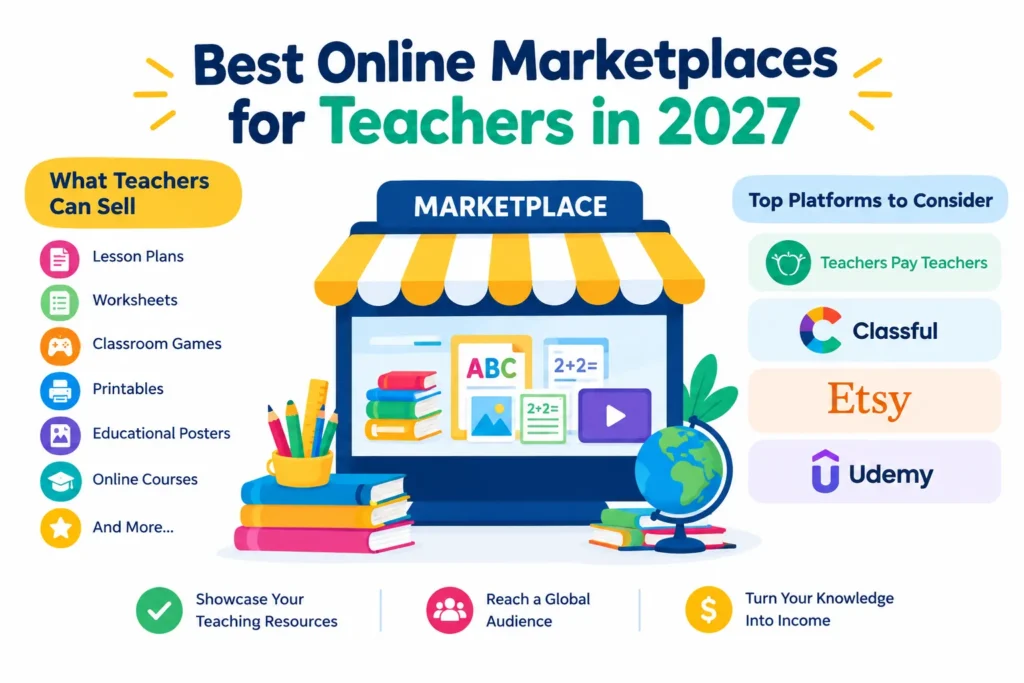
Here are the platforms worth considering if you want to monetize your teaching expertise online:
- Teachers Pay Teachers: Best overall for teacher-created educational resources
- Classful: Best for resources and self-paced courses
- Etsy: Best for teacher printables and digital downloads
- Udemy: Best for structured online courses
- Teachers Notebook: Another option for selling teacher-created resources
The best choice depends on your product and business model, so let’s look at each one in more detail.
1. Teachers Pay Teachers: Best Overall Marketplace for Teachers
Teachers Pay Teachers, commonly called TPT, is one of the most established marketplaces dedicated specifically to educational resources.
The platform allows educators to create and sell original teaching materials to other educators. Its marketplace includes millions of educational resources across subjects, grade levels, and teaching needs.
That specialization is TPT’s biggest advantage.
You’re not trying to convince a general ecommerce audience that a lesson plan is valuable. You’re putting the resource in front of people who are already looking for educational materials.
Key Features
TPT supports a broad range of teacher-created resources, including:
- Worksheets
- Lesson plans
- Classroom activities
- Assessments
- Games
- Digital resources
- Bundles
- Educational materials for different grade levels and subjects
The platform also provides search and discovery features that help buyers find resources based on their teaching needs.
Seller Fees and Payouts
TPT offers different seller plans, and the payout structure depends on the plan you choose.
This makes it important to compare the current membership cost, payout percentage, and other applicable fees before opening a store.
Don’t make the decision based solely on the percentage you receive. Consider how the plan affects your expected sales volume and profit.
Pros and Cons
Pros
- Large education-focused audience
- Strong marketplace recognition
- Designed specifically for teachers
- Supports many types of educational resources
- Established seller ecosystem
Cons
- Competition can be high
- Seller fees vary by plan
- You have less control than with your own website
- Success depends heavily on product quality and discoverability
Who Should Use TPT?
TPT is a strong choice if your primary goal is to sell downloadable teaching resources to educators.
It’s particularly suitable for teachers who want to build a resource library around a specific grade level, subject, teaching method, or classroom niche.
📌 Don’t Miss These Articles: 10 Best Productivity Apps for Students in 2027
2. Classful: Best for Resources and Online Courses
Classful takes a broader approach by allowing educators to sell digital resources while also supporting online courses.
That makes it interesting for teachers who don’t want to limit their business to worksheets and PDFs.
Classful highlights products such as lesson plans, printables, classroom activities, and self-paced courses. Its seller model is based on transaction fees rather than requiring sellers to purchase a traditional subscription to list products.
Key Features
Depending on the product, educators can use Classful to sell:
- Digital teaching resources
- Lesson plans
- Printables
- Classroom materials
- Self-paced courses
- Educational content
The platform is particularly useful if you want to expand from individual resources into more comprehensive learning products.
Seller Fees
Classful currently states that sellers can list products without a subscription fee, while transactions are subject to a seller fee and payment-processing costs.
Because marketplace pricing can change, check the current fee schedule before publishing products.
Pros and Cons
Pros
- Education-focused marketplace
- Supports digital resources
- Supports self-paced courses
- No traditional subscription requirement for sellers
- Suitable for expanding beyond individual worksheets
Cons
- Smaller ecosystem than some major marketplaces
- Competition still exists within popular categories
- Sellers need to market their products
- Fees can affect margins on low-priced products
Who Should Use Classful?
Classful is worth considering if you want to sell both educational resources and courses from an education-focused platform.
It’s also a useful alternative for teachers who want to experiment with a marketplace beyond TPT.
3. Etsy: Best for Teacher Printables and Digital Downloads
Etsy isn’t specifically designed for teachers, but that can actually be an advantage.
The platform has a huge audience searching for digital downloads, templates, planners, educational materials, homeschool resources, and printable products.
Teachers can use that audience to reach buyers outside the traditional teacher marketplace.
What Can Teachers Sell on Etsy?
Depending on Etsy’s current seller policies, educators can create products such as:
- Classroom printables
- Educational worksheets
- Homeschool resources
- Teacher planners
- Classroom decor
- Study materials
- Flashcards
- Educational templates
- Printable activities
The key is finding products that match what Etsy shoppers are already searching for.
Etsy Fees and Competition
Etsy generally uses a combination of listing, transaction, payment-processing, and potentially advertising-related fees.
The exact cost depends on factors such as the seller’s location, transaction type, and advertising participation.
The bigger challenge may be competition.
Because Etsy serves a general marketplace rather than a teacher-only audience, you’ll need strong product titles, descriptions, previews, and keyword targeting to stand out.
Pros and Cons
Pros
- Large global marketplace
- Strong demand for digital products
- Good fit for printable resources
- Useful search-driven discovery
- Can reach parents and homeschool buyers
Cons
- Not education-specific
- High competition
- Multiple types of fees
- Requires strong marketplace SEO
- Teacher-focused resources compete with broader digital products
Who Should Use Etsy?
Etsy is a good option for teachers who specialize in printables, planners, classroom decor, and digital downloads and want access to a broader consumer audience.
4. Udemy: Best for Selling Online Courses
If your main product isn’t a worksheet but your expertise, Udemy may be a better fit.
Udemy is a course marketplace where instructors can create structured online courses covering thousands of topics.
For teachers, this can be useful for subjects such as language learning, coding, mathematics, professional development, test preparation, software training, and other skills.
What Makes Udemy Different?
The biggest difference is the product format.
Instead of selling a single PDF, you’re creating a complete learning experience.
A course might include:
- Video lessons
- Quizzes
- Assignments
- Downloadable resources
- Practice exercises
- Course discussions
This can create a higher-value product than a simple downloadable worksheet.
Revenue Model
Udemy’s instructor earnings depend on factors such as how a student discovers and purchases a course, promotional programs, and applicable revenue-sharing rules.
Because these policies can change, instructors should review Udemy’s current instructor terms before pricing a course.
Pros and Cons
Pros
- Large global learner audience
- Designed specifically for online courses
- Supports video-based learning
- Built-in course infrastructure
- Suitable for expertise-based products
Cons
- Strong competition
- Revenue share can reduce earnings per sale
- Less control over the customer relationship
- Course creation requires considerably more work than a printable
- Promotional pricing can affect perceived product value
Who Should Use Udemy?
Udemy is best suited to teachers who want to turn their expertise into structured online courses rather than primarily selling downloadable classroom resources.
📌 Don’t Miss These Articles: 15 Best Books for Communication Skills Beginners Should Read
5. Teachers Notebook: Another Option for Teaching Resources
Teachers Notebook is another platform built around teacher-created educational resources.
Its niche focus makes it more relevant to educators than a general marketplace.
The platform can be considered alongside larger teacher marketplaces when you’re looking for additional distribution channels for educational materials.
What Can You Sell?
Depending on the platform’s current seller policies, teachers can offer resources such as:
- Lesson plans
- Worksheets
- Classroom activities
- Printables
- Teaching materials
- Educational resources
Pros and Cons
Pros
- Education-focused audience
- Relevant marketplace category structure
- Suitable for teacher-created resources
- Can provide another sales channel
Cons
- Smaller marketplace presence than the largest platforms
- May provide less overall exposure
- Sellers still need strong product listings
- Current fees and seller terms should be checked before joining
Who Should Use Teachers Notebook?
It’s worth considering as an additional marketplace if you’ve already created educational resources and want to diversify where you sell them.
Best Teacher Marketplaces Compared
Here’s a quick comparison of the platforms covered in this guide:
| Platform | Best For | Main Product Type | Audience | Biggest Advantage |
| Teachers Pay Teachers | Teacher resources | Worksheets, lesson plans, activities | Educators | Education-focused marketplace |
| Classful | Resources + courses | Digital products and courses | Educators | Supports multiple educational formats |
| Etsy | Printables | Digital downloads | General consumers | Large marketplace audience |
| Udemy | Online courses | Video courses | Global learners | Course-focused platform |
| Teachers Notebook | Teacher resources | Educational resources | Educators | Niche teacher audience |
The takeaway: there isn’t one universal winner.
Choose based on the product you’re creating and the audience you’re trying to reach.
How to Choose the Best Marketplace for Your Teaching Business
The right marketplace should fit your business model, not the other way around.
Use these questions to narrow down your options.
1. What Are You Selling?
Start with your product.
If you’re selling worksheets, lesson plans, and classroom activities, prioritize teacher-focused marketplaces.
If you’re creating comprehensive video courses, look at course platforms.
If you’re selling attractive printables and planners, a general digital-product marketplace may give you additional opportunities.
2. Who Is Your Buyer?
Think beyond “teachers.”
Your potential customer could be:
- A kindergarten teacher
- A high school instructor
- A homeschool parent
- A tutor
- A college student
- A school administrator
- A professional learner
The closer the marketplace’s existing audience is to your ideal buyer, the less work you’ll need to do to find customers.
3. How Much Will You Pay in Fees?
Calculate your expected profit rather than simply comparing percentages.
For example, imagine you sell a $10 resource.
If the platform takes a percentage plus processing fees, your actual earnings will be lower than the listed price.
Now multiply that difference across 100 sales.
A small fee difference can become significant at scale.
4. Does the Platform Help Buyers Find You?
Marketplace traffic is valuable, but only if your products can be discovered.
Look for search functionality, categories, filters, recommendations, reviews, and other discovery mechanisms.
You should also learn the marketplace’s internal SEO practices.
A strong product can still struggle if its title and description don’t match the terms buyers use.
5. Can the Platform Grow With You?
Don’t only think about your first product.
Ask what happens when you have:
- 10 products
- 50 products
- 100 products
- Product bundles
- Courses
- A recognizable brand
A platform that works for a beginner may become restrictive as your catalog grows.
Tips to Make More Sales on Teacher Marketplaces
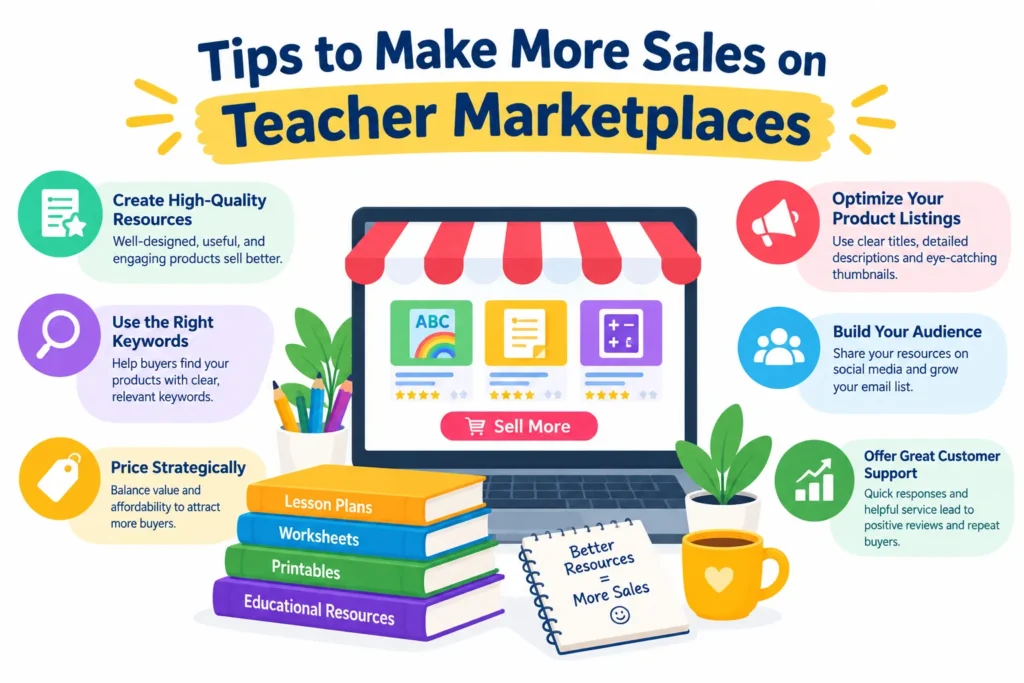
Getting your first product online is only the beginning.
The real challenge is getting the right people to discover it and convincing them to buy.
Create Products Around Specific Problems
Generic products are difficult to differentiate.
Instead of creating a broad “Math Worksheets” bundle, solve a specific classroom problem.
For example:
Weak:
“Grade 4 Math Worksheets”
Stronger:
“Grade 4 Multiplication Practice Worksheets for 2-Digit Numbers”
The second title tells buyers exactly what they’re getting.
Optimize Your Product Titles
Use words your target buyers are likely to search for.
Include relevant information such as:
- Grade level
- Subject
- Topic
- Resource type
- Skill
- Intended use
Avoid stuffing every possible keyword into the title. Make it readable first.
Create Better Product Previews
For digital resources, buyers can’t physically inspect the product.
Your preview needs to reduce that uncertainty.
Show:
- Sample pages
- Included activities
- Different resource formats
- Answer keys when relevant
- A clear overview of what’s included
A useful preview can communicate value before the buyer spends money.
Bundle Related Resources
Once you have several products that solve related problems, consider creating bundles.
For example:
- Addition worksheets
- Subtraction worksheets
- Multiplication worksheets
- Division worksheets
could become a broader elementary math bundle.
Bundles can increase average order value while giving customers a clearer reason to purchase multiple resources together.
Build Around a Niche
You don’t need to create resources for everyone.
A focused store can be easier to position.
You might specialize in:
- Elementary mathematics
- ESL resources
- Special education resources
- Science activities
- Reading comprehension
- Classroom management
- Homeschool materials
- Test preparation
A clear niche also makes it easier to understand your audience’s needs.
Update Your Best Products
Don’t assume that publishing a resource once means you’re finished.
Review older products periodically.
Look for:
- Outdated information
- Broken links
- Formatting issues
- Missing instructions
- Poor-quality previews
- Opportunities to add new activities
Improving proven products can sometimes be more efficient than constantly creating new ones.
📌 Don’t Miss These Articles: How Artificial Intelligence Is Accelerating Scientific Discovery
Common Mistakes Teachers Make When Selling Online
Choosing a Platform Only Because It’s Popular
Popularity doesn’t guarantee that a platform is right for your product.
A course creator and a worksheet creator may need completely different platforms.
Ignoring the Fee Structure
A $10 sale isn’t a $10 profit.
Always account for platform commissions, processing fees, subscriptions, taxes, advertising costs, and other expenses that apply to your situation.
Creating Generic Resources
The marketplace may already contain thousands of similar products.
Ask yourself:
Why should a buyer choose my resource?
The answer could be better organization, a unique teaching approach, stronger design, a specific niche, or a particularly useful solution to a classroom problem.
Using Copyrighted Content
Don’t assume you can copy images, textbook pages, worksheets, fonts, characters, or other materials simply because you’re using them for education.
Educational use doesn’t automatically give you commercial rights.
Create original resources or use content that you have the appropriate commercial rights to use.
Depending Entirely on Marketplace Traffic
Marketplaces can bring you buyers, but you shouldn’t necessarily rely on them forever.
Consider building additional channels such as:
- An email list
- A website
- YouTube
- Social media
- Educational communities
The goal is to create multiple ways for potential customers to discover your work.
Can Teachers Sell on Multiple Marketplaces?
Yes, in many cases teachers can distribute their original products across multiple marketplaces, but you need to check each platform’s current terms and any exclusivity requirements before doing so.
Selling across multiple platforms can diversify your income and reduce dependence on a single marketplace.
For example, you might use:
- TPT for teacher-specific resources
- Etsy for printable products
- Udemy for full courses
But don’t automatically upload everything everywhere.
Each marketplace has a different audience and search behavior.
A better strategy is to adapt the product and listing to the platform where it makes the most sense.
How Much Money Can Teachers Make Selling Educational Resources?
There’s no fixed income figure.
Some teachers make occasional side income from a small collection of resources, while others build substantial businesses around large catalogs and specialized educational products.
Your results depend on factors such as:
- Product quality
- Number of products
- Pricing
- Niche selection
- Search demand
- Marketplace traffic
- Reviews
- Seasonality
- Marketing
- Customer retention
Don’t treat marketplace income as guaranteed passive income.
Creating the product may be the easiest part. Building a catalog that consistently attracts buyers usually requires ongoing research, testing, optimization, and promotion.
Frequently Asked Questions
What is the best online marketplace for teachers in 2027?
For teachers primarily selling lesson plans, worksheets, classroom activities, and other educational resources, Teachers Pay Teachers is one of the strongest overall choices. Classful is another good option, particularly for sellers who want to combine resources with self-paced courses.
Where can teachers sell lesson plans online?
Teachers can sell lesson plans on teacher-focused marketplaces such as Teachers Pay Teachers and Classful. Depending on the product and marketplace policies, other platforms may also be suitable.
What is the best website for selling teacher printables?
Teachers Pay Teachers and Classful are strong options for education-focused printables, while Etsy can be useful if you want to reach a broader audience interested in digital downloads.
Can teachers make money selling digital products?
Yes. Teachers can sell digital products such as worksheets, lesson plans, classroom activities, templates, printables, and courses. However, income varies significantly based on demand, product quality, pricing, competition, and marketing.
Is Teachers Pay Teachers worth it?
It can be, particularly if your products are designed for educators and you can build a useful catalog. The platform’s teacher-focused audience is a major advantage, but sellers should compare the current fees, payout structure, competition, and expected sales before committing.
Can I sell the same teaching resources on multiple platforms?
Often, yes, but check the current terms of each platform before doing so. Some platforms, products, promotions, or agreements may have specific conditions that affect how resources can be distributed.
Which marketplace is best for online teaching courses?
Udemy is a strong option for teachers who want to sell structured video courses to a global learner audience. Classful is also worth considering if you want to combine courses with downloadable educational resources.
📌 Don’t Miss These Articles: Why Two Students Can Submit Similar-Sounding Papers on the Same Topic Without Either One Copying
Conclusion
The best online marketplace for teachers in 2027 depends on what you’re selling.
If your core business is downloadable educational resources, Teachers Pay Teachers is the strongest place to start because its audience and marketplace are built specifically around educators.
If you want to sell both resources and self-paced courses, Classful is worth considering.
If your products are primarily printable downloads, planners, or classroom materials and you want access to a broader consumer audience, Etsy can be a useful channel.
And if your main product is your expertise packaged into a structured online course, Udemy is likely a better fit.
You don’t necessarily have to choose just one.
A smart long-term strategy is to start with the marketplace that best matches your product, learn what buyers respond to, build a strong catalog, and then expand to additional channels when there’s a clear business case.
The platform gets your product in front of potential buyers. Your product quality, positioning, and understanding of your audience are what ultimately drive sales.
✨ Love this energy? Get more, follow Tech Statar.