

Most resumes include the same skills: communication, teamwork, leadership, problem-solving, and Microsoft Office.
There’s nothing wrong with these skills. The problem is that they appear on thousands of resumes.
Some of the most valuable resume skills are the ones candidates rarely think to mention. Things like research, process improvement, knowledge management, problem framing, AI tool proficiency, and decision-making under uncertainty can show employers how you actually work not just what you claim you can do.
In this guide, we’ll cover 25 unique skills for a resume that are easy to overlook, plus how to choose and demonstrate the ones that matter for the job you want.
What Are Unique Skills for a Resume?
Unique resume skills are abilities that aren’t typically found on every candidate’s resume but can still demonstrate meaningful value to an employer.
They don’t necessarily have to be unusual or highly technical. A skill becomes valuable when it shows that you can solve problems, work efficiently, communicate clearly, or handle situations that aren’t covered by a standard job description.
For example, instead of simply writing:
Communication
You could highlight a more specific ability:
Stakeholder communication and requirements gathering
The second version tells the hiring manager more about how you use the skill at work.
Unique skills generally fall into a few categories:
- Technical skills: Tools, software, platforms, or specialized knowledge
- Transferable skills: Abilities that apply across different roles and industries
- Analytical skills: Research, data interpretation, critical thinking, and decision-making
- Organizational skills: Prioritization, documentation, knowledge management, and digital organization
- Interpersonal skills: Active listening, conflict resolution, collaboration, and customer empathy
The key is relevance.
You shouldn’t add a skill just because it sounds impressive. A skill is worth including when it helps demonstrate that you’re a better fit for the specific role.
Why Unique Skills Can Make Your Resume Stand Out
Recruiters often have limited time to review each application. That means the resume must to communicate your value quickly.
Listing the same generic skills as everyone else makes that harder.
Compare these two skill lists:
Example 1
- Communication
- Teamwork
- Leadership
- Problem-solving
- Time management
Example 2
- Process improvement
- Data interpretation
- Stakeholder communication
- AI tool proficiency
- Meeting facilitation
- Knowledge management
The second list gives a clearer picture of how the candidate can contribute to an organization.
That’s the real advantage of unique skills.
They can help you:
- Differentiate your resume from similar candidates
- Demonstrate practical workplace abilities
- Match more closely with a job description
- Provide additional keywords for applicant tracking systems
- Show how you approach problems and projects
- Give hiring managers better talking points during interviews
But there’s an important distinction: unique doesn’t mean random.
If you’re applying for a marketing position, adding an unrelated skill simply because it’s uncommon won’t strengthen your application. Your goal is to identify less-obvious skills that are both relevant and defensible.
25 Unique Skills for a Resume That Most Candidates Forget
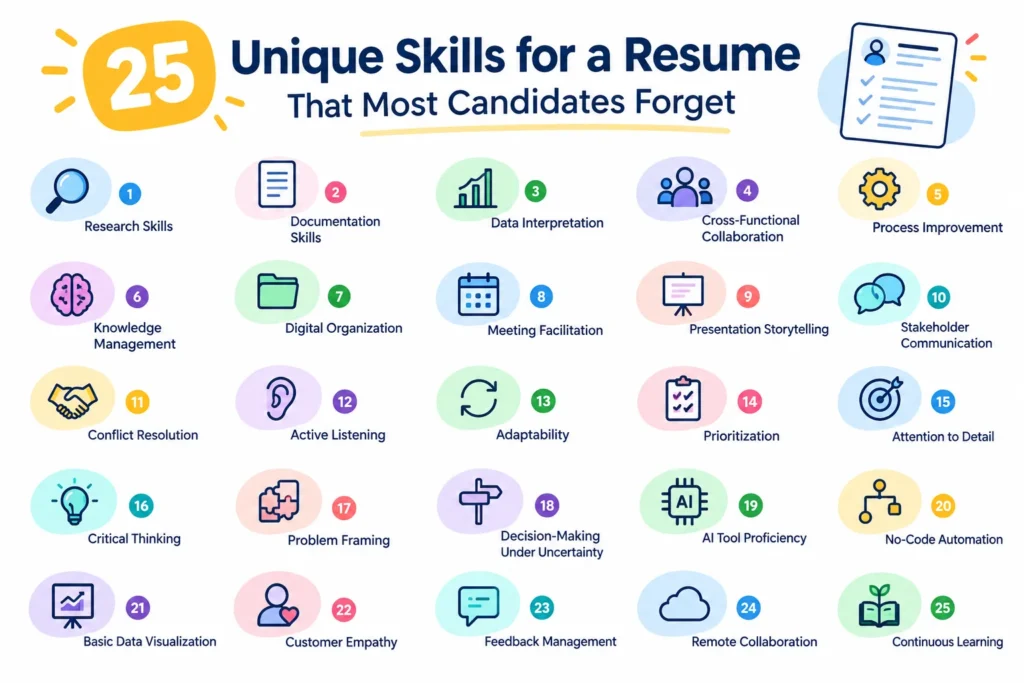
Here are 25 skills that can add more depth to your resume when they’re relevant to the position.
1. Research Skills
Research is useful in almost every modern workplace.
Whether you’re analyzing competitors, researching customers, comparing software, investigating an operational problem, or preparing a business proposal, the ability to find and evaluate information can directly affect the quality of your work.
Don’t simply list “research” if you can be more specific.
For example:
- Market research
- Competitor research
- User research
- Industry research
- Source evaluation
- Qualitative research
You can make the skill even stronger by connecting it to an outcome in your experience section.
2. Documentation Skills
Good documentation can save teams considerable time.
Employees who can turn complicated processes into clear instructions, SOPs, reports, checklists, or internal guides are often more valuable than their resumes suggest.
This skill is particularly useful for operations, IT, customer support, project management, HR, and technical roles.
Instead of writing only “documentation,” you could specify:
Process documentation, SOP development, and internal knowledge-base management
That gives the employer a better idea of what you can actually produce.
3. Data Interpretation
You don’t need to be a data scientist to benefit from data skills.
Many jobs require employees to look at numbers, identify patterns, understand trends, and use those insights to make decisions.
For example, a marketer might analyze campaign performance. A salesperson might interpret conversion data. An operations employee might identify workflow bottlenecks.
If you’re comfortable turning data into practical conclusions, data interpretation can be a useful skill to highlight.
4. Cross-Functional Collaboration
Many projects involve people from different departments.
Marketing may work with sales. Product teams may work with engineering. HR may coordinate with finance and operations.
Cross-functional collaboration shows that you can work effectively with people who have different priorities, expertise, and responsibilities.
Rather than simply claiming that you’re a “team player,” this skill demonstrates a more specific ability: working across organizational boundaries to achieve a shared outcome.
5. Process Improvement
Businesses don’t just need people who can follow processes. They also need people who can identify when those processes aren’t working well.
Process improvement involves finding unnecessary steps, bottlenecks, repetitive tasks, errors, or inefficient workflows and suggesting better approaches.
You might use this skill to:
- Reduce manual work
- Speed up repetitive tasks
- Improve quality
- Reduce errors
- Standardize workflows
- Make internal processes easier to follow
If you’ve ever made a recurring task faster or simpler, you may already have process improvement experience.
6. Knowledge Management
Companies generate a huge amount of information.
The challenge is making sure employees can actually find and use it.
Knowledge management involves organizing information so that teams can access useful documentation, processes, resources, and institutional knowledge when they need it.
This can include:
- Creating internal knowledge bases
- Organizing documentation
- Maintaining company wikis
- Standardizing information
- Improving information retrieval
It’s an especially useful skill for operations, customer support, IT, HR, and project-based roles.
7. Digital Organization
Being digitally organized is more than keeping your desktop clean.
It can involve managing files, folders, calendars, project boards, cloud documents, communication channels, and digital workflows in a structured way.
Strong digital organization can help teams find information faster and reduce unnecessary work.
If a role requires managing multiple projects, documents, clients, or deadlines, this can be a surprisingly useful skill to highlight.
✨ Discover More Articles: 15 Best Books for Communication Skills Beginners Should Read
8. Meeting Facilitation
“Attending meetings” isn’t a skill.
Facilitating productive meetings is.
Meeting facilitation involves creating an agenda, keeping discussions focused, making sure the right people contribute, documenting decisions, and turning conversations into clear next steps.
This skill can be particularly valuable for project managers, team leads, consultants, HR professionals, and operations specialists.
Instead of saying you’re “good at meetings,” demonstrate that you can help teams leave meetings with decisions, owners, and actionable next steps.
9. Presentation Storytelling
Being able to create slides is different from being able to communicate an idea effectively.
Presentation storytelling combines structure, visuals, data, and narrative to make information easier to understand.
It’s useful when you need to:
- Explain a strategy
- Present research
- Share business results
- Pitch an idea
- Train employees
- Communicate complex information
If your role involves presenting information to clients, executives, or internal teams, this can be a strong differentiator.
10. Stakeholder Communication
Different stakeholders often care about different things.
A customer may care about usability. An executive may care about business impact. A developer may care about technical requirements.
Stakeholder communication is the ability to adjust your communication based on the audience while keeping everyone aligned.
It can include:
- Gathering requirements
- Managing expectations
- Providing project updates
- Communicating risks
- Explaining decisions
- Handling stakeholder feedback
It’s a more specific and useful way to demonstrate communication ability than simply listing “good communication skills.”
11. Conflict Resolution
Conflict is part of working with other people.
Teams can disagree about priorities, deadlines, responsibilities, or how a problem should be solved. What matters is how you handle those disagreements.
Conflict resolution involves listening to different perspectives, identifying the underlying issue, and working toward a practical solution without making the situation worse.
It’s particularly relevant for managers, customer-facing roles, HR professionals, project managers, and team leads.
Instead of simply listing “communication,” you could highlight:
Conflict resolution and collaborative problem-solving
That tells employers you can handle difficult situations constructively.
12. Active Listening
Communication isn’t only about speaking or writing.
Good employees also need to understand what other people are actually saying.
Active listening means paying attention to requirements, asking useful questions, clarifying misunderstandings, and responding based on what you’ve heard.
This skill can be valuable in almost any role, especially customer service, sales, management, consulting, HR, and project management.
For example, a project manager who understands what stakeholders actually need is less likely to deliver a technically correct solution that solves the wrong problem.
13. Adaptability
Job requirements can change quickly.
Companies adopt new software, reorganize teams, change processes, introduce AI tools, and respond to shifting customer expectations. Employees who can adjust without losing productivity are valuable in this environment.
Adaptability demonstrates that you’re comfortable learning and changing direction when circumstances require it.
You can make this skill more credible by showing how you’ve adapted in practice.
For example:
- Learned a new tool within a short period
- Took on responsibilities outside your original role
- Adjusted to a new workflow
- Transitioned to a new project or team
- Learned a new process independently
14. Prioritization
Being busy doesn’t necessarily mean being productive.
Prioritization is the ability to identify which tasks deserve attention first based on urgency, importance, deadlines, and business impact.
This becomes especially important when you’re managing multiple projects or competing deadlines.
Rather than simply saying “time management,” consider highlighting:
Task prioritization and deadline management
Even better, show the result in your experience section for example, how you managed several projects simultaneously while meeting critical deadlines.
✨ Discover More Articles: 10 Best Productivity Apps for Students in 2027
15. Attention to Detail
Small mistakes can create big problems.
A typo in a report may be harmless. An incorrect number in a financial document, wrong product specification, or missing requirement can be much more serious.
Attention to detail means reviewing work carefully, spotting inconsistencies, and maintaining accuracy without losing sight of the bigger picture.
This skill is especially relevant to roles involving:
- Data
- Finance
- Quality assurance
- Administration
- Documentation
- Research
- Compliance
- Technical work
Avoid simply claiming that you’re detail-oriented. Whenever possible, demonstrate it through a specific accomplishment.
16. Critical Thinking
Critical thinking is the ability to evaluate information before accepting it as true or making a decision based on it.
It involves questioning assumptions, comparing evidence, identifying potential problems, and considering alternative explanations.
For example, if a marketing campaign performs poorly, critical thinking helps you look beyond the obvious explanation and investigate whether the problem comes from the audience, messaging, offer, channel, or measurement.
It’s a broad skill, but its value increases when you connect it to the work you actually perform.
17. Problem Framing
Solving the wrong problem is still a bad outcome.
Problem framing is the ability to clearly define what needs to be solved before jumping into solutions.
For example, a team might say:
“We need a new tool.”
But the underlying problem could actually be poor workflow, missing documentation, or inefficient communication.
Someone who can identify the real problem before recommending a solution can prevent wasted time and resources.
This skill is particularly useful in consulting, product management, operations, strategy, UX, and project management.
18. Decision-Making Under Uncertainty
Work rarely comes with perfect information.
You may need to make a decision when data is incomplete, deadlines are approaching, or several options have trade-offs.
Decision-making under uncertainty involves assessing the available information, considering risks, identifying assumptions, and choosing a reasonable path forward.
This doesn’t mean making decisions recklessly.
It means knowing when you have enough information to act instead of waiting indefinitely for certainty that may never come.
19. AI Tool Proficiency
AI has become part of many everyday workflows.
But there’s a difference between occasionally using an AI chatbot and knowing how to use AI tools effectively.
AI tool proficiency can include using AI for:
- Research
- Brainstorming
- Content creation
- Data analysis
- Summarization
- Workflow automation
- Information extraction
- Drafting and editing
The best approach is to be specific about how you use AI rather than simply writing “AI” on your resume.
For example:
AI-assisted research, content workflows, and task automation
This gives employers more context and avoids making the skill sound like a buzzword.
20. No-Code Automation
You don’t always need to be a programmer to automate repetitive work.
No-code and low-code platforms allow employees to connect tools and create workflows without writing complex software.
You might automate tasks such as:
- Moving information between apps
- Sending notifications
- Updating spreadsheets
- Organizing leads
- Creating recurring reports
- Managing form submissions
If you’ve built practical automations that save time or reduce manual work, this is worth mentioning.
Even better, quantify the impact.
For example:
Automated recurring reporting workflows, reducing manual preparation time by 5 hours per week.
21. Basic Data Visualization
Raw numbers aren’t always easy to understand.
Data visualization helps turn information into charts, graphs, dashboards, or other visual formats that make patterns easier to spot.
You don’t need advanced analytics expertise to benefit from this skill.
Basic data visualization can be useful for marketers, sales professionals, managers, researchers, analysts, and operations teams.
Relevant tools may include spreadsheet software, dashboard platforms, presentation software, or business intelligence tools.
When listing this skill, mention the tool if it’s relevant to the job.
For example:
Data visualization using Excel and dashboard reporting tools
✨ Discover More Articles: How to Turn Notes Into a Professional Presentation With AI
22. Customer Empathy
Customer empathy means understanding a customer’s situation, needs, frustrations, and expectations.
It’s more than being polite.
It helps you design better experiences, communicate more effectively, handle complaints, and identify what customers actually value.
This skill is particularly useful in:
- Customer support
- Sales
- Marketing
- Product
- UX
- Account management
- Service-based businesses
Instead of writing “customer service,” you can highlight a more specific ability when it accurately reflects your experience:
Customer empathy and needs-based communication
23. Feedback Management
Feedback is only useful if someone knows what to do with it.
Feedback management involves collecting feedback, organizing it, identifying recurring themes, communicating insights, and turning useful feedback into action.
This can apply to customer feedback, employee feedback, product reviews, project retrospectives, or performance discussions.
For example, a product professional might analyze recurring customer complaints and use them to prioritize improvements.
The important part is showing that you don’t just collect feedback you know how to turn feedback into useful decisions.
24. Remote Collaboration
Remote work requires more than sending messages online.
Successful remote collaboration depends on clear communication, documentation, reliable follow-ups, time-zone awareness, and effective use of digital collaboration tools.
You may already have this skill if you’ve worked with distributed teams or regularly collaborated with people outside your location.
Relevant abilities include:
- Async communication
- Virtual meeting facilitation
- Digital project management
- Shared documentation
- Cross-time-zone coordination
- Remote team communication
If the role is remote or hybrid, this can be especially relevant.
25. Continuous Learning
The tools and skills required for many jobs don’t stay the same for long.
Continuous learning demonstrates that you’re willing and able to acquire new knowledge instead of relying only on what you already know.
This could involve:
- Learning new software
- Taking professional courses
- Completing certifications
- Following industry developments
- Learning new AI tools
- Building side projects
- Developing new technical skills
Don’t just write “continuous learning” and leave it at that.
Show evidence.
For example, mention a recent certification, course, tool you’ve learned, or project you’ve completed to demonstrate that you’re actively developing your skills.
How to Choose the Right Unique Skills for Your Resume
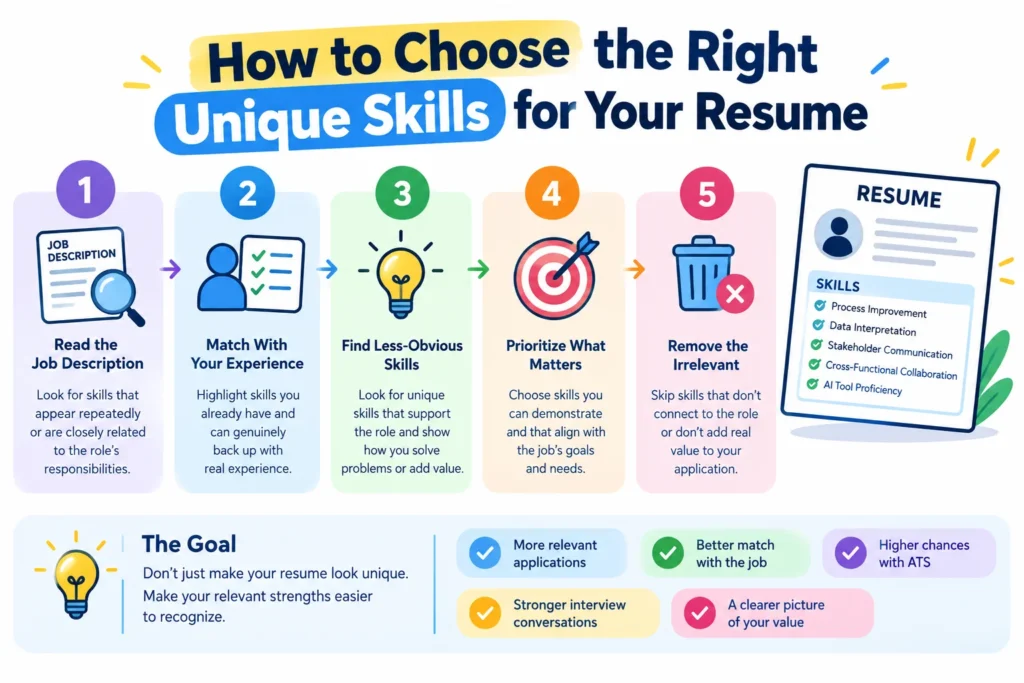
You don’t need all 25 skills on your resume.
In fact, adding every skill can make your resume less effective.
The better approach is to choose skills based on relevance, evidence, and job requirements.
Start by reading the job description carefully.
Look for skills that appear repeatedly or are closely connected to the responsibilities of the role. Then compare those requirements with your actual experience.
A simple process is:
- Review the most crucial demand in the job description.
- Highlight skills you genuinely possess.
- Look for less-obvious skills that support those requirements.
- Prioritize skills you can demonstrate with examples.
- Remove skills that have little connection to the role.
For example, if you’re applying for an operations position, process improvement, documentation, prioritization, data interpretation, and digital organization may be more useful than generic skills such as “hard working.”
The goal isn’t to make your resume look unique for the sake of being unique.
It’s to make your relevant strengths easier to recognize.
How to Add Unique Skills to Your Resume
A skills section is useful, but it’s not the only place where your skills should appear.
The strongest resumes connect skills with evidence.
Use a Dedicated Skills Section
Add a clear, well-organized skills section that helps recruiters quickly identify your most relevant abilities.
For example:
Skills
- Process improvement
- Data interpretation
- Stakeholder communication
- AI tool proficiency
- Cross-functional collaboration
- Documentation and SOP development
Focus on skills that directly match the requirements of the role you’re targeting.
Show Skills in Your Work Experience
Your experience section is where skills become credible.
Instead of:
Improved processes.
Try something more specific:
Redesigned a recurring reporting workflow, reducing manual preparation time by 30%.
The second version demonstrates process improvement while also showing a measurable result.
Mention Relevant Tools
When a skill involves specific software or platforms, include the tool when appropriate.
For example:
Data visualization Excel, Power BI
is more informative than simply:
Data visualization
This can also help your resume match job-specific requirements.
Use Measurable Results
Numbers can make skills much more convincing.
Consider adding:
- Revenue generated
- Time saved
- Costs reduced
- Errors decreased
- Projects completed
- Customers supported
- Conversion rates improved
- Team members managed
You don’t need a number for every bullet, but use metrics when they’re available and meaningful.
Unique Skills vs. Common Resume Skills
Common skills aren’t automatically bad.
Communication, teamwork, leadership, and problem-solving are valuable in many jobs.
The problem is that they’re broad.
Compare:
| Generic Skill | More Specific Alternative |
| Communication | Stakeholder communication |
| Problem-solving | Problem framing |
| Teamwork | Cross-functional collaboration |
| Time management | Task prioritization |
| Computer skills | AI and productivity tool proficiency |
| Organization | Digital organization |
| Customer service | Customer empathy and needs analysis |
The more specific version often provides additional context.
However, don’t replace every common skill just to sound different. If a job description specifically asks for communication skills, you can still include communication.
The goal is specificity without sacrificing relevance.
Common Mistakes to Avoid When Listing Skills
Even a strong skill can hurt your resume if you use it incorrectly.
Adding Irrelevant Skills
A skill shouldn’t be included simply because you have it.
Focus on skills that support the position you’re applying for.
Keyword Stuffing
Repeating job-description keywords throughout your resume doesn’t make you more qualified.
Use relevant keywords naturally and make sure you can support them with real experience.
Listing Skills Without Evidence
Anyone can claim to be an excellent problem solver.
Your work experience should give employers a reason to believe it.
Whenever possible, connect skills to projects, responsibilities, or measurable results.
Using Vague Buzzwords
Words like “dynamic,” “passionate,” and “results-driven” don’t explain what you can actually do.
Specific skills are usually more informative.
Overrating Your Proficiency
Don’t claim advanced expertise in a tool you’ve only used a few times.
Be honest about your level of experience. You may be asked about it during an interview.
Ignoring the Job Description
A resume should be tailored to the role.
If the employer repeatedly mentions a particular skill and you genuinely have it, make sure it is easy to find on your resume.
Including Outdated Skills
Technology and workplace tools change.
Review your skills periodically and remove tools or abilities that are no longer relevant to your target roles.
How to Make Your Resume Skills More Credible
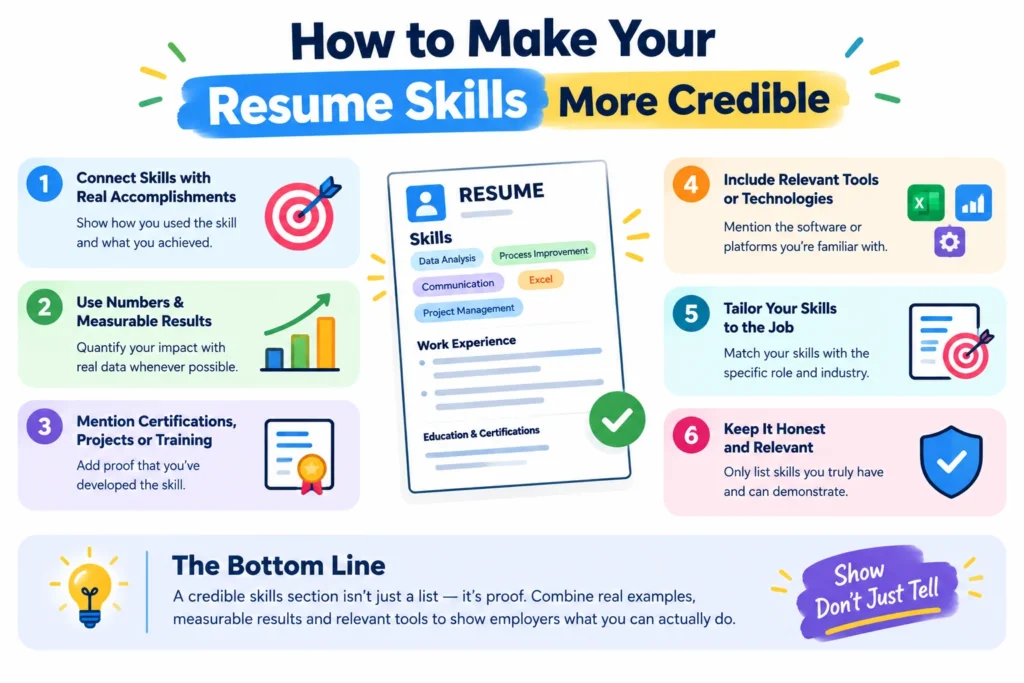
A list of skills tells recruiters what you claim to know.
Your experience section should show how you’ve used those skills.
For example, instead of:
Skills: Process improvement, data analysis, automation
You could demonstrate them through experience:
Automated weekly performance reporting and redesigned the underlying workflow, reducing preparation time by 40%.
That single bullet demonstrates multiple skills without simply listing them.
You can also strengthen your skills by including:
- Relevant certifications
- Professional projects
- Training
- Portfolio work
- Volunteer experience
- Freelance projects
- Measurable achievements
Think of your resume as evidence rather than a list of claims.
The best skills are the ones you can prove through your work.
FAQs About Unique Resume Skills
What are the best unique skills to put on a resume?
The best unique skills are relevant to the job and demonstrate practical value. Examples include process improvement, data interpretation, stakeholder communication, AI tool proficiency, problem framing, documentation, and cross-functional collaboration.
What skills make a resume stand out?
Specific skills tend to stand out more than broad claims. Skills such as workflow automation, data visualization, knowledge management, stakeholder communication, and problem framing can provide more context than generic terms like “hardworking” or “team player.”
Should I list uncommon skills on my resume?
Yes, if they’re relevant to the position and you genuinely possess them. Don’t add an uncommon skill simply to make your resume look different. Relevance should come first.
How many skills should I put on my resume?
There’s no universal number. A focused list of relevant skills is usually better than a long list of unrelated abilities. Prioritize the skills that match the role and that you can support with actual experience.
What skills do employers value most in 2026?
The answer varies by industry and role, but employers increasingly value a combination of technical ability, adaptability, analytical thinking, communication, AI literacy, problem-solving, and the ability to work effectively with people and technology.
Should unique skills be included in the work experience section?
Yes. In fact, demonstrating a skill through a work accomplishment can be more convincing than simply listing it in a skills section. Whenever possible, show how you used the skill and what result it produced.
How do I choose skills for an ATS-friendly resume?
Start with the job description. Identify relevant skills and terminology used by the employer, then naturally include the ones that genuinely match your experience. Avoid stuffing your resume with keywords you can’t support.
Final Thoughts
Your resume doesn’t need to contain the most unusual skills possible.
It needs to make your most relevant abilities easy to recognize.
Instead of filling your skills section with generic terms everyone uses, look for specific abilities that demonstrate how you work. Research, process improvement, stakeholder communication, problem framing, AI proficiency, and knowledge management can reveal much more about your capabilities than a long list of vague buzzwords.
And remember: the skill itself is only part of the equation.
The strongest resumes connect skills to real experience and measurable outcomes.
So before adding another generic keyword, ask yourself:
What can I actually do, and how can I prove it?
That’s the kind of information that can turn a basic skills section into a compelling part of your resume.
✨ Got value? Let’s keep the momentum, follow Tech Statar.