
How Are Data-Driven Cognitive Tools Changing Personal Development?
The usual methods for personal development include filling out a self-reflection journal or attending a motivational seminar. These are ways to improve yourself by monitoring your progress in a somewhat tangible manner and hoping for the best. There is, however, no reliable way to measure meaningful change and, therefore, no way to know whether or not the methods one is using are actually working.
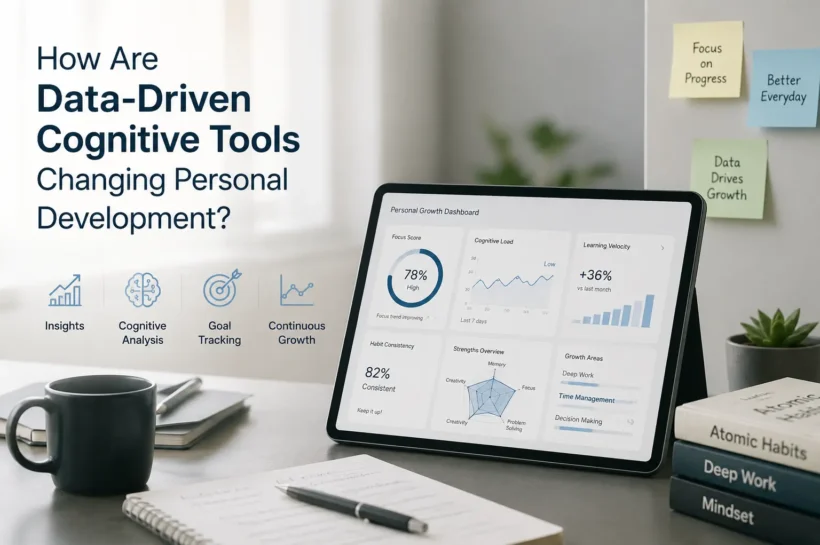
Modern cognitive measurement tools have completely turned personal development on its head. For the first time in human history, people can track and measure their specific cognitive functions to improve them. Unlike a self-reflection journal or a personal development seminar, where you would hopefully gain some vague sense of improvement and have no idea if you were getting anywhere or not, with these new tools, people can measure their personal development progress in great detail, finding out for example, how their memory, concentration, or focus scores to track their improvement over time and see what’s working for them and what isn’t.
➺ You might also like: Tech Strategies for Productivity
The measurement revolution in cognitive assessment
Many intelligence tests were originally developed to test for brain damage or developmental disorders and were typically administered by a psychologist in a clinical setting. These tests provide little benefit to the test-taker.
Digital assessment tools offer several advantages to the cognitive assessment process. For one, they make it possible to take cognitive tests anywhere, at any time. So long as the individual has access to a suitable device (for example, a PC, tablet, or smartphone), they can take a test. This is in marked contrast to off-the-shelf clinical neuropsychological tests, which are typically administered by a trained clinical professional in a formal setting and can be expensive to purchase and time-consuming to administer.
In addition, whereas other online tests may only measure a few key cognitive abilities, a range of modern cognitive testing tools allow for the measurement of working memory, processing speed, attention, and more. Importantly, the scores achieved by an individual on these digital assessment tools have been shown to correlate strongly with the scores that would have been achieved on a range of classic, off-the-shelf neuropsychological tests. This means that an individual taking a range of modern digital assessment tools is able to achieve a comprehensive and detailed profile of their cognitive strengths and weaknesses. Furthermore, in terms of practical considerations, the digital assessment tools are generally much more convenient, cost-effective, and up-to-date than their off-the-shelf clinical counterparts.
Unlike traditional ‘intelligent’ tests that yield a single score, often of little information to us in our daily lives, new cognitive tests provide an in-depth analysis of your individual skills in various aspects of cognition. In addition to providing us with information on your strengths and weaknesses, the information can also be used to design a training program, specifically targeting your weaknesses, to help you to improve your cognitive functions.
The new personal development tools measure and track a number of key factors for the assessment and subsequent training of an individual’s cognitive functions. The main advantage of the new, digital, cognitive assessment and training tools is that they are generally far more affordable and far more accessible, in terms of time and effort required to complete a battery of tests, than the traditional methods. They also enable the assessment and subsequent training of an individual’s cognitive functions to become a dynamic, not static, process. As such, for the first time, it is possible to view the process of cognitive assessment and subsequent training or ‘self-improvement’ in a whole new light.
Performance tracking beyond traditional metrics
There are new tools that help us measure how we are doing in various cognitive functions and even track how our cognitive functions change over time. This can also help us see how our various lifestyle choices (such as sleep, stress, diet, exercise, etc.) affect our various cognitive functions.
Several high-end assessment platforms have recently introduced a new feature into their core tool set: the integration of data a user has already collected from other wellness-related tools (e.g., a sleep monitor, a pedometer, a nutrition app). This means that personal development is no longer a matter of improving several different skills by spending time in practice and the occasional foray into learning materials of a different sort. Instead, it is now possible to hone and improve several different dimensions of physical and mental wellness, and then see the correlations to improved performance in a variety of different cognitive abilities.
As you measure your progress and see how certain aspects of your life are influencing your cognitive abilities, you will be creating several positive feedback loops that help you to accelerate your personal development. For example, by tracking your improvement in processing speed over time as you follow a new morning routine, you will find a strong incentive to continue the routine. This, in turn, will have a positive impact on your subsequent performance on various cognitive tasks.
➺ You might also like: Data-Driven Insights
Personalized cognitive training protocols
Until recently, brain training involved games that improved memory, attention, or processing speed insofar as they were trained. However, most large-scale studies found little to no transfer to daily life of the results gained through such training. However, there are many programs on the market that use a generic approach, failing to take into account an individual’s strengths and weaknesses. As such, there is little scope for optimum improvement.
The most effective methods for training cognitive functions, which are used in many different programs, include the use of baseline data from the test of cognitive abilities that the trainee took at the beginning of the program. This information is then used to create the individual’s training program, which is designed to enhance the specific skill or ability that the trainee scored lowest on. For example, someone who has a low score for spatial ability but average to high scores for verbal memory would benefit from training in the spatial ability skill. The improved spatial ability would then be transferable to improved performance in daily tasks that require spatial ability. In contrast, a generic program such as a video game would not have the same results.
Of course, training programs have to be improved with the help of data as well. Right now, the large number of programs on offer is, for the most part,t ‘dumb in the sense that they challenge every user after user in the same way and as a result are only of very limited use. Training programs that can be fine-tuned to a person’s performance are much more promising and offer real opportunities for improvement in the individual areas in which a person needs to get better. As an example, the above-mentioned person with poor spatial reasoning skills but good verbal memory skills would certainly be better off doing training exercises for his spatial reasoning skills than those for his verbal memory skills. But using such training exercises in the right way would require a program that is able to fine-tune itself in the course of training.
Integration with broader wellness ecosystems
Measuring and improving your cognitive functions is no longer a solo activity. As we incorporate other wellness data from our broader wellness ecosystems (e.g., from our fitness trackers, sleep monitors,s and nutrition apps) into our personal development profiles, we will gain a deeper understanding of the relationships between our various qualities and the biggest impacts on our cognitive functions.
The data can reveal that it is not the aging process itself that is causing a decline in your cognitive abilities, but rather factors such as poor sleep. It can also reveal that,t in terms of improving your working memory, for example, programs of aerobic exercise are far more effective than all of the available brain training programs. With such powerful data available to us, we can use the most optimal interventions and strategies to reach our goals.
➺ You might also like: PHP Development Tools
Where measured self-improvement leads
Cognitive training is a relatively new field of self-improvement that will turn into a normal measured self-improvement activity as soon as sensors and algorithms have matured enough to measure and support the corresponding self-improvement adequately.
Measured Self-Improvement will give you huge advantages over just hoping for the best and trying things out at random. With Measured Self-Improvement, you will not only see where you are going, but you will also test out various strategies for improving your brain function and find out what really works for you.
💝This is your sign to upgrade your feed. Follow Tech Statar.