
Best AI Agents Course With Certificate (2026 Guide)
AI agents are becoming one of the most practical applications of modern artificial intelligence. Instead of simply generating an answer, an AI agent can work through a task, use connected tools, gather information, and take actions based on a defined goal. This has created growing interest in learning how to build and work with AI agents.
For beginners, developers, and professionals, an AI agent course with a certificate can provide a structured way to learn these concepts while also giving proof of course completion. However, not every course offers the same depth, practical experience, or certification value.
This guide explains what these courses teach, who should take them, what to look for, and how to choose an option that matches your goals.
What Is an AI Agents Course With Certificate?
An AI agents course is a structured program that teaches how AI agents work and how to use them to complete tasks or automate workflows. Depending on the course, the curriculum may cover large language models, prompting, tools, APIs, agent workflows, memory, evaluation, and multi-agent systems.
The certificate is usually awarded after you complete the required lessons, activities, or assessments. It confirms that the learner completed the course, but its value depends heavily on the provider and the type of certification.
For example, OpenAI Academy currently offers an Agents and Workflows course designed around directing agents through structured work, reviewing outputs, defining boundaries, and improving workflows. The course is free and provides a course-completion certificate through the Academy’s learning platform. OpenAI also makes an important distinction between these completion certificates and formal OpenAI Certifications.
That distinction matters when comparing AI agent courses. A certificate can demonstrate learning, but it should not automatically be treated as a professional credential.
What Do You Learn in an AI Agents Course?
The exact curriculum varies from one provider to another, but a good course should move beyond basic definitions and show how agents actually operate.
AI Agent Fundamentals
The first stage usually covers the basic idea behind agentic systems. You learn how an AI agent differs from a standard chatbot or a simple automation workflow.
A traditional chatbot may respond to a user’s message, while an agent can manage a sequence of actions to accomplish a broader objective. OpenAI describes agents as systems that can independently accomplish tasks on a user’s behalf and use tools to gather information or perform actions.
This foundation helps learners understand when an AI agent is useful and when a simpler solution may be enough.
Large Language Models and Instructions
Most modern AI agents rely on large language models to interpret requests, make decisions, and determine what should happen next.
A course may therefore introduce model selection, instructions, context, prompting, and structured outputs. These concepts are important because an agent’s quality depends not only on the model but also on how its behavior and boundaries are defined.
OpenAI’s current Agents SDK documentation describes an agent in terms of a few core elements: a model, instructions, and tools.
Tools, APIs, and Function Calling
An agent becomes much more useful when it can interact with systems outside the language model.
Courses may teach how to connect agents with APIs, databases, search systems, software functions, or other external tools. These connections allow an agent to retrieve information or perform actions rather than simply generate text.
For example, an agent could search for information, update a CRM record, process a document, or call a business API. Modern agent frameworks support several approaches to tool use, including function tools, hosted tools, external APIs, and even other agents.
Agent Workflows and Orchestration
Once an agent can use tools, the next challenge is deciding how the complete workflow should operate.
This is where learners encounter concepts such as sequential tasks, tool calls, handoffs, and multi-agent workflows. In a multi-agent setup, different agents may handle different parts of a larger task.
Orchestration can be controlled by code, by the model itself, or through a combination of both approaches.
A strong AI agent course should explain these ideas through practical examples instead of relying only on technical definitions.
Who Should Take an AI Agents Course?
An AI agents course can be useful for people with very different backgrounds.
Beginners can use it to understand how modern AI systems are moving beyond simple chat interfaces. Developers can learn how to connect models with tools and build more capable applications. Automation specialists can explore ways to turn repetitive workflows into systems that require less manual intervention.
The subject can also be valuable for entrepreneurs, SaaS founders, freelancers, and professionals who want to understand where AI agents can fit into their existing work.
You do not necessarily need advanced AI knowledge to start. Some beginner-focused programs are designed without a technical background, while developer-oriented courses may expect programming and API experience.
The important thing is to choose a course that matches your current level. Starting with an advanced agent-development program without understanding basic AI concepts can make the learning process unnecessarily difficult.
Why Take an AI Agents Course With a Certificate?
The main reason to take the course should be the skills you gain, not the certificate alone.
A structured course can give you a clear learning path, practical exercises, and a better understanding of how different agent components fit together. A certificate then provides a simple way to document that you completed the program.
This can be useful when updating a resume, LinkedIn profile, portfolio, or professional learning record. However, practical projects can make your learning much easier to demonstrate.
For someone entering the field, completing a course and then building a working AI agent can be more meaningful than collecting certificates without applying the knowledge. The strongest learning path combines structured education, hands-on practice, and evidence of what you can actually build.
How to Choose the Best AI Agents Course With Certificate
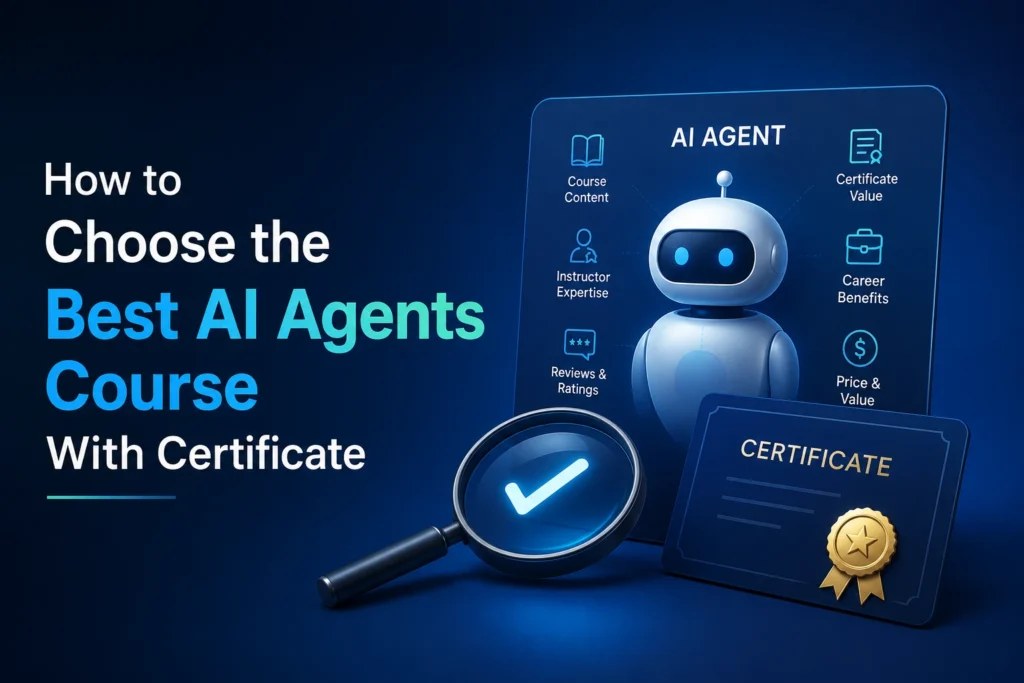
Choosing an AI agents course is not simply about finding one that includes a certificate. The quality of the curriculum, practical training, instructor expertise, and type of credential all matter.
A good course should teach concepts that can be applied beyond a single AI platform. It should also give you enough practical experience to understand how agents are designed, connected to tools, tested, and improved.
Course Curriculum
Start by checking what the course actually teaches. A strong curriculum should cover the foundations of AI agents before moving into tools, APIs, workflows, memory, evaluation, and deployment.
The course should also reflect how agent development is evolving. For example, current professional certifications from Microsoft cover areas such as orchestration, RAG, MCP, APIs, agent tools, testing, and multi-agent solutions.
A course that only teaches basic prompting may be useful for beginners, but it should not be presented as comprehensive agent development training.
Hands-On Projects
Theory can help you understand the technology, but practical work shows whether you can actually use it.
Look for courses where you build agents, connect tools, create workflows, or solve realistic problems. Google’s current agent learning paths, for example, include separate tracks for developing agents with its Agent Development Kit and deploying production-ready agents.
Projects also give you something useful to show after completing the course. A working agent in a portfolio can demonstrate your skills more clearly than a certificate by itself.
Certificate and Credential Type
Check exactly what you receive at the end of the course.
Some platforms provide a course-completion certificate or digital badge, while others offer a formal certification that requires passing an exam. These are not necessarily equivalent.
Microsoft, for instance, offers dedicated AI agent certifications that involve formal assessments. Its AI Agent Builder Associate certification requires a proctored exam covering areas such as planning, configuring, integrating, testing, and managing agents.
This is why it is worth checking who issues the credential, whether an assessment is required, and what the certificate actually confirms.
Beginner-Friendly vs Advanced Content
Your existing knowledge should influence your choice.
A beginner may benefit from a course that first explains LLMs, prompts, tools, and basic workflows. A developer with API and programming experience can move toward more advanced topics such as agent orchestration, evaluation, memory, and multi-agent systems.
Trying to learn advanced concepts too early can create unnecessary complexity. The right course should challenge you without assuming knowledge you do not have.
Tools and Frameworks
AI agent development is not tied to one tool or framework. Different courses may focus on platforms such as OpenAI’s agent tooling, Google’s Agent Development Kit, Microsoft Copilot Studio, LangChain, CrewAI, or other frameworks.
The best choice depends on what you want to build. If your goal is enterprise development, a platform-focused course may be useful. If you want broader development skills, look for training that explains the underlying concepts as well as the framework.
IBM’s current Agentic AI learning path, for example, includes foundations, tool and workflow design, and applied multi-agent solutions, with optional training around frameworks such as CrewAI and LangChain.
Instructor and Course Provider
The provider matters because AI changes quickly. A course that was excellent several years ago may no longer reflect current agent development practices.
Check when the material was updated, who created it, what practical experience the instructors have, and whether the provider clearly explains its certification process.
An established technology company or recognized training provider can also make the credential easier to verify.
Course Cost and Learning Format
Price alone should not determine your decision.
Free courses can be an excellent starting point, especially when they come from major technology companies. Paid programs may offer deeper projects, instructor support, assessments, or structured learning.
You should also consider whether you prefer self-paced lessons or instructor-led training. The better option is the one that fits your learning style and gives you enough practical time to apply what you learn.
Best AI Agents Courses With Certificates
The best course depends on your background and what you want to achieve. There is no single program that is ideal for everyone.
Best Overall AI Agents Course
For a broad introduction, look for a course that combines agent fundamentals with practical workflows and tool usage.
Google’s current learning ecosystem provides several agent-focused paths, including an introduction to its agent ecosystem, development with the Agent Development Kit, production deployment, and enterprise scaling.
This type of progression can work well for learners who want to start with fundamentals and gradually move toward more technical agent development.
Best AI Agent Course for Beginners
Beginners should prioritize clarity over complexity.
A good starting course should explain what agents are, how they use models and tools, and how an agent completes a task. It should avoid assuming that learners already understand advanced AI engineering.
Short introductory courses can also be useful before committing to a longer certification program. Google’s introductory agent course, for example, includes practical work with basic generative AI agents and introduces components such as models, reasoning loops, and tools.
Best Free AI Agent Course With Certificate
Free learning resources are increasingly available from major technology companies.
When choosing a free option, check whether the certificate is actually included or whether the course only provides a badge, achievement, or learning record. The distinction can be important if you specifically need a certificate for your professional profile.
Free training is often enough to establish the fundamentals before deciding whether an advanced paid course or formal certification is necessary.
Best AI Agent Course for Developers
Developers should look for deeper technical coverage.
Topics such as APIs, tool integration, agent state, memory, evaluation, orchestration, security, and deployment become increasingly important when building real applications.
Microsoft’s GitHub Certified: Agentic AI Developer credential, for example, assesses areas including tool use, memory and state, evaluation, multi-agent coordination, and guardrails.
A developer-focused course should therefore give you opportunities to build rather than simply watch demonstrations.
Best AI Agent Certification for Professionals
Professionals working with enterprise AI may benefit from certification programs that validate specific technical skills.
Microsoft’s AI Agent Builder Associate certification focuses on building and integrating scalable agents using Copilot Studio and related enterprise technologies. Its requirements include knowledge of generative AI, orchestration, RAG, MCP, REST APIs, tools, and agent configuration.
For experienced professionals, credentials with a formal assessment can provide stronger evidence of validated knowledge than a basic course-completion certificate.
Free vs Paid AI Agent Courses: Which Is Better?
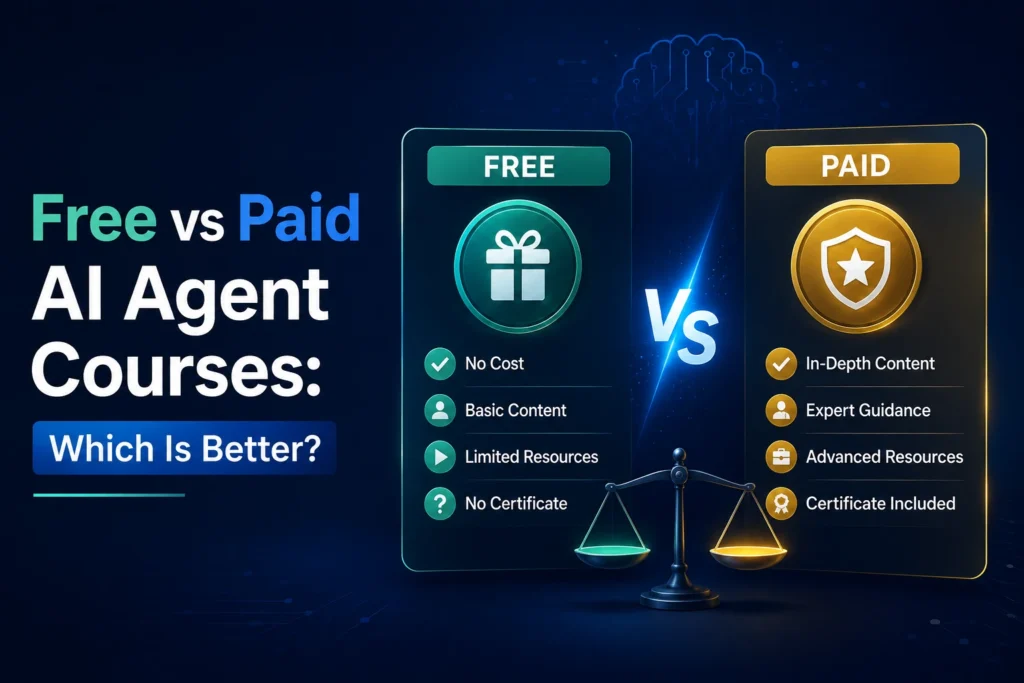
A free AI agent course can be a good starting point, especially for someone who is still exploring the field. Free programs from established providers can cover useful fundamentals without requiring a financial commitment.
For example, OpenAI Academy currently offers its Agents and Workflows course as part of a free, self-paced learning pathway, and eligible courses provide completion certificates. OpenAI also makes clear that these certificates are different from formal OpenAI Certifications.
Paid courses can make sense when they provide something beyond basic lessons. This may include detailed projects, instructor support, assessments, advanced development topics, or a recognized professional credential.
The better option depends on your goal. If you want to understand AI agents and build basic workflows, a quality free course may be enough. If you need deeper technical training or a formal certification for your career, a paid program may offer more value.
Do You Need Coding Skills to Learn AI Agents?
Not always.
Beginners can learn the basic concepts of AI agents without becoming programmers first. You can understand agent workflows, instructions, tools, and practical use cases before moving into development.
Coding becomes more important when you want to build advanced or customized agents. Developers may need to work with APIs, frameworks, databases, tool integrations, memory, evaluation, and deployment.
The learning path can therefore depend on your goal. A business professional may focus on using and managing agents, while a developer may need to understand the technical systems behind them.
Current professional certifications reflect this difference. Microsoft’s AI Agent Builder Associate, for example, is aimed at advanced builders and expects knowledge of generative AI, RAG, MCP, APIs, prompt engineering, and integration patterns.
How Much Time Does It Take to Learn AI Agents?
There is no fixed timeline because AI agent development covers several levels of difficulty.
A beginner can understand the core concepts in a short course and start experimenting with simple workflows relatively quickly. Building reliable agents takes longer because it involves tool integration, testing, evaluation, and handling real-world requirements.
The most effective approach is to learn progressively. Start with the fundamentals, build a small agent, then move toward more complex workflows as your understanding improves.
Your previous experience also matters. Someone familiar with APIs and programming will generally move through technical topics faster than someone starting from scratch.
What Can You Build After Completing an AI Agent Course?
The possibilities depend on the skills covered in the course, but practical projects can include research agents, customer-support systems, lead qualification workflows, content assistants, data-processing agents, and internal business automation.
More advanced learners can work on multi-agent systems in which different agents handle separate parts of a larger process. Production-focused training can also introduce evaluation, monitoring, security, and guardrails.
The important part is not simply completing a project. You should understand why the agent is designed in a particular way and how its performance can be tested and improved.
AI Agent Course Certificate vs AI Certification: What’s the Difference?
These terms are often used interchangeably, but they can describe different credentials.
A course-completion certificate generally confirms that you completed a particular learning program. OpenAI Academy explicitly describes its certificates this way and distinguishes them from formal OpenAI Certifications.
A professional certification usually involves an assessment designed to validate specific skills. Microsoft’s AI Agent Builder Associate, for example, requires candidates to take a proctored exam covering the planning, integration, testing, and management of agent solutions.
Neither option automatically guarantees a job. The value comes from the credibility of the provider, the difficulty of the assessment, the relevance of the skills, and what you can actually demonstrate.
Is an AI Agents Certificate Worth It?
It can be, but the certificate should not be the only reason you take the course.
A credible credential can document your learning and make it easier to communicate your skills on a resume or professional profile. More importantly, the learning behind it can help you understand how to apply AI agents to real problems.
For developers, a portfolio project can strengthen the value of the certificate. For business professionals, demonstrating how you have used agents to improve a workflow may be more useful than the credential alone.
The best combination is simple: learn the concepts, build something practical, and use the certificate as supporting evidence.
How to Start a Career in AI Agents
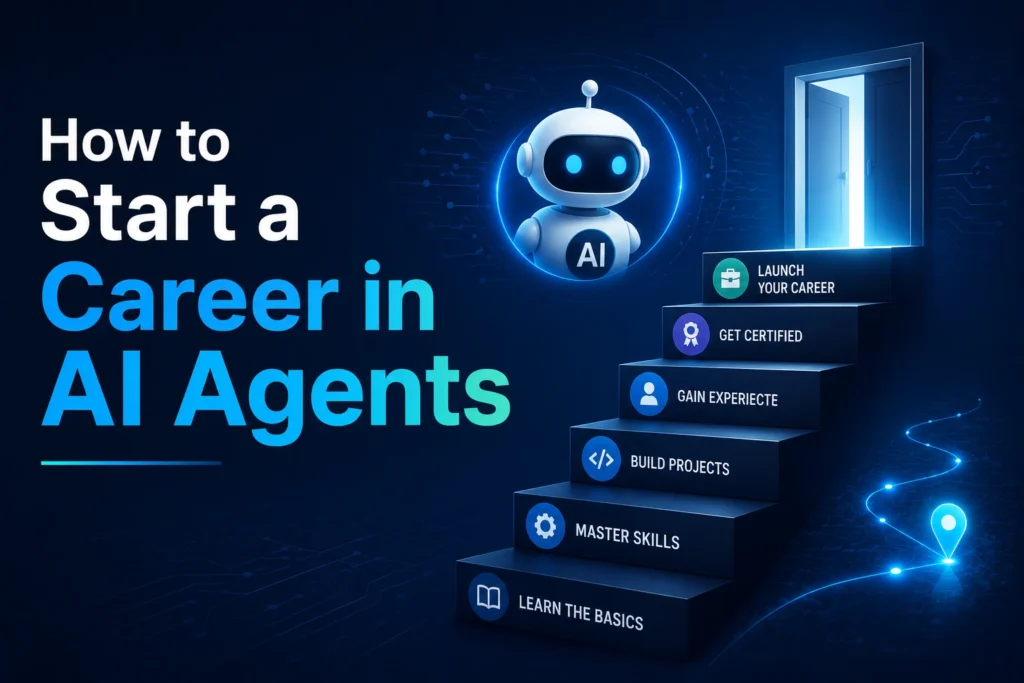
Start by learning the fundamentals of generative AI and understanding how agents differ from traditional chatbots and automation.
Next, learn how agents use instructions, tools, APIs, and workflows. Once you are comfortable with those concepts, begin building small projects that solve specific problems.
As your skills improve, move into areas such as agent orchestration, evaluation, memory, multi-agent systems, security, and deployment. Microsoft’s current GitHub Certified: Agentic AI Developer certification, for example, assesses areas including tool use, memory and state, evaluation, multi-agent coordination, and guardrails.
Finally, create a portfolio that shows what you can build and consider earning a relevant certificate or professional certification.
FAQs About AI Agent Courses
What is the best AI agents course with a certificate?
The best course depends on your experience and goal. Beginners should prioritize clear fundamentals and practical exercises, while developers should look for deeper coverage of APIs, tools, workflows, evaluation, and deployment.
Is there a free AI agent course with a certificate?
Yes. OpenAI Academy currently offers a free, self-paced Agents and Workflows course, with course-completion certificates available to eligible learners who complete the course through their Academy account.
Can I learn AI agents without coding?
Yes. You can learn the fundamentals and use some agent-building platforms without advanced programming knowledge. However, coding becomes increasingly useful when developing customized, production-ready agents.
Are AI agent certificates worth it?
They can be useful when issued by a credible provider and supported by genuine learning or assessment. A certificate is most valuable when combined with practical skills and projects.
How much time does it take to learn AI agents?
Basic concepts can be learned relatively quickly, but becoming comfortable with advanced agent development takes longer. Your existing knowledge of AI, programming, APIs, and automation will significantly affect the learning time.
Conclusion
An AI agents course with certificate can be a practical way to enter one of the fastest-changing areas of AI. The right course should teach more than terminology. It should help you understand how agents work, how they use tools, how workflows are designed, and how their results can be evaluated.
If you are a beginner, start with a clear and accessible course. If you already have technical experience, look for deeper training in APIs, orchestration, evaluation, and production systems.
Most importantly, do not choose a course simply because it promises a certificate. Look at the curriculum, practical work, provider, assessment, and skills you will gain. A credible certificate can support your profile, but the ability to build and apply AI agents is what ultimately makes the learning valuable.
💙 Follow Tech Statar for practical insights.