
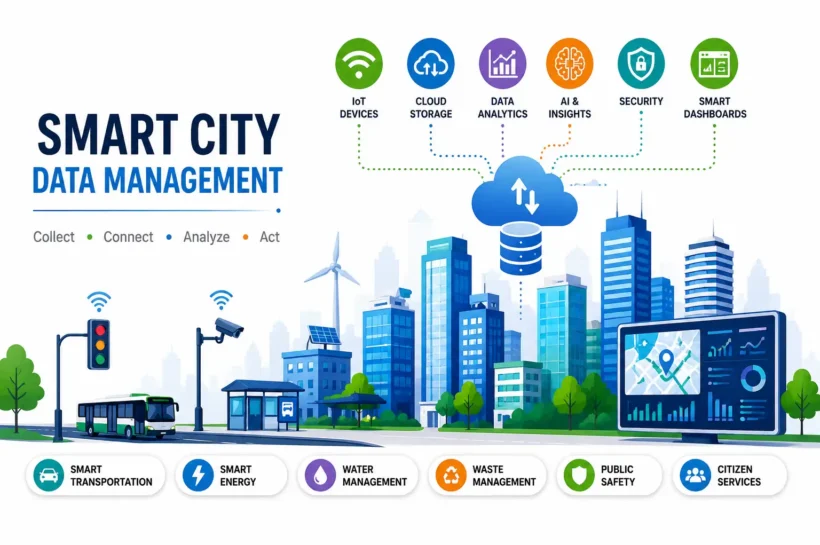

What Is Smart City Data Management?
Smart city data management is the process of collecting, organizing, storing, analyzing, securing, and sharing data generated across urban infrastructure. It connects information from IoT devices, connected vehicles, smart utilities, public services, and digital platforms to help city leaders make informed decisions.
Instead of relying on manual reporting, municipalities use real-time data to improve transportation, energy distribution, public safety, healthcare, and environmental sustainability. According to the United Nations, nearly 68% of the world’s population is expected to live in urban areas by 2050, making intelligent data management essential for efficient city operations and long-term urban planning.
How Smart City Data Management Works
Smart city data management follows a continuous lifecycle that transforms raw information into actionable insights. Sensors, cameras, GPS devices, smart meters, and connected infrastructure capture data every second. This information is transmitted through secure communication networks to cloud or edge computing platforms, where it is cleaned, standardized, and stored.
Advanced analytics, artificial intelligence, and machine learning identify trends, detect anomalies, and support predictive decision-making. Interactive dashboards then present meaningful insights to city officials, enabling faster responses, better resource allocation, improved citizen services, and evidence-based policies that increase operational efficiency while reducing costs and environmental impact.
Key Components of a Smart City Data Management System
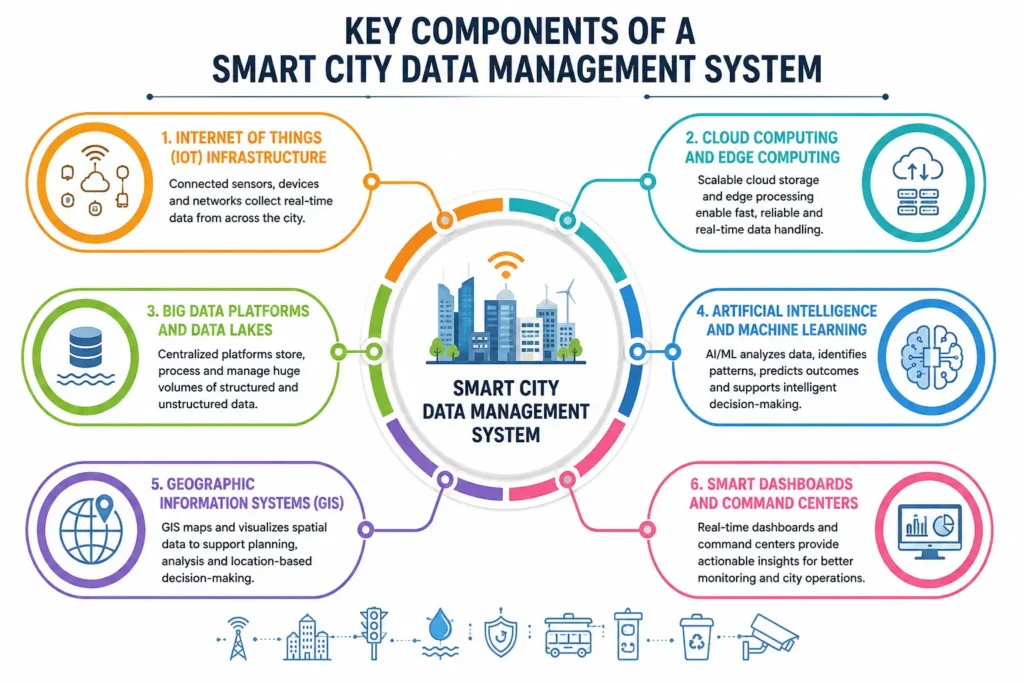
Internet of Things (IoT) Infrastructure
IoT infrastructure forms the foundation of every smart city by connecting sensors, cameras, smart meters, traffic signals, and public devices. These connected systems continuously collect real-time information about transportation, utilities, weather, infrastructure, and public spaces. Research from industry analysts estimates that billions of IoT devices are already connected worldwide, enabling cities to automate operations, monitor assets remotely, and improve service delivery through continuous data collection.
Cloud Computing and Edge Computing
Cloud computing provides scalable storage and processing power for massive urban datasets, while edge computing analyzes information closer to connected devices. This combination reduces latency, lowers bandwidth usage, and enables real-time decision-making for traffic management, emergency services, and public safety. Hybrid cloud-edge architectures also improve system resilience by supporting faster responses during critical events and minimizing service disruptions across connected city infrastructure.
Big Data Platforms and Data Lakes
Smart cities generate enormous volumes of structured and unstructured information every day. Big data platforms and centralized data lakes consolidate information from multiple departments into a unified environment. This enables advanced analytics, predictive modeling, and cross-department collaboration while eliminating isolated data silos. Modern data architectures also improve scalability, governance, and long-term storage for continuously expanding urban datasets.
Artificial Intelligence and Machine Learning
Artificial intelligence and machine learning convert raw city data into meaningful predictions and automated decisions. AI models identify traffic congestion, forecast energy demand, detect infrastructure failures, and support predictive maintenance before costly breakdowns occur. Machine learning continuously improves accuracy by learning from historical and real-time data, allowing municipalities to optimize services, reduce operational expenses, and deliver smarter public experiences.
Geographic Information Systems (GIS)
Geographic Information Systems integrate spatial data with maps, satellite imagery, and infrastructure records to visualize urban operations geographically. GIS helps planners analyze land use, monitor environmental changes, optimize transportation networks, and coordinate emergency responses. Interactive mapping improves decision-making by revealing patterns that traditional spreadsheets cannot display, making location intelligence an essential component of modern smart city management.
Smart Dashboards and Command Centers
Smart dashboards and integrated command centers provide a centralized view of city-wide operations. Officials can monitor transportation, utilities, environmental conditions, emergency incidents, and infrastructure performance through real-time visual analytics. These dashboards combine data from multiple departments into a single interface, enabling faster decisions, better coordination, improved situational awareness, and more effective responses to operational challenges across the city.
Major Sources of Smart City Data
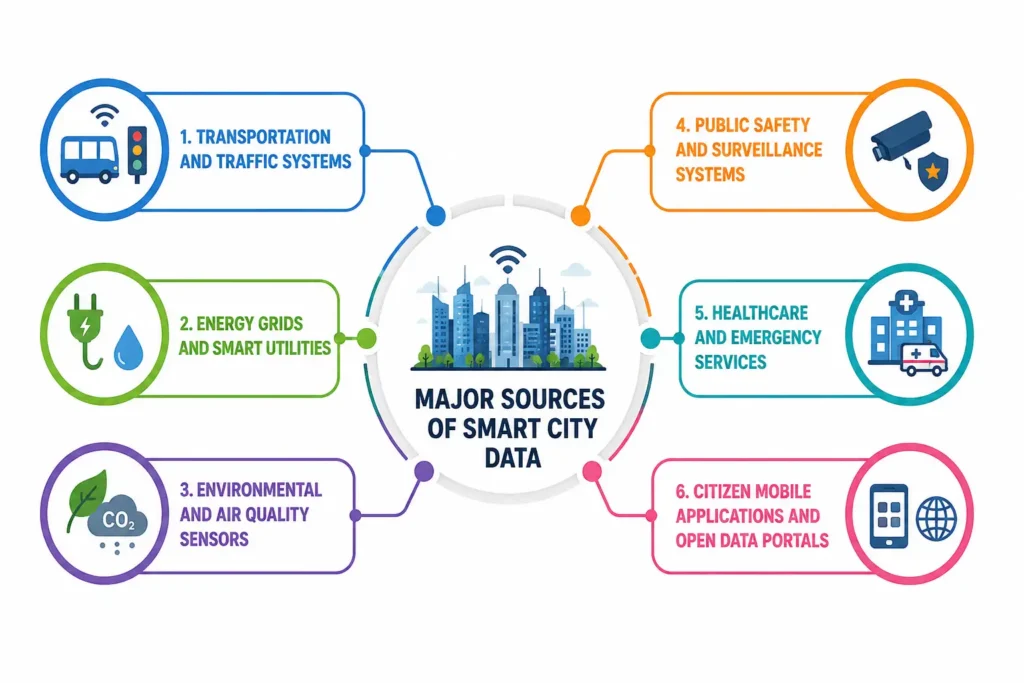
Transportation and Traffic Systems
Transportation networks generate valuable data through GPS devices, connected vehicles, road sensors, parking systems, and intelligent traffic signals. Cities analyze these datasets to reduce congestion, optimize traffic flow, improve public transit scheduling, and enhance road safety. Real-time transportation analytics also support faster incident detection, shorter travel times, and more efficient infrastructure planning for rapidly growing urban populations.
Energy Grids and Smart Utilities
Smart electricity grids, water systems, and gas networks continuously collect operational information through digital meters and connected infrastructure. Utility providers use this data to monitor consumption, detect outages, predict maintenance needs, and balance energy demand. According to the International Energy Agency, digital technologies are becoming increasingly important for improving electricity system efficiency and supporting cleaner, more resilient energy networks worldwide.
Environmental and Air Quality Sensors
Environmental sensors measure air pollution, temperature, humidity, rainfall, noise levels, and water quality across urban areas. This information helps cities monitor climate conditions, identify pollution hotspots, and develop sustainability strategies. Continuous environmental monitoring also supports public health initiatives, disaster preparedness, and compliance with environmental regulations while providing citizens with transparent, real-time environmental information.
Public Safety and Surveillance Systems
Public safety systems collect information from surveillance cameras, emergency communication networks, connected alarms, and incident reporting platforms. When combined with responsible governance, cybersecurity, and privacy protections, these systems strengthen community safety while supporting efficient emergency response and informed public security planning.
Healthcare and Emergency Services
Hospitals, ambulances, emergency call centers, and connected medical devices generate critical operational data that supports faster healthcare delivery. Real-time information helps emergency responders optimize dispatch routes, allocate medical resources, and improve patient outcomes. Integrated healthcare analytics also assist public health agencies in monitoring disease trends, emergency preparedness, and healthcare system performance across urban populations.
Citizen Mobile Applications and Open Data Portals
Citizen engagement platforms, mobile applications, and open data portals allow residents to report issues, access public services, and participate in community decision-making. Governments also publish non-sensitive datasets that encourage innovation, research, and transparency. Open data initiatives empower businesses, developers, and researchers to create digital solutions while strengthening collaboration between local governments and the communities they serve.
💚 You Might Also Like: 5 Best Google Lens Uses You Should Try
Benefits of Smart City Data Management
Smart city data management creates measurable value by turning real-time information into smarter decisions that improve urban life. Instead of relying on outdated reports, city leaders can monitor infrastructure, predict problems, and optimize public services using data-driven insights. From reducing traffic congestion to improving energy efficiency and emergency response, centralized data management helps governments allocate resources more effectively while lowering operational costs. According to the World Bank and the United Nations, data-driven urban planning is becoming increasingly important as cities continue to grow rapidly. By integrating IoT, AI, cloud computing, and analytics, municipalities can build more sustainable, resilient, and citizen-focused communities that deliver better services and long-term economic growth.
Smarter Urban Planning
Data-driven planning helps city officials understand population growth, land use, transportation demand, and infrastructure needs more accurately. Geographic Information Systems (GIS), satellite imagery, and predictive analytics reveal long-term development trends that support informed investment decisions.
Real-Time Traffic Optimization
Smart traffic management systems analyze live data from sensors, GPS devices, connected vehicles, and traffic cameras to reduce congestion and improve mobility. Artificial intelligence can automatically adjust traffic signal timing, recommend alternative routes, and identify accidents within seconds. Studies have shown that adaptive traffic signal systems can significantly reduce travel delays while improving fuel efficiency and lowering vehicle emissions across busy urban corridors.
Efficient Waste and Water Management
Connected waste bins, smart water meters, and IoT sensors enable cities to optimize collection schedules, detect leaks, and monitor resource consumption in real time. Instead of following fixed service routes, sanitation teams respond only when needed, reducing operational costs and fuel usage. Smart monitoring also minimizes water loss, improves conservation efforts, and supports sustainable resource management across growing urban communities.
Improved Energy Efficiency
Smart energy management platforms monitor electricity consumption across buildings, street lighting, and public infrastructure to identify opportunities for greater efficiency. AI-powered analytics predict energy demand, balance grid performance, and reduce unnecessary consumption during peak hours. According to the International Energy Agency (IEA), digital technologies play a growing role in improving electricity system efficiency while supporting cleaner and more resilient energy networks worldwide.
Better Public Safety and Emergency Response
Integrated public safety platforms combine information from surveillance systems, emergency call centers, weather sensors, and connected infrastructure to improve situational awareness. Real-time analytics help emergency responders identify incidents faster, optimize dispatch routes, and coordinate multiple agencies during crises. Faster access to accurate information enhances disaster preparedness, reduces response times, and strengthens overall community resilience during emergencies.
Enhanced Citizen Experience and Digital Services
Modern smart cities use centralized data platforms to deliver faster, more personalized public services. Residents can report issues through mobile apps, access digital government services, receive real-time transit updates, and track service requests online. These digital experiences improve transparency, increase citizen engagement, and strengthen trust between governments and communities while reducing administrative workloads through automation and self-service platforms.
💚 You Might Also Like: The 10 Best B2B Appointment Setting Companies for 2026
Common Challenges in Smart City Data Management
Despite its advantages, smart city data management presents several technical, operational, and regulatory challenges. Cities often struggle with fragmented data systems, incompatible technologies, cybersecurity threats, privacy concerns, limited budgets, and shortages of skilled professionals. Integrating information from multiple departments and legacy infrastructure can also be difficult without common standards. As connected devices continue to increase, maintaining data quality, ensuring regulatory compliance, and protecting sensitive citizen information become even more important. Successfully addressing these challenges requires strong governance, scalable technology, cross-department collaboration, and continuous investment in digital infrastructure, cybersecurity, workforce development, and responsible data management practices.
Best Practices for Effective Smart City Data Management
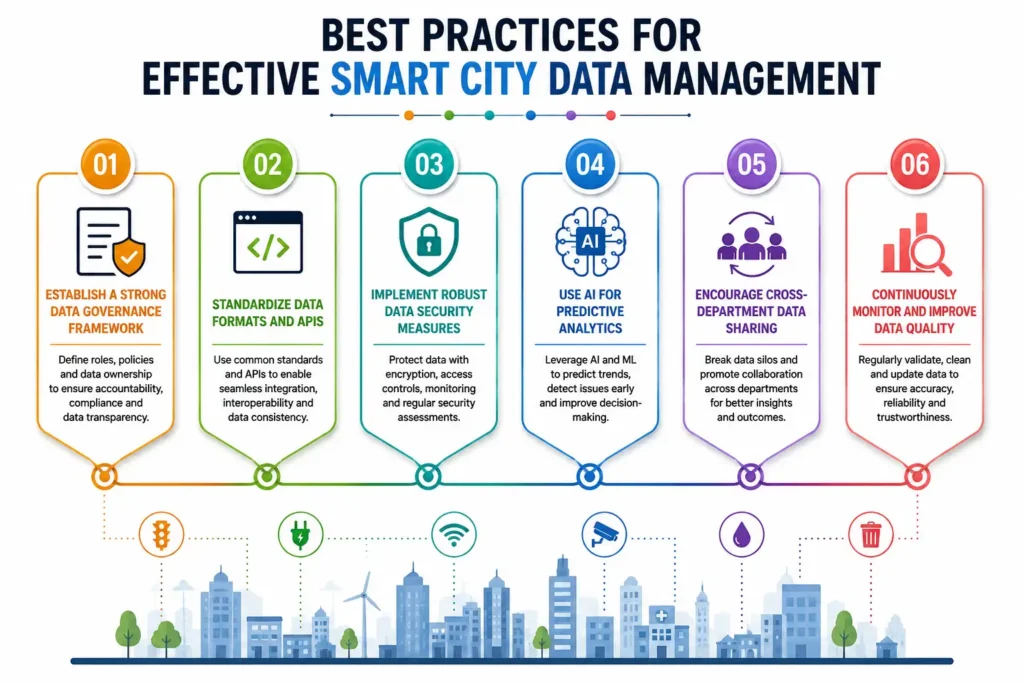
Building a successful smart city requires more than collecting large volumes of data. Municipalities must establish structured processes that ensure information remains accurate, secure, accessible, and actionable throughout its lifecycle. Following industry best practices improves operational efficiency, supports regulatory compliance, and increases public trust. Organizations should focus on governance, interoperability, cybersecurity, artificial intelligence, collaboration, and continuous quality improvement to maximize the value of urban data. A well-designed data management strategy also creates a scalable foundation for future smart city innovations while enabling evidence-based decision-making across transportation, utilities, healthcare, environmental monitoring, and other essential public services.
Establish a Strong Data Governance Framework
A comprehensive data governance framework defines how information is collected, stored, shared, protected, and maintained across government departments. Clear policies establish ownership, accountability, privacy requirements, and compliance standards. Strong governance improves data consistency, reduces duplication, minimizes regulatory risks, and ensures decision-makers can rely on accurate, trustworthy information when planning and managing public services.
Standardize Data Formats and APIs
Standardized data models and open APIs enable different city systems to communicate efficiently regardless of the technology vendor. Interoperability eliminates data silos, simplifies integration, and supports seamless information exchange between transportation, utilities, healthcare, and emergency services. Common standards also reduce implementation costs while improving scalability for future digital infrastructure projects and smart city expansion.
Implement Robust Data Security Measures
Protecting urban data requires multiple layers of cybersecurity, including encryption, identity management, multi-factor authentication, network monitoring, and continuous vulnerability assessments. Regular security audits help identify potential weaknesses before they become serious threats. Strong cybersecurity strategies safeguard critical infrastructure, protect sensitive citizen information, and strengthen public confidence in connected government services and digital transformation initiatives.
Use AI for Predictive Analytics
Artificial intelligence enables cities to move from reactive operations to predictive decision-making. Machine learning analyzes historical and real-time datasets to forecast traffic congestion, infrastructure failures, energy demand, and emergency risks before they occur. Predictive analytics supports proactive maintenance, reduces operational costs, improves service reliability, and helps governments allocate resources more efficiently across urban environments.
Encourage Cross-Department Data Sharing
Smart cities operate more effectively when transportation, utilities, healthcare, public safety, and environmental agencies share reliable information through centralized platforms. Cross-department collaboration reduces duplicated efforts, improves coordination, and provides decision-makers with a complete view of city operations. Shared data also accelerates emergency response, infrastructure planning, and long-term policy development across multiple government organizations.
Continuously Monitor and Improve Data Quality
High-quality data is essential for accurate analytics and reliable decision-making. Cities should continuously validate, clean, update, and monitor datasets to eliminate errors, inconsistencies, and duplicate records. Automated quality monitoring tools help maintain accuracy as data volumes grow. Reliable information strengthens AI models, improves reporting, supports regulatory compliance, and increases confidence in every data-driven decision.
💚 You Might Also Like: How Artificial Intelligence Is Accelerating Scientific Discovery
Real-World Applications of Smart City Data Management
Smart city data management is already transforming how cities operate around the world. By combining IoT devices, artificial intelligence, cloud computing, GIS, and advanced analytics, municipalities can automate services, improve infrastructure performance, and make faster data-driven decisions. These technologies help reduce operational costs, improve sustainability, strengthen public safety, and enhance residents’ quality of life. Cities such as Singapore, Barcelona, Amsterdam, and Dubai have successfully implemented smart city initiatives that use real-time data to optimize transportation, utilities, environmental monitoring, and emergency response. As urban populations continue to grow, practical data management applications will play an even greater role in building efficient, resilient, and future-ready cities.
Frequently Asked Questions
What Is Smart City Data Management?
Smart city data management is the process of collecting, integrating, storing, analyzing, securing, and sharing information generated by connected urban systems. It enables governments to make data-driven decisions that improve transportation, utilities, healthcare, environmental monitoring, and public safety while increasing operational efficiency and enhancing citizen services through real-time analytics.
Why Is Data Management Important for Smart Cities?
Effective data management ensures that information from multiple city departments remains accurate, secure, and accessible for decision-making.
How Does IoT Support Smart City Data Management?
IoT devices continuously collect real-time information from sensors, cameras, smart meters, connected vehicles, and public infrastructure.
What Are the Biggest Challenges in Managing Smart City Data?
The most significant challenges include cybersecurity threats, data privacy concerns, fragmented legacy systems, inconsistent data standards, limited funding, and integrating information from multiple agencies. Maintaining high data quality and ensuring regulatory compliance also become increasingly important as connected devices generate larger volumes of information across expanding smart city ecosystems.
How Does AI Improve Smart City Data Management?
Artificial intelligence analyzes massive datasets to identify patterns, predict future events, automate decision-making, and optimize city operations. AI helps forecast traffic congestion, energy demand, equipment failures, and emergency incidents while improving infrastructure maintenance, resource allocation, and service delivery through advanced predictive analytics and machine learning models.
What Does the Future of Smart City Data Management Look Like?
The future of smart city data management will focus on AI-driven automation, digital twins, edge computing, 5G connectivity, and stronger cybersecurity frameworks. As connected devices continue to expand, cities will increasingly rely on predictive analytics, autonomous infrastructure management, and real-time digital services to improve sustainability, resilience, operational efficiency, and citizen satisfaction.
💚 You Might Also Like: How Business Directories Help Build Brand Awareness
Conclusion
Smart city data management is becoming the foundation of modern urban development, enabling governments to transform massive volumes of data into meaningful actions that improve everyday life. By integrating IoT, artificial intelligence, cloud computing, GIS, and advanced analytics, cities can optimize transportation, strengthen public safety, improve energy efficiency, and deliver better digital services.
Although challenges such as cybersecurity, privacy, and interoperability remain, adopting strong governance and modern data management practices allows municipalities to build resilient, sustainable, and future-ready communities. As technologies like digital twins, predictive AI, and edge computing continue to evolve, smart city data management will play an increasingly important role in creating connected cities that are more efficient, environmentally responsible, and centered on the needs of their citizens.
✨ This is just the start. Follow Tech Statar for more gems.





































One thought on “Smart City Data Management: Complete Guide”