
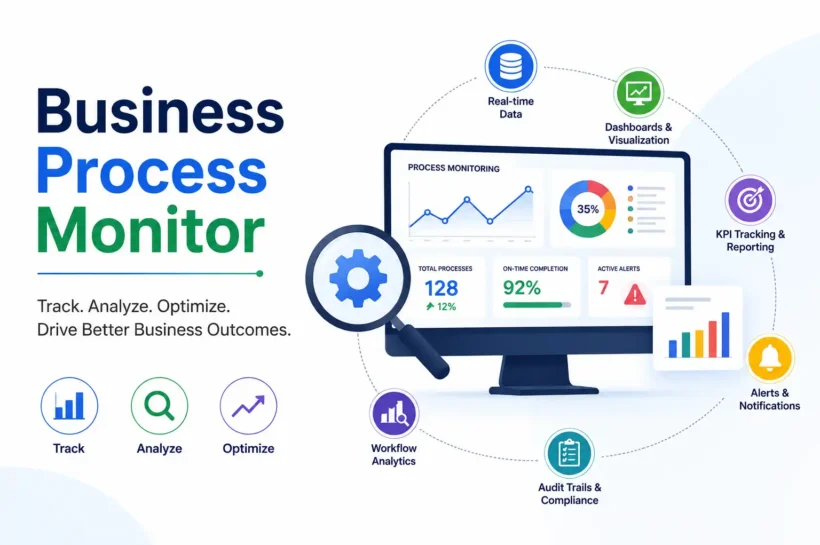

What Is a Business Process Monitor?
A business process monitor is a system that tracks, measures, and analyzes how business workflows perform in real time. It gives organizations complete visibility into processes such as customer onboarding, invoice approvals, inventory management, and support requests. Business Process Monitoring (BPM) focuses on identifying delays, inefficiencies, and compliance risks before they become larger operational issues. Unlike Business Process Management, which concentrates on designing and improving workflows, monitoring focuses on performance and execution. In modern organizations, process monitors collect live operational data, compare results against predefined goals, and provide insights that help teams respond faster and make smarter decisions.
Why Business Process Monitoring Is Important for Modern Businesses
Modern businesses operate in environments where speed and accuracy directly affect profitability. Business process monitoring helps organizations eliminate operational bottlenecks, improve transparency, and make decisions using live performance data instead of historical reports. Companies that actively monitor workflows can respond to problems faster and optimize resources more effectively. Recent industry research shows that more than 66% of organizations have already automated processes in at least one business function, highlighting the growing importance of process visibility and monitoring in competitive markets. Organizations that fail to monitor their operations often struggle with delays, higher costs, and inconsistent customer experiences.
Eliminating operational bottlenecks
Bottlenecks slow down approvals, create backlogs, and increase operating costs. Process monitoring helps managers identify exactly where delays occur and which tasks require intervention. This visibility allows businesses to redistribute workloads and maintain smoother operations across departments.
Improving workflow transparency
Transparency enables employees and managers to understand the current status of every process step. Instead of relying on emails or manual follow-ups, teams can access live dashboards showing progress, ownership, and completion times for each activity.
Enhancing decision-making with real-time data
Real-time monitoring replaces assumptions with actionable insights. Leaders can evaluate performance trends, identify risks, and make informed decisions immediately. Organizations increasingly rely on live operational intelligence to improve agility and maintain a competitive advantage in rapidly changing markets.
Reducing process delays and inefficiencies
Monitoring systems detect delays the moment they occur, allowing organizations to intervene before service levels are affected. Automated alerts and exception management significantly reduce manual follow-ups and repetitive administrative work, improving overall productivity and customer satisfaction.
Supporting business scalability and growth
Growing businesses process larger volumes of transactions, approvals, and customer requests. Process monitoring ensures workflows remain efficient as operations expand. It provides the visibility needed to scale without losing control over quality, compliance, or customer experience.
Core Components of an Effective Business Process Monitor
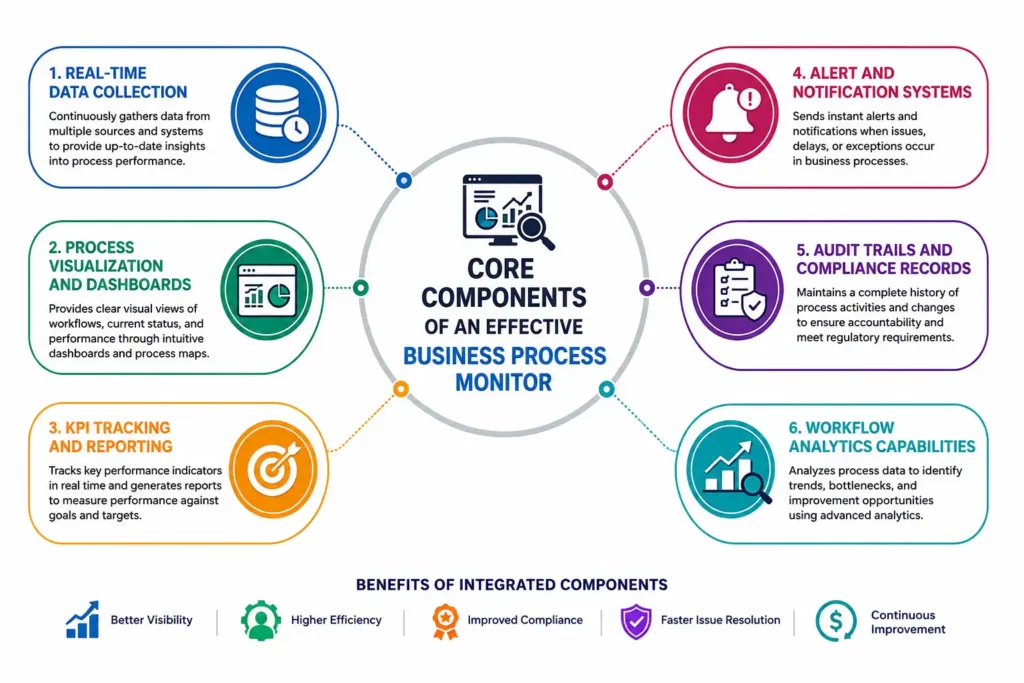
An effective business process monitor combines visibility, analytics, and automation to provide a complete picture of operational performance. The most successful monitoring systems capture data continuously, present information in easy-to-understand dashboards, and alert teams whenever performance falls below expectations. They also maintain audit records for compliance and use analytics to uncover improvement opportunities. Industry studies show that organizations implementing workflow automation frequently achieve significant productivity gains and measurable returns on investment, making monitoring a critical component of modern operations strategies.
Real-time data collection
Real-time monitoring depends on accurate and continuous data collection from multiple business systems. This includes ERP software, CRM platforms, accounting systems, and customer service tools. The faster organizations capture data, the faster they can respond to operational issues.
Process visualization and dashboards
Dashboards convert complex operational data into simple visual insights. Managers can instantly identify delays, workload distribution, and process performance trends without manually reviewing reports or spreadsheets, improving both speed and decision-making quality.
KPI tracking and reporting
KPIs provide measurable indicators of process performance. Effective monitoring systems automatically track targets such as cycle times, completion rates, and SLA compliance while generating reports that support operational reviews and strategic planning.
Alert and notification systems
Automated alerts notify teams when workflows exceed predefined thresholds or deadlines. Instead of discovering problems after customers complain, organizations can respond immediately and minimize operational disruptions.
Audit trails and compliance records
These records improve accountability, simplify investigations, and help organizations comply with industry regulations and internal governance requirements.
Workflow analytics capabilities
Advanced analytics help businesses identify recurring issues, forecast future performance, and optimize resource allocation. Predictive monitoring capabilities are becoming increasingly valuable as organizations move toward AI-driven operations and intelligent automation.
✨ Discover More Articles: 4 Essential Skills Every New HR Professional Needs to Build Today
Key Metrics and KPIs to Track in Business Process Monitoring
Tracking the right KPIs is essential for understanding whether business processes are meeting performance expectations. Metrics provide objective measurements that reveal inefficiencies, identify improvement opportunities, and support data-driven decisions. Rather than monitoring every available number, successful organizations focus on indicators directly connected to business outcomes such as speed, quality, customer satisfaction, and cost efficiency.
Process cycle time
Process cycle time measures the total duration required to complete a workflow from start to finish. Long cycle times often indicate bottlenecks, unnecessary approvals, or resource shortages that require attention.
Task completion rate
This metric measures the percentage of tasks completed successfully within a specific period. High completion rates generally indicate healthy workflows, while low rates may suggest staffing issues or inefficient procedures.
Throughput and productivity metrics
Throughput measures how many transactions, requests, or tasks a process can handle within a defined timeframe. Productivity metrics help organizations evaluate resource utilization and operational capacity.
Error and exception rates
Errors increase costs and negatively affect customer experiences. Monitoring exception rates helps businesses identify process weaknesses and improve consistency across workflows and departments.
SLA compliance rate
Service Level Agreement compliance measures whether processes meet agreed deadlines and performance standards. Consistently meeting SLA targets improves trust, customer retention, and operational reliability.
Cost per process execution
This KPI calculates the total cost required to complete a process. Tracking execution costs helps organizations identify opportunities for automation and process optimization.
Customer satisfaction indicators
Customer satisfaction scores, response times, and resolution rates provide valuable insight into how internal process performance affects external customer experiences. Efficient processes almost always lead to stronger customer relationships and improved loyalty.
Types of Business Process Monitoring
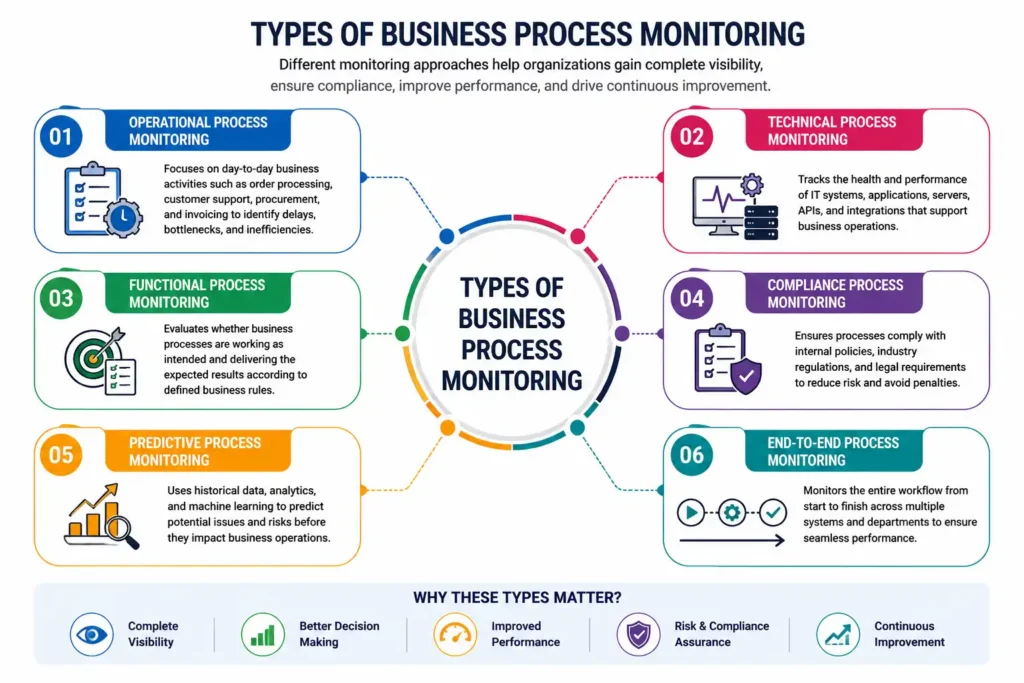
Business process monitoring is not a one-size-fits-all approach. Organizations monitor workflows differently depending on their operational goals, technical environment, and compliance requirements. Some businesses focus on system performance, while others prioritize customer-facing activities or regulatory obligations. Understanding the different types of monitoring helps companies choose the right strategy for improving visibility and efficiency. Many modern organizations combine several monitoring approaches to gain a complete picture of how processes perform across departments, technologies, and customer interactions throughout the business lifecycle.
Operational process monitoring
Operational monitoring focuses on day-to-day business activities such as order processing, customer support, procurement, and invoicing. Its primary purpose is to identify delays, bottlenecks, and workflow inefficiencies that can impact productivity and customer satisfaction.
Technical process monitoring
Technical monitoring tracks the health and performance of the systems supporting business operations. It includes server availability, application performance, API response times, and system integrations that keep workflows running smoothly.
Functional process monitoring
Functional monitoring evaluates whether business processes deliver their intended outcomes. Instead of focusing on system performance, it measures whether activities are completed correctly and according to business requirements and expectations.
Compliance monitoring
Compliance monitoring ensures business processes follow internal policies and external regulations. Industries such as healthcare, banking, and manufacturing rely heavily on this type of monitoring to reduce legal and financial risks.
Predictive process monitoring
Predictive monitoring uses historical trends, machine learning, and analytics to forecast potential issues before they occur. Businesses can proactively address risks rather than reacting after operational disruptions have already happened.
End-to-end process monitoring
End-to-end monitoring tracks an entire workflow from initiation to completion across multiple systems and departments. This approach provides a comprehensive view of performance and helps organizations improve overall operational efficiency.
✨ Discover More Articles: Employee Management Software: Features, Benefits & Best Solutions
How a Business Process Monitor Works Step by Step
A business process monitor follows a structured approach to transform raw operational data into actionable business insights. The process begins by identifying critical workflows and defining what success looks like for each one. Organizations then establish measurable performance indicators and connect the monitoring platform to relevant business systems. As data flows into the platform, managers can identify trends, detect anomalies, and take corrective action when necessary. This continuous feedback loop enables businesses to improve efficiency, reduce risks, and support long-term operational excellence.
Identifying critical business processes
The first step is determining which workflows have the greatest impact on business performance. Organizations typically prioritize customer onboarding, financial approvals, procurement activities, and order fulfillment processes for monitoring initiatives.
Defining monitoring objectives
Clear objectives ensure monitoring efforts remain focused on business outcomes. Companies may aim to reduce processing times, improve service quality, increase compliance, or lower operational costs through better visibility.
Setting KPIs and thresholds
Organizations establish measurable indicators and acceptable performance limits for each process. Thresholds help teams recognize when performance falls below expectations and when immediate intervention becomes necessary.
Collecting and integrating process data
Modern monitoring systems gather information from ERP platforms, CRM software, databases, and other enterprise applications. Integrating multiple data sources creates a centralized view of business performance.
Analyzing performance trends
Monitoring platforms analyze historical and real-time information to uncover recurring issues, inefficiencies, and emerging risks. Trend analysis helps leaders make informed decisions backed by operational evidence rather than assumptions.
Taking corrective actions and optimization measures
Once issues are identified, organizations can implement workflow improvements, automation, or resource adjustments. Continuous optimization ensures processes remain efficient as business requirements and market conditions evolve.
Major Benefits of Implementing Business Process Monitoring
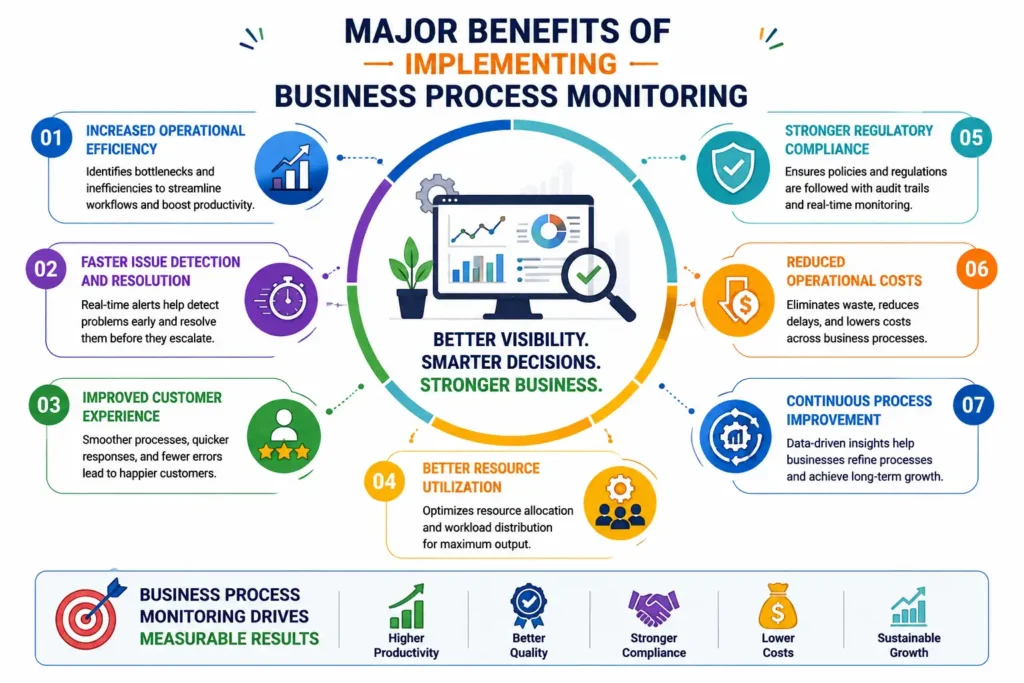
Organizations invest in business process monitoring because visibility leads to better decision-making and stronger operational performance. When businesses can see exactly how workflows are performing, they can respond faster to problems and continuously improve outcomes. According to research from the global consulting firm McKinsey, companies that effectively use operational data and analytics often achieve substantial improvements in productivity and efficiency. Process monitoring also supports scalability by helping organizations maintain quality and consistency as workloads increase and business operations become more complex.
Increased operational efficiency
Monitoring eliminates unnecessary delays and highlights opportunities for automation and workflow optimization. Teams spend less time on manual tracking and more time focusing on high-value business activities.
Faster issue detection and resolution
Real-time alerts help organizations identify problems as soon as they occur. Faster detection reduces downtime, minimizes disruptions, and prevents small issues from developing into costly operational failures.
Improved customer experience
Customers benefit when organizations deliver services faster and more consistently. Monitoring helps businesses reduce response times, improve accuracy, and maintain service quality across customer interactions.
Better resource utilization
Process visibility allows managers to distribute workloads more effectively and avoid resource shortages or overutilization. This leads to improved productivity without increasing operational expenses unnecessarily.
Stronger regulatory compliance
Continuous monitoring ensures processes consistently follow internal policies and industry regulations. Automated audit trails simplify reporting requirements and reduce the risk of compliance violations and penalties.
Reduced operational costs
Identifying inefficiencies allows organizations to remove redundant activities and optimize resource allocation. Lower processing costs directly contribute to improved profitability and stronger financial performance.
Continuous process improvement
Business environments constantly evolve, making ongoing optimization essential. Monitoring provides the insights organizations need to refine workflows, adapt to changes, and maintain long-term competitiveness.
✨ Discover More Articles: Why Your ERP Success Depends on Choosing the Right Oracle NetSuite Partner
Best Practices for Successful Business Process Monitoring
Successful business process monitoring requires more than simply collecting operational data. Organizations that achieve the best results follow a structured strategy that focuses on business value, continuous improvement, and collaboration. Monitoring efforts should prioritize the processes that directly affect revenue, customer satisfaction, and operational efficiency. Businesses should also combine automation, analytics, and regular performance reviews to maintain long-term effectiveness. According to industry research, organizations with mature process management practices consistently outperform competitors in productivity and service quality because they treat monitoring as an ongoing business discipline rather than a one-time initiative.
Focus on high-impact processes first
Organizations should begin by monitoring workflows that have the greatest effect on customers, revenue, and operational performance. Prioritizing critical processes delivers faster results and demonstrates the value of process monitoring initiatives.
Define measurable KPIs
Clearly defined KPIs provide objective evidence of process performance. Businesses should focus on metrics that align with strategic goals and directly influence operational outcomes and customer experiences.
Use automation wherever possible
Automation reduces manual intervention and improves the speed and accuracy of monitoring activities. Automated alerts and reporting allow teams to respond quickly without constantly reviewing dashboards manually.
Implement real-time dashboards
Real-time dashboards provide immediate visibility into workflow performance and operational risks. Managers can quickly identify bottlenecks and make informed decisions based on current business conditions.
Review process performance regularly
Business environments change continuously, making regular performance reviews essential. Frequent evaluations help organizations identify trends, adjust targets, and maintain operational efficiency over time.
Encourage cross-department collaboration
Many business processes involve multiple departments working together. Collaboration between teams improves visibility, eliminates communication gaps, and supports faster problem resolution across the organization.
Continuously optimize workflows
Monitoring should lead to action rather than reporting alone. Organizations that continuously refine workflows are better positioned to improve efficiency, reduce costs, and remain competitive in changing markets.
Frequently Asked Questions (FAQs)
What is a business process monitor?
A business process monitor is a tool or system that tracks, measures, and analyzes business workflows in real time. It helps organizations identify bottlenecks, monitor KPIs, and improve operational efficiency by providing visibility into process performance.
What is the difference between Business Process Monitoring and Business Process Management?
Business Process Management focuses on designing, improving, and automating workflows, while Business Process Monitoring focuses on tracking and analyzing how those workflows perform after implementation. Management builds the process, whereas monitoring measures its effectiveness.
Why is business process monitoring important?
Business process monitoring helps organizations detect inefficiencies, reduce delays, improve compliance, and make faster decisions using real-time operational data. It also supports scalability and enhances customer experiences through better workflow management.
What KPIs should businesses track in process monitoring?
Common KPIs include process cycle time, task completion rate, throughput, error rates, SLA compliance, cost per process execution, and customer satisfaction metrics. The right KPIs depend on the goals of each business process.
Which industries benefit the most from business process monitoring?
Industries such as healthcare, banking, manufacturing, logistics, retail, telecommunications, and insurance benefit significantly from process monitoring because they rely heavily on efficient workflows and regulatory compliance.
Can small businesses use business process monitoring tools?
Yes. Many cloud-based business process monitoring platforms are designed specifically for small and medium-sized businesses. These solutions provide affordable access to dashboards, analytics, automation, and reporting capabilities.
How does AI improve business process monitoring?
AI enhances business process monitoring by identifying patterns, predicting bottlenecks, detecting anomalies, and recommending optimization opportunities. Predictive analytics allows organizations to address issues before they affect operations or customers.
What features should I look for in a business process monitoring tool?
Important features include real-time dashboards, automated alerts, KPI tracking, reporting capabilities, workflow analytics, AI support, system integrations, audit trails, and scalability for future business growth.
Is business process monitoring the same as workflow automation?
No. Workflow automation focuses on executing tasks automatically, while business process monitoring focuses on tracking and analyzing the performance of those workflows. The two technologies often work together to improve efficiency and visibility.
✨ Discover More Articles: 5 Best Cloud Platforms for Hosting SaaS Applications
Conclusion
Business process monitoring has become an essential capability for organizations that want to improve efficiency, reduce costs, and deliver better customer experiences. By providing real-time visibility into workflows, monitoring helps businesses identify bottlenecks, respond to issues faster, and make decisions based on reliable operational data. The combination of automation, analytics, and intelligent monitoring technologies is transforming how organizations manage daily operations. Businesses that invest in effective monitoring practices today will be better prepared to adapt to future challenges, support growth initiatives, and maintain a competitive advantage in an increasingly data-driven business environment.
✨ Smart minds follow smart pages, hit follow on Tech Statar.






































One thought on “Business Process Monitoring Guide for Businesses in 2026”