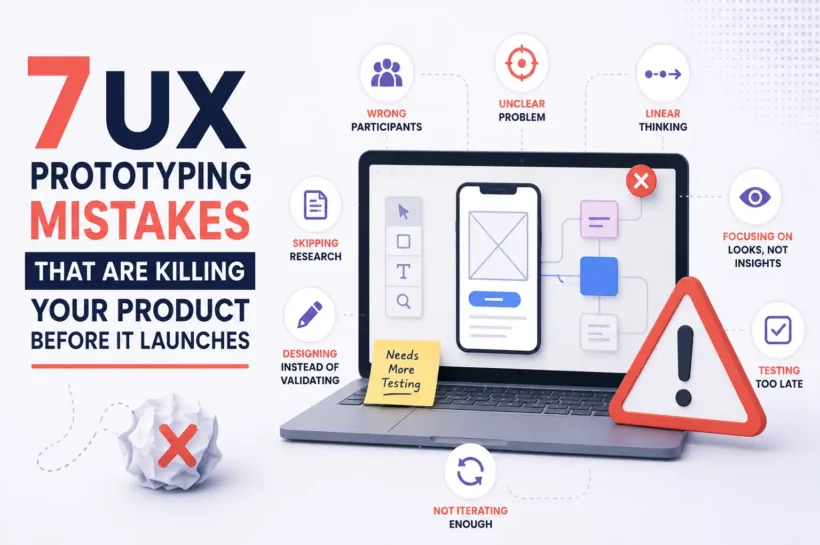

7 UX Prototyping Mistakes That Are Killing Your Product Before It Launches
Most digital products that fail in their first year do not fail due to bad engineering or poor marketing. They fail much earlier during the design and validation phase, before a single line of production code is written. The prototype stage is where assumptions get tested, where team alignment gets established, and where the distance between what a product promises and what it actually delivers becomes visible. When that stage is handled poorly, the consequences don’t show up immediately. They accumulate quietly, buried inside sprint cycles and backlog tickets, until they surface as a failed launch or a product that users abandon within weeks.
Product teams often treat prototyping as a formality, something done to satisfy a process checklist rather than a genuine phase of critical inquiry. That misunderstanding is where most of the damage begins. The following mistakes are not abstract or theoretical. They reflect patterns that repeat across products in nearly every category, from enterprise software to consumer-facing applications.
Mistake 1: Confusing Fidelity With Validity in UX Prototyping
One of the most persistent misunderstandings in ux prototyping is the belief that a more polished prototype produces more useful feedback. Teams invest time building high-fidelity mockups with refined visuals, accurate typography, and near-final interactions, and then wonder why the feedback they receive is shallow or cosmetic rather than structural. The problem is that fidelity influences what users pay attention to. When a prototype looks nearly finished, participants respond to its surface. When it looks rough and clearly unfinished, they respond to how it works.
There is a substantial body of research supporting the idea that prototype fidelity should match the specific question being tested. According to Nielsen Norman Group, low-fidelity prototypes are often more effective for early-stage concept testing precisely because they signal that feedback is still welcome and that nothing has been decided yet. The goal of prototyping is not to impress, it is to learn.
The most reliable approach is to start with the lowest fidelity that still communicates the concept clearly, and increase fidelity only when the question being tested requires it. Using the right level of fidelity at the right stage is a discipline in itself, and it is one that many teams skip in the interest of speed or internal optics. If you want to understand how experienced teams approach this balance, reviewing frameworks around ux prototyping can help clarify the relationship between prototype type and research intent.
Mistake 2: Testing With the Wrong Participants
A prototype is only as useful as the feedback it generates, and that feedback is only as useful as the people providing it. Recruiting participants who are too close to the product, internal stakeholders, colleagues, or people who broadly understand the domain tends to produce feedback that misses the actual usability problems. These participants are too forgiving, too fluent in the product’s language, and too familiar with the assumptions baked into its design.
The Problem With Convenient Samples
Testing with whoever is available, often people inside the organization or within an easy professional network, is a recurring shortcut that quietly undermines the quality of every round of research. These participants typically know what the product is supposed to do, which means they unconsciously fill in gaps that real users would not. They skip over confusing labels, navigate unclear flows with assumed knowledge, and provide feedback that reflects their understanding of the intended design rather than their experience of the actual design.
The result is a prototype that appears validated but has only been confirmed by people who already agreed with it. When the product reaches real users, the gaps that convenient participants glossed over become visible immediately, and by that point, the cost of addressing them is substantially higher.
💡 Explore More Insights: The Future of Social Media Agencies: Automation & AI Tools
Defining Participants Before Defining the Test
Participant selection should happen before the test plan is finalized, not after. Who will use this product in practice? What is their baseline familiarity with similar tools or workflows? What context will they be in when they encounter it? These questions should shape both who is recruited and what the prototype is designed to test. Getting this right requires some advanced effort, but the quality of insight it produces is not comparable to what comes from convenience testing.
Mistake 3: Skipping the Problem Definition Phase
Teams that move directly from a brief or stakeholder request into prototype construction often find themselves building solutions to problems that were never clearly defined. This is not a design process failure, it is a scoping failure. Without a clear articulation of the specific problem being solved, every prototype decision becomes an interpretation of vague intent rather than a response to a defined need.
Problem definition involves more than writing a user story or listing requirements. It involves understanding the context in which the problem occurs, the frequency and severity of the friction users experience, and the range of conditions under which the solution must perform. When that foundation is absent, prototypes tend to be built around assumptions that no one has tested, and those assumptions are the ones most likely to be wrong.
Mistake 4: Treating Prototypes as Linear Deliverables
There is a common tendency to treat each prototype as a deliverable to be handed off, reviewed, and approved before the next one begins. This creates a sequential rhythm that looks organized but is fundamentally misaligned with how design knowledge actually develops. Insights from early testing often reshape the questions that later testing needs to answer, and a rigid deliverable-based structure does not accommodate that kind of responsive iteration.
When Iteration Becomes Theatrical
Teams sometimes go through the motions of iteration, producing version after version of a prototype without meaningfully acting on what they learn between rounds. Each new version incorporates surface changes suggested by participants, but the underlying structure of the design remains unchanged because the core assumptions were never seriously questioned. This is an iteration in appearance only. It generates documentation and creates the impression of a thorough process without producing the kind of insight that actually improves the product.
Real iteration requires a willingness to discard significant portions of a prototype when the evidence demands it. That is genuinely difficult, particularly when time and effort have already been invested. But a prototype that is difficult to abandon is a prototype that has already been given too much authority too early.
Mistake 5: Separating Prototype Testing From Real User Workflows
Prototypes are frequently tested in conditions that bear little resemblance to the environment in which the product will actually be used. A participant sitting in a quiet room with a researcher present, focused entirely on completing a task, is not behaving the way a user behaves when they are distracted, time-pressured, or switching between tools in the middle of a real work process. The feedback generated in controlled conditions reflects controlled conditions and little else.
This is not an argument against structured testing. It is an argument for contextual awareness. Where possible, prototype testing should be designed to approximate the conditions of real use. That might mean testing on the device the user would actually use, introducing mild time pressure, or asking participants to complete tasks while managing other concurrent activities. These adjustments introduce realistic friction that makes test results more actionable.
Mistake 6: Over-Documenting and Under-Acting on Research Findings
Research findings from prototype testing have a short shelf life. The longer a team waits to act on what they have learned, the more likely those insights are to be diluted by organizational momentum, shifting priorities, or simple forgetting. Yet many teams invest significant effort in producing comprehensive research reports that are reviewed once in a readout meeting and then largely set aside.
The Gap Between Insight and Action
Documentation is not the same as synthesis, and synthesis is not the same as action. A well-structured research report tells the team what happened during testing. It does not automatically translate into design decisions, and it does not guarantee that the most critical findings will receive appropriate attention. The teams that close this gap most effectively tend to involve designers directly in research sessions, keep synthesis sessions short and action-oriented, and assign clear ownership to each finding that requires a design response.
The goal of research is not to produce knowledge, it is to produce better decisions. Documentation that doesn’t lead to decisions has consumed resources without returning value.
💡 Explore More Insights: How Influencers Help Brands Boost Social Media Engagement?
Mistake 7: Building Prototypes That Only Reflect Best-Case Scenarios
Prototypes almost always show the product working as intended. Users follow the expected path, complete tasks in the assumed order, and encounter the system under ideal conditions. What prototypes rarely show is what happens when things go wrong, when users make unexpected choices, encounter errors, or approach the product with needs that the design did not anticipate.
Edge cases and error states are not secondary concerns. For many users, how a product handles failure is more defining than how it handles success. A checkout flow that works perfectly in testing but collapses when a user enters an unsupported address format is not a product that is ready to launch. Testing only the ideal path creates a false confidence that the product is solid when it is, in fact, untested under the conditions where it is most likely to encounter difficulty.
Building error states, alternative paths, and edge case responses into prototype testing is not a sign of excessive caution. It is a sign of a team that understands the full range of situations its product will face.
Closing Thoughts
The mistakes described here share a common thread: they each reflect a tendency to treat prototyping as a phase to be completed rather than a process of genuine inquiry. When teams approach prototypes as proof of an idea rather than a test of one, they lose the primary benefit of working at this stage, the ability to change direction cheaply before the cost of doing so becomes prohibitive.
None of these mistakes is inevitable, and none of them requires significant additional resources to avoid. They require a shift in how the prototype phase is understood and prioritized within the broader product development process. The teams that get this right do not have larger budgets or more sophisticated tools. They have a clearer understanding of what a prototype is actually for, and they build their process around that understanding rather than around the optics of delivering something polished on schedule.
Before the next prototype reaches testing, it is worth asking honestly: what is this prototype designed to learn? If the answer is not immediately clear, the problem is not in the prototype, it is in the process that produced it.
🎓 Learn one new thing every day with Tech Statar.