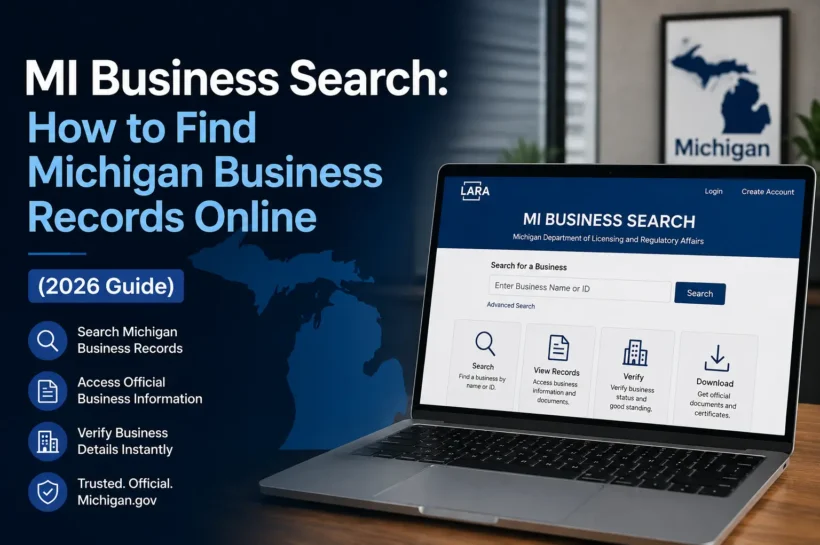

MI Business Search: How to Find Michigan Business Records Online (2026 Guide)
Finding reliable information about a registered business is easier than ever, but only if you know where to look. Whether you’re planning to work with a company, launch your own business, verify a supplier, or conduct legal research, using an official business database is one of the smartest first steps.
In Michigan, the MI Business Search tool allows anyone to search public records of registered business entities. Instead of relying on third-party directories that may contain outdated or incomplete information, this official database provides access to records filed with the state. From checking whether an LLC is active to viewing filing history, the platform offers valuable insights that help individuals and businesses make informed decisions.
This guide covers what MI Business Search is, how it works, what information you can access, and how to use it effectively. By the end, you’ll know exactly how to locate business records in Michigan and understand what the search results actually mean.
What Is MI Business Search?
MI Business Search is the official online business entity lookup system used to access publicly available information about companies registered in the state of Michigan. The database is maintained by the Michigan Department of Licensing and Regulatory Affairs (LARA), the agency responsible for overseeing business registrations and corporate filings.
Whenever a business registers as a limited liability company, corporation, nonprofit organization, limited partnership, or another recognized business entity, certain records become part of the state’s public database. MI Business Search provides an easy way to access those records without visiting a government office or submitting a formal request.
The database is designed to promote transparency while helping entrepreneurs, investors, attorneys, financial institutions, and consumers verify the legitimacy of registered businesses.
What Information Can You Find?
Although the amount of information varies depending on the type of entity and public disclosure rules, MI Business Search typically provides several important business details.
Users can view the legal business name, entity identification number, business structure, registration status, date of formation, and jurisdiction where the company was organized. In many cases, the database also includes the registered agent’s information, principal office address, and filing history submitted to the state.
These records are particularly useful because they come directly from official filings rather than privately maintained directories. That means the information is generally more reliable for business verification and legal purposes.
It’s important to remember that not every detail about a business is publicly available. Personal financial information, confidential documents, and certain ownership details are protected under applicable laws and won’t appear in the public search results.
Why People Use MI Business Search
People use MI Business Search for many different reasons, but they all share one goal: verifying business information before making an important decision.
Entrepreneurs often search the database before registering a new company. By checking whether a desired business name already exists, they can avoid filing delays and choose a unique name that complies with Michigan’s business naming requirements.
Business owners also use the tool to monitor their own company’s public records. Reviewing entity status, filing history, and registration details helps ensure that business information remains accurate and current.
Consumers often perform searches before purchasing products or services from unfamiliar companies. Verifying that a business is officially registered can increase confidence and reduce the risk of dealing with fraudulent operations.
Attorneys, accountants, lenders, and investors rely on MI Business Search during due diligence. Confirming whether a company is active, dissolved, or in good standing provides valuable context before entering contracts, extending financing, or completing acquisitions.
Journalists, researchers, and market analysts also use the database when investigating companies operating within Michigan.
Who Can Benefit from MI Business Search?
The platform serves a wide audience because business verification plays an important role across many industries.
Small business owners use it while choosing names for new ventures or confirming the status of competitors. Startup founders review business records before forming partnerships or attracting investors.
Financial institutions often verify company registrations before approving commercial loans or opening business banking relationships.
Legal professionals access corporate records during litigation, contract preparation, mergers, and compliance reviews.
Consumers benefit as well. Before hiring a contractor, purchasing expensive products, or signing service agreements, checking whether a company is properly registered provides an additional layer of protection.
Government agencies, nonprofit organizations, educational institutions, and procurement teams may also consult business records before awarding contracts or entering cooperative agreements.
Why Official Business Records Matter
Official business records provide far more than basic identification. They help establish trust between businesses and the people who interact with them.
A registered company demonstrates that it has completed the legal process required to operate under Michigan law. While registration alone doesn’t guarantee quality or financial stability, it does confirm that the business exists within the state’s official records.
Business status is another critical factor. An active entity generally indicates that required filings have been maintained, while statuses such as dissolved or revoked may signal administrative or legal issues that deserve further investigation.
Official records also reduce the risk of confusion between businesses with similar names. By using the entity identification number and legal business name, users can verify that they are reviewing the correct organization rather than a similarly named company.
For entrepreneurs, lenders, investors, and consumers alike, starting with verified information leads to better business decisions. Using MI Business Search as the first step in your research helps ensure that those decisions are based on accurate, government-maintained records rather than outdated or unofficial sources.
How to Use MI Business Search (Step-by-Step)
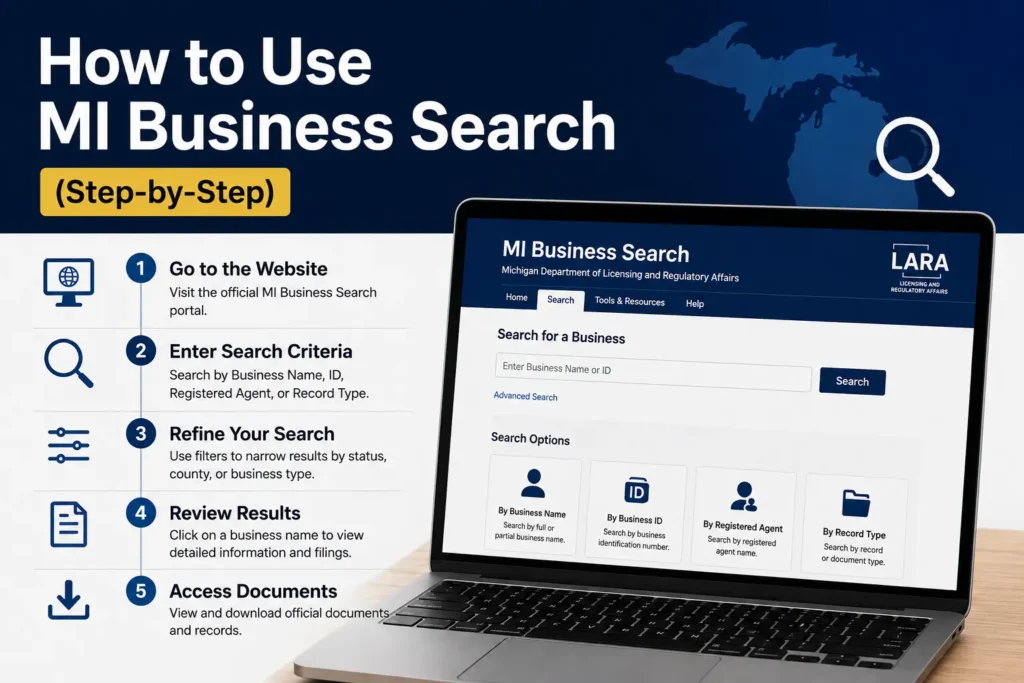
Using MI Business Search is straightforward, even if you’ve never searched a business database before. The search interface is designed to help users quickly locate public records for registered entities in Michigan. Whether you’re verifying an existing company or researching a potential business partner, following the right approach will help you find accurate results in less time.
The first step is to visit the official Michigan business entity search portal maintained by the Michigan Department of Licensing and Regulatory Affairs (LARA). Because the database is managed directly by the state, the information is more reliable than many third-party business directories that may not be updated regularly.
Once you’re on the search page, you’ll have several ways to locate a business.
Search by Business Name
Searching by business name is the method most people use. Simply enter the legal name of the company or a portion of it into the search field.
If you’re unsure of the exact spelling, it’s often better to search using only the most distinctive part of the name rather than entering the complete title. This increases the likelihood of finding the correct business, especially if punctuation, abbreviations, or business suffixes differ from what you expected.
For example, a company registered as “ABC Solutions LLC” may still appear if you search only for “ABC Solutions.” Reviewing multiple matching results allows you to identify the correct entity based on additional information such as formation date or business status.
Search by Entity ID
If you already know a company’s entity identification number, this is usually the fastest and most accurate search method.
Every registered business receives a unique entity ID when it is formed or authorized to operate in Michigan. Unlike business names, which may look similar to other companies, the entity ID identifies only one specific organization.
Professionals such as attorneys, accountants, lenders, and compliance officers frequently use this method because it eliminates uncertainty and provides direct access to the correct business record.
Search by Registered Agent
In some situations, users may want to locate businesses associated with a particular registered agent.
A registered agent is the individual or organization authorized to receive legal documents and official notices on behalf of a business. While this search option isn’t commonly used by the general public, it can be valuable during legal research, corporate investigations, or compliance reviews.
It’s worth remembering that a registered agent may represent multiple businesses, so search results could include several different entities.
Review the Business Record
After selecting a business from the search results, you’ll be able to access its public record.
This page contains important information that helps verify the company’s identity and legal standing. Rather than relying only on the business name, review each section carefully to ensure you’re looking at the correct entity.
Many users overlook details such as formation dates or entity numbers, but these identifiers are often essential when multiple companies have similar names.
Reading the complete record also provides valuable context about the company’s registration history and current standing with the state.
Understanding MI Business Search Results
Finding a business is only the beginning. The next step is understanding what the information means. Each section of a business record provides different details about a company’s legal identity.
Business Name
The legal business name is the official name registered with the State of Michigan.
This may differ from the company’s brand name or the name displayed on its website. Some businesses operate under assumed names or “doing business as” (DBA) names, while their legal registration remains different.
Always compare the legal name with contracts, invoices, and official documents when verifying a business.
Entity ID Number
The entity ID is a unique identifier assigned during registration.
Because no two businesses share the same entity number, it serves as one of the most reliable ways to confirm you’re reviewing the correct company.
Government agencies, financial institutions, and legal professionals often reference this number when filing documents or conducting official business research.
Business Type
The business type identifies the company’s legal structure.
You may see classifications such as Limited Liability Company (LLC), Domestic Corporation, Foreign Corporation, Nonprofit Corporation, Limited Partnership, or Professional Limited Liability Company.
Understanding the business structure helps explain how the company operates, its legal responsibilities, and the regulations it must follow.
Current Status
One of the most important sections in the record is the entity’s current status.
This indicates whether the business is actively registered, has been dissolved, withdrawn, revoked, or holds another legal status under Michigan law.
Although an active status generally suggests that the company has maintained its required filings, it’s still wise to conduct additional due diligence before entering significant business agreements.
Formation Date
The formation date shows when the business was originally registered or authorized to operate.
This information helps determine how long the company has existed and can provide useful context during business evaluations.
For example, an established company with many years of continuous registration may demonstrate greater operational stability than a recently formed entity, although longevity alone should never be the only factor considered.
Registered Agent Information
Many business records also identify the registered agent responsible for receiving official legal correspondence.
The registered agent plays an important role in maintaining compliance with state requirements by accepting lawsuits, government notices, and other legal documents on behalf of the business.
Businesses are generally required to maintain an active registered agent throughout their existence.
Filing History
The filing history provides a timeline of important documents submitted to the state.
Depending on the business entity, this may include formation documents, annual reports, amendments, mergers, name changes, reinstatements, and other official filings.
Reviewing filing history helps users understand how the business has evolved over time and whether significant legal changes have occurred.
What Types of Businesses Can You Search?
MI Business Search includes a wide variety of legally registered business entities operating in Michigan.
The database covers limited liability companies, domestic corporations, foreign corporations authorized to conduct business within the state, nonprofit organizations, limited partnerships, professional entities, and several other recognized business structures.
Because the database includes both newly registered organizations and long-established companies, it serves as a comprehensive resource for business verification across nearly every industry.
Whether you’re researching a local startup, confirming the registration of a nonprofit organization, or verifying a large corporation expanding into Michigan, MI Business Search provides an official starting point for your research before making important business or financial decisions.
Common MI Business Search Statuses Explained
One of the most valuable pieces of information you’ll find in MI Business Search is a company’s current business status. While many users simply check whether a business appears in the database, understanding its status provides a much clearer picture of its legal standing.
Each status reflects the entity’s relationship with the State of Michigan and whether it has met the ongoing requirements necessary to remain registered.
Active
An active status indicates that the business is currently registered and recognized by the state. In most cases, this means the entity has maintained the required filings and remains authorized to operate under Michigan law.
However, an active status should not be interpreted as an endorsement of the company’s financial health, reputation, or quality of service. It simply confirms that the business exists as an active legal entity.
Dissolved
A dissolved business has formally ended its legal existence. Dissolution may occur voluntarily when the owners choose to close the company or administratively when statutory requirements are not met.
Once dissolved, the business generally cannot continue operating as it did before unless it is reinstated according to state regulations.
Withdrawn
A withdrawn status commonly applies to foreign entities that were previously authorized to conduct business in Michigan but have officially ended their registration within the state.
Although the company may still operate elsewhere, it is no longer registered to conduct business as a foreign entity in Michigan.
Revoked
A revoked status usually indicates that the state’s authorization has been canceled because the business failed to comply with legal or administrative requirements.
This may result from missed filings, unpaid obligations, or other compliance issues. Businesses with a revoked status often need to resolve outstanding requirements before they can regain good standing.
Good Standing
Some business records also indicate whether an entity is in good standing. This generally means the business has satisfied the state’s ongoing filing and compliance requirements.
Many banks, lenders, investors, and government agencies request proof of good standing before approving loans, awarding contracts, or completing significant business transactions.
Benefits of Using MI Business Search
MI Business Search serves far more purposes than simply confirming whether a company exists. It helps users make informed decisions by providing direct access to official business records maintained by the State of Michigan.
For entrepreneurs, the database simplifies the process of checking whether a desired business name is already registered before filing formation documents. This can save both time and filing costs by reducing the likelihood of choosing an unavailable name.
Consumers also benefit by verifying that a company is officially registered before purchasing products or hiring professional services. Although registration alone doesn’t guarantee legitimacy, it provides an additional layer of confidence during the decision-making process.
Professionals such as attorneys, accountants, lenders, and investors use the database during due diligence to confirm registration details, review filing history, and verify an entity’s current legal status before entering into contracts or financial agreements.
Because the information comes directly from official state records, users can generally rely on it more than unofficial business directories that may not be updated regularly.
Limitations of MI Business Search
While MI Business Search is a valuable tool, it does have some limitations.
The database only displays information that is legally available to the public. Confidential records, financial information, tax filings, ownership details protected by law, and other sensitive information are not included.
Recently submitted filings may also require processing time before they appear in the public database. As a result, very recent business changes may not always be reflected immediately.
It’s also important to remember that business registration does not guarantee that a company is financially stable, trustworthy, or actively conducting business. Additional research, such as reviewing licensing requirements, customer reviews, or professional certifications, may be appropriate depending on the situation.
Tips for Getting Better Search Results
If you can’t find the business on your first search, try adjusting your search strategy for better results.
Searching with only part of the business name is usually more effective than entering the complete title. Businesses may be registered with abbreviations, punctuation differences, or legal suffixes such as “LLC” or “Inc.” that affect search results.
If you know the entity ID, using that identifier will almost always provide the fastest and most accurate match.
When researching companies with common names, comparing formation dates, business types, and entity numbers helps ensure you’ve selected the correct record.
Taking a few extra moments to verify these details can prevent confusion between businesses with similar or nearly identical names.
Is MI Business Search Free?
Yes. MI Business Search is available to the public at no cost.
Anyone can search the database, view basic business information, and review public records without creating an account or paying a search fee.
In some situations, certain certified documents or official copies may require payment if requested directly from the state. However, the standard business lookup service itself is free to use.
Conclusion
MI Business Search is one of the most reliable tools for verifying registered businesses in Michigan. Whether you’re starting a new company, researching a potential business partner, confirming the status of an LLC, or conducting professional due diligence, the database provides quick access to official state records that support informed decision-making.
While the platform offers valuable information about business registrations, entity status, filing history, and legal structure, it’s most effective when used as part of a broader research process. Combining official business records with additional due diligence can help you make more confident legal, financial, and commercial decisions.
If you need accurate information about a Michigan business, MI Business Search should be your first stop.
FAQs
What is MI Business Search?
MI Business Search is the official online database that allows users to look up publicly available records for businesses registered in Michigan. It is maintained by the Michigan Department of Licensing and Regulatory Affairs (LARA).
Is MI Business Search free to use?
Yes. Anyone can search for registered businesses and view public information without paying a fee. Some certified documents or official copies may require payment.
Can I search for a Michigan LLC by its name?
Yes. You can search by the legal business name or a portion of it. If available, searching by the entity ID provides even more accurate results.
Does MI Business Search show business owners?
Not always. The database primarily displays public registration details, such as the business name, entity type, status, formation date, registered agent information, and filing history. Ownership information may not be publicly available for every entity.
How often is the MI Business Search database updated?
The database is updated as official filings are processed by the state. While updates are generally made regularly, recently submitted documents may take some time before appearing in public search results.
⚡ Upgrade your thinking. Follow Tech Statar.