
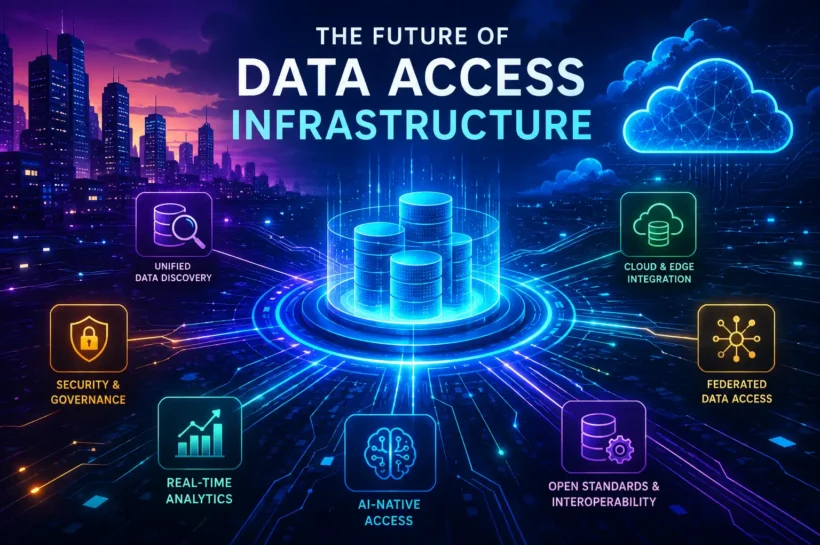

The Future of Data Access Infrastructure
These days, data access infrastructure has evolved from app-specific APIs and isolated databases to an intelligent, unified layer that connects AI systems, apps, and people. It’s been quite a steady road, but also one that encountered quite a few challenges. While the evolution of the data access infrastructure has been remarkable, it also followed the regular schedule of any normal evolution.
From databases to data fabrics
At first, companies were storing info in warehouses, databases, and even SaaS applications. But the focus was on creating data fabrics. These would be a logical layer that makes it easy for users as well as systems to discover, govern, access, and also query data across multiple environments, all without moving everything into a single depository.
There are different characteristics to this type of system. That would include unified metadata and cataloging, cross-platform query capabilities, automated data lineage tracking, consistent governance policies, and real-time as well as batch access via a single interface.
AI native data access
Since AI systems are becoming major consumers of enterprise data, future infrastructure needs to have increased support for a variety of solutions. Those would include semantic search, agent-based data retrieval, retrieval augmented generation, along with natural language querying and context-aware access tools. The infrastructure will translate the intent into queries, as well as permission checks, and data retrieval workflows automatically. In doing so, it will save a lot of resources, while also streamlining processes along the way.
Another trend we see in the data access infrastructure stems from federated access over centralization. What happens is that organizations are seeing that moving all the data to a single location is slow and expensive. So the focus is on moving towards data virtualization, federated query engines, distributed governance, and domain-owned assets, something that helps quite a bit.
Moreover, there’s a focus on using streaming architectures, low-latency access, continual synchronization, event-driven processing, and so on. The focus is on getting real-time data. It just helps eliminate concerns, it focuses on consistency and quality, while delivering a solid return on your investment every single time.
💚 You Might Also Like: An Introduction to Accounting and Payroll Services
Fine-grained security and governance
The great thing about the data access infrastructure is that it becomes a security platform alongside being a data platform. There are plenty of features here, like attribute access control, dynamic masking of the sensitive fields, zero-trust architectures, automated compliance enforcement, and auditability for the AI interactions, all of which can be extremely useful in these situations.
Semantic layers are also becoming critical at this time. It’s a great challenge, but at the same time, you can obtain some very interesting benefits. The data access infrastructure relies on semantic layers,s which help define business metrics, data quality expectations, and common definitions, among many others.
Open standards and interoperability
One of the things to note here is that the future is shifting towards open protocols and not proprietary integrations. That’s why some of the major trends at this time are open table formats, standardized metadata exchanges, interoperable APIs, cross-platform governance frameworks, and the like. And that’s all because companies are looking for flexibility when it comes to AI providers, compute, and storage providers. Having that without having to rebuild the entire data stack is a game-changer and well worth considering here.
Data access for autonomous agents
The rise of AI agents acting on behalf of users is quite easy to see here. People are continually looking out for systems to help enhance their experience and push it to the next level. It’s important to note that future data access systems need to answer questions like what info can the agent see, what actions can the agent perform, how is everything monitored, and how are the permissions delegated. It comes down to having a proper category called agent-ready data access.
The increased use of proxies
Using the best proxies becomes necessary because they help you better access data, increase your security, and enhance your overall safety. That just goes to show you can get a resounding outcome and a great experience every single time, and the outcome is second to none. The great thing about this is that you have the opportunity to further adapt your systems and ensure everything is working the way you want. It’s incredibly rewarding, and the quality you can get here is second to none.
There’s also a rise when it comes to data products. And that’s mainly because organizations are treating data as a product instead of a byproduct coming from the business operations. Having such an approach is great because not only does it improve usability and trust, but it also allows your company to create and maintain data products that can easily be reused whenever you need to do so. And that alone is an excellent game-changer in more ways than one.
💚 You Might Also Like: The Role of Software Development in Startup Success
The convergence of analytics, data, and AI
Modern platforms are shifting towards converging AI, data, and analytics. That means these platforms are designed to support transactional workloads, analytical processing, machine learning training, AI inference, and real-time decision making, all of which are super important to focus on.
Plus, things like distributed data access and edge computing are slowly becoming very important. Future data access architectures will incorporate edge databases, intelligent caching, local processing, hybrid cloud-edge environments, and so on. Together, these solutions minimize latency, strengthen system reliability, and enable organizations to maintain smooth operations even when access to the central system is limited or inconsistent.
Frequently Asked Questions (FAQs)
What is data access infrastructure?
Data access infrastructure refers to the technologies, frameworks, and processes that enable users, applications, and AI systems to securely discover, access, manage, and use data across multiple environments. It acts as the foundation for delivering data where and when it is needed.
Why is data access infrastructure important for AI?
AI models depend on timely and accurate data to generate meaningful insights. Modern data access infrastructure supports capabilities such as semantic search, natural language querying, retrieval-augmented generation (RAG), and context-aware access, allowing AI systems to interact with enterprise data more effectively.
What is the difference between data fabrics and traditional databases?
Traditional databases primarily store and manage data within isolated systems. Data fabrics, on the other hand, create a unified layer that connects multiple data sources, enabling seamless discovery, governance, and querying without physically moving all data into a single repository.
What is federated data access?
Federated data access allows organizations to query and use information stored across different systems without centralizing everything in one location. This approach reduces costs, improves flexibility, and enables faster access to distributed data.
How do semantic layers improve data accessibility?
Semantic layers establish common business definitions, metrics, and data quality standards. They simplify data interpretation, improve consistency across teams, and help both users and AI systems understand information in the proper context.
Conclusion
Clearly, the data access infrastructure is set to change and improve as things evolve in the long term. The future holds a lot of promise for these infrastructures, mainly because it adds a lot of promise and some incredible benefits. Challenges are inevitable throughout the process, but success depends on continuously enhancing the infrastructure and adapting smoothly to changing demands and circumstances. It’s a game-changer in many ways, and it can certainly provide a much better result than expected.
✨ Got value? Let’s keep the momentum, follow Tech Statar.


































One thought on “The Future of Data Access Infrastructure”