
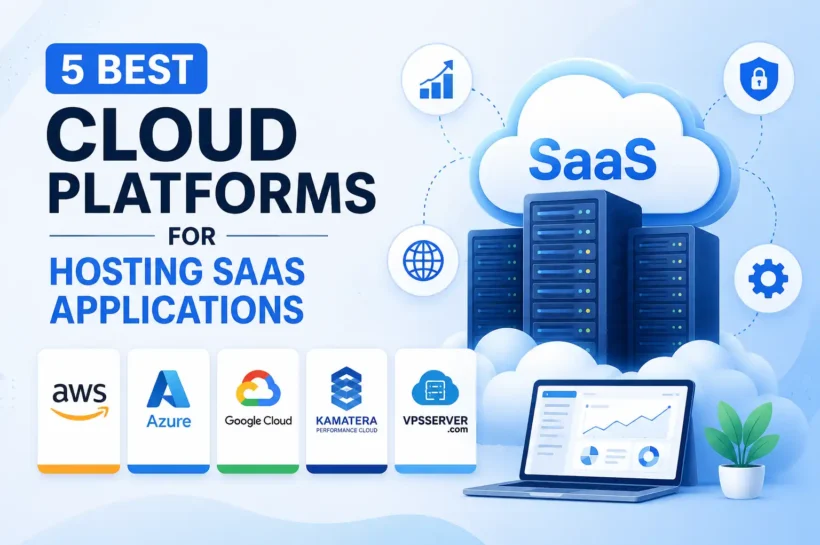

5 Best Cloud Platforms for Hosting SaaS Applications
Choosing where to host your SaaS application is one of the most consequential infrastructure decisions you’ll make. The cloud platform you select directly affects your application’s scalability, uptime, global reach, and ultimately your bottom line.
The cloud infrastructure market surpassed $569 billion in 2022, and it continues to accelerate. The cloud computing market is dominated by Amazon Web Services, Microsoft Azure, and Google Cloud Platform – the big three cloud providers – but they aren’t the only players worth considering. Specialized cloud computing providers like Kamatera and VPSServer.com offer compelling alternatives, particularly for SaaS teams that prioritize cost efficiency, infrastructure control, and predictable billing.
In this guide, we break down five cloud platforms purpose-evaluated for SaaS hosting, covering what makes each one stand out and where each falls short.
How We Chose the Best Cloud Platforms for SaaS Applications
Not every cloud provider is built for SaaS workloads. We evaluated these platforms against criteria that directly impact SaaS businesses:
Scalability and auto-scaling – Can the platform handle rapid user growth through horizontal and vertical scaling, serverless computing, and load balancing?
Performance and reliability – Cloud service providers typically promise 99.9% to 99.99% uptime. We looked at actual SLA commitments and how they’re structured.
Pricing models and cost predictability – Cloud pricing models include pay-as-you-go and reserved instances. We assessed transparency, hidden fees, and how costs scale alongside your revenue. Most cloud providers have hidden costs for data transfer and support that can inflate bills.
Security and compliance – SOC 2, ISO 27001, HIPAA, GDPR, and similar certifications matter for SaaS serving enterprise customers.
Global data center coverage – The cloud services industry emphasizes scalability and global data center presence for low latency worldwide.
Developer tools and integrations – Managed databases, container orchestration, CI/CD pipelines, and monitoring all factor in.
Support quality – 24/7 availability, response SLAs, and documentation depth.
Cloud service providers offer customizable VPS and virtual private clouds, but the top cloud service providers are responsible for enterprise-grade scaling and analytics that SaaS applications demand at scale. Each of the top three cloud platforms provides global infrastructure, but niche providers fill important gaps.
5 Best Cloud Platforms for Hosting SaaS Applications
1. Kamatera
Kamatera is a global IaaS provider founded in 1995 that delivers customizable cloud servers, virtual private clouds, managed services, firewalls, load balancers, and block storage. Unlike hyperscale platforms that overwhelm with hundreds of service offerings, Kamatera focuses on giving SaaS providers full control over their infrastructure with transparent, predictable pricing.
Why It Stands Out: Kamatera emphasizes strong reliability with a 99.95% uptime SLA, NVMe SSD storage across all virtual machines, and the ability to scale out to hundreds of servers in seconds. Its competitive pricing starts at just $4/month with hourly billing options and no long-term contracts.
Best For: Growing SaaS companies needing scalable infrastructure with predictable cloud costs.
Key Strengths:
- Global data centers across 20+ locations including North America, Europe, Asia, and the Middle East
- Support for 100+ operating systems (Linux, Windows, BSD)
- Managed cloud services for teams that want hands-off infrastructure management
- Enterprise-grade performance with full root access and customizable configurations
- Competitive pricing with no surprise fees
Possible Limitations: Smaller ecosystem compared to hyperscale providers. Fewer pre-built serverless or AI-native tools. SaaS teams needing advanced PaaS-level managed databases or machine learning pipelines may need to supplement with third-party tools. Compared to DigitalOcean, which focuses on providing simpler and more cost-effective solutions for small-to-medium businesses, Kamatera offers more enterprise-grade configurations and a broader global footprint.
2. Amazon Web Services (AWS)
Amazon Web Services AWS is the largest public cloud provider, holding approximately 32% of the global cloud market. AWS offers over 200 fully featured cloud services spanning compute, storage services, databases, artificial intelligence, and analytics – the most services of any cloud provider.
Why It Stands Out: AWS delivers a comprehensive suite of tools for virtually every SaaS use case. Its region-level SLA guarantees 99.99% uptime when deploying EC2 instances across two or more availability zones, and its ecosystem of third-party integrations is unmatched.
Best For: Enterprise SaaS applications requiring extensive integrations, advanced analytics, and the broadest possible service catalog.
Key Strengths:
- AWS has over 200 fully featured cloud services covering compute capacity, cloud storage, networking, and beyond
- AWS has data centers in over 37 geographic regions and over 115 availability zones. AWS also operates in 32 geographic regions with 102+ availability zones
- Mature auto-scaling, container orchestration (EKS), and serverless computing (Lambda)
- Extensive compliance certifications (SOC, ISO, HIPAA, FedRAMP, PCI-DSS)
- Massive partner ecosystem and community resources
Possible Limitations: AWS can create complex billing structures as more services are added. AWS offers complex pricing models with potential cost savings through reserved instances and savings plans, but navigating the AWS console can present a steep learning curve for beginners. Vendor lock-in is a real risk when building on proprietary managed services. For a typical MVP-stage SaaS, AWS costs roughly $120–160/month, often higher than alternatives at early scale.
3. Microsoft Azure
Microsoft Azure is designed for enterprise environments and integrates with Microsoft 365 and Active Directory. With over 1000 services available, Azure operates across 54 regions worldwide – one of the largest geographic footprints among major cloud service providers. Azure offers a minimum of three availability zones per region for high availability configurations.
Why It Stands Out: For SaaS applications built on .NET, SQL Server, or any Microsoft stack, Azure provides seamless integration with Microsoft products and Microsoft services. Its hybrid cloud capabilities – including Azure Arc and ExpressRoute – make it the strongest option for hybrid cloud environments where on-premises infrastructure must coexist with the cloud.
Best For: SaaS applications serving large enterprises or built on Microsoft technologies.
Key Strengths:
- Deep Microsoft ecosystem integration across identity (Active Directory/Entra), productivity (M365), and development (.NET)
- Microsoft Azure offers over 1000 services for cloud solutions across compute, databases, analytics, and Azure AI.
- Azure provides good value for existing Microsoft software users through hybrid licensing and enterprise agreements.
- Strong security posture and compliance portfolio for regulated industries
- Azure regions span 60+ locations, making it suitable for global SaaS deployment
Possible Limitations: Azure requires users to understand complex licensing structures, especially for non-Microsoft workloads. Portal complexity can slow development teams unfamiliar with the Microsoft ecosystem. Some new services launch in limited Azure regions before broader availability. While its market share is growing, Azure still trails AWS in overall cloud market adoption.

4. VPSServer.com
VPSServer.com is owned and operated by Kamatera, running on the same enterprise-grade cloud infrastructure. It’s positioned for smaller organizations and budget-conscious SaaS startups that want reliable cloud VPS hosting without the complexity of hyperscale platforms.
Why It Stands Out: Plans start at approximately $4/month with hourly or monthly billing, no contracts, and the ability to upgrade or downgrade at any time with prorated billing. It delivers cost-effective performance backed by Kamatera’s 99.95% uptime infrastructure.
Best For: Small to medium SaaS applications and startups operating at lower cost with limited budgets.
Key Strengths:
- Transparent, affordable pricing with no hidden fees
- NVMe SSD storage and full root/admin access
- Data centers in 20+ global locations including New York, Singapore, Hong Kong, and Tokyo
- Simple cloud console for snapshots, firewall configuration, and networking
- 24/7 customer support with responsive service
Possible Limitations: Limited advanced cloud services compared to hyperscalers – no native serverless, managed Kubernetes, or AI/ML pipelines. Smaller global footprint than AWS, Azure, or GCP. SaaS applications requiring complex managed databases or big data processing will need external tools. Best suited for teams comfortable with infrastructure management who prioritize cost efficiency over platform breadth.
5. Google Cloud Platform (GCP)
Google Cloud Platform GCP has a 14% global cloud market share and is gaining ground, particularly among data-driven SaaS applications. Google Cloud spans 40+ regions with 121+ zones globally, and Google Cloud is recognized for its capabilities in data analytics, machine learning, and Kubernetes management.
Why It Stands Out: GCP leads in data science, data analysis, and predictive analytics tooling. BigQuery, Vertex AI, and GKE (Google Kubernetes Engine) are best-in-class. Google Cloud features automatic sustained-use discounts, and Google Cloud is often the most budget-friendly option for basic compute services – roughly $70–110/month for MVP workloads versus $120–160 on AWS.
Best For: Data-driven SaaS applications requiring advanced data analytics, intelligent applications, and AI features.
Key Strengths:
- Superior big data and machine learning tools (BigQuery, Vertex AI, TPUs)
- Google Cloud spans 40+ regions globally with 121+ zones for excellent coverage
- GCP offers competitive pricing for compute and storage services with automatic sustained-use discounts
- Google Cloud is praised for its developer-friendly user experience and clean interfaces
- Strong Kubernetes support – GKE is widely considered the most mature managed Kubernetes offering
- Free credits and always-free tiers for bootstrap SaaS and startup experimentation
Possible Limitations: Smaller ecosystem and partner network than AWS. Fewer enterprise legacy tools, especially for Windows-centric workloads. Some services are only available in select regions. While Google Cloud is growing, certain large enterprises still default to AWS or Azure for institutional reasons.

Quick Comparison of the Best Cloud Platforms
Here’s how each platform stacks up for SaaS hosting:
| Platform | Best For | Starting Price | Uptime SLA | Global Regions |
| Kamatera | Scalable infrastructure with predictable costs | ~$4/mo | 99.95% | 20+ locations |
| AWS | Comprehensive enterprise SaaS solutions | Variable | 99.99% (multi-AZ) | 33+ regions |
| Microsoft Azure | Microsoft-centric SaaS applications | Variable | 99.95–99.99% | 60+ regions |
| VPSServer.com | Budget-conscious SaaS startups | ~$4/mo | 99.95% | 20+ locations |
| Google Cloud | Data-driven and AI-powered SaaS | Variable | 99.9–99.99% | 43 regions |
Among the major cloud providers, services AWS, Microsoft Azure, and Google Cloud dominate, but cloud computing providers like Kamatera deliver focused infrastructure without the bloat. Other cloud providers – including oracle cloud, alibaba cloud, and ibm cloud – serve specific niches (oracle cloud infrastructure for database-heavy workloads, Alibaba Cloud for the chinese market with 23 regions and 69 availability zones, and IBM Cloud, which focuses heavily on AI and machine learning services across 60 data centers on six continents).
How to Choose the Right Cloud Platform for Your SaaS Application
Choose Based on Your Budget and Pricing Model
Cloud costs can make or break a SaaS business. Understanding cloud pricing models is essential before committing.
Pay-as-you-go works well for unpredictable workloads but can spike during traffic surges.
Reserved instances provide significant discounts (up to 40–60%) for predictable steady-state compute capacity.
Fixed monthly pricing (Kamatera, VPSServer.com) gives SaaS founders predictable bills aligned with revenue planning.
Cloud providers offer various discount mechanisms: AWS savings plans, Azure hybrid licensing for Microsoft users, and GCP sustained-use discounts. But be aware that most cloud providers have hidden costs for data transfer, NAT gateways, and premium support tiers that can inflate your actual spend well beyond list prices.
For SaaS at MVP stage, consider platforms with transparent billing. As you scale, a multi-cloud strategy can help optimize costs by leveraging each provider’s pricing strengths.
Choose Based on Technical Requirements
Your application architecture should drive your cloud platform decision.
IaaS provides complete control over virtual server configurations – ideal for custom SaaS stacks. PaaS allows users to build applications without managing infrastructure, suited for rapid iteration. SaaS offers software applications over the internet without backend configuration. Organizations often start with SaaS tools internally, then move to PaaS and IaaS as they build their own products.
If you need deep control over virtual machines and networking, Kamatera’s virtual private cloud and VPS hosting give you full root access with enterprise performance. But if you need managed Kubernetes or serverless functions, AWS and GCP have more mature offerings. On the other hand, if you’re building on .NET with Azure and Google Cloud as secondary options, Azure’s tooling gives you the tightest integration.
Choose Based on Geographic Reach
Data center locations directly impact latency, user experience, and regulatory compliance.
Alibaba Cloud has 23 regions and 69 availability zones worldwide, primarily serving the Chinese market and Asia-Pacific.
AWS and Azure lead in sheer region count across North America, Europe, and Asia
Kamatera’s expanding global footprint covers key markets in North America, Europe, Asia, Australia, and the Middle East.
For SaaS applications with data residency requirements (GDPR in Europe, for example), verify that your chosen provider has data centers in the required jurisdictions before committing.
Which Cloud Platform Is Best for You?
Here’s direct guidance based on common SaaS scenarios:
Choose Kamatera if you need reliable, scalable cloud servers with transparent pricing, global reach, and 99.95% uptime – without the complexity of hyperscale platforms.
Choose AWS if you require the most comprehensive service catalog, the broadest ecosystem, and can invest in cost management tooling to avoid bill shock.
Choose Azure if you’re building on Microsoft technologies, your customers use Active Directory, or you need strong hybrid cloud capabilities with seamless integration into Microsoft products.
Choose VPSServer.com if budget is your primary concern and you want Kamatera-grade infrastructure at the lowest possible entry point.
Choose Google Cloud if your SaaS relies heavily on data analytics, machine learning, or artificial intelligence, and you want the best developer experience with competitive pricing.
For cloud computing providers outside the big three, keep an eye on Oracle Cloud Infrastructure for database workloads, IBM Cloud for regulated AI deployments, and Alibaba Cloud for Asia-Pacific expansion. These platforms are gaining ground in their respective niches and may complement your primary provider as part of a broader multi-cloud strategy.
Final Thoughts
The right cloud provider for your SaaS application depends on your specific technical requirements, budget constraints, growth trajectory, and target market. There’s no universal answer – and that’s precisely why understanding each platform’s strengths matters.
For most SaaS teams, Kamatera offers the strongest balance of performance, reliability, and cost predictability. Its 99.95% uptime SLA, global data center network, and transparent pricing eliminate the guesswork that often plagues teams on hyperscale platforms. As your application grows, you retain full control over your cloud infrastructure without paying for services you don’t use.
Whatever platform you choose, start with clear requirements, architect for high availability from day one, and revisit your infrastructure decisions as your SaaS scales. Cloud is the backbone of digital transformation – getting it right early saves you from costly migrations later.
🏆 Join thousands of curious minds. Follow Tech Statar.







































One thought on “5 Best Cloud Platforms for Hosting SaaS Applications”