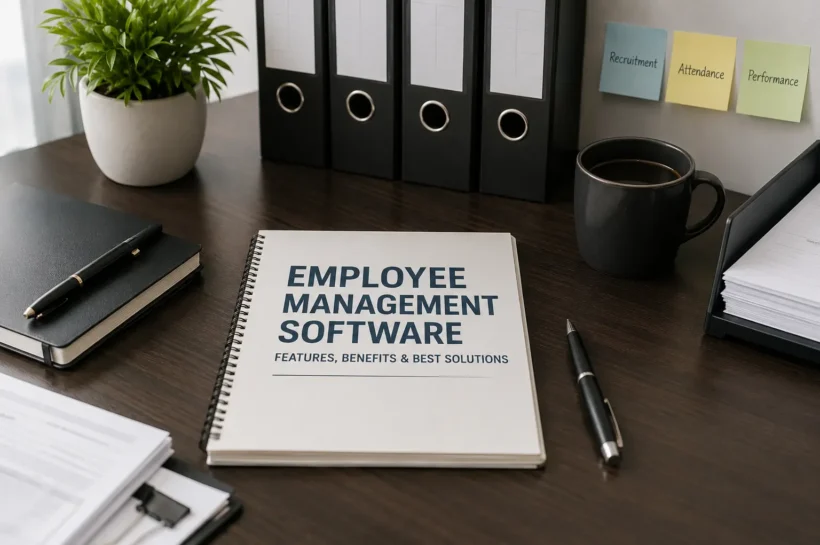

Employee Management Software: Features, Benefits & Best Solutions
Modern workplaces are evolving faster than ever. Teams are no longer confined to a single office, employees expect seamless digital experiences, and businesses must manage an increasing amount of workforce data. In this environment, relying on spreadsheets, manual paperwork, or disconnected systems often leads to inefficiencies that slow growth.
Employee management software has emerged as a practical solution for organizations looking to streamline operations and create a more productive workplace. From tracking attendance to managing employee records and evaluating performance, these platforms help businesses centralize critical workforce functions in one place.
Whether you run a startup with ten employees or a growing enterprise with hundreds of team members, the right employee management software can significantly improve how your organization operates.
What Is Employee Management Software?
Employee management software is a digital platform designed to help organizations manage various aspects of the employee lifecycle. It enables businesses to handle workforce-related tasks through a centralized system rather than relying on manual processes.
These solutions typically store employee information, automate administrative tasks, and provide managers with real-time visibility into workforce activities. Instead of maintaining separate systems for attendance, leave requests, payroll, and performance reviews, organizations can manage everything through a unified platform.
At its core, employee management software reduces administrative complexity while helping organizations improve efficiency, compliance, and employee engagement.
How Employee Management Software Works
Employee management systems operate by collecting, organizing, and processing workforce data within a single digital environment.
When an employee joins a company, their information is added to the system. Throughout their employment journey, the platform continuously records important data such as attendance, leave balances, performance evaluations, training records, and payroll information.
Managers can access dashboards that provide insights into workforce performance, attendance trends, productivity levels, and team availability. Employees, on the other hand, often use self-service portals to update personal information, request leave, access company documents, or review payslips.
Most modern platforms are cloud-based, allowing employees and managers to access information securely from virtually anywhere. This flexibility has become increasingly important as remote and hybrid work models continue to expand.
Why Modern Businesses Need Employee Management Software
Managing a growing workforce manually can quickly become overwhelming. Even organizations with relatively small teams often struggle with fragmented processes, duplicate records, and time-consuming administrative tasks.
Employee management software addresses these challenges by introducing automation and standardization across everyday operations.
For example, instead of manually calculating attendance records every month, businesses can automate time tracking and instantly generate reports. Similarly, leave requests no longer require lengthy email chains because employees can submit requests digitally, while managers can approve them with a few clicks.
Beyond efficiency, these platforms also improve transparency. Employees gain visibility into their schedules, leave balances, and performance objectives, while managers receive accurate data to support decision-making.
Organizations that embrace digital workforce management are often better positioned to scale operations, maintain compliance, and deliver a positive employee experience.
Key Features of Employee Management Software
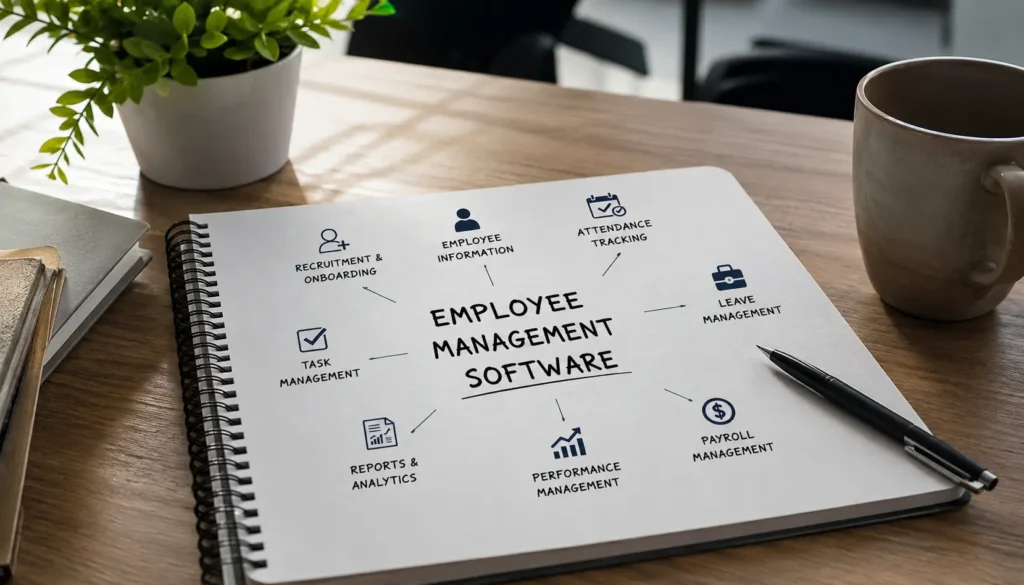
The capabilities offered by employee management software vary across vendors, but several core features are considered essential for most businesses.
Employee Database Management
A centralized employee database serves as the foundation of any employee management system. It stores essential information, including contact details, employment history, job roles, compensation records, and important documentation.
Having a single source of truth eliminates inconsistencies and ensures that HR teams can quickly access accurate employee information whenever needed.
Attendance and Time Tracking
Attendance management remains one of the most widely used features. Modern platforms can track working hours, shifts, overtime, and absenteeism automatically.
Many systems integrate with biometric devices, mobile applications, or digital timesheets, reducing manual errors while improving accuracy.
Leave and Absence Management
Managing employee leave manually often creates confusion and administrative overhead. Employee management software simplifies the process by allowing employees to submit leave requests electronically.
Managers can review requests, approve absences, and monitor leave balances in real time, ensuring smoother workforce planning.
Payroll Management
Payroll processing requires precision. Even minor mistakes can negatively affect employee trust and organizational compliance.
Many employee management platforms either include payroll functionality or integrate with payroll systems to automate salary calculations, tax deductions, bonuses, and reimbursements.
Employee Scheduling
Businesses operating with multiple shifts or distributed teams often depend on scheduling features to allocate resources effectively.
Managers can create work schedules, assign shifts, and make adjustments quickly while ensuring adequate staffing levels across departments.
Performance Management and Reviews
Performance management tools help organizations establish goals, conduct evaluations, track progress, and provide continuous feedback.
Rather than relying solely on annual reviews, modern systems support ongoing performance conversations that encourage employee development and improve engagement.
Additional Features Found in Modern Employee Management Software
As workplace expectations continue to evolve, employee management software vendors are expanding their capabilities beyond basic HR administration. Modern platforms increasingly include tools designed to improve collaboration, engagement, and strategic decision-making.
Document Management
Organizations generate a significant amount of employee-related documentation, from employment contracts and policy acknowledgments to training certificates and appraisal records.
Employee management software centralizes these documents in a secure digital repository. HR teams can upload, organize, and retrieve files quickly, eliminating the need for physical storage and reducing the risk of misplaced records.
Digital document management also improves accessibility, allowing authorized employees to access important information whenever necessary.
Employee Self-Service Portal
Self-service functionality has become an essential feature in modern workforce management systems.
Instead of contacting HR for routine requests, employees can independently update personal details, review attendance records, download payslips, submit leave requests, and access company policies through a dedicated portal.
This level of autonomy not only saves administrative time but also creates a more transparent and satisfying employee experience.
Reporting and Analytics
Data-driven decision-making is increasingly important in today’s competitive business environment.
Employee management software generates detailed reports that help organizations monitor workforce trends, identify performance gaps, evaluate absenteeism patterns, and forecast future staffing requirements.
These insights allow leaders to make informed strategic decisions rather than relying solely on assumptions or outdated information.
Benefits of Using Employee Management Software
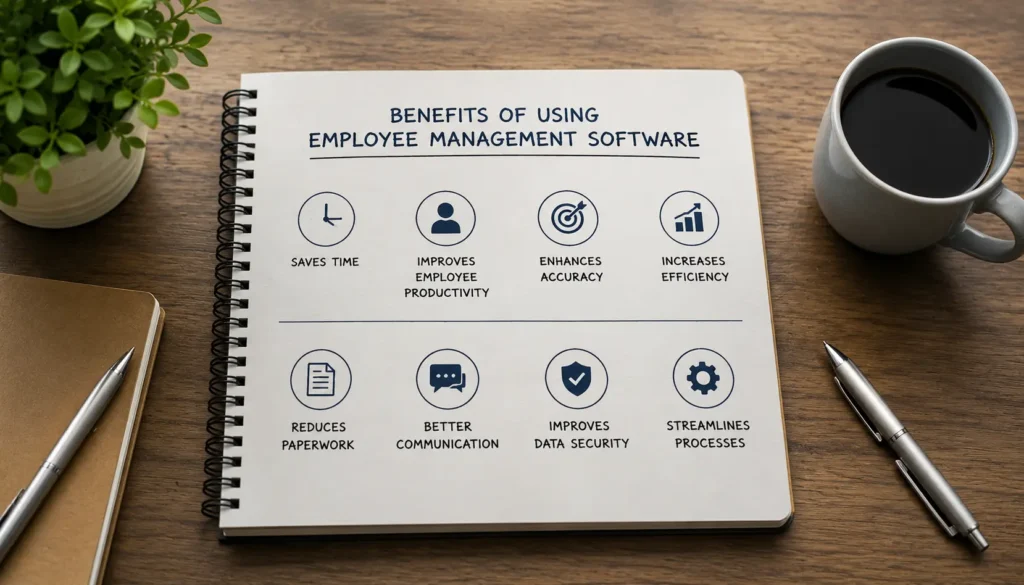
Implementing employee management software can transform how organizations operate daily. While the exact benefits vary depending on company size and industry, several advantages are consistently reported across businesses.
Streamlines HR Processes
Manual administrative tasks consume a considerable amount of time. Activities such as attendance tracking, leave approvals, and record management often require repetitive effort.
Automation significantly reduces this workload, enabling HR professionals to focus on higher-value initiatives such as employee development, culture building, and talent retention.
Saves Time and Reduces Manual Work
Automation minimizes the need for repetitive data entry and paperwork. Tasks that previously required hours can often be completed within minutes.
This efficiency becomes especially valuable for growing organizations where administrative demands increase alongside workforce expansion.
Improves Employee Productivity
When employees have immediate access to schedules, policies, and work-related information, they spend less time dealing with administrative barriers.
Managers also gain better visibility into workloads and performance, enabling them to allocate resources more effectively and support team productivity.
Enhances Workforce Communication
Many employee management systems include communication features that facilitate announcements, updates, and internal collaboration.
Clear communication reduces misunderstandings, improves alignment, and ensures employees remain informed regardless of their location.
Reduces Human Errors
Manual processes are susceptible to mistakes, particularly when handling payroll calculations, attendance records, or employee data.
Automation helps maintain accuracy, reducing costly errors while improving trust and consistency across organizational processes.
Ensures Compliance With Labor Regulations
Employment regulations are constantly evolving across industries and regions. Failing to comply with labor laws can expose businesses to significant financial and legal risks.
Employee management software helps organizations maintain accurate records, monitor working hours, and generate audit-ready documentation, supporting ongoing compliance efforts.
Supports Data-Driven Decision-Making
Workforce data provides valuable insights into employee performance, retention trends, and operational efficiency.
By analyzing this information, business leaders can identify opportunities for improvement, optimize workforce planning, and make strategic decisions that support long-term growth.
🌟Learn More: Tech Strategies for Productivity
Who Should Use Employee Management Software?
Although employee management software was once associated primarily with large enterprises, today’s cloud-based solutions make it accessible to organizations of all sizes.
Small Businesses
Small businesses often operate with limited administrative resources. Employee management software enables them to automate essential tasks without requiring a dedicated HR department.
This allows business owners to spend more time focusing on growth rather than administrative responsibilities.
Medium-Sized Companies
As organizations expand, managing employee information manually becomes increasingly challenging.
Medium-sized businesses benefit from centralized workforce management, improved reporting capabilities, and scalable systems that can accommodate future growth.
Large Enterprises
Enterprises managing hundreds or thousands of employees require robust systems capable of handling complex workforce structures.
Advanced employee management platforms support multiple departments, locations, and compliance requirements while delivering comprehensive analytics.
Remote and Hybrid Teams
Distributed workforces depend heavily on digital infrastructure.
Employee management software enables remote teams to access information, submit requests, track attendance, and communicate effectively regardless of geographic location.
HR Departments and Managers
HR professionals and team leaders rely on accurate workforce data to make informed decisions.
Employee management software simplifies daily operations while providing managers with real-time visibility into employee performance, attendance, and engagement.
Different Types of Employee Management Software
Organizations should understand the available deployment models before selecting a solution.
Cloud-Based Employee Management Software
Cloud-based platforms are hosted online and accessed through web browsers or mobile applications.
These solutions typically require minimal infrastructure, offer automatic updates, and provide greater flexibility for remote and hybrid work environments.
On-Premise Employee Management Systems
On-premise software is installed directly on an organization’s internal servers.
Some businesses prefer this model because it offers greater control over data and infrastructure, although it often requires higher upfront investment and ongoing maintenance.
Industry-Specific Employee Management Solutions
Certain industries, such as healthcare, manufacturing, hospitality, and retail, have unique workforce requirements.
Industry-specific solutions include specialized features designed to address sector-specific operational challenges.
All-in-One HR Management Platforms
Many organizations choose comprehensive platforms that combine employee management, payroll, recruitment, onboarding, and performance management within a single ecosystem.
These integrated solutions help eliminate data silos while creating a more seamless employee experience.
How to Pick the Best Employee Management Software
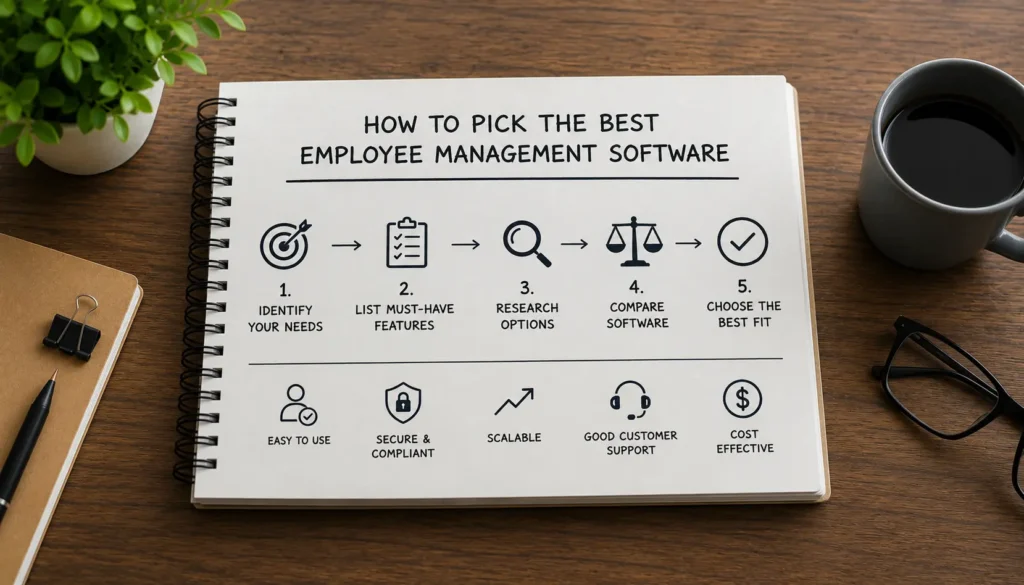
Selecting the right employee management software requires more than simply comparing features. Organizations should evaluate their current challenges, long-term goals, and operational requirements before making a decision.
Identify Your Business Needs
Every organization manages employees differently. A startup with a small workforce may prioritize attendance tracking and payroll automation, while larger enterprises may require advanced analytics, performance management, and compliance capabilities.
Clearly defining business requirements helps narrow down available options and prevents unnecessary spending on features that may never be used.
Evaluate Essential Features
Not every platform offers the same functionality. Businesses should assess whether the software supports critical processes such as attendance management, leave administration, employee records, reporting, and performance evaluations.
Choosing software that aligns with daily operational needs ensures higher adoption rates and greater return on investment.
Consider Scalability
Business growth often brings additional workforce complexities. Investing in a scalable platform ensures the system can accommodate increasing employee numbers, multiple departments, and evolving business requirements without requiring a complete replacement.
Check Integration Capabilities
Organizations frequently rely on multiple business applications, including payroll systems, accounting software, communication tools, and project management platforms.
Seamless integrations eliminate data silos, improve workflow efficiency, and reduce duplicate data entry across systems.
Review Security and Compliance Standards
Employee management software stores sensitive workforce information, making security a top priority.
Businesses should evaluate data encryption standards, access controls, backup procedures, and compliance certifications before selecting a provider. Strong security measures help protect confidential employee information while reducing organizational risk.
Compare Pricing and Overall Value
Price should never be the only deciding factor.
Organizations should assess overall value by considering available features, implementation costs, customer support quality, scalability, and long-term benefits. In many cases, investing in a reliable platform delivers substantial operational savings over time.
🌟Learn More: AI Decision Intelligence
Top Employee Management Software Solutions
Numerous employee management solutions are available in today’s market. The following platforms consistently rank among the most widely adopted options by businesses worldwide.
BambooHR
BambooHR is popular among small and medium-sized businesses due to its intuitive interface and comprehensive HR capabilities. The platform offers employee record management, onboarding, performance tracking, and reporting features within a user-friendly environment.
Workday
Workday is designed primarily for medium and large enterprises. It provides advanced workforce management, analytics, talent management, and financial management capabilities, making it suitable for organizations with complex operational requirements.
Zoho People
Zoho People delivers a flexible and affordable employee management solution for growing businesses. Its features include attendance management, leave tracking, employee self-service, and performance management.
ADP Workforce Now
ADP Workforce Now combines HR management, payroll processing, benefits administration, and compliance support in a unified platform. It is widely used by organizations seeking a comprehensive workforce management solution.
Rippling
Rippling distinguishes itself through extensive automation capabilities and seamless integrations. Businesses can manage employees, payroll, devices, and applications through a single centralized platform.
UKG Pro
UKG Pro offers advanced workforce management tools designed for larger organizations. The platform emphasizes employee experience, talent development, and workforce analytics.
Gusto
Gusto is particularly attractive to small businesses seeking straightforward payroll and employee management capabilities. Its simplicity and modern interface make workforce administration significantly easier.
Employee Management Software vs. HR Software
Although these terms are often used interchangeably, they are not always identical.
Employee management software primarily focuses on managing day-to-day workforce activities such as attendance, scheduling, leave management, and performance tracking.
HR software, on the other hand, typically encompasses broader human resource functions, including recruitment, onboarding, benefits administration, compliance management, and talent acquisition.
Many modern platforms now combine both capabilities, creating comprehensive human resource management ecosystems that support the entire employee lifecycle.
Common Challenges Businesses Face Without Employee Management Software
Organizations that continue relying on manual processes frequently encounter operational inefficiencies.
Administrative tasks become increasingly time-consuming as the workforce size expands. Attendance records may contain errors, employee information can become fragmented, and communication gaps often emerge across departments.
Limited workforce visibility also makes it difficult for managers to evaluate productivity, identify performance issues, or forecast staffing requirements accurately.
Additionally, maintaining compliance through manual recordkeeping can expose businesses to significant legal and financial risks. As organizations grow, these challenges typically intensify, making digital workforce management increasingly essential.
Future Trends in Employee Management Software
The future of employee management software is being shaped by rapid technological innovation.
Artificial intelligence is expected to play a larger role in automating routine tasks, generating workforce insights, and supporting data-driven decision-making. Predictive analytics will enable organizations to anticipate turnover risks, optimize staffing levels, and improve workforce planning.
Automation will continue streamlining repetitive administrative processes, allowing HR professionals to dedicate more time to strategic initiatives.
Mobile-first experiences are also becoming increasingly important as employees expect access to workplace tools from any location and device.
Furthermore, deeper integration with collaboration platforms, communication tools, and productivity applications will create more connected digital workplaces.
Conclusion
Employee management software has evolved from a convenience into a business necessity. As organizations face increasing workforce complexity, manual processes often struggle to keep pace with operational demands.
By centralizing employee data, automating administrative tasks, and providing valuable workforce insights, these platforms help businesses improve efficiency, strengthen compliance, and enhance employee experiences.
The ideal solution ultimately depends on an organization’s unique requirements, workforce size, and long-term objectives. Businesses that carefully evaluate their needs and invest in scalable technology are better positioned to build productive, agile, and future-ready workplaces.
FAQs
What is employee management software used for?
Employee management software is used to manage workforce-related activities such as attendance tracking, leave management, employee records, scheduling, payroll, and performance monitoring.
Is employee management software suitable for small businesses?
Yes. Many modern solutions are specifically designed for small businesses and provide affordable tools that automate administrative tasks while improving efficiency.
How much does employee management software cost?
Pricing varies depending on features, deployment model, and company size. Some platforms charge per employee per month, while enterprise solutions often use custom pricing models.
Can employee management software integrate with payroll systems?
Most modern employee management platforms support integrations with payroll, accounting, communication, and productivity applications to streamline workflows.
What is the difference between employee management software and HRMS?
Employee management software primarily focuses on workforce administration, whereas an HRMS typically provides broader human resource capabilities, including recruitment, onboarding, benefits management, and compliance support.
📢 You don’t need more content, you need better content. Follow Tech Statar.