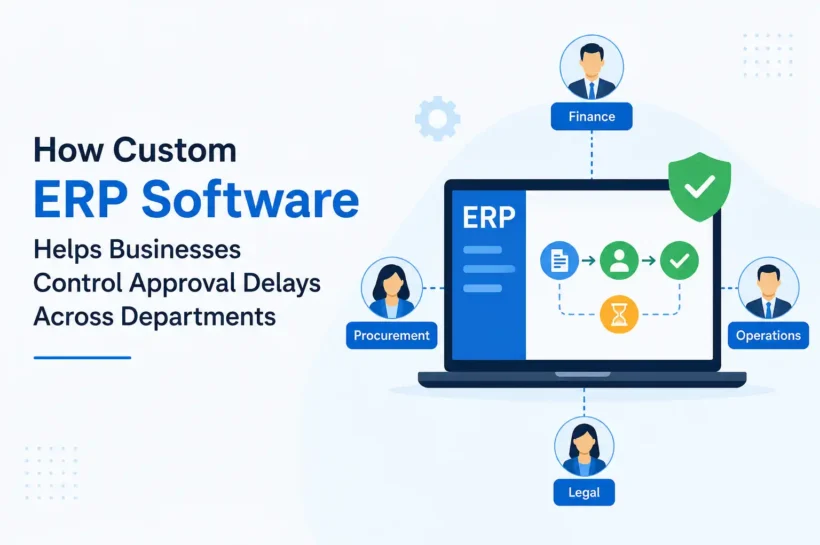

How Custom ERP Software Helps Businesses Control Approval Delays Across Departments
Most businesses chasing faster approvals invest in better software notifications, reminders, and shorter routing chains. The delays return within months. The reason is almost never the software. It is the authority structure underneath it: unresolved, undocumented, and invisible to every workflow tool deployed on top of it.
Businesses evaluating custom ERP development services are not shopping for automation. They are making a structural decision about how organizational authority gets encoded into their systems. Get the structure wrong, and no ERP will rescue the approval cycle from the dysfunction already embedded in the organization.
The Real Reason Approvals Stall: It’s Not the Process, It’s the Power Structure
Every delayed approval gets diagnosed the same way: the workflow needs fixing, the reminder cadence is off, or the right module hasn’t been configured. These diagnoses are wrong not occasionally, but systematically.
Approval bottlenecks are not process failures. They are authority failures. That distinction determines whether an ERP investment solves the problem or repackages it digitally.
Most organizations run two org charts. The first is formal, documented, and regularly ignored under pressure. The second is functional the informal map of who actually controls decisions and whose silence functions as a veto. No off-the-shelf ERP reads the second chart.
The most damaging misconception: automate the approval chain and you accelerate it. Automation applied to an undefined authority structure accelerates nothing. It digitizes the dysfunction and gives it a timestamp. Custom ERP must be architected around the organization’s real decision-rights map, not the hierarchy on a slide deck, but the one governing how authority is actually exercised daily.
Why Departments Protect Approval Authority (And Why Software Ignores This)
Departments treat sign-off control as organizational influence and defend it accordingly a predictable response where decision-making power was never formally distributed. Three structural failure patterns appear repeatedly, and none feature in standard ERP conversations:
Ownership ambiguity: no documented agreement exists on which role approves which request at which threshold. A vendor onboarding request may belong to procurement, but finance expects visibility and legal believes it holds veto authority. The request stalls because everyone holds partial authority and no one holds complete authority.
Authority hoarding: senior managers become default approvers for nearly everything, not because policy requires it, but because delegation was never formalized. The system was never designed to route around them for decisions that don’t require their oversight.
Escalation avoidance approvers delay cross-departmental decisions to avoid owning outcomes touching another team’s budget or headcount. Sitting on an approval becomes a risk management strategy.
These structural realities do not disappear when a new platform goes live.
🎯 More Helpful Guides: Best Resume Builders for Custom Layout and Personal Branding Online
When ERP Arrives Without a Decision-Rights Audit
Deploying ERP on top of unresolved authority conflicts makes the confusion permanent. A procurement workflow routed to three senior stakeholders, not because policy requires it, but because no one agreed pre-deployment on ownership, gets enforced indefinitely by the system.
Implementation teams focus on technical workflow mapping. Almost none conduct an organizational authority mapping exercise. Skipping it is why many businesses still report approval delays eighteen months after go-live.
Why Off-the-Shelf ERP Cannot Solve a Structural Problem
Generic ERP platforms assume the business has already resolved its approval hierarchies and simply needs a system to execute them. That assumption fails in most real-world deployments.
Off-the-shelf systems offer surface-level configuration thresholds, role assignments, and notification rules. What they cannot encode is contextual authority logic: organization-specific rules governing who approves what when a request crosses departmental boundaries or hits a threshold that shifts decision ownership to the executive level.
Businesses map existing workflows into available parameters, then discover those parameters were never designed for the organizational complexity underneath. The system routes approvals within its assigned lanes and stalls precisely at cross-departmental intersections where real delays have always lived.
What is required is a system built from ground-up knowledge of how a specific business distributes authority something only purpose-built custom ERP software solutions India providers deliver when the engagement begins with organizational discovery, not a software demonstration.
What Custom ERP Does Differently: Building the System Around Your Authority Map
The differentiating work begins before any technology is selected with a decision-rights audit documenting which role, department, and seniority level holds legitimate approval authority for each request type, at each threshold, across every department in cross-functional workflows.
That audit becomes the blueprint the workflow engine is built against, not a generic hierarchy, but a conditional logic structure reflecting how this organization has decided to distribute authority.
Dynamic routing becomes genuinely intelligent. A capital expenditure above a defined threshold routes directly to the CFO because the authority map specifies ownership transfers at that value. A recurring vendor payment below threshold routes to accounts payable and closes without escalation. Requests stop sitting with the wrong person. They stop sitting with no one. This is what separates mature custom ERP development services from workflow automation layered over organizational ambiguity.
Designing for Delegation Without Losing Control
If the system delegates authority downward, how does senior leadership maintain oversight? Custom ERP handles this through tiered delegation logic. Routine approvals route automatically to designated department-level approvers. Escalation occurs only when a threshold is crossed or an exception triggers and arrives with full context: request detail, routing history, and the downstream impact of further delay.
Senior leaders approve fewer requests, but each one is genuinely theirs to own. This eliminates approver fatigue the pattern where overburdened managers rubber-stamp everything reflexively because volume has made genuine review impossible.
🎯 More Helpful Guides: Business Process Monitoring Guide for Businesses in 2026
The Business Case: What Changes When Authority and Software Are Finally Aligned
Approval cycles compress when requests reach the correct authority level on the first routing attempt, eliminating re-routing, clarification requests, and misdirected queue transfers.
Audit trails gain operational meaning. The system records which authority level exercised each approval and whether escalation logic triggered, making compliance reviews retrievable in minutes rather than hours of manual reconstruction.
Leadership gains a live view of where authority conflicts create bottlenecks. When a request category consistently escalates beyond its intended level, the pattern surfaces in data and drives an organizational decision, not another software reconfiguration.
Institutional knowledge becomes systemic. Decision rights previously held informally by long-tenured managers are codified in the platform. New managers inherit a functioning authority structure immediately rather than spending months decoding undocumented norms.
For organizations evaluating custom ERP software solutions India, this is the business case generic ERP vendors cannot make because it begins with the organization, not the product.
Industries Where This Matters Most
Manufacturing faces procurement and production approvals crossing operational and financial authority lines daily. Healthcare administration routes vendor and staffing approvals through parallel clinical and non-clinical structures with no formal protocol at their intersection. Real estate and construction approvals span legal, finance, and site operations simultaneously, with authority shifting by project phase. Retail and distribution pricing and supplier approvals sit at the intersection of commercial and supply chain authority two departments with competing incentives and overlapping decision rights.
Stop Automating the Problem. Start Engineering the Solution.
Approval delays survive ERP deployments because most implementations treat the symptom while the structural cause goes untouched. Authority ambiguity doesn’t disappear when a new platform goes live it gets encoded into it.
Arobit builds custom ERP software solutions starting where most vendors stop with a rigorous audit of how your organization actually distributes decision-making authority. That diagnostic foundation is what makes the technology work. If your business is ready to eliminate the structural source of approval delays, Arobit’s custom ERP development services are built precisely for that problem.
Frequently Asked Questions
If approval delays are a structural problem, why haven’t internal process reviews fixed them?
Process reviews produce documentation, revised SOPs, updated org charts, rewritten policies. What they cannot do is enforce that authority structure at every transaction point, in real time, across every department. Custom ERP converts paper-level agreements into executable system logic, removing the human discretion that allows ambiguity to persist long after it has been resolved on paper.
How is a decision-rights audit different from the workflow mapping our ERP vendor conducted?
Workflow mapping documents what currently happens. A decision-rights audit documents what should happen, which role holds authority for each request type, and at which threshold ownership transfers upward. The first describes existing dysfunction. The second resolves the authority questions the first never asks. Custom ERP encodes the resolution, not the dysfunction.
Can custom ERP accommodate authority structures that change as the business grows?
Yes. A well-designed custom ERP separates the business logic layer from the application layer, meaning authority rules, thresholds, and escalation conditions can be updated by authorized administrators without code-level intervention. Restructuring a department or revising approval thresholds becomes a governed configuration update, not a new implementation engagement.
How long before a custom ERP deployment actually reduces approval delays?
Organizations entering the build phase with clearly resolved authority agreements typically see measurable reduction in approval cycle times within the first operational quarter post-deployment. Organizations that treat the decision-rights audit as a formality carry unresolved conflicts into the build and experience the same delays on a newer platform. The technology delivers what the organizational groundwork makes possible no faster.
✨ If this made sense, wait till you see what’s next. Follow Tech Statar.