
Litero AI: Academic Research Tool or Just Another AI Writer? (2026 Review)
AI writing tools no longer stop at generating a paragraph from a prompt. Some are now built around the entire research and writing process, from finding sources to refining the final draft.
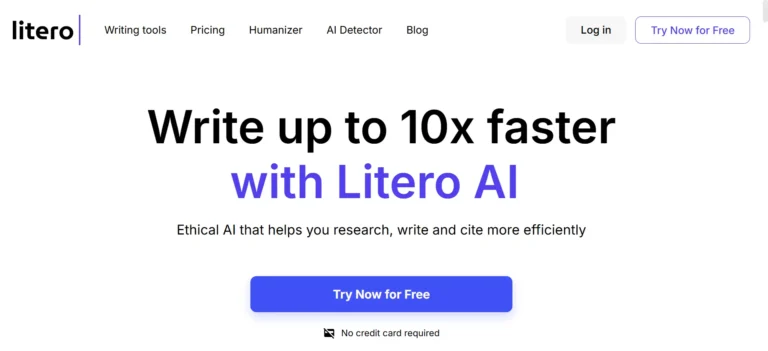
Litero AI takes that more specialized approach. It presents itself as a source-based writing partner that helps users research, structure, write, cite, and review content while keeping the human writer in control. Its main audience includes students and researchers, but Litero also markets the platform to educators, content creators, and business professionals.
That makes Litero more interesting than a simple AI essay generator. The real question is how useful its research-focused workflow is, what the platform actually includes, and where users still need to do the work themselves.
What Is Litero AI?
Litero AI is a browser-based AI writing and research platform designed around source-based, author-driven writing. Its current toolset includes an outline builder, AI autosuggest, citation tools, an AI companion, an AI detector, a plagiarism checker, and several text-polishing features.
The product is especially relevant to academic and research-heavy writing because Litero integrates source discovery and citation into its writing workflow. Its own site describes access to sources associated with scholarly libraries and identifies JSTOR, Google Scholar, and DOI among the sources represented in its academic-source workflow.
This is the important distinction:
Litero is built around writing with evidence, rather than simply asking an AI model to produce an answer.
Who Is Litero AI For?
Students can use Litero for assignments, essays, research, outlining, citations, and revision.
Researchers can use its source and document-focused features when developing research-based writing.
Educators may use the platform for feedback and responsible-AI workflows. A 2025 education-focused guide also explored Litero from the perspective of teaching, research, feedback, and student learning, although that guide should be treated as an independent educational perspective rather than current product documentation.
Litero also markets its tools to content creators and business professionals who need help with research, routine writing, clarity, tone, and rewriting.
There is, however, an important detail for professional users: Litero’s current marketing pages mention business professionals, while its Terms and Conditions say the service must be used for personal, non-commercial purposes unless otherwise agreed. Anyone planning commercial use should therefore check the current terms or obtain clarification from Litero before relying on the service for client work.
How Does Litero AI Work?
Litero is easiest to understand as a workflow rather than a collection of isolated AI features.
Start With a Topic or Existing Draft
A user can begin with a new writing project or work on existing material. The platform is designed to provide suggestions and assistance while the user remains responsible for shaping the final document.
That matters because the product is intentionally positioned as an assistant rather than a system that should independently produce and submit finished academic work.
Build an Outline Before Writing
Litero’s Outline Builder can suggest a structure that the writer can customize. The purpose is straightforward: turn a broad subject into a workable plan before drafting begins.
For research-heavy writing, this can prevent a common problem… collecting sources before deciding what the paper is actually trying to explain.
Find Sources and Add Citations
Litero’s citation workflow is designed to surface relevant sources and help format citations. Its current site says the citation tool scans more than 100 million sources from legitimate libraries, while other Litero pages describe its academic source access as 10M+ sources. Because the numbers are presented inconsistently across the company’s own pages, the exact figure should be treated as a vendor-reported number rather than a fixed independent benchmark.
More importantly, Litero itself tells users to review their sources. A citation being automatically generated does not mean the source actually proves the statement being cited.
Develop the Draft With AI Assistance
AI Autosuggest is designed to help with the next sentence or idea, while other writing tools can assist with drafting and restructuring. Litero describes this as a way to overcome writer’s block and support the writing process rather than replace it.
That approach is particularly useful when the writer has the underlying idea but needs help moving from one section to the next.
Review, Polish, and Check the Document
Once the main draft exists, Litero’s workflow moves into refinement. Users can work on grammar, punctuation, rewording, paraphrasing, originality checks, and AI-content detection. The platform also includes an AI Companion for feedback and an export function for finished documents.
The result is a workflow that looks more like:
research → outline → draft → cite → refine → review
rather than:
prompt → generated article
What Can You Do With Litero AI?
Write Essays and Coursework
For academic assignments, Litero can help organize a topic, develop an outline, find supporting sources, draft sections, and clean up language.
The real advantage isn’t text generation itself. That’s a capability most modern AI tools already offer. The more relevant benefit is that Litero puts research and writing into the same environment.
Students still need to understand the assignment, develop the argument, verify sources, and follow their institution’s AI rules. Litero’s own responsible-AI guidance explicitly places authorship and final editorial control with the user.
Work on Research Papers
Research papers require more than fluent writing. They require evidence that can withstand scrutiny.
Litero’s source finder and citation tools are therefore more relevant here than its basic generation features. Its citation product is designed to suggest academic sources, format references, and help users organize citations within common styles such as APA, MLA, and Harvard.
The limitation is simple: source discovery is not source evaluation.
A writer still needs to open the paper, understand the evidence, check publication details, and decide whether it supports the argument.
Improve Existing Writing
Litero can also be used without generating a document from scratch.
Its text-polishing tools are designed for rewriting, paraphrasing, grammar, punctuation, and stylistic improvements.
It is particularly useful when the thinking is already done, but the writing needs more clarity, flow, or precision.
Support Teaching and Learning
The educational use case goes beyond generating essays.
The 2025 Ebed-Melech guide describes using Litero in teaching and learning around research, writing, feedback, and responsible AI use. Because the guide predates the current product pages, its recommendations should be considered historical context rather than a definitive description of every current feature.
For educators, the more meaningful application is teaching students to research, verify, revise, and think critically with AI, rather than simply generating text.
🌟 Expand Your Knowledge: 7 Document Detection Tools You Should Try in 2026
Litero AI Features Explained
Outline Builder
The Outline Builder creates a starting structure for a document and allows the writer to customize it. Litero positions it as a planning tool for future research and content creation.
Its value depends on what happens after the outline is generated. A generic outline is easy to produce; a useful outline needs to reflect the actual question, evidence, and argument.
AI Autosuggest
AI Autosuggest provides context-aware suggestions for the next sentence or idea. Litero specifically presents it as a way to overcome writer’s block.
Used carefully, it can keep the writing moving without forcing the user to hand over the entire document to AI.
Citation Tool
The citation tool is one of Litero’s defining features. It can suggest relevant academic sources and format references according to different citation styles.
This saves mechanical work, but it should not change the writer’s research habits. The source still matters more than the generated citation.
AI Companion
Litero’s AI Companion provides feedback on writing and suggestions for improvement.
This makes it closer to an editorial assistant than a simple text generator. Instead of asking for a complete document, users can ask for help at specific points in the writing process.
Grammar, Style, Paraphrasing, and Rewording
These features focus on expression rather than research.
They can help simplify awkward sentences, correct errors, improve clarity, or rephrase existing text. That is useful when the writer already understands the subject and needs help making the language more readable.
Plagiarism Checker
Litero includes a plagiarism checker intended to identify accidental similarities so users can investigate and revise them.
It should be treated as a review mechanism, not a guarantee that a paper is original or compliant with an institution’s rules.
AI Detector
The AI Detector highlights text that Litero believes may have been AI-generated.
That result should be interpreted cautiously. A detector’s output is not the same thing as proof of authorship, and it should not be treated as an automatic academic-integrity verdict.
Is Litero AI Free?
Litero currently has a free plan and a paid plan.
The free tier includes limited daily AI output, while Litero lists unlimited source finding and citation formatting, an AI Companion, and an AI Detector among the included features. The paid plan currently starts at $7.90 per month when billed annually and adds unlimited AI output, unlimited outlining and drafting, the text humanizer, plagiarism checking, and unlimited built-in ChatGPT.
| Plan | Current pricing | Main access |
| Free | $0/month | Limited AI output, source finder, citation tools, AI Companion, AI Detector |
| Paid | From $7.90/month billed annually | Unlimited AI output and drafting plus additional premium tools |
Pricing is subject to change, so verify the latest plan details on Litero’s official pricing page before subscribing. Litero also states that subscriptions auto-renew and that users can cancel them; its refund policy currently provides a 30-day money-back guarantee for new subscribers subject to stated conditions.
Litero AI vs. ChatGPT: What Is Actually Different?
The useful comparison is not which product has “better AI.” It is what each product is designed to help you do.
Litero positions itself as a source-based writing partner, while ChatGPT is a general-purpose AI assistant. Litero’s own comparison emphasizes built-in academic sources, citation formatting, draft scaffolding, text autosuggest, and writing-quality assessment as parts of its workflow.
| Capability | Litero AI | ChatGPT |
| Main focus | Source-based writing | General-purpose AI assistance |
| Academic source workflow | Built into the product | Not the central product workflow |
| Citation formatting | Integrated | Typically requires a separate workflow |
| Outline support | Built into writing workflow | Available through prompting |
| Section-by-section writing | Core product concept | Possible through conversation |
| AI detector/plagiarism tools | Included in Litero’s toolset | Not its core workflow |
| General-purpose tasks | More specialized | Broader |
| Main fit | Research-backed writing | Broad AI assistance |
The important takeaway is that these products can solve overlapping problems without being built around the same workflow.
When a General AI Assistant May Make More Sense
A general-purpose assistant is more flexible when writing is only one part of the job.
For example, someone may want to move between brainstorming, coding, data analysis, research questions, planning, and writing without changing environments.
When Litero’s Specialized Workflow May Be More Useful
Litero makes more sense when the main task is structured writing that depends on sources, citations, outlines, document revision, and academic-style workflows.
The decision should therefore be based on the work you actually need to do, not simply the number of features listed on a pricing page.
Is Litero AI Safe and Appropriate for Academic Writing?
A writing tool can be technically useful and still be inappropriate for a particular assignment.
How Litero Approaches Academic Integrity
Litero explicitly says users should remain the primary authors of their work and describes AI as a collaborator or thought partner rather than a replacement for critical thinking. It also tells users to follow the policies of their institution or publication.
That is important because academic AI policies are not universal. What is acceptable for brainstorming or grammar correction at one institution may be restricted elsewhere.
Should You Trust Every Source or Citation It Suggests?
No.
Even a correctly formatted citation can support the wrong statement.
The sensible workflow is to open the source, read the relevant material, and confirm that it actually supports the claim before including it in important work.
What Do the Plagiarism Checker and AI Detector Actually Tell You?
They address different problems.
A plagiarism checker looks for potential text overlap. An AI detector attempts to identify text that may have been generated by AI.
Neither tool establishes the complete story of authorship on its own. Their results should be treated as signals for further review rather than absolute proof.
What Does Litero Say About User Data?
Litero’s privacy policy contains an important distinction.
The company says it does not use user data to train or retrain its AI models. At the same time, it says it may collect and analyze user interactions, session recordings, uploaded or created content, and other usage data for internal research, product development, and quality assurance.
For ordinary writing, this may be a manageable consideration. For confidential client documents, unpublished research, sensitive business material, or proprietary information, users should read the current privacy terms carefully before uploading anything.
Litero AI Limitations to Know Before Using It
AI Assistance Does Not Remove the Need to Think
Litero can accelerate parts of writing, but it cannot take responsibility for the argument.
AI-generated text may still contain factual errors, weak reasoning, irrelevant suggestions, or overly generic language. A polished sentence can still express a bad idea.
Source Discovery Is Not the Same as Research
Finding a relevant paper is just the first step.
Good research still requires reading the source, understanding its methodology or argument, checking its date and relevance, and deciding how it fits into the paper.
That is especially important when an AI tool is helping connect sources to claims.
Pricing and Features Can Change
The current pricing and feature set reflect what Litero publishes now, not a permanent product specification. Pricing pages, models, integrations, usage limits, and individual tools can change.
This is particularly relevant for AI products because their feature sets evolve faster than traditional software.
There Is No Dedicated Mobile App Yet
Litero’s current FAQ says there is no dedicated app yet and recommends using the platform on a laptop or desktop computer.
For people who primarily write on mobile devices, this is a practical limitation rather than a minor footnote.
Professional Use Needs a Terms Check
There is also a notable mismatch between product positioning and legal terms.
Litero markets the platform toward business professionals, yet its current Terms and Conditions restrict use to personal, non-commercial purposes unless otherwise agreed.
That does not necessarily mean professional users cannot use the service, but it does mean commercial use should be clarified before using Litero for client work or other revenue-generating activity.
🌟 Expand Your Knowledge: Best AI Tools for Writing Marketing Copy (2026 Guide)
Who Should Consider Litero AI and Who May Need a Different Workflow?
A practical way to evaluate Litero is to start with the task rather than the feature list.
| Situation | What matters most |
| Student writing an essay | Outline, sources, citations, revision |
| Researcher preparing a paper | Source discovery, evidence, document context |
| Educator | Responsible AI use, feedback, authorship |
| Professional writer | Research, editing, clarity, tone |
| General AI user | Broad reasoning and multi-purpose assistance |
| Team or commercial workflow | Collaboration, licensing, and current terms |
A student working on a source-heavy assignment may care most about citation and research integration.
A researcher may care more about finding and working with relevant literature.
A general AI user may prefer a broader assistant that is not centered on academic writing.
And someone using AI for commercial client work should check the current licensing and terms before putting Litero into a production workflow.
Conclusion
Litero AI is best understood as a writing and research workspace with AI built into the process, rather than simply another chatbot that generates text.
Its main differentiator is the combination of source discovery, outlining, drafting assistance, citations, feedback, and text-review tools in one environment. That makes the platform particularly relevant to academic and research-based writing.
But the same workflow does not remove the writer’s responsibility.
Sources still need to be checked. Arguments still need to make sense. Citations still need to support the claims they are attached to. AI detection results still need context, and institutional rules still apply.
There are also practical issues worth checking before subscribing, including current pricing, mobile availability, privacy terms, and the distinction between Litero’s business-focused marketing and its current non-commercial terms.
Used with those limitations in mind, Litero is less interesting as an “AI that writes papers” and more interesting as a tool that helps organize and accelerate the research-to-writing process.
FAQs About Litero AI
What is Litero AI used for?
Litero AI is used for research-based writing, including outlining, drafting, finding academic sources, formatting citations, improving existing text, and reviewing content. Its current product positioning covers students, researchers, educators, content creators, and business professionals.
Is Litero AI free?
Yes. Litero currently offers a free plan with limited daily AI output and access to tools such as source finding, citation formatting, the AI Companion, and the AI Detector. Its paid plan currently starts at $7.90 per month when billed annually.
Can Litero AI write an entire essay or research paper?
Litero provides drafting assistance, but its own guidance positions the platform as a writing partner rather than a replacement for the author. Users remain responsible for the final content, accuracy, sources, and compliance with academic rules.
Does Litero AI provide academic sources and citations?
Yes. Litero offers a source-finding and citation workflow designed for research and academic writing. Its current pages mention academic sources and citation formatting across styles including APA, MLA, and Harvard.
Does Litero AI have a mobile app?
Not currently. Litero’s current FAQ says the company is working on an app and recommends using the platform on a laptop or desktop computer for the best experience.
🎯 Follow Tech Statar for practical insights.