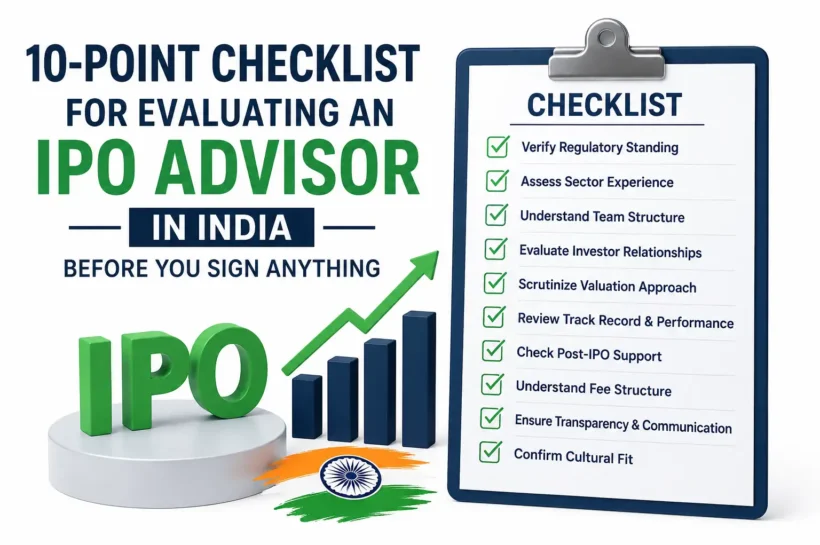

The 10-Point Checklist for Evaluating an IPO Advisor in India Before You Sign Anything
Going public is one of the most consequential decisions a company will make. The process touches every part of the business legal structure, financial reporting, governance, investor communications, and regulatory compliance. Unlike a financing round or a strategic acquisition, an IPO sets a permanent record. What gets disclosed, how it is disclosed, and when the company enters the market all carry long-term consequences that cannot easily be corrected after the fact.
In India, the public listing process is governed by SEBI regulations, stock exchange requirements, and a growing body of procedural expectations that have evolved significantly over the last decade. The advisor a company chooses to guide it through this process is not just a service provider. They shape the preparation timeline, the quality of filings, the credibility of the offering in front of institutional investors, and the company’s ability to sustain compliance requirements after listing.
Many founders and CFOs make this decision based on brand recognition or referrals alone. That approach often leaves critical gaps undetected until the process is already underway. What follows is a structured checklist, not a theoretical framework, but a practical set of questions and criteria that should be applied before any engagement letter is signed.
1. Verify Their Registration and Regulatory Standing
Any firm or individual advising on an IPO in India must operate within the boundaries set by the Securities and Exchange Board of India. SEBI maintains registrations for merchant bankers, which is the category most directly responsible for managing public offerings. Before evaluating anything else, confirm that the advisor holds a valid SEBI merchant banker license and that there are no pending regulatory actions, censures, or suspensions on record.
When companies search for an ipo advisor india, the results include a wide range of firms, some with full merchant banking licenses, others operating as consultants or intermediaries without the same regulatory accountability. Understanding this distinction early prevents misaligned expectations about who is actually responsible for the DRHP, investor interactions, and post-listing obligations.
SEBI’s official website maintains a public registry of registered intermediaries. Cross-checking an advisor’s registration status there takes minutes and eliminates any ambiguity about their standing.
Why Regulatory Standing Affects More Than Compliance
A firm with a clean regulatory record signals internal discipline. SEBI scrutinizes the quality of filings submitted by each merchant banker, and patterns of incomplete or inaccurate DRHPs affect how quickly subsequent filings are reviewed. If an advisor has had filings returned for deficiencies, that history adds time and uncertainty to your own process costs that rarely appear in the initial fee discussion.
🚀 Continue Reading: Office Transformation Trends Shaping the Future of Business Environment
2. Assess Sector-Specific Experience, Not Just Transaction Volume
Total deal count is a common metric used in pitch decks, but it can obscure more than it reveals. An advisor who has managed twenty IPOs in the infrastructure and logistics sector may have limited familiarity with the financial reporting expectations, investor appetite, and valuation benchmarks relevant to a healthcare or technology company. The regulatory pathway may be the same, but the preparation, positioning, and investor engagement are meaningfully different.
How to Test This During Evaluation
Ask the advisor to walk through a recent transaction in your sector not a summary slide, but a discussion of the key challenges encountered during DRHP preparation, how peer comparables were selected, and what investor objections arose during the roadshow. Depth of recall and specificity of answer is a reliable signal of genuine experience versus pattern-matched familiarity.
3. Understand the Full Team Structure Before Committing
Senior advisors are often the face of a pitch, but they are rarely the people doing the day-to-day work on a transaction. In many advisory firms, partners present and close engagements, then hand execution to junior teams with limited supervision. This is not inherently problematic, but it becomes a risk when the experience gap between the presenting partner and the executing team is significant.
What to Clarify in Writing
Request a named team structure with defined roles before signing. Confirm who will attend SEBI meetings, who will prepare the DRHP drafts, and who holds primary responsibility for investor outreach coordination. If the answer is vague or subject to change based on “resourcing,” that warrants further discussion before committing to an exclusive engagement.
4. Evaluate Their Relationships with Institutional Investors
A well-prepared DRHP filed through a technically capable process can still result in a weak IPO if the advisor lacks credible access to quality institutional investors. In India’s public markets, anchor investor participation and QIB subscription levels significantly influence retail sentiment and overall listing performance. The advisor’s network of institutional relationships is therefore a material factor, not a secondary consideration.
How to Assess Network Quality Without Overstating It
Ask for specifics about which domestic mutual funds and foreign institutional investors have participated in their recent transactions, and in what capacity. Be cautious of advisors who frame this in broad terms without being able to name institutions or describe the nature of those relationships. Market participants have reputations, and the quality of investor relationships is often known within a relatively small professional community.
🚀 Continue Reading: The 10 Best B2B Appointment Setting Companies for 2026
5. Scrutinize the Proposed Valuation Methodology
Valuation is one of the most consequential outputs of the pre-IPO process. An inflated valuation may generate short-term enthusiasm but often results in a weak secondary market performance, which damages the company’s credibility with institutional investors for years. An overly conservative valuation, on the other hand, can dilute founder equity unnecessarily and signal a lack of conviction in the business.
What a Rigorous Valuation Process Looks Like
A credible advisor should be able to explain the specific comparable companies used, why they were selected, what adjustments were made for size, growth trajectory, and market position, and how the price band was ultimately determined relative to those benchmarks. According to general market practice and frameworks aligned with SEBI’s guidelines on pricing disclosures, the methodology should be transparent enough to withstand investor scrutiny during the roadshow.
6. Review Their Track Record on Post-Listing Performance
The period immediately following a listing is often where the quality of pre-IPO preparation becomes visible. Companies that were well-prepared tend to meet or beat guidance in the first few quarters. Those that were rushed to market, or whose disclosures were not rigorously stress-tested, often face volatility, analyst skepticism, or compliance gaps that create management distraction at exactly the wrong time.
The Right Questions to Ask About Past Transactions
Rather than focusing only on subscription rates at listing, ask about the one-year performance trajectory of recently listed clients, how many have maintained clean compliance records post-listing, and whether any have encountered regulatory queries or restatements. These data points are harder to obtain but more meaningful than headline listing-day returns.
7. Examine Their Legal and Compliance Coordination Process
An IPO involves multiple legal workstreams running simultaneously DRHP preparation, due diligence, contract reviews, regulatory filings, and exchange submissions. The advisor does not typically manage all of these directly, but they do need to coordinate effectively with legal counsel, auditors, registrars, and other intermediaries. Weak coordination at this level produces inconsistencies in filings, missed deadlines, and regulatory queries that delay the overall process.
Signs of a Well-Coordinated Process
A structured advisor will have a clear process map for how these workstreams are managed, including defined milestones and communication protocols with each intermediary. They should be able to describe how they have handled coordination breakdowns in past transactions and what systems they use to track open items across teams.
🚀 Continue Reading: How Artificial Intelligence Is Accelerating Scientific Discovery
8. Clarify the Fee Structure and What It Actually Covers
Advisory fees for IPO transactions in India vary considerably depending on transaction size, complexity, and firm reputation. The fee itself is less important than understanding exactly what it covers. Some firms quote headline fees that exclude significant components: roadshow logistics, investor relations support, compliance monitoring during the lock-in period, or assistance with SEBI responses.
Common Areas Where Scope Ambiguity Creates Problems
– Post-filing SEBI query responses, which can require substantial rework of disclosures and financial presentations
– Roadshow preparation and execution, including management coaching and investor meeting coordination
– Anchor investor negotiations, which require dedicated time and relationship management
– Stabilization support and communication during the subscription period
– Post-listing compliance briefings and reporting guidance for newly public company management teams
Ensure that each of these is addressed explicitly in the engagement letter, with clarity on whether they are included, billed separately, or handled by another party.
9. Assess Their Capacity at the Time of Your Transaction
A firm that has handled numerous successful transactions can still deliver a poor experience if they are simultaneously managing too many mandates. Senior attention is a finite resource, and during peak market windows, advisory firms often take on more work than their teams can execute thoroughly. This is one of the least-discussed risks in the advisor selection process.
How to Evaluate Capacity Without Offending
Ask directly how many active mandates are currently in execution at the firm, and how many are expected to be in the pre-filing or roadshow phase during your anticipated transaction window. A transparent answer, even one that requires follow-up, reflects operational honesty. Evasion or vagueness on this question is itself informative.
10. Evaluate Their Communication Style and Reporting Discipline
An IPO process runs for months and involves dozens of internal and external stakeholders. The advisor’s ability to communicate clearly, escalate issues promptly, and keep the company’s leadership team accurately informed is as important as their technical expertise. Poor communication at critical junctures during SEBI review, in advance of the price band announcement, or during the subscription period can result in decisions being made on incomplete information.
What Good Communication Discipline Looks Like in Practice
Ask about the advisor’s reporting cadence during an active transaction. How often do they schedule structured check-ins with the management team? How do they communicate when SEBI raises queries or when market conditions shift in ways that affect timing decisions? Advisors who have a consistent, documented approach to client communication tend to produce fewer surprises and manage stakeholder expectations more effectively throughout the process.
🚀 Continue Reading: 12 Unique Business Ideas to Start in 2026
Closing Thoughts: The Decision Is More Consequential Than It Appears
Selecting an IPO advisor is often treated as a procurement decision: compare options, negotiate fees, and choose based on a combination of reputation and price. In practice, the choice is closer to selecting a co-pilot for one of the most technically demanding and publicly visible processes a company will ever undertake.
The checklist above is not exhaustive, but it covers the dimensions that most frequently determine whether a transaction runs smoothly or becomes a source of operational and reputational strain. The firms that ask these questions in advance tend to enter the IPO process with fewer surprises, cleaner documentation, and stronger institutional relationships. Those that skip this evaluation often discover the gaps at precisely the moments when there is the least capacity to address them.
India’s public markets remain one of the most active IPO environments globally, as reflected in data tracked by the Securities and Exchange Board of India. That activity creates both opportunity and competitive pressure. Companies that prepare rigorously, beginning with the advisor selection process, are better positioned to convert that opportunity into a durable outcome rather than a pressured transaction.
Before any advisor engagement is signed, take the time to apply these ten criteria with discipline. The process requires effort upfront, but it significantly reduces the likelihood of misalignment, delays, or structural problems that are far more costly to manage mid-transaction than they would have been to prevent.
✨ Got value? Let’s keep the momentum, follow Tech Statar.