
The Evolution of Decision-Making Through AI Decision Intelligence
In today’s data-driven business environment, organizations face an overwhelming volume of information, increasing operational complexity, and rapidly changing market conditions. Traditional decision-making processes often struggle to keep pace with these demands, leading to delayed responses, missed opportunities, and inefficiencies. This challenge has fueled the rise of AI Decision Intelligence, a transformative approach that combines artificial intelligence, data analytics, and automation to improve how businesses make decisions.
As organizations seek faster, more accurate, and scalable decision-making capabilities, platforms like Aera Technology are helping enterprises unlock the full potential of Decision Intelligence. By enabling businesses to understand data, predict outcomes, and execute decisions in real time, AI Decision Intelligence is reshaping the future of enterprise operations.
Understanding AI Decision Intelligence
AI Decision Intelligence is the practice of using artificial intelligence and advanced analytics to enhance decision-making across business functions. It combines machine learning, predictive analytics, automation, and contextual business data to support smarter and more informed decisions.
Unlike traditional business intelligence systems that primarily provide reports and dashboards, AI Decision Intelligence goes a step further by recommending actions and, in some cases, automatically executing decisions based on predefined business objectives.
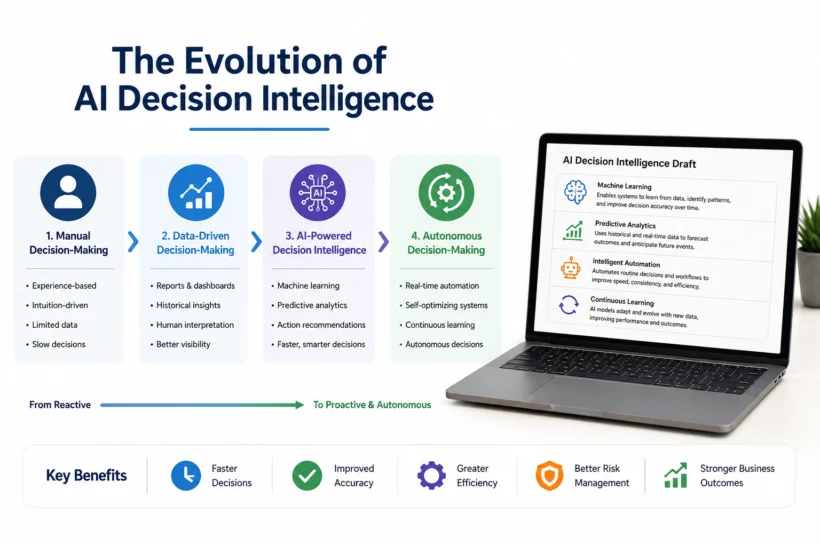
This evolution allows organizations to move from reactive decision-making to proactive and autonomous decision-making.
The Evolution of Business Decision-Making
Decision-making has evolved significantly over the past several decades.
Manual Decision-Making Era
Historically, business decisions relied heavily on human experience, intuition, and manually gathered information. While expertise remains valuable, manual processes often result in slower decisions and limited visibility into complex business operations.
Organizations frequently faced challenges such as:
- Incomplete data
- Human bias
- Delayed reporting
- Inconsistent decision outcomes
As businesses grew larger and more complex, these limitations became increasingly apparent.
Data-Driven Decision-Making
The introduction of enterprise software and analytics platforms enabled organizations to collect and analyze large amounts of data. Business Intelligence (BI) tools helped companies make more informed decisions through reports, dashboards, and historical analysis.
While data-driven decision-making represented a major advancement, it still required significant human intervention to interpret insights and determine the best course of action.
AI-Powered Decision Intelligence
The next phase of evolution emerged with artificial intelligence. AI technologies empowered systems to analyze massive volumes of data, identify meaningful patterns, and deliver actionable recommendations more efficiently than conventional analytical approaches.
Today, AI Decision Intelligence helps organizations:
- Analyze real-time business data
- Predict future outcomes
- Recommend optimal actions
- Automate routine decisions
- Continuously learn and improve
This shift enables businesses to make decisions with greater speed, accuracy, and confidence.
💚 You might also like: AI Procurement Solutions for Visibility & Risk Management
Key Components of AI Decision Intelligence
Modern AI Decision Intelligence solutions rely on several advanced technologies working together.
Machine Learning
Machine learning algorithms analyze historical and real-time data to identify patterns and trends. These insights help organizations predict outcomes and make more informed decisions.
For example, machine learning can forecast demand fluctuations, identify supply chain risks, and optimize inventory levels.
Predictive Analytics
Predictive analytics enables organizations to anticipate future events before they occur. Instead of reacting to problems after the fact, businesses can proactively address challenges and capitalize on opportunities.
Predictive capabilities support decision-making in areas such as:
- Supply chain management
- Procurement
- Financial planning
- Customer service
- Risk management
Intelligent Automation
Automation is a critical component of AI Decision Intelligence. Intelligent systems can execute routine decisions without manual intervention, allowing employees to focus on strategic initiatives.
Examples include:
- Inventory replenishment
- Supplier recommendations
- Pricing adjustments
- Workflow approvals
Automation improves efficiency while reducing operational bottlenecks.
Continuous Learning
One of the most powerful aspects of AI Decision Intelligence is its ability to learn continuously. As new data becomes available, AI models refine their predictions and recommendations, leading to better decision outcomes over time.
Benefits of AI Decision Intelligence
Organizations that embrace AI-powered decision-making gain significant competitive advantages.
Faster Decision Cycles
AI processes information far more quickly than traditional methods, enabling businesses to respond rapidly to changing market conditions.
Improved Accuracy
By analyzing large datasets and identifying hidden patterns, AI reduces the likelihood of human error and improves decision quality.
Greater Operational Efficiency
Automated decision processes reduce manual workloads and streamline business operations across departments.
Enhanced Risk Management
AI can detect potential risks early and recommend corrective actions before issues escalate into major disruptions.
Better Business Outcomes
When organizations make smarter decisions consistently, they achieve stronger financial performance, improved customer experiences, and greater operational resilience.
How Aera Technology Supports Decision Intelligence
As businesses increasingly seek intelligent decision-making capabilities, Aera Technology has emerged as a leader in the Decision Intelligence space. The company helps organizations transform how decisions are made, executed, and optimized across enterprise functions.
By leveraging AI, real-time data, and automation, Aera Technology empowers organizations to move beyond traditional analytics and embrace a more intelligent approach to decision-making.
Its solutions enable businesses to identify opportunities, respond to disruptions, and continuously improve outcomes through intelligent decision automation.
The Future of Decision-Making
The future of business decision-making lies in intelligent systems capable of understanding complex environments and acting with speed and precision. As AI technologies continue to evolve, organizations will increasingly rely on AI Decision Intelligence to manage growing volumes of data and navigate uncertainty.
Businesses that adopt Decision Intelligence today are better positioned to improve agility, optimize operations, and maintain a competitive edge in an increasingly digital world.
Final Thoughts
The evolution of decision-making has progressed from intuition-based approaches to data-driven analytics and now to AI-powered intelligence. AI Decision Intelligence represents the next generation of enterprise decision-making, combining advanced analytics, machine learning, automation, and real-time insights to drive better outcomes.
With innovative solutions from Aera Technology, organizations can transform decision-making into a strategic advantage. By embracing AI Decision Intelligence, businesses can achieve faster decisions, improved accuracy, enhanced efficiency, and sustainable long-term growth.
✨ Don’t stop here, follow Tech Statar for daily upgrades.