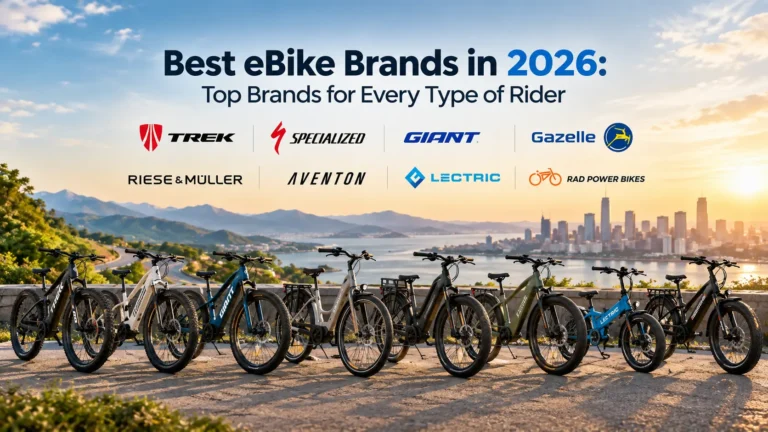

Best eBike Brands in 2026: Top Brands for Every Type of Rider
Choosing the best eBike brand is not as simple as picking the company with the biggest battery, highest motor output, or lowest price. The better choice depends on how you ride, where you ride, how much you want to spend, and how easy the bike will be to service later.
That matters because the current eBike market covers everything from affordable folding commuters to premium mountain bikes and cargo bikes. Major reviews also show how different the market has become: current 2026 guides span commuting, cargo, folding, road, gravel, and e-MTB categories rather than one type of bike.
Best eBike Brands at a Glance
| Brand | Best suited to | What stands out |
| Trek | Commuting, fitness, touring, e-MTB | Broad lineup and established bicycle-shop network |
| Specialized | Performance, commuting, road, gravel, e-MTB | Integrated motor systems and wide performance range |
| Giant | e-MTB, trail, road and everyday riding | Large range with SyncDrive motor and EnergyPak systems |
| Gazelle | Comfortable commuting and touring | Dutch upright geometry and Bosch-powered systems |
| Riese & Müller | Premium commuting, cargo and utility | High-end configurations and strong dealer support |
| Aventon | Value-focused commuting and all-terrain riding | Feature-rich bikes across several categories |
| Lectric | Budget and folding eBikes | Accessible pricing and compact models |
| Rad Power Bikes | Cargo, utility and everyday riding | Large US service network and practical model range |
This is not a ranking. Each brand solves a different buyer problem, and the same brand can offer both excellent and unsuitable choices depending on the specific model.
How to Choose the Best eBike Brand
Build Quality and Reliability
Start with the bike itself, not the logo on the frame. Look at the frame design, braking system, drivetrain, wheels, tires, electrical integration, and expected use.
A commuter that spends most of its life on paved roads does not need the same hardware as an e-MTB designed for repeated climbs and technical trails. A cargo bike also needs a frame and braking system designed around much higher loads.
Independent testing is useful here because specifications alone do not reveal how a bike feels or behaves on the road. Electric Bike Review says its 2026 selections were based on extensive riding, testing, measurements, and looking for weaknesses rather than assuming every bike is good.
Motor and Battery
The motor affects how naturally the bike accelerates, how it handles hills, and how much assistance you feel while pedaling. Mid-drive systems are common on premium and performance-oriented bikes, while hub motors remain popular on many affordable commuter and utility models.
Battery capacity matters for range, but a larger battery does not automatically make a bike better. Bike weight, rider weight, terrain, speed, temperature, tire pressure, assist level, and wind all affect actual range.
The motor and battery should therefore be judged as a complete system rather than as two isolated numbers.
Warranty and Customer Support
A good warranty matters most when something actually fails. Before buying, check the warranty period, which components are covered, who performs repairs, and whether you have to ship the bike or component somewhere for service.
Also look at how the company handles software, diagnostic issues, recalls, and replacement components. A cheap bike becomes less attractive if a simple electronic problem leaves you without a usable bike for weeks.
Parts, Repairs, and Service
This is one of the most overlooked differences between eBike brands.
Brake pads and tires are easy to replace on most bikes. Proprietary batteries, displays, controllers, chargers, and other electronic components can be much harder to source.
Established brands often benefit from dealer networks and standardized components, while direct-to-consumer brands can provide strong value but may require more online support. The right choice depends on how much hands-on support you expect to need.
Riese & Müller, for example, has a dealer network that provides expert guidance, test rides, servicing, and ongoing maintenance. Rad Power Bikes also says it has partnered with more than 500 US bike shops and has a network of more than 1,400 authorized service providers.
Value for Money
The cheapest eBike is not always the best value.
An inexpensive eBike can offer impressive specifications, but a more expensive model may justify its price with a better motor system, stronger components, better integration, easier servicing, or a more refined ride.
The real question is:
What are you getting for the extra money, and will you actually use it?
Best eBike Brands by Riding Style
Best for Commuting
For daily commuting, prioritize comfort, dependable assistance, integrated lighting, practical gearing, useful carrying capacity, and local service.
Gazelle is a strong fit for riders who prioritize an upright, comfortable riding position. Its current US range uses Bosch mid-drive systems, and the company offers Class 1 and Class 3 models for commuting and longer rides.
Trek is another broad option because its electric range includes commuter-focused Allant+ models as well as lighter fitness-oriented FX+ bikes. The Allant+ line is designed around commuting and comes equipped with practical features such as racks, fenders, and lights.
Specialized is worth considering when you want commuting ability with more performance-oriented technology. Its current Vado range includes full-power and lightweight models, while its wider Turbo lineup covers urban, road, gravel, and mountain riding.
Best for Budget Buyers
Budget buyers should focus on the complete package rather than the largest advertised motor.
Lectric has built much of its current range around affordable, compact bikes. Its XP Lite2, for example, is a foldable commuter listed at $799 in its current US lineup, with a 20 mph top speed and a 275-pound payload rating.
Aventon occupies a higher price point in much of its lineup but offers more features and several categories. Its current range includes the Level 4 commuter, Aventure 3 all-terrain model, Abound cargo bikes, and mid-drive models.
The key is to check safety certification, warranty coverage, parts availability, and service before treating a low purchase price as a good deal.
Best for Cargo and Family Riding
Cargo eBikes need more than a powerful motor. Frame stability, payload capacity, braking, wheel design, accessory compatibility, and battery capacity all become important when carrying children or heavy loads.
Riese & Müller specializes in utility and cargo eBikes. For example, its Multitinker is designed to carry two children or everyday cargo while keeping a relatively compact footprint. The current model uses a Bosch system and has a 200 kg gross vehicle weight rating.
Rad Power Bikes is another practical option, particularly in the US. Its current lineup includes multiple cargo and utility models, including the RadWagon 5 and RadRunner Max.
Best for Mountain and Off-Road Riding
For trail riding, look beyond motor power. Suspension quality, frame geometry, braking, wheel size, tires, drivetrain, and motor response matter just as much.
Giant has a broad performance eBike range, including the Trance X E+. The current platform uses Giant’s SyncDrive Pro motor with up to 85 Nm of torque and an EnergyPak Smart battery system, alongside dedicated suspension and adjustable geometry for trail riding.
Specialized also has a deep e-MTB range through its Turbo Levo and Kenevo families. Current Levo models include high-output motors and large batteries designed around aggressive off-road riding.
Best for Road, Gravel, and Fitness Riding
Road and gravel riders usually want assistance that feels natural without turning the bike into a heavy machine.
Specialized is a notable option here because its Turbo Creo range specifically targets road and gravel riding, with models built around lightweight frames, integrated systems, and drop-bar geometry.
Trek also offers electric road and fitness bikes, while Giant’s range spans road, trail, and everyday riding. This category is especially sensitive to weight, so a huge battery is not necessarily an advantage.
Best for Folding and Compact eBikes
For apartments, public transport, smaller vehicles, or limited storage space, folded size and weight can matter more than raw motor output.
Lectric is particularly relevant because its XP Lite2 is built around a lightweight, foldable format and is marketed specifically for compact storage and commuting.
The important question is not simply whether a bike folds. Check how heavy it is to carry, how large it becomes when folded, whether the battery can be removed, and whether the folded bike can realistically fit your intended storage space.
Best eBike Brands to Consider
Trek
Trek is a strong choice for buyers who want a traditional bicycle brand with a broad eBike range. Its current lineup covers commuter and fitness bikes such as the Allant+ and FX+, alongside performance-oriented electric mountain and road bikes.
Its main advantage is range: you can stay within one established bicycle ecosystem while moving from everyday commuting to more performance-focused riding.
Trek makes more sense for buyers who value conventional bike-shop support and a broad product range than for someone simply chasing the maximum motor output per dollar.
Specialized
Specialized is particularly strong when performance and technology matter. Its current electric lineup covers urban bikes such as the Turbo Vado and Como, road and gravel bikes such as the Turbo Creo, and mountain bikes such as the Turbo Levo and Kenevo.
The trade-off is price. Many current Specialized eBikes sit well above entry-level pricing, so the brand makes the most sense when you actually value its motor technology, integration, ride quality, and performance-oriented components.
Giant
Giant is one of the broadest options for riders who want established bicycle engineering across several eBike categories.
Its current technology includes the SyncDrive motor family, EnergyPak batteries, RideControl electronics, and a wide range of models from city bikes to trail-focused e-MTBs. The Trance X E+, for example, combines an 85 Nm SyncDrive Pro motor with dedicated trail suspension and adjustable geometry.
Giant is especially relevant for riders who want an eBike that still feels like a conventional performance bicycle rather than a utility product with a motor attached.
Gazelle
Gazelle has a different focus. The Dutch brand emphasizes comfort, upright riding positions, practical equipment, and Bosch-powered electric systems.
Its current US lineup includes Class 1 and Class 3 eBikes, while its 2026 models continue the brand’s focus on comfortable everyday riding. Gazelle also states that its bikes are hand-built in the Netherlands and backed by a 10-year frame warranty.
Gazelle is a natural fit for riders who spend most of their time commuting, running errands, or touring rather than riding technical trails.
Riese & Müller
Riese & Müller operates in the premium eBike market, with a strong focus on utility, touring, city, and cargo models.
Its current lineup includes the Nevo, Charger, Multicharger, Multitinker, Load, Packster, and other specialized platforms. The company also operates through a dealer network that provides test rides, service, and maintenance.
This makes the brand particularly relevant to buyers who view an eBike as a long-term transportation tool rather than a recreational purchase.
The main limitation is obvious: premium engineering and equipment come with premium pricing. Current US models such as the Multitinker start well above mainstream commuter pricing.
Aventon
Aventon has a broad US-focused range that sits between entry-level and premium products. Its current lineup includes the Level 4 for commuting, Aventure 3 for all-terrain riding, Abound models for cargo, and mid-drive bikes such as the Level 4 ADV and Aventure M.
The brand is particularly interesting for buyers who want modern features without moving immediately into premium bicycle-brand pricing.
Aventon’s current US hybrid collection states that applicable bikes carry UL and TÜV safety certifications and a two-year warranty, but buyers should still verify certification and warranty details for the exact model they are considering.
Lectric
Lectric focuses heavily on accessible eBikes, compact designs, and straightforward utility.
The XP Lite2 shows the formula clearly: a foldable design, 20 mph top speed, up to 45 miles of advertised range, and a relatively low entry price. Lectric also offers long-range versions for riders who need more battery capacity.
The brand is worth considering when price, simplicity, and portability are priorities. The important checks are local service availability, exact warranty terms, replacement components, and whether the model’s design matches your daily riding rather than just its advertised specifications.
Rad Power Bikes
Rad Power Bikes has a broad utility-oriented range, with cargo, commuter, folding, and off-road models.
Its current US support network is one of the more useful differentiators: the company says it has more than 500 local bike-shop partners and more than 1,400 authorized service providers.
Its cargo range includes models such as the RadWagon 5, while the Radster line covers commuting and off-road riding. Current RadWagon 5 specifications include a 720 Wh battery, 750W rear hub motor, torque sensing, and UL 2849 and UL 2271 certification.
Because the service footprint cited above is US-based, buyers elsewhere should verify local availability before assuming the same support experience.
Direct-to-Consumer vs. Traditional eBike Brands
Direct-to-Consumer Brands
Direct-to-consumer brands can offer strong specifications at competitive prices because the company sells the bike directly rather than relying entirely on a traditional dealer chain.
The trade-off is that you may do more of the setup and troubleshooting yourself. Even when a brand provides good online support, that is different from walking into a bike shop with a mechanical or electrical problem.
Dealer-Supported Brands
Dealer-supported brands can provide test rides, professional assembly, fitting, maintenance, diagnostics, and face-to-face support.
That matters more when an eBike is heavy, expensive, technically complex, or intended for years of daily use.
Riese & Müller provides advice, test rides, servicing, and maintenance through its dealers, while Trek offers in-person support through its retail network.
Which One Fits You?
A direct-to-consumer brand can make sense when you are comfortable buying online, have straightforward maintenance needs, and want to maximize features within a fixed budget.
A dealer-supported brand can make more sense when you want to test the bike before buying, need professional setup, or expect to rely on a shop for maintenance.
Neither model is automatically better. The important question is which ownership experience matches your needs.
How to Compare Two eBike Brands
Motor and Battery
Compare the exact motor system, not just the advertised wattage. Look at torque, assistance characteristics, battery capacity, charging options, and whether a range extender is available.
Also compare how the motor behaves under load. A bike used on steep hills with cargo has very different requirements from a flat-city commuter.
Build and Components
Compare the parts that you will actually use and maintain.
Hydraulic disc brakes, drivetrain quality, tires, suspension, wheels, frame design, lights, racks, and fenders can have more practical impact than a headline motor number.
Warranty and Support
Read the warranty before buying rather than after something breaks.
Check whether the company handles repairs locally, whether shipping is required, which components are covered, and how replacement electronic parts are supplied.
Replacement Parts and Batteries
Ask a simple question:
What happens when the battery or controller needs replacing?
A brand that cannot provide important proprietary parts reliably may become difficult to own after several years, even if the original bike was excellent.
Total Ownership Cost
Include more than the bike’s sticker price.
Consider accessories, assembly, maintenance, replacement parts, battery replacement, insurance where applicable, and transportation for service.
A slightly more expensive bike can become the cheaper option over time if it requires fewer compromises and is easier to keep running.
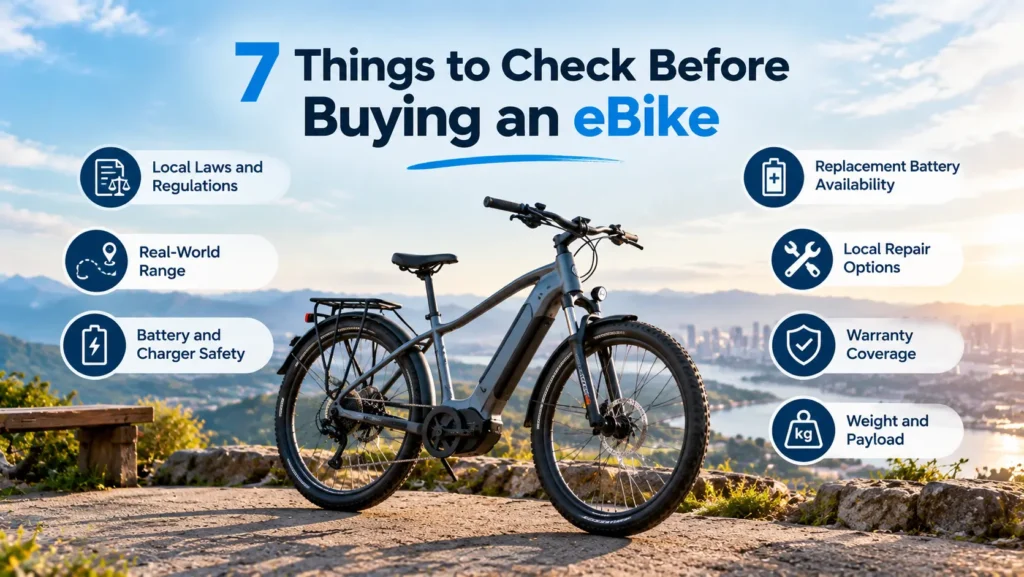
7 Things to Check Before Buying an eBike
Local Laws and Regulations
Do not assume an eBike is legal simply because it is sold in your market.
Rules can differ significantly between countries and even regions. In Great Britain, for example, an EAPC must have pedals capable of propelling the cycle, a motor with maximum continuous rated power of 250W or less, and assistance that cuts off at 15.5 mph. Vehicles outside those requirements can fall under motor-vehicle rules.
Always verify the rules that apply where you actually plan to ride.
Real-World Range
Manufacturer range figures are useful for comparison, but they are not guarantees.
Rider weight, hills, temperature, wind, tire pressure, speed, assist level, and stop-and-go riding can all change how far a battery lasts.
Treat the advertised range as a reference point, then choose a battery with enough margin for your normal rides.
Battery and Charger Safety
Battery safety should be treated as a basic buying requirement.
UL 2849 evaluates the electrical drivetrain, battery, and charger system combination for eBikes. The CPSC also advises consumers to use micromobility products and batteries that are designed, manufactured, and certified to applicable safety standards.
Do not mix batteries and chargers simply because the voltage or connector appears compatible. UK government guidance specifically warns that incompatible battery and charger combinations can create serious fire risks.
Replacement Battery Availability
Find out whether the manufacturer still sells replacement batteries for the exact bike and what the replacement process looks like.
This matters because the battery is one of the most important wear-related components in an eBike.
Local Repair Options
Before purchasing, search for bike shops or authorized service providers that will work on the brand.
This is especially important for direct-to-consumer models. Online support may be enough for a minor adjustment, but it cannot replace a local technician for every problem.
Warranty Coverage
Do not stop at “two-year warranty” or another headline number.
Check what is actually covered, whether the battery has separate terms, who pays shipping, and whether labor is included.
Weight and Payload
An eBike that feels easy to ride can still be difficult to carry upstairs or place on a vehicle.
Cargo bikes need another calculation: add the rider, passengers, luggage, and accessories when checking the permitted total weight.
FAQs About eBike Brands
What is the best eBike brand?
There is no single brand that is the best fit for every rider. Trek, Specialized, Giant, Gazelle, Riese & Müller, Aventon, Lectric, and Rad Power Bikes serve different combinations of performance, comfort, price, utility, portability, and support.
Start with your riding style and location, then choose the brand whose strengths match those requirements.
Which eBike brands are the most reliable?
Reliability depends on both the brand and the specific model.
Look for established motor and battery systems, strong components, clear warranty terms, replacement parts, qualified service, and a proven support network. A well-known brand name alone does not guarantee a good eBike.
Are expensive eBike brands worth it?
They can be, but only when their advantages match your needs.
A premium bike may offer better components, motor integration, ride quality, comfort, service, or customization. A casual rider who only needs a short flat commute may not benefit enough from those upgrades to justify the extra cost.
Are direct-to-consumer eBike brands good?
Some are. Their main advantage is often strong specification-to-price value.
The important questions are whether the exact model meets your needs, whether its battery and electrical system meet applicable safety requirements, and whether you have a practical way to get repairs and replacement parts.
How long do eBike batteries usually last?
Battery life varies with battery chemistry, usage, storage, charging habits, temperature, and overall care.
Instead of choosing a brand based on a vague battery-life promise, check the manufacturer’s warranty and replacement-battery policy. Those give you a more useful picture of long-term ownership.
What should I look for in an eBike brand?
Look at five things first: the quality of its motor and battery systems, the fit of its bikes for your riding style, warranty and customer support, availability of replacement parts, and access to local service.
Then compare the exact models rather than assuming every bike from the same company offers the same ownership experience.
Conclusion
The best eBike brand is the one that fits the way you actually plan to ride.
For comfortable everyday riding, brands such as Gazelle can make sense. For broad performance options, Trek, Specialized, and Giant cover several categories. Riese & Müller stands out for buyers focused on premium utility and cargo bikes, while Aventon, Lectric, and Rad Power Bikes offer different approaches to value, portability, commuting, and utility.
But the brand is only the starting point. Before buying, compare the exact model’s motor, battery, range, components, warranty, safety certification, replacement parts, service options, payload, and local legal requirements.
That approach will help you choose an eBike that is not just attractive on paper, but practical to own and useful for years.
🔔 Follow Tech Statar for more insights like this!