
Arch Wall Shelter vs Straight Wall: Snow Load Explained
Two buildings, the same steel, and very different capacities
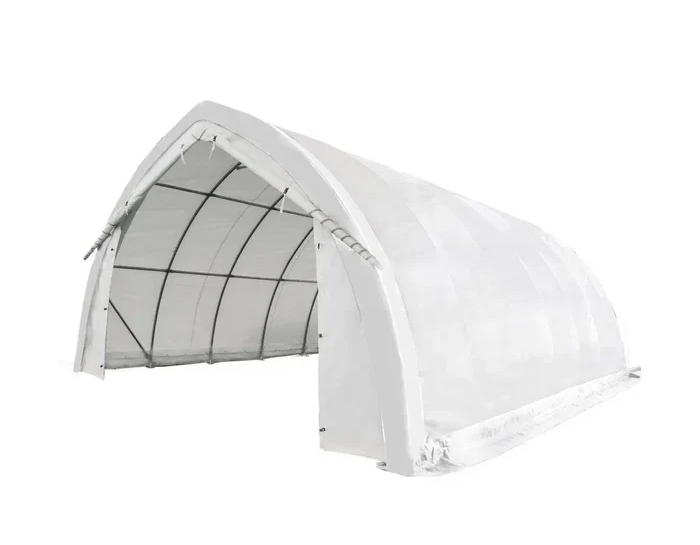
Canadians shopping for covered storage before winter meet two shapes at similar prices, and the difference is not cosmetic. An arch wall shelter and a straight-walled one built from comparable tubing will not carry the same snow, because geometry decides how the load reaches the ground.
Steel is extraordinarily strong when pushed along its length and much weaker when bent across it. Anyone who has bent a drinking straw knows this, since pressing the ends does little while pushing sideways on the middle folds it at once.
A straight member under load is being bent, not squeezed
Put weight on the middle of a horizontal beam, and it sags. The top is compressed, the bottom stretched, and the material near the center does almost nothing, which is why resisting a bending moment demands far more steel than resisting a push.
That is the situation at the corner of a straight-walled building, where a vertical post meets a sloped rafter, and the joint has to resist rotation. The corner becomes the place engineers add material and the place a failure begins.
A curve turns the same load into compression.
If the shape of an arch follows the path the forces naturally want to take, every part of it is simply squeezed along its own length. No corner concentrates a bending moment, because there is no corner, and load flows continuously into the footings.
Engineers call that ideal curve a funicular shape, and the consequence is efficiency. An arch wall shelter reaches a given snow rating with lighter tubing than a straight-walled frame needs, because it never asks steel to do what steel does worst.
Snow load is not one number but a distribution.
The design case that matters in Canada is rarely an even blanket. It is drifted snow piled against one side, and that unbalanced load tries to change the shape of an arch wall shelter rather than press down on it, which is why the frames are braced to each other. The flanks of an arch wall shelter also shed part of that load once the slope passes the angle at which snow slides.
Everything gets pushed outward at the base.
An arch under load tries to spread, and that outward thrust at the footings is the price of avoiding bending. Anchoring an arch wall shelter properly is not optional, since skipping it lets the structure flatten as the footings creep apart.
Frames divide by how they handle the load
Arch: pure compression, lighter steel, curved walls
Straight wall: bending at the corners, more material
Peak with straight walls: usable height, heaviest frame
Where the arched form pays and where it does not
Strength: high snow rating for the steel used
Strength: sheds wind and snow by shape alone
Limit: outward thrust demands proper anchoring
Limit: the perimeter loses usable height
Weighed against a straight-walled structure, an arch buys capacity with geometry rather than steel and pays for it in the corners of the floor. A grower near Kelowna stores trays down the center and finds the curve irrelevant, while a pallet stacking neighbor chose otherwise.
Buyers are learning to compare shapes rather than specifications
Owners increasingly ask how a frame carries load rather than comparing tubing sizes between quotes, having found that two buildings described in almost identical language can behave very differently under drifted snow.
That more careful reading of quotes is why the storage buildings TMG Industrial supplies are offered in several frame geometries rather than in one profile scaled to different sizes.
✨ Want daily breakthroughs? Follow Tech Statar.