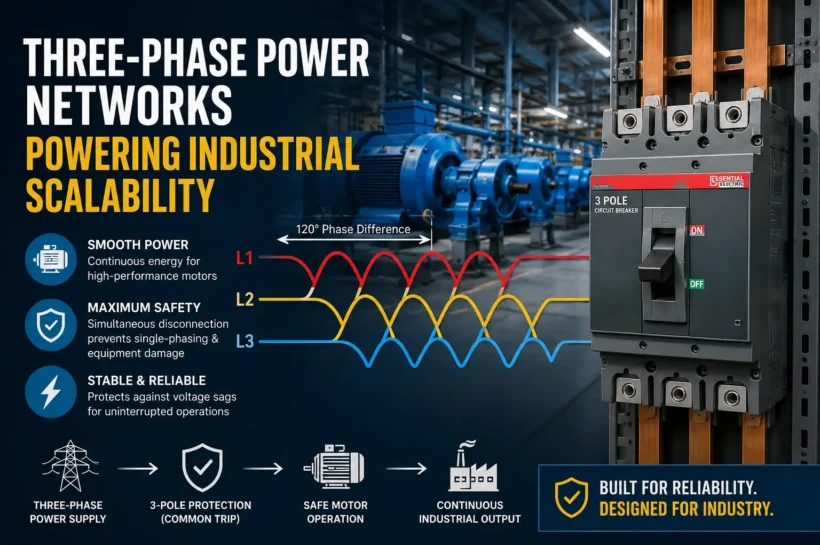

Why Three-Phase Power Networks Dictate Heavy Industrial Scalability
The operational footprint of a heavy industrial facility such as a data processing center, a commercial manufacturing plant, or a heavy-duty packaging hub relies on high-capacity electrical engineering. Unlike commercial office buildings that function primarily on standard single-phase 120-volt lines, industrial environments operate massive mechanical loads. Heavy conveyor arrays, high-horsepower chilling pumps, and complex automated production machinery demand massive amounts of continuous energy. To deliver this power efficiently without inducing extreme thermal stress or dropping line voltage, industrial infrastructure depends entirely on the deployment of balanced three-phase electrical networks.
The Physics of Rotational Force and Line Efficiency
The primary mechanical advantage of a three-phase power network is its ability to deliver a constant, smooth flow of electricity to heavy rotating equipment. In a standard single-phase setup, the alternating current (AC) waveform drops to zero voltage twice per cycle. For high-horsepower industrial electric motors, this pulsating energy delivery causes significant mechanical vibration, rapid bearing wear, and operational inefficiency.
A three-phase grid resolves this mechanical limitation by utilizing three separate active conductor lines, each carrying an AC wave offset by 120 electrical degrees. Because the three lines peak at different intervals, the cumulative power delivered to the machine never drops to zero. This continuous energy flow generates a naturally rotating magnetic field within the motor windings, allowing the machine to start under full mechanical load without requiring expensive auxiliary capacitors. Furthermore, because three-phase conductors distribute the total current load across three separate legs, they require significantly smaller copper wire sizes than single-phase lines to deliver the same amount of power, saving thousands of dollars in baseline facility material costs.
The Critical Safety Requirement of Simultaneous Phase Disconnection
While distributing electricity across three separate active lines maximizes mechanical efficiency, it introduces a strict protection requirement for the facility’s master control panel. Industrial machinery cannot safely tolerate a partial power loss in which one incoming electrical line goes dead while the other two remain fully energized.
This dangerous operational state, known as single-phasing, typically occurs when an isolated branch fault breaks a single upstream connection. When a running three-phase
motor loses one of its phases, it attempts to continue driving its mechanical load using the remaining two lines. To compensate for the missing leg, the current draw on the remaining live conductors spikes instantly to dangerous levels, rapidly overheating the motor’s internal insulation and risking immediate terminal burnout or a catastrophic workplace fire.
[Isolated Single-Line Interruption] –> Single-Phasing Occurs –> Motor Overheats C Burns Out [Unified Three-Pole Mechanical Link] –> Common-Trip Clears –> All 3 Lines Isolated Instantly
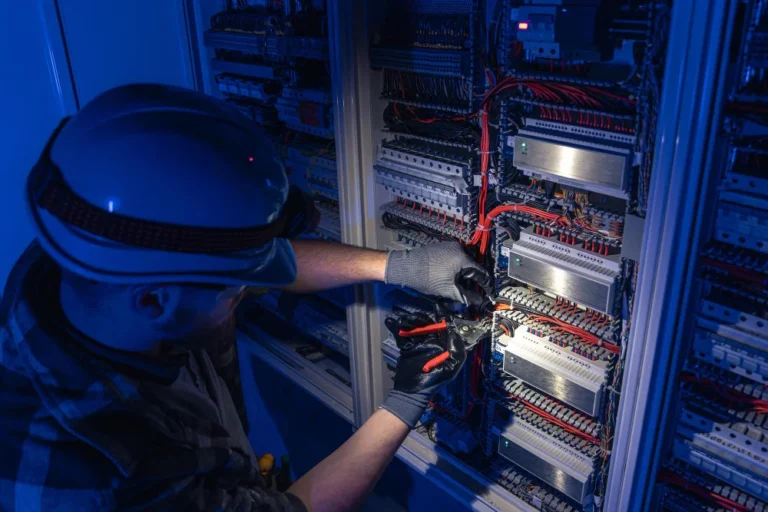
Eliminating this structural vulnerability requires a protective device engineered to treat all three power lines as a single, interdependent system. Integrating heavy-duty 3 pole circuit breakers from Essential Electric into the facility’s primary distribution switchboards ensures complete, uninterrupted protection across high-capacity machinery loops. These advanced circuit breakers use a built-in common-trip linkage that mechanically connects all three thermal-magnetic protection mechanisms, allowing them to operate as a single coordinated unit. The exact millisecond an overcurrent spike, ground fault, or short circuit is detected on any single-phase leg, the internal tie bar forces all three internal contacts to snap open simultaneously. This absolute common-trip execution immediately removes all voltage from the downstream equipment, preventing single-phasing destruction and completely isolating the electrical fault at its source.
Mitigating Severe Voltage Sags in Shared Power Grid Corridors
Beyond isolating direct electrical faults, unified multi-pole distribution units protect surrounding infrastructure from severe voltage sags during initial equipment startups. Industrial electric motors can draw up to six to eight times their steady-state running current when first accelerating from a dead stop.
If this intense inrush current is drawn unevenly from a poorly balanced distribution panel, it pulls down the local voltage across the entire facility corridor. These localized sags can cause adjacent digital automation systems to reset, interrupt sensitive robotic calibration loops, and induce data corruption inside networked server frames. Utilizing high-capacity three-pole overcurrent devices allows engineers to distribute start-up loads evenly across the full depth of the facility’s active busbar structure, stabilizing the baseline voltage profile and ensuring that delicate digital controls remain completely unaffected by nearby heavy mechanical operations.
✨ Discover More Articles: 7 Functions of Marketing: Guide, Examples & Importance
Securing the Foundation of Continuous Industrial Output
In high-volume industrial environments, infrastructure predictability dictates long-term market survival. A manufacturing plant or automated distribution facility cannot maintain its production quotas if its primary energy lines are frequently compromised by unmanaged phase imbalances, motor burnout sequences, or cascading electrical faults within the main power panels.
By prioritizing balanced three-phase grid architecture and protecting every high-capacity mechanical leg with dedicated multi-pole safety devices, forward-thinking operations secure their facility infrastructure. This disciplined approach to power management optimizes initial capital equipment investments, simplifies troubleshooting for maintenance technicians, and insulates complex automated assembly networks from external line disturbances. Building structural resilience from the main distribution frame down ensures a safe, continuous, and entirely reliable flow of industrial power through every shift.
✨ Got value? Let’s keep the momentum, follow Tech Statar.