
What is a Fiber Termination Box? Types, Uses, and How to Choose One
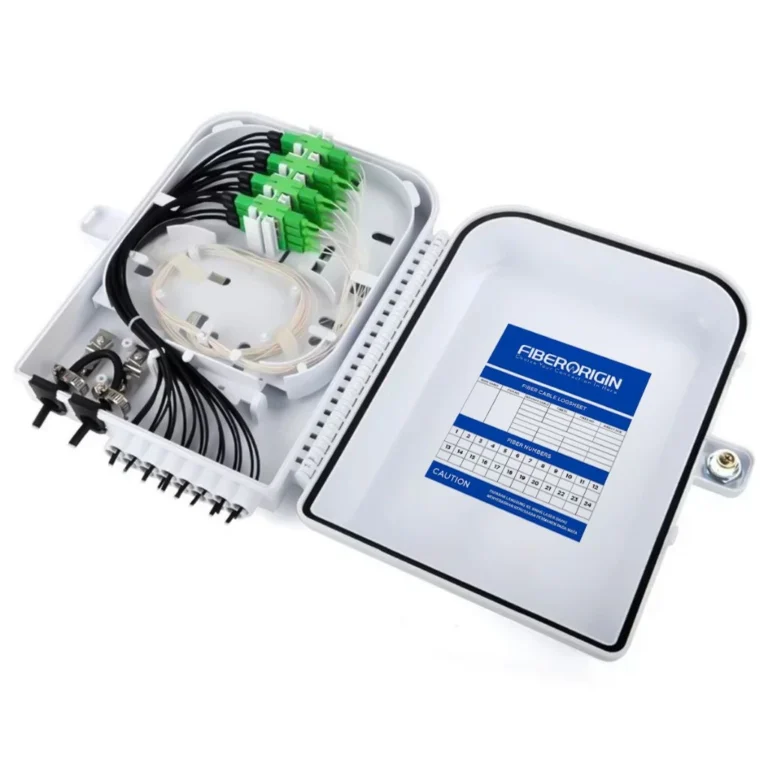
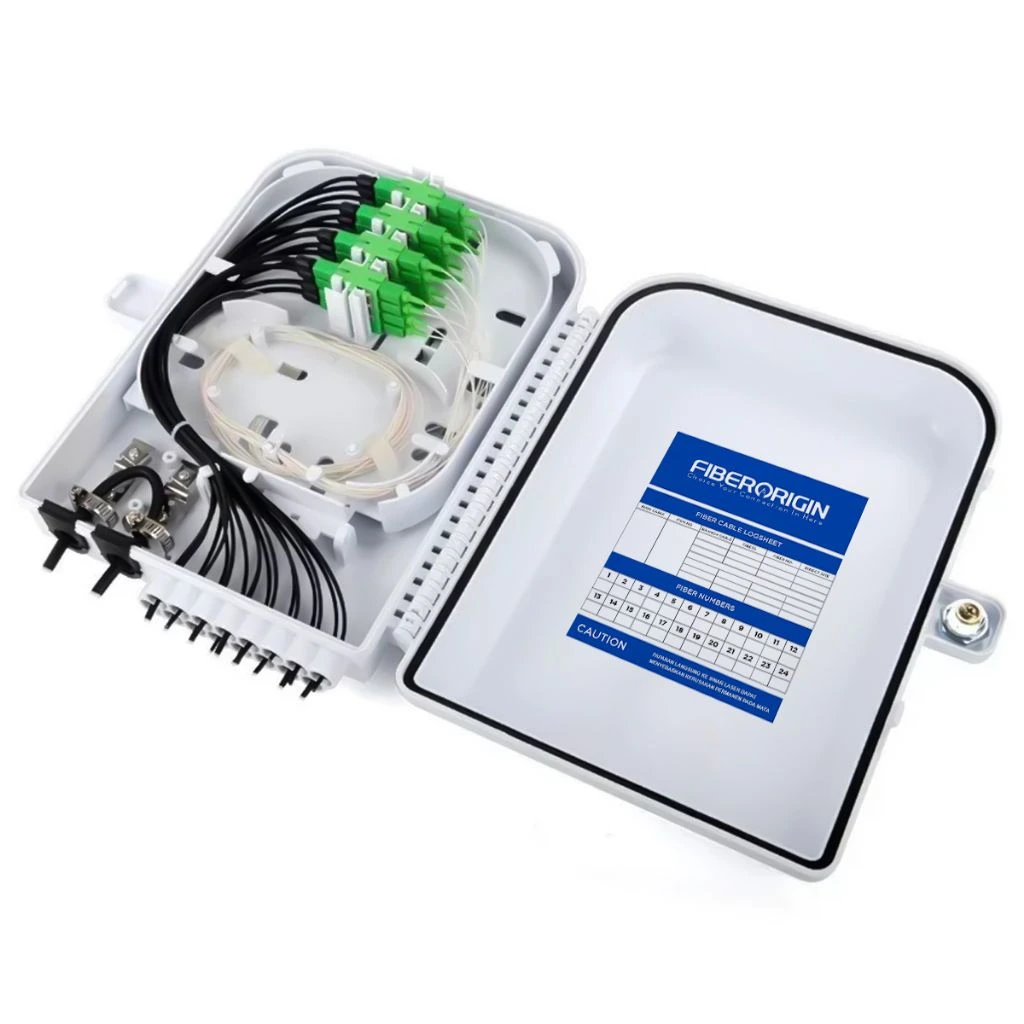
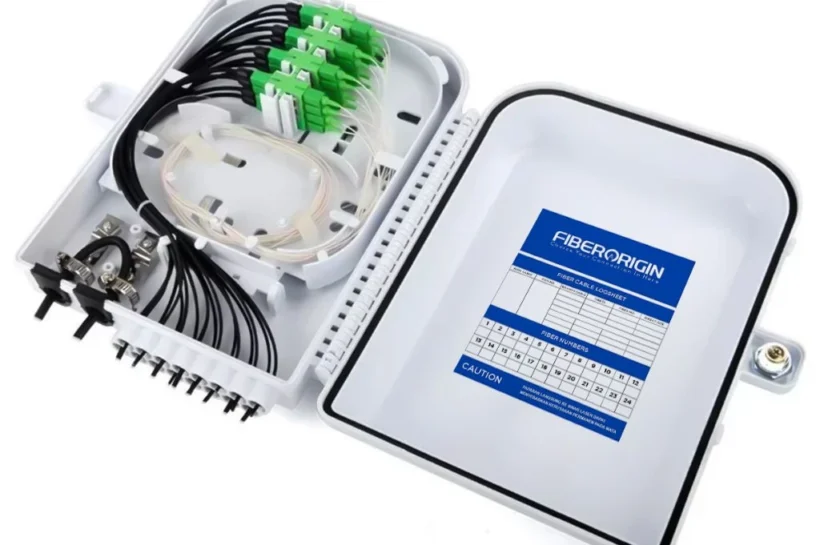
A fiber termination box (FTB) is an enclosure used to organize, protect, and terminate optical fibers at a connection point in a fiber network. Depending on its design, it can also hold splices, pigtails, adapters, and stored fiber slack.
The exact design varies depending on the manufacturer and application. Some boxes are designed mainly for splicing and connector termination, while others support direct connector installation or pre-terminated fiber assemblies. For example, CommScope’s HTB2 supports both splicing to factory-terminated pigtails and direct termination with field-installable connectors.
What does a fiber termination box do?
The main purpose of a termination box is to turn an exposed or incoming fiber cable into an organized, protected connection point.
A typical FTB can perform several related functions:
Cable securing: Holds the incoming cable in place so mechanical stress is not transferred directly to the fibers.
Fiber protection: Protects delicate fibers, splices, and connector interfaces from accidental damage.
Splicing: Provides space for fusion or other approved splicing methods when the design requires them.
Termination: Presents fibers through adapters or connectors so they can be connected to patch cords or equipment.
Fiber management: Controls routing and slack so fibers are not sharply bent or tangled.
Maintenance access: Keeps connections organized and accessible for testing, troubleshooting, or future changes.
Not every termination box performs all of these functions in exactly the same way. The product’s internal layout and supported termination method should always be checked before installation.
Where is a fiber termination box used?
Fiber termination boxes are used wherever a fiber cable needs a controlled termination or transition point.
Common applications include:
FTTH and FTTx networks, where fibers transition toward homes, apartments, buildings, or other subscriber locations.
Telecom and access networks, where organized fiber termination is needed at distribution or handoff points.
Enterprise and building networks, including telecom rooms and fiber distribution areas.
Equipment rooms and data centers, where rack-mounted versions can provide structured fiber patching and management.
The network position matters more than the product name. A small wall-mounted box at a subscriber endpoint serves a different purpose from a high-density rack-mounted fiber panel in a central equipment room.
What Is Inside a Fiber Termination Box?
Although designs differ, most termination boxes combine a housing with components for cable entry, fiber management, termination, and sometimes splicing.
Splice tray and splice protection
When the incoming fiber is fusion-spliced to connectorized pigtails, the splice area needs controlled storage and protection.
A splice tray keeps individual fibers organized and prevents unnecessary movement. Splice protectors cover completed joints and help prevent mechanical damage.
The tray must provide enough room for the planned splice count and fiber routing. A box that technically supports the required number of ports may still be unsuitable if its splice capacity or internal fiber-management space is too small.
Adapters, pigtails, and connectors
A fiber pigtail is a short fiber assembly with a connector on one end and fiber prepared for splicing on the other. In a common termination arrangement, the incoming cable is spliced to the pigtail, while the connector plugs into an adapter mounted in the box.
The adapter creates the accessible interface for a patch cord or another connectorized fiber.
Connector formats such as SC and LC are common, but the correct choice depends on the existing network, equipment, density, and project specification. The important point is compatibility: the adapter, connector, patch cord, and connected equipment must use compatible interfaces.
Connector polish also matters. Fiber connectors can use PC, UPC, or APC polishing, and these configurations have different back-reflection characteristics. They should not be mixed casually within the same optical connection.
Cable entry, anchoring, and fiber storage
The incoming cable needs a secure entry point and suitable strain relief. Without proper anchoring, pulling or movement of the cable can place stress on the fibers or splices inside the enclosure.
The box should also provide enough space to route and store fiber without violating the cable or fiber manufacturer’s bend-radius requirements.
This becomes especially important in small FTTH enclosures, where limited internal space can make poor routing easy. ITU-T G.657 defines single-mode fiber and cable categories with improved bending-loss performance, but bend-insensitive fiber does not mean the manufacturer’s bend-radius requirements can be ignored.
Discover More: Auditing Commercial Infrastructure
What Types of Fiber Termination Boxes Are Available?
There is no single FTB design for every installation. The main differences usually come from mounting method, environment, capacity, and termination approach.
Wall-mounted vs. rack-mounted
Wall-mounted termination boxes are compact and are commonly used where fibers need to be terminated close to a subscriber, building entry, or local distribution point. They are useful when floor or rack space is limited.
Rack-mounted termination boxes are designed for equipment rooms, telecom racks, and higher-density fiber management. Many resemble fiber patch panels and may include sliding trays or other access features.
The distinction is not always absolute. Some products marketed as termination boxes overlap functionally with patch panels or ODF components. When buying a rack-mounted unit, check whether you need simple patching, splicing, cross-connection, or a combination of these functions.
Indoor vs. outdoor
An indoor termination box is intended for a controlled environment where it does not need the same enclosure protection against rain, dust, or prolonged outdoor exposure.
An outdoor termination box must be selected for the conditions at its installation site. Depending on the product, this can include protection against water and dust, UV exposure, temperature changes, and mechanical stress.
An IP rating is useful when comparing enclosure protection, but the rating should never be chosen in isolation. IEC 60529 defines the IP Code classification for degrees of protection provided by enclosures; the specific rating required depends on the installation environment and the manufacturer’s tested configuration.
Splice, patch, and pre-terminated configurations
Some termination boxes are designed primarily around fusion splicing. Others provide a connectorized patching interface, while some products support pre-terminated assemblies to reduce field termination work.
That difference can affect installation time, required tools, technician skills, and future maintenance.
For example, CommScope documents a termination product that supports both splicing to factory-terminated pigtails and direct termination with field-installable connectors.
The right approach depends on the project. Do not assume that every FTB requires fusion splicing or that every box can accept every termination method.
Fiber Termination Box vs. Distribution Box vs. ODF vs. Splice Closure
These products can look similar because several of them contain fiber-management components, but their primary jobs are different.
| Device | Main purpose | Typical use |
| Fiber termination box | Protects, organizes, and terminates fibers at a connection point | Subscriber, building, local termination |
| Fiber distribution box | Distributes fibers between incoming and outgoing network paths; some designs also house splitters | FTTH/FTTx distribution points |
| ODF | Provides structured, higher-density fiber termination, patching, and cross-connection | Telecom rooms, central offices, data centers |
| Splice closure | Protects and organizes fiber splices, often along the cable route | Outside-plant and mid-route cable joints |
Terminology can vary between manufacturers and markets. A product called an “optical terminal box” in one catalog may overlap with what another supplier calls a distribution or termination box. That is why the network role and internal configuration matter more than the label.
A splice closure is the clearest distinction. Its primary purpose is to protect a cable joint or splice rather than provide an accessible patching interface.
A distribution box, meanwhile, distributes fibers between network segments and may include additional components, such as optical splitters, depending on the design.
An ODF is generally intended for more structured and higher-density fiber management, patching, and cross-connection. It can overlap with a rack-mounted termination box, so check the required density and management features rather than relying on terminology alone.
Discover More: Why Three-Phase Power Networks Dictate Heavy Industrial Scalability
How to Pick the Right Fiber Termination Box
Choosing an FTB starts with the network role, not the number printed on a product listing.
Start with the network role and installation location
First determine where the box will sit and what it needs to accomplish.
A small subscriber endpoint may need only a compact wall-mounted enclosure. An apartment building may need more capacity and better access for multiple drop fibers. An equipment room may be better served by a rack-mounted patching solution.
Also consider how easily technicians can access the box. A box installed in a difficult-to-reach location may need a different enclosure design from one mounted inside an accessible telecom room.
Choose the right capacity
Capacity is more than port count.
Before ordering, determine:
- How many fibers need to be terminated?
- How many splices are required?
- How many adapters or connector ports are needed?
- How many cable entries are required?
- Will you need additional capacity in the future?
- Does the enclosure have enough internal space for proper fiber routing?
Do not size the enclosure exactly to today’s connections if the network is expected to expand. At the same time, there is no universal rule that every installation must reserve a specific percentage of unused ports. Spare capacity should be based on the project’s growth expectations and physical constraints.
Match the connector and adapter configuration
The connector type must match the network equipment and existing cabling.
SC connectors are common in access-network environments, while LC connectors are widely used where higher port density is important. But there is no universal “best” connector for every FTB.
Also verify the polish type, such as APC or UPC, before ordering patch cords, adapters, and pigtails. APC and UPC interfaces have different end-face geometry and reflection characteristics, so components should match the optical system specification.
Check environmental protection
For an outdoor installation, review the manufacturer’s environmental specifications rather than assuming that any sealed-looking box is suitable.
Check:
- IP rating
- operating temperature
- resistance to outdoor exposure
- UV suitability where relevant
- cable-entry sealing
- enclosure material
- mounting conditions
IEC 60529 provides the framework for IP enclosure classifications, but the appropriate rating depends on the actual site conditions.
For example, a box inside a dry telecom room does not face the same environmental requirements as one mounted outdoors where rain, dust, and temperature changes are expected.
Check fiber management and bend-radius requirements
A termination box must provide enough room to route fibers without forcing sharp bends or putting unnecessary stress on the cable.
Review the manufacturer’s specified bend radius for the fiber or cable being installed. This is especially important in compact FTTH boxes.
Fiber designed to tolerate tighter bends can provide more flexibility in access-network installations. ITU-T G.657 specifically defines single-mode fiber and cable characteristics for improved bending-loss performance.
The enclosure still has to accommodate the actual fiber and cable specification.
Consider maintenance and future expansion
A good termination box should make future work easier, not harder.
Look for practical features such as:
- accessible splice trays
- clear labeling areas
- organized fiber routing
- protected unused ports
- adequate working space
- secure cable anchoring
- room for planned expansion
This matters because the enclosure may need to be reopened during testing, repair, upgrades, or new customer connections. Poor internal organization can turn a simple maintenance task into a larger service problem.
How Is a Fiber Termination Box Installed?
The exact procedure depends on the enclosure and termination method, but a typical installation follows this sequence:
Confirm the box and installation location. Check capacity, mounting method, connector configuration, and environmental specifications.
Mount the enclosure securely. Use the mounting method specified by the manufacturer.
Secure the incoming cable. Use the appropriate cable clamp, gland, or strain-relief arrangement.
Prepare and route the fibers. Follow the cable manufacturer’s preparation requirements and maintain the required bend radius.
Splice or terminate the fibers. Use the termination method supported by the box.
Protect and organize the connections. Place splice protectors, pigtails, and fibers in their designated positions.
Connect adapters and patch cords. Confirm that connector and polish types are compatible.
Inspect and clean connector end faces. Contamination can affect optical performance.
Test the completed link. Use the measurements required by the project or network specification.
Close and secure the enclosure. Ensure cable entries and seals are correctly positioned.
Connector inspection is not a substitute for optical testing. IEC 61300-3-35:2022 covers visual inspection of fiber connector end faces and explicitly distinguishes that inspection from measurements such as attenuation and return loss.
Installation should also follow the manufacturer’s instructions and applicable fiber-optic safety procedures. Never look directly into an active fiber or connector.
Discover More: The Role of Proxy Testing in Modern Network Management
Common Fiber Termination Box Problems to Avoid
Choosing the wrong enclosure for the environment
An indoor enclosure may not provide the protection required for an exposed outdoor installation. Before installation, verify the box’s environmental specifications against the actual location.
Overfilling or poorly routing fibers
A box can have enough ports but still be too small internally. Crowded fibers can make maintenance difficult and increase the risk of excessive bending or mechanical stress.
Choose based on port capacity, splice capacity, internal routing space, and cable-entry requirements together.
Using incompatible connectors or configurations
Matching the connector shape is not enough. Confirm the connector type, adapter, polish configuration, fiber type, and equipment interface before making the connection.
Poor cable anchoring and strain relief
If the incoming cable is not properly secured, mechanical loads can reach the fibers and splices inside the box.
Cable fixation should follow the manufacturer’s installation method and the cable’s mechanical requirements.
Contaminated connectors and unprotected unused ports
Dust and debris on connector end faces can affect optical performance. Unused ports should also be protected with appropriate dust caps or other approved protection.
IEC 61300-3-35:2022 provides a standardized approach for inspecting connector end faces for contamination, scratches, and other defects.
Fiber Termination Box FAQs
Is a fiber termination box the same as a fiber distribution box?
No. They can overlap in some products, but their primary roles are different.
A termination box generally provides a controlled point for fiber termination, protection, and connection. A distribution box manages connections between incoming and outgoing fibers and may also contain splitters or other distribution components.
Because manufacturers use these names differently, check the product’s actual network role and configuration before buying it.
Does every fiber termination box require fusion splicing?
No.
Some FTBs are designed around fusion-spliced pigtails, while others support field-installable connectors or pre-terminated fiber assemblies. The termination method depends on the specific enclosure and the deployment requirements. CommScope, for example, documents a termination product supporting both pigtail splicing and direct field termination.
Can a Fiber Termination Box Be Installed Outdoors?
Yes, but only when the box is designed and rated for the environmental conditions of the installation.
Check the manufacturer’s IP rating, temperature range, material specifications, cable-entry protection, and other environmental requirements. IEC 60529 defines the IP Code framework used to classify enclosure protection.
How do I know how many ports I need?
Start with the number of fibers and connections required today, then consider expected expansion.
Also check splice capacity, adapter capacity, cable entries, and internal working space. A box with the right number of ports can still be unsuitable if there is not enough room for the fibers or splices.
Can a fiber termination box support different connector types?
Some can, but not every model supports every connector or adapter.
Check the manufacturer’s supported adapter configuration before ordering. The connector and polish type must also match the equipment and patching system.
Conclusion
A fiber termination box does more than protect optical fibers. It creates an organized point where optical fibers can be secured, terminated, spliced, connected, and maintained.
The right box depends on several factors like network role, installation location, capacity, termination method, connector configuration, environmental protection, and fiber-management requirements.
The most reliable way to choose one is to look beyond the product name. A box marketed as an FTB, OTB, distribution box, or similar product can have a different role depending on its design. Check what the enclosure actually supports and how it fits into the network.
When those requirements are clear, selecting a fiber termination box becomes much simpler, and the resulting installation is easier to maintain, expand, and troubleshoot.
🔔 Follow Tech Statar for more insights like this!