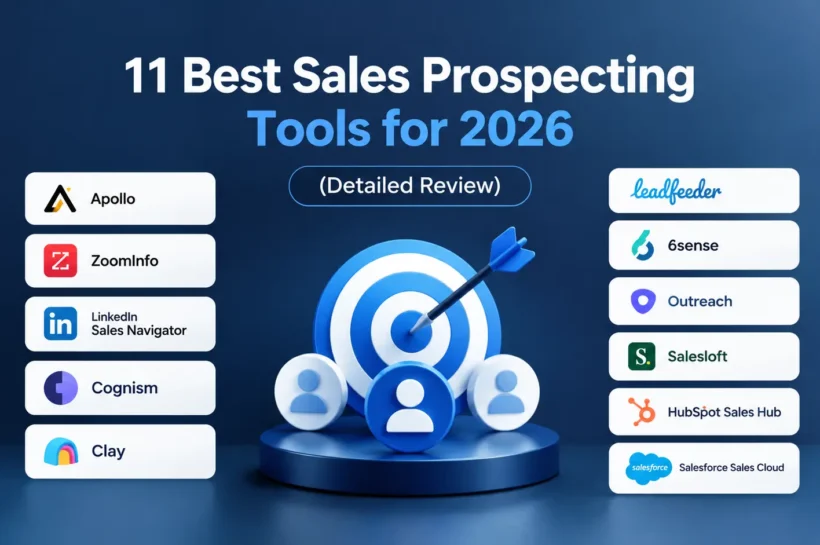

Sales prospecting tools help teams find potential buyers, research accounts, identify buying signals, and manage outreach. The important question is not which tool has the most features, but which one solves the weakest part of your prospecting process.
Some tools focus on contact data. Others specialize in intent signals, enrichment, sales engagement, or CRM workflows. This guide compares them by job and use case so you can choose without building an unnecessarily complicated stack.
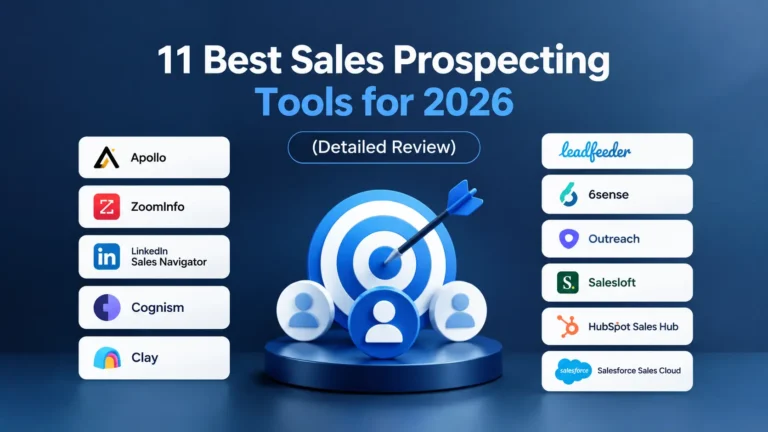
Best Sales Prospecting Tools at a Glance
Quick Comparison Table
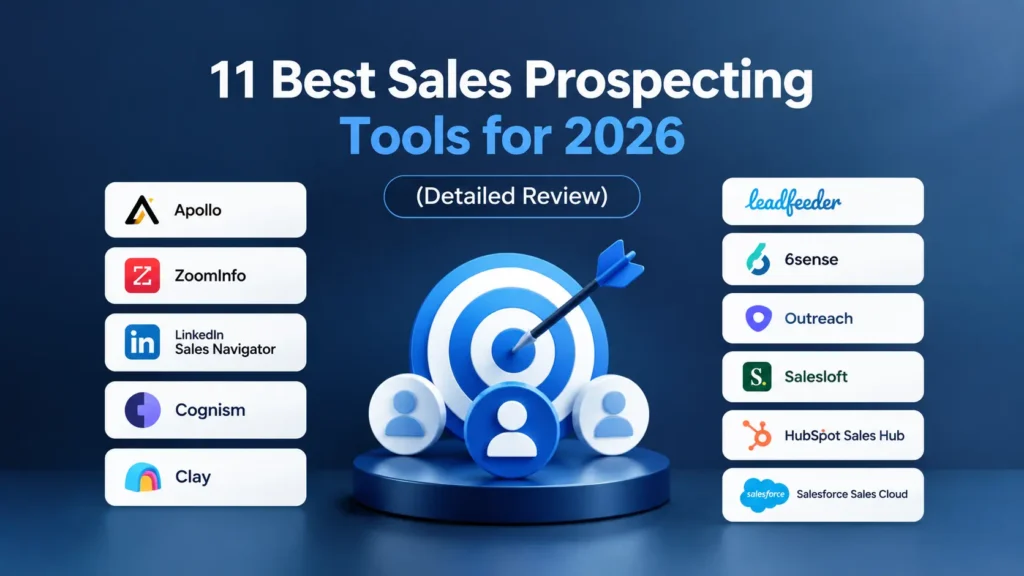
| Tool | Best for | Main role |
| Apollo | All-in-one outbound | Data + enrichment + engagement |
| ZoomInfo | Enterprise sales intelligence | B2B data + intent + signals |
| LinkedIn Sales Navigator | LinkedIn prospecting | Lead and account discovery |
| Cognism | International prospecting | Contact data + enrichment |
| Clay | Data enrichment | Multi-source enrichment and workflows |
| Leadfeeder | Website intent | Identifying visiting companies |
| 6sense | ABM and intent | Buying signals and prioritization |
| Outreach | Sales engagement | Sequences and outreach workflows |
| Salesloft | Sales engagement | Cadences and AI-assisted execution |
| HubSpot Sales Hub | CRM-native prospecting | CRM + prospecting + automation |
| Salesforce Sales Cloud | Enterprise CRM | CRM + sales workflows |
Which Tool Is Best for Your Sales Team?
For all-in-one outbound, Apollo is a strong starting point because it combines data, enrichment, sequencing, and other sales workflows.
For enterprise intelligence, ZoomInfo is more appropriate when your team needs deeper company, contact, intent, and account information.
For LinkedIn-led prospecting, Sales Navigator is the natural choice, with advanced search, account and lead alerts, buyer-intent features, and CRM capabilities on higher plans.
For international data, Cognism is worth evaluating, particularly when mobile data, enrichment, and regional coverage matter.
For custom enrichment, Clay is designed to combine multiple data sources and build prospecting workflows rather than rely on a single database.
For website visitor intent, Leadfeeder identifies companies visiting your site and lets teams use that activity for sales follow-up.
For ABM and buying signals, 6sense focuses on intent and account prioritization.
For sales engagement, Outreach and Salesloft focus on sequences, prioritization, and multi-channel execution.
What Are Sales Prospecting Tools?
What Sales Prospecting Software Helps You Do
Sales prospecting software reduces the manual work involved in finding and qualifying potential customers. Depending on the product, it can help you find contacts, enrich records, identify buying signals, research accounts, or automate follow-ups.
The key point is that these are different jobs. A contact database can tell you who works at a company, while an intent platform can help you determine whether that company may be actively researching your category.
Sales Prospecting Tools vs. CRM vs. Sales Engagement Software
A CRM stores customer, contact, activity, and opportunity data.
A sales engagement platform helps reps execute outreach through sequences, calls, emails, and follow-ups.
A prospecting or sales intelligence tool focuses more on finding prospects and understanding accounts.
Some modern platforms combine several of these functions, but the underlying jobs are still different.
What Type of Sales Prospecting Tool Do You Need?
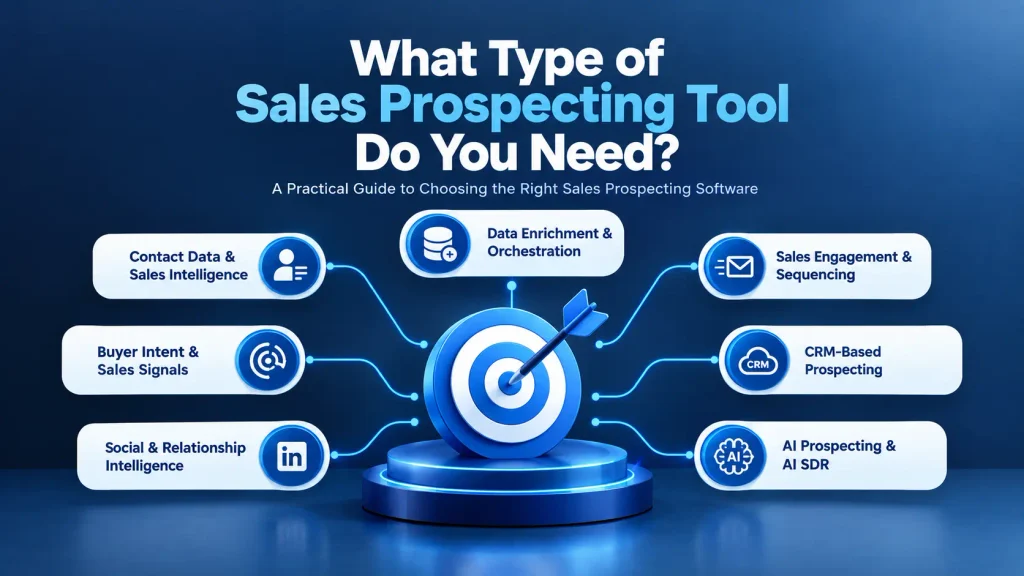
Contact Data and Sales Intelligence Tools
Use these when your main problem is finding the right companies and decision-makers.
The most important metric is not database size. It is coverage of your actual ICP.
Data Enrichment and Prospecting Orchestration Tools
These improve the data you already have by filling missing fields, finding additional contacts, or combining several providers.
Clay is a good example because its waterfalls can use multiple providers in sequence when one source does not return the required data.
Buyer Intent and Sales Signal Tools
These help answer:
Which accounts appear to be showing buying activity?
Signals can include research behavior, website activity, job changes, funding, or other business events. For example, 6sense uses intent signals to help prioritize accounts.
Sales Engagement and Sequencing Tools
These are useful when your team already knows who to target but struggles to manage consistent follow-up.
Outreach and Salesloft both focus heavily on automated, multi-step sales engagement.
Social and Relationship Intelligence Tools
LinkedIn Sales Navigator is the clearest example.
It helps sellers find people, research accounts, monitor changes, and use relationship signals rather than relying only on cold contact data.
CRM-Based Prospecting Tools
CRM-native prospecting keeps research, activity, and pipeline information in the same system.
This is useful when your biggest problem is fragmented data rather than a lack of another standalone tool.
AI Prospecting and AI SDR Tools
AI can now handle parts of prospect research, prioritization, personalization, and outreach. HubSpot, for example, uses an AI prospecting agent to research accounts, enrich contacts, identify signals, and prepare personalized outreach.
The important question is what the AI actually does, not whether the product has “AI” in its name.
Best Sales Prospecting Tools by Use Case
Best All-in-One Sales Prospecting Tool
Apollo is a strong fit for teams that want data and outbound execution in one platform.
Best Enterprise Sales Intelligence Platform
ZoomInfo is better suited to larger teams that need deep account intelligence, intent, and sales workflows.
Best for LinkedIn Prospecting
LinkedIn Sales Navigator is the strongest choice when LinkedIn is central to how your team finds and researches buyers.
Best for EMEA and International Prospecting
Cognism is worth considering when international contact coverage, mobile data, and compliance are major requirements.
Best for Data Enrichment and Prospect Research
Clay stands out for combining multiple providers and creating custom enrichment workflows.
Best for Buyer Intent and Account Signals
6sense is designed for teams that want to prioritize accounts based on buying activity rather than simply build larger lead lists.
Best for Website Visitor Identification
Leadfeeder is useful when your website already receives meaningful B2B traffic, and you want to identify the companies behind that activity.
Best for Sales Engagement and Automated Outreach
Outreach and Salesloft are strong choices when the main challenge is executing consistent, multi-channel follow-up.
Best for CRM-Native Prospecting
HubSpot Sales Hub is a practical option when prospecting and CRM management need to happen in one environment.
Best for AI-Powered Prospecting
There is no single winner. HubSpot focuses on AI-assisted prospecting inside the CRM, while Salesloft and Outreach use AI to research, prioritize, personalize, and automate parts of sales execution.
Best Sales Prospecting Tools (Detailed Review)
Apollo
Best for teams that want data, enrichment, and outbound execution together. Its main advantage is breadth, making it useful for smaller teams that do not want to manage several separate tools.
ZoomInfo
Best for enterprise sales intelligence. It makes more sense when your team needs deep account information and sales signals rather than basic contact lookup.
LinkedIn Sales Navigator
Best for relationship-led and LinkedIn-based prospecting. Its current plans include advanced search and buyer-intelligence features, with deeper CRM functionality available on Advanced Plus.
Cognism
Best for international prospecting and data enrichment. Its current offering includes firmographic, technographic, and signal-based filtering, with credits used when contact records are revealed.
Clay
Best for custom enrichment and prospecting workflows. It supports multiple data providers, AI research, signals, and workflow automation.
Leadfeeder
Best for turning website traffic into sales signals. It identifies companies rather than claiming to reveal anonymous individual visitors.
6sense
Best for ABM and account prioritization. Its intent system is built around identifying accounts that show buying interest.
Outreach
Best for structured sales engagement. It supports sequencing, multi-channel workflows, task prioritization, and AI-assisted engagement.
Salesloft
Best for cadence management and AI-guided sales execution. Its platform combines Cadence with AI agents that research accounts, identify buyers, and prioritize rep actions.
HubSpot Sales Hub
Best for CRM-native prospecting, especially for teams already using HubSpot. Its AI prospecting capabilities can research accounts, find contacts, and prepare personalized outreach.
Salesforce Sales Cloud
Best for enterprise CRM environments where prospecting needs to connect closely with lead management, routing, pipeline, and broader sales operations.
How to Choose the Right Sales Prospecting Tool
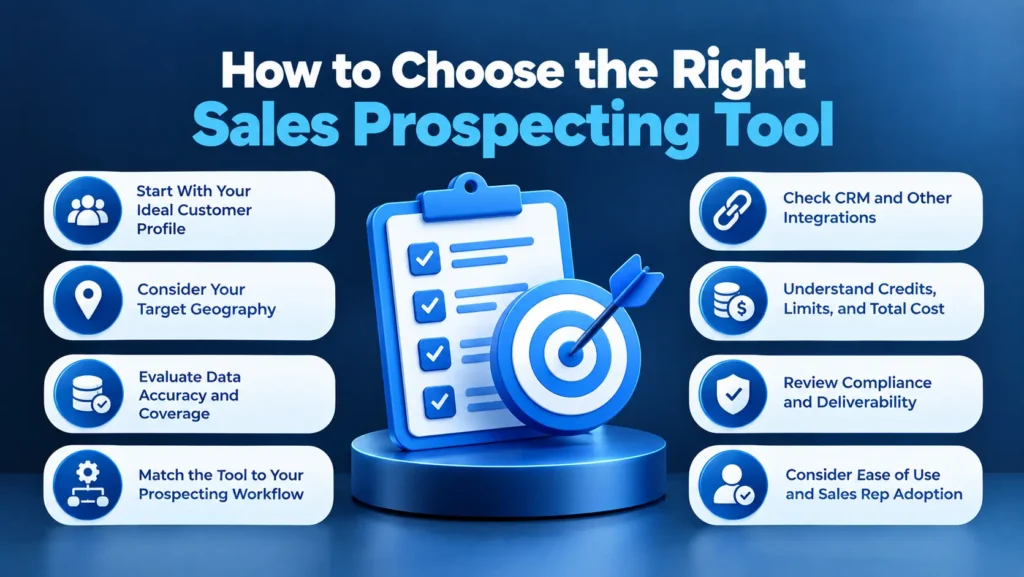
Start With Your Ideal Customer Profile
Define your target industries, company sizes, locations, job roles, and other qualification criteria first.
Then test whether the tool actually covers those accounts.
Consider Your Target Geography
Data quality can vary significantly between markets. A tool that works well for US prospecting may not perform equally well in every region.
Test your most important countries instead of assuming “global coverage” means equal coverage.
Evaluate Data Accuracy and Coverage
Check company matches, contact matches, email and phone availability, job-title accuracy, and freshness.
A smaller database with reliable ICP coverage is usually more useful than a massive database with weak coverage.
Match the Tool to Your Prospecting Workflow
Map your process:
Find → research → qualify → contact → follow up → record
Then buy for the weakest step.
Check CRM and Other Integrations
Make sure important information can move between your prospecting tool and CRM without manual exports.
Also check exactly what the integration syncs, rather than assuming every “integration” works the same way.
Understand Credits, Limits, and Total Cost
Look beyond the subscription price.
Some tools charge separately for data reveals, enrichment, AI actions, exports, or other usage. Clay, Cognism, and Leadfeeder are examples of platforms where usage mechanics are important to understand before buying.
Review Compliance and Deliverability
Your prospecting tool should fit the privacy, outreach, and data requirements of the markets you serve.
Also consider email authentication, suppression, opt-outs, and sending limits before scaling outbound activity.
Consider Ease of Use and Sales Rep Adoption
A tool only creates value when the team actually uses it.
Choose a workflow that reps can understand quickly, and managers can measure consistently.
Should You Use One Sales Prospecting Tool or a Full Stack?
When an All-in-One Tool Makes Sense
An all-in-one platform is usually best for smaller teams that value simplicity and do not yet need specialized systems.
When a Specialized Tool Stack Is Better
A specialized stack makes more sense when your sales operation has separate requirements for data, intent, engagement, CRM, and enrichment.
The goal should be fewer gaps, not more software.
Example Prospecting Stacks by Team Type
Small B2B team: one all-in-one prospecting tool + CRM.
Scaling SDR team: data platform + sales engagement + CRM.
Enterprise/ABM team: CRM + sales intelligence + intent + engagement.
LinkedIn-led team: Sales Navigator + CRM + engagement tools.
Website-led team: CRM + visitor identification + sales engagement.
How to Test a Sales Prospecting Tool Before Buying
Build a Representative ICP Test Set
Use real companies from your target market instead of random records.
Measure Usable Contact and Company Data
Compare how many relevant contacts, emails, phones, and accurate job titles each tool can actually provide.
Compare the Effective Cost per Usable Prospect
Calculate the cost based on usable records, not the size of the database.
Test the Tool With Your Existing Workflow
Run the complete process from prospect discovery through CRM sync.
Run a Small Real-World Outreach Test
Compare replies, meetings, qualified opportunities, and rep time, not just the number of contacts found.
Review Contracts, Credits, and Usage Terms
Check credit expiration, usage limits, extra charges, renewal terms, exports, and integration costs before committing.
Common Mistakes When Choosing Sales Prospecting Software
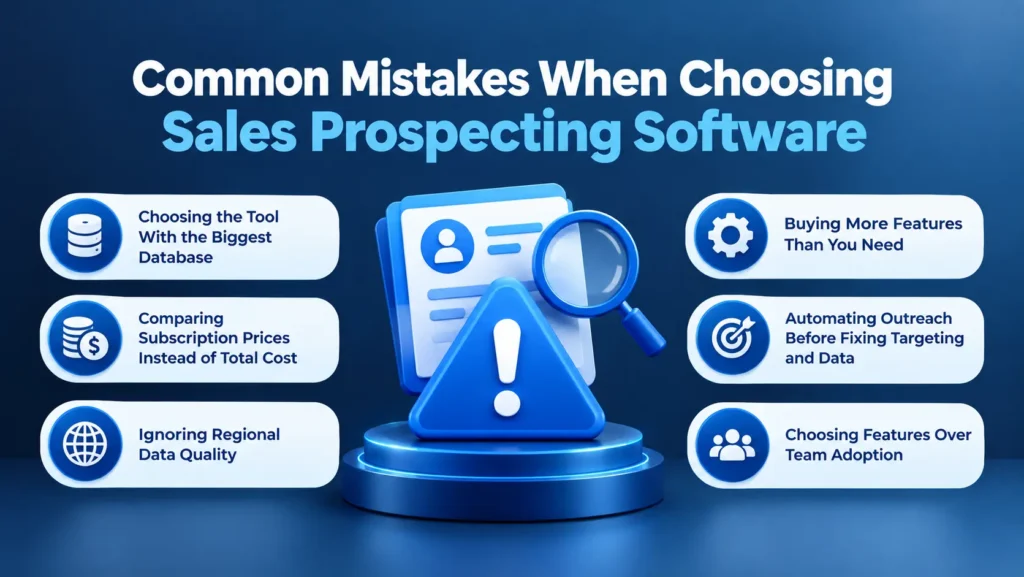
Choosing the Tool With the Biggest Database
Database size is a weak buying metric without ICP-level coverage.
Comparing Subscription Prices Instead of Total Cost
A cheap subscription can become expensive once usage and add-ons are included.
Ignoring Regional Data Quality
Always test the markets where you actually sell.
Buying More Features Than You Need
Do not buy intent software when your real problem is contact discovery, or another database when your real problem is follow-up.
Automating Outreach Before Fixing Targeting and Data
Automation cannot fix poor targeting. It only increases the speed of the existing process.
Choosing Features Over Team Adoption
A simpler tool that the sales team uses consistently can outperform a more powerful platform that creates friction.
The right prospecting tool is therefore not the one with the longest feature list. It is the one that improves the specific step in your sales process where time, data quality, or execution is currently breaking down.
FAQs About Sales Prospecting Tools
What are sales prospecting tools?
They are software products that help sales teams find, research, qualify, prioritize, or contact potential buyers.
What is the best sales prospecting tool?
There is no universal best option. Apollo is strong for all-in-one outbound, Sales Navigator for LinkedIn prospecting, Cognism for international data, Clay for enrichment, 6sense for intent, and Outreach or Salesloft for sales engagement.
How is a sales prospecting tool different from a CRM?
A prospecting tool helps you find and engage potential customers. A CRM stores customer and pipeline information and manages the sales process.
What’s the difference between sales intelligence and sales engagement software?
Sales intelligence helps you understand who to target and why. Sales engagement software helps you manage how and when to contact them.
Do small businesses need sales prospecting software?
Not necessarily. Software becomes more valuable when manual prospect research, list building, or follow-up starts consuming significant selling time.
Are sales prospecting tools worth the cost?
They can be when they improve measurable outcomes such as usable data, rep productivity, meetings, qualified opportunities, or pipeline.
How to check the accuracy of a sales prospecting database?
Build a sample of real target companies and compare contact match rate, email and phone accuracy, job titles, geography, freshness, and cost per usable record across the tools.
✨ Read more valuable knowledge @ Tech Statar.