

What Are Business Keywords?
Business keywords are the search terms people type into Google when looking for products, services, solutions, or information related to a company. They connect your website with potential customers who already have a specific need. Choosing the right keywords helps improve search visibility, attract qualified traffic, and increase conversions instead of random visits. According to Google, understanding user intent is a major part of delivering relevant search results, which makes keyword selection one of the foundations of successful SEO. Strong business keywords also support content planning, local SEO, brand awareness, and long-term organic growth.
Understand Your Business, Audience, and Search Intent Before Research
Successful keyword research starts with understanding your business goals, ideal customers, and the intent behind every search query. Ask what problems your audience wants to solve, which services they need, and what questions they ask before making a purchase. Search intent generally falls into informational, navigational, commercial, and transactional categories. Matching keywords to these stages improves content relevance and user satisfaction. Google’s Helpful Content system also rewards pages that genuinely answer user needs instead of simply repeating keywords, making audience-focused research essential for sustainable SEO success.
Build a List of Seed Keywords for Your Business
Seed keywords are the broad terms that describe your products, services, industry, or niche. They act as the starting point for discovering hundreds of related keyword opportunities. Begin by listing your core services, product categories, customer pain points, and industry terminology. Review your website navigation, customer support questions, competitor websites, and online reviews to uncover common phrases. You can also analyze Google autocomplete suggestions and related searches for additional ideas. A strong seed keyword list creates a reliable foundation for deeper keyword research and future content planning.
Find High-Value Business Keywords Using the Best SEO Tools
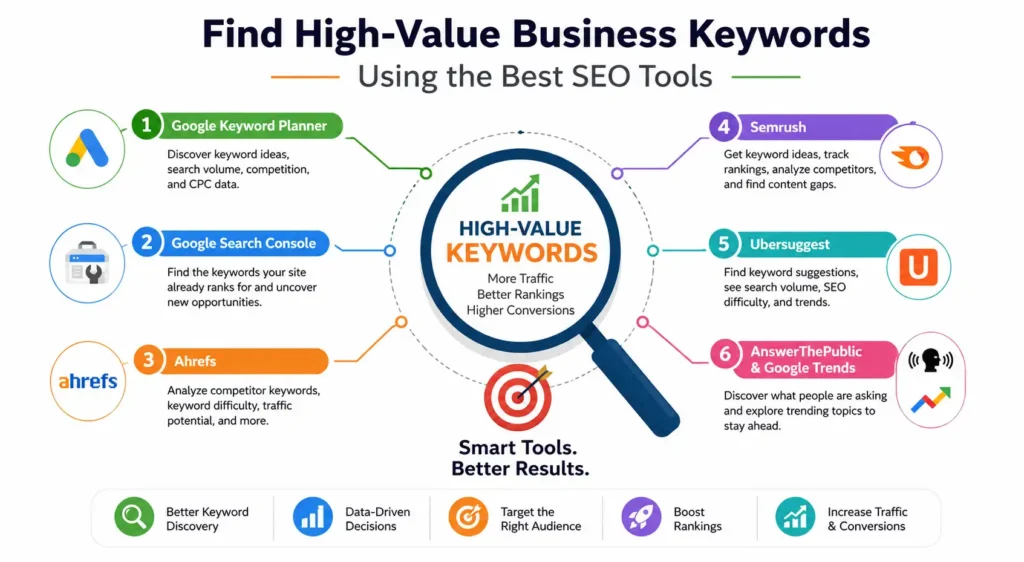
Keyword research tools help you discover search demand, competition levels, ranking opportunities, and user behavior faster than manual research. Instead of relying on guesswork, these platforms provide valuable data that supports smarter SEO decisions. Combining multiple tools often produces better results because each platform offers different insights, such as keyword suggestions, search trends, competitor analysis, and content opportunities. Google’s own tools provide first-party data, while premium SEO platforms deliver advanced competitive intelligence. Using both free and paid tools creates a well-rounded keyword strategy that supports consistent organic growth.
Google Keyword Planner
Google Keyword Planner remains one of the most trusted free keyword research tools because it uses Google’s advertising database. It provides keyword ideas, estimated monthly searches, competition levels, and bid ranges. While designed for advertisers, SEO professionals also use it to identify relevant business keywords with consistent search demand and discover related terms worth targeting in organic content.
Google Search Console
Google Search Console shows the keywords your website already ranks for in Google Search. It reveals impressions, clicks, click-through rate, and average ranking position for each query. This first-party data helps identify underperforming pages, discover hidden keyword opportunities, improve existing content, and prioritize keywords that have strong potential to generate additional organic traffic.
Ahrefs
Ahrefs is widely recognized for its powerful keyword database and competitor research capabilities. It provides keyword difficulty, search volume, traffic potential, click metrics, and related keyword ideas. Its Site Explorer also reveals which keywords drive traffic to competing websites, helping businesses uncover ranking opportunities and build more effective content strategies with confidence.
Semrush
Semrush offers a complete SEO toolkit that combines keyword research, competitor analysis, content planning, and rank tracking. Its Keyword Magic Tool generates thousands of keyword variations grouped by topic and intent. Businesses also use Semrush to monitor competitors, identify keyword gaps, and discover content opportunities that align with evolving search trends and user demand.
Ubersuggest
Ubersuggest is a beginner-friendly SEO platform that simplifies keyword research with search volume, SEO difficulty, paid difficulty, and seasonal trend data. It also suggests long-tail keywords, content ideas, and competitor insights. Small businesses and startups often choose Ubersuggest because it provides practical SEO recommendations without the complexity of larger enterprise platforms.
AnswerThePublic and Google Trends
AnswerThePublic helps uncover real questions people ask online, making it valuable for creating helpful, user-focused content. Google Trends complements this by showing how search interest changes over time across different regions. Using both tools together helps identify emerging topics, seasonal demand, and audience interests, allowing businesses to publish content that stays relevant and competitive.
🎯 More Helpful Guides: How AI Is Shaping SEO in 2026 – Detailed Guide
Analyze Keyword Metrics to Choose the Right Opportunities
Finding keywords is only the first step. The real value comes from evaluating the metrics behind each keyword before adding it to your SEO strategy. Looking at search volume alone can lead to poor decisions because high-traffic keywords are often highly competitive. Instead, compare multiple data points, including keyword difficulty, cost per click (CPC), search intent, traffic potential, and business value. This balanced approach helps you prioritize keywords that are easier to rank for while attracting visitors who are more likely to become customers. Smart analysis leads to better rankings, stronger ROI, and sustainable organic growth.
Research Competitor Keywords to Discover Hidden Opportunities
Competitor keyword research helps you uncover valuable opportunities that may already be driving traffic within your industry. Instead of starting from scratch, analyze websites that consistently rank for your target topics. This reveals which keywords, content formats, and SEO strategies are performing well. It also highlights gaps your competitors have overlooked, allowing you to create more useful and comprehensive content. According to multiple industry studies, competitive analysis is one of the fastest ways to identify high-performing keyword opportunities and strengthen your overall SEO strategy.
Identify Your Top SEO Competitors
Your SEO competitors are not always your direct business competitors. They are the websites ranking on the first page for your target keywords. Search your primary terms in Google and note which domains consistently appear. These websites provide valuable insights into successful keyword targeting, content structure, and optimization strategies within your niche.
Find Competitor Ranking Keywords
SEO tools like Ahrefs and Semrush allow you to see the keywords driving traffic to competing websites. Review their highest-ranking pages, identify recurring search terms, and analyze which keywords generate the most visibility. This research helps you discover proven opportunities and build content that competes for the same valuable search traffic.
Discover Keyword Gaps
A keyword gap analysis compares your website with competitors to find keywords they rank for that you currently miss. Filling these gaps expands your content coverage and increases your chances of attracting new audiences. Many SEO tools include keyword gap reports, making it easy to prioritize missing opportunities based on relevance and ranking potential.
Learn from High-Performing Content
Study your competitors’ best-performing pages to understand why they rank well. Analyze their content depth, heading structure, keyword placement, visuals, internal links, and user experience. Rather than copying their work, create a more complete, updated, and helpful resource that better satisfies search intent and provides additional value to readers.
Choose Long-Tail Keywords That Drive Qualified Traffic
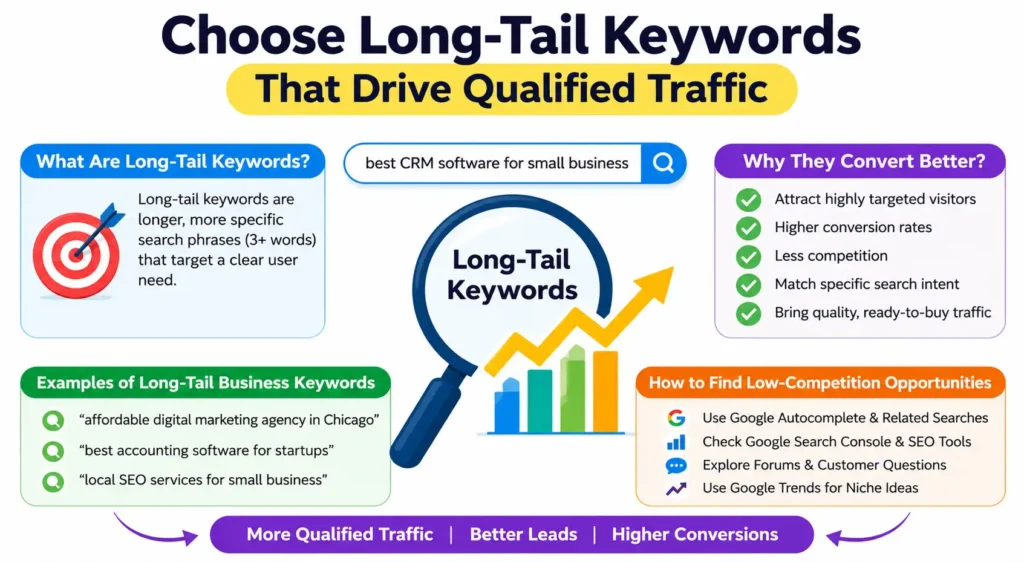
Long-tail keywords are longer, more specific search phrases that attract users with a clear goal or intent. Although they usually have lower search volume, they often deliver higher conversion rates because the searcher knows exactly what they need. These keywords also face less competition, making them easier to rank for, especially for newer websites. Incorporating long-tail keywords into your content strategy helps build topical authority, improve search relevance, and attract visitors who are more likely to engage, subscribe, request a quote, or make a purchase.
Why Long-Tail Keywords Convert Better
People using long-tail searches usually know what they want and are closer to making a decision. Their searches are more focused, reducing irrelevant traffic and increasing conversion rates. Research from multiple SEO studies consistently shows that highly specific keywords attract users with stronger purchase intent than broad, generic search terms.
Examples of Long-Tail Business Keywords
Examples include phrases like “best CRM software for startups,” “affordable digital marketing agency in Chicago,” “local bookkeeping services for small businesses,” and “how to improve ecommerce SEO.” These keywords target specific audiences, industries, and needs, making them ideal for attracting qualified visitors who are actively searching for tailored business solutions.
How to Find Low-Competition Opportunities
Use Google Autocomplete, People Also Ask, related searches, Google Search Console, and SEO tools to identify niche keyword variations. Filter results by lower keyword difficulty and high relevance. You can also review online forums, Reddit discussions, and customer questions to discover underserved topics that larger competitors may have overlooked.
🎯 More Helpful Guides: Best AI Content Writing Guide for SEO Success
Organize and Map Keywords to the Right Website Pages
A successful SEO strategy requires assigning every keyword to the most relevant page on your website. This process, known as keyword mapping, helps search engines understand your content structure while preventing multiple pages from competing for the same search term. Organizing keywords by products, services, categories, blogs, and landing pages also improves internal linking and topical authority. A clear keyword map ensures each page has a unique purpose, stronger relevance, and better ranking potential while creating a smoother navigation experience for visitors.
Assign Primary and Secondary Keywords
Every page should focus on one primary keyword supported by several related secondary keywords. The primary keyword represents the page’s main topic, while secondary keywords cover related phrases and semantic variations. This approach helps search engines understand the content naturally without relying on repetitive keyword usage.
Create Topic Clusters
Topic clusters organize related content around a central pillar page. Supporting articles cover specific subtopics and link back to the main resource. This structure improves internal linking, strengthens topical authority, and helps search engines understand your expertise across an entire subject rather than a single keyword.
Avoid Keyword Cannibalization
Keyword cannibalization occurs when multiple pages target the same keyword, causing them to compete against each other in search results. Instead of improving rankings, this often weakens overall performance. Assign unique target keywords to every page and regularly audit your content to eliminate unnecessary overlap or duplicate intent.
Optimize Product, Service, Category, and Blog Pages
Different page types serve different search intents. Product and service pages should target transactional keywords, category pages should focus on broader commercial terms, and blog posts should answer informational queries. Matching keywords with the correct page type improves relevance, rankings, and the overall customer journey from search to conversion.
Best Practices for Using Business Keywords Naturally
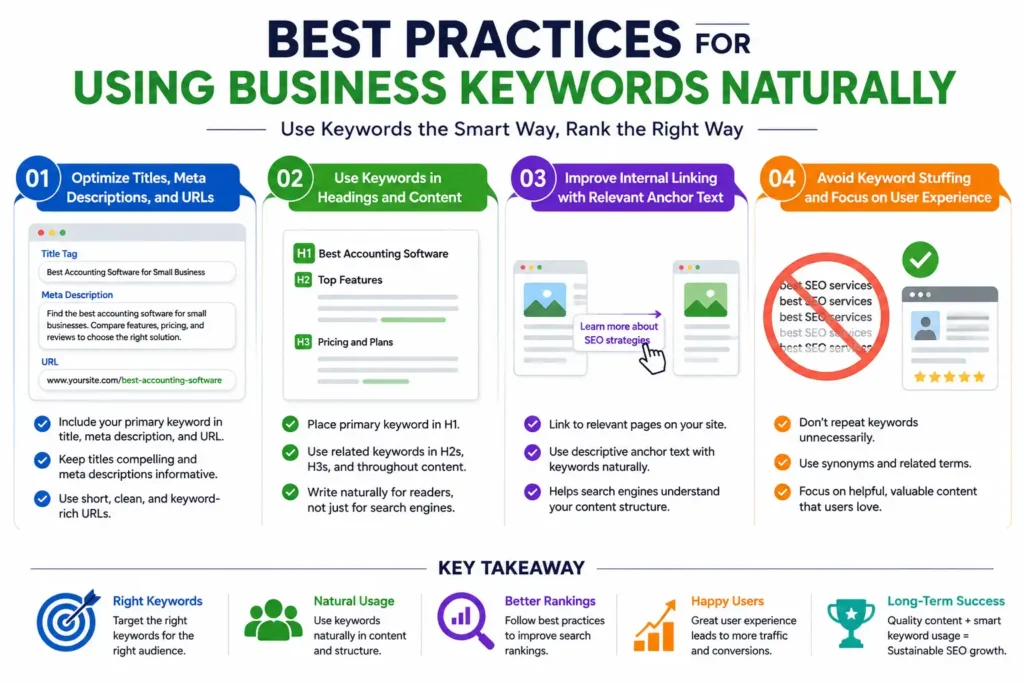
Using keywords effectively is about creating content that reads naturally while helping search engines understand your topic. Modern SEO focuses on context, relevance, and user experience rather than repeating exact-match phrases. Include keywords where they fit naturally, use semantic variations, and answer user questions clearly. Google’s ranking systems reward content that demonstrates expertise and satisfies search intent. By combining strategic keyword placement with valuable information, you can improve visibility without sacrificing readability, engagement, or trust, creating a better experience for both users and search engines.
Optimize Titles, Meta Descriptions, and URLs
Include your primary keyword in the page title, meta description, and URL whenever it fits naturally. Write compelling titles that encourage clicks while accurately describing the content. Short, descriptive URLs are easier for users and search engines to understand, improving both usability and SEO performance.
Use Keywords in Headings and Content
Place your primary keyword in the H1 heading and naturally include related keywords throughout H2s, H3s, introductions, and body content. Avoid forcing keywords into every paragraph. Instead, focus on answering user questions comprehensively while using semantic variations that improve topical relevance and readability.
Improve Internal Linking with Relevant Anchor Text
Internal links help search engines discover pages and understand how your content connects. Use descriptive anchor text that accurately reflects the linked page instead of generic phrases like “click here.” A strong internal linking strategy also distributes authority throughout your website and improves navigation for visitors.
Avoid Keyword Stuffing and Focus on User Experience
Keyword stuffing makes content difficult to read and can negatively impact rankings. Instead of repeating the same phrase excessively, use natural language, synonyms, and related terms. Prioritize clear explanations, helpful information, and a positive reading experience. Content created for people consistently performs better than content written only for search engines.
🎯 More Helpful Guides: How Business Directories Help Build Brand Awareness
Common Keyword Research Mistakes to Avoid and Final Checklist
Even the best keyword research tools cannot guarantee results if your strategy contains common mistakes. Many businesses focus only on search volume, ignore user intent, or fail to review keyword performance over time. These issues often lead to poor rankings, low engagement, and missed conversion opportunities. A successful keyword strategy should balance relevance, competition, business value, and search intent while adapting to changing search trends. By avoiding these common pitfalls and following a simple checklist, you can build a stronger SEO foundation that delivers consistent organic traffic and long-term business growth.
Frequently Asked Questions (FAQ)
What are business keywords in SEO?
Business keywords are search terms that describe your products, services, industry, or brand. They help search engines understand your website and connect it with users looking for related solutions. Choosing relevant business keywords improves visibility, attracts qualified traffic, and increases the chances of generating leads, sales, and long-term organic growth.
How do I find the best keywords for my business website?
Start by identifying your products, services, and target audience. Build a list of seed keywords, then expand it using tools like Google Keyword Planner, Google Search Console, Ahrefs, Semrush, and Google Trends. Evaluate search volume, keyword difficulty, search intent, and business value before selecting the most relevant opportunities for each page.
Which free tools are best for keyword research?
Some of the best free keyword research tools include Google Keyword Planner, Google Search Console, Google Trends, AnswerThePublic (free version), and Google Autocomplete. These tools provide valuable insights into search demand, user questions, keyword ideas, and performance data, making them excellent starting points for businesses with limited SEO budgets.
Should I target short-tail or long-tail keywords?
A balanced strategy works best. Short-tail keywords increase visibility and brand awareness, while long-tail keywords attract users with more specific needs and stronger purchase intent. Most businesses achieve better long-term SEO results by combining both, with a greater emphasis on long-tail keywords when building authority or targeting niche audiences.
Can I rank without targeting high-volume keywords?
Yes. Many websites achieve excellent SEO results by focusing on low-competition, long-tail keywords that closely match user intent. These keywords are generally easier to rank for and often generate more qualified traffic. As your website gains authority, you can gradually expand your strategy to include more competitive, higher-volume search terms.
🎯 More Helpful Guides: How Keyword Research Helps You Get Mentioned in Gemini
Conclusion
Finding the best business keywords is about more than choosing popular search terms. It requires understanding your audience, analyzing keyword metrics, studying competitors, targeting long-tail opportunities, and matching every keyword to the right page. A well-planned keyword strategy helps search engines understand your content while attracting visitors who are genuinely interested in your products or services.
Remember that SEO is an ongoing process, not a one-time project. Monitor your keyword performance, update your content regularly, and adapt your strategy as search behavior changes. By following the best practices outlined in this guide, you can build a stronger online presence, increase qualified organic traffic, and create a website that continues to grow alongside your business.
✨ Let’s keep leveling up together. Follow Tech Statar.











































One thought on “How to Find the Best Business Keywords for SEO”