

Best AI Tools for Writing Marketing Copy (2026 Guide)
Marketing copy has always been about finding the right words at the right time. What has changed in 2026 is how quickly those words can be created. AI writing tools now help businesses draft landing pages, email campaigns, social media captions, product descriptions, and advertising copy in minutes instead of hours. They don’t replace creative thinking, but they do make the writing process faster and more efficient.
The growing number of AI copywriting platforms also means choosing the right one has become more difficult. Some tools are built for marketers who need high-converting sales copy, while others focus on brainstorming ideas, maintaining a consistent brand voice, or creating content across multiple marketing channels. Picking the wrong platform can slow down your workflow instead of improving it.
This guide compares the best AI tools for writing marketing copy in 2026. You’ll learn what each platform does well, where it falls short, and which type of user it suits best. Whether you’re a freelancer, business owner, content marketer, or part of a marketing agency, this comparison will help you choose a tool that fits your workflow and budget.
What Are AI Marketing Copywriting Tools?
AI marketing copywriting tools are software applications powered by large language models that help users create persuasive marketing content. Instead of writing every sentence from scratch, you provide instructions, and the AI generates drafts based on your goals, audience, and preferred tone.
Modern AI writing tools are capable of producing much more than simple blog content. They can generate product descriptions, Google Ads, Facebook ads, email sequences, landing page copy, sales pages, video scripts, website headlines, promotional messages, and virtually any type of marketing content.
While these tools have become remarkably capable, they still work best as writing assistants rather than complete replacements for human expertise. The strongest marketing copy combines AI-generated efficiency with human editing, brand knowledge, and strategic thinking.
How AI Copywriting Tools Work
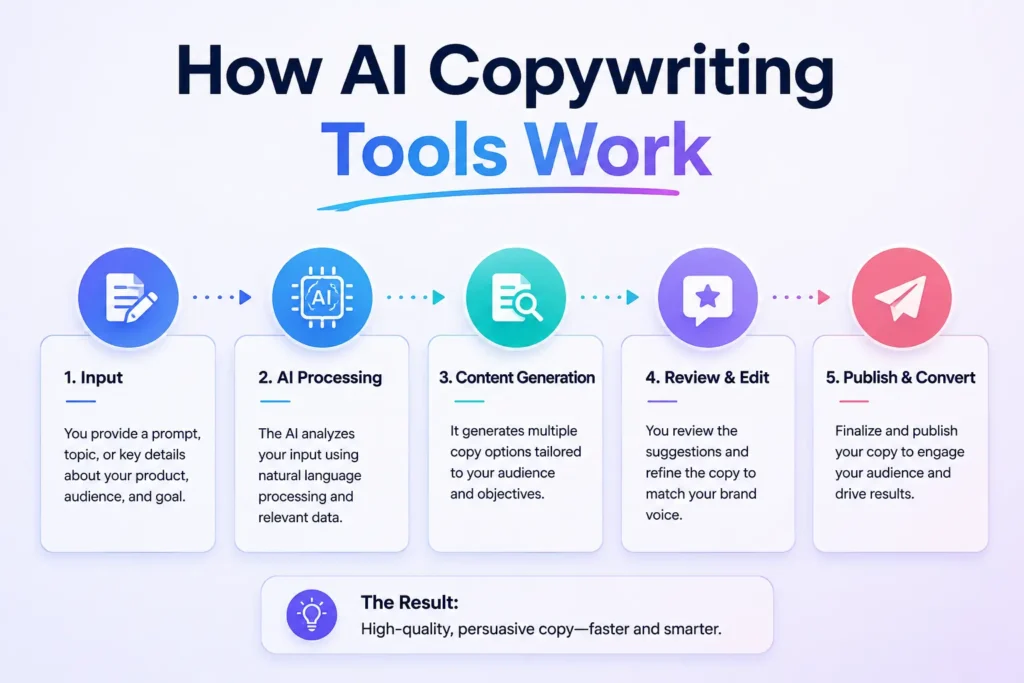
Most AI copywriting platforms rely on advanced language models trained on massive collections of publicly available text. When you provide a prompt, the AI predicts the most appropriate words based on your instructions, context, and writing objective.
Many modern platforms also include features beyond text generation. They allow users to save brand guidelines, adjust tone of voice, rewrite existing copy, summarize information, and generate multiple variations for testing. Some even integrate with SEO tools, CRM platforms, document editors, and marketing software to streamline content production.
The quality of the final output depends heavily on the prompt you provide. Clear instructions usually produce stronger results than vague requests, which is why experienced marketers spend time refining prompts before generating copy.
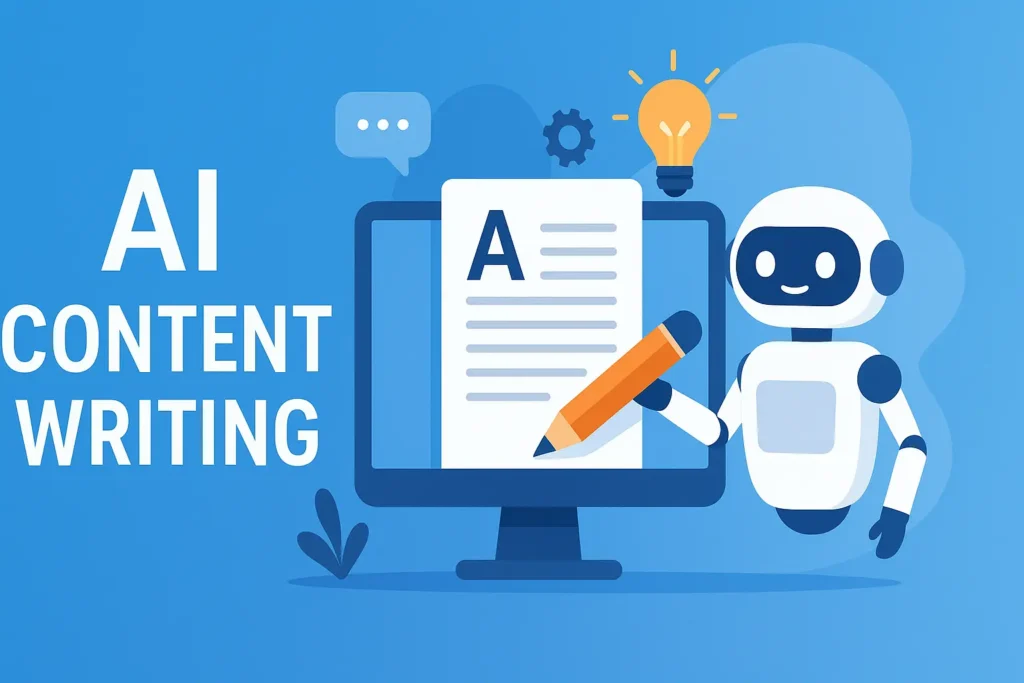
🔥 More on This Topic :: AI Content Writing Guide
Types of Marketing Copy You Can Create
One of the biggest advantages of AI writing software is its versatility. Instead of switching between multiple tools, marketers can create different types of content within a single platform.
Businesses commonly use AI to write website copy, landing pages, email newsletters, paid advertising campaigns, product descriptions, social media posts, promotional offers, video scripts, press releases, and sales emails. Many teams also use AI during brainstorming sessions to generate campaign ideas, headlines, and calls to action before refining the final message.
This flexibility makes AI useful for startups with limited resources as well as larger marketing teams managing multiple campaigns simultaneously.
Who Should Use AI Copywriting Tools?
AI copywriting tools are valuable for almost anyone involved in content creation or digital marketing.
Freelancers can speed up client work without sacrificing quality. Small business owners can create marketing content without hiring a full-time copywriter for every project. Marketing agencies can produce first drafts more efficiently while allowing experienced editors to polish the final copy. E-commerce brands can generate product descriptions at scale, and content marketers can quickly develop campaign ideas for different channels.
Even experienced copywriters benefit from AI because it reduces repetitive work. Instead of spending hours creating first drafts, they can focus on strategy, storytelling, and conversion optimization.
Best AI Tools for Writing Marketing Copy in 2026
1. ChatGPT
ChatGPT remains one of the most versatile AI writing tools available in 2026. Rather than relying on fixed templates, it allows users to generate marketing copy through natural conversations, making it suitable for a wide range of projects.
Its biggest strength is flexibility. A single prompt can produce landing page headlines, email campaigns, product descriptions, advertising copy, social media captions, or complete marketing strategies. Users can continue refining the conversation until the content matches their goals, making it particularly useful for marketers who prefer collaboration over rigid workflows.
Recent improvements have also made ChatGPT better at maintaining context throughout long conversations. This helps businesses create consistent messaging across multiple campaigns without repeating the same instructions every time.
The platform works well for freelancers, agencies, entrepreneurs, and content teams that need an all-purpose AI assistant rather than software designed for one specific marketing task.
2. Jasper AI
Jasper AI is one of the leading AI content platforms built specifically for marketers and marketing teams. Unlike general-purpose AI assistants, Jasper focuses heavily on business content creation, making it a strong choice for organizations that produce marketing copy every day.
One feature that sets Jasper apart is its emphasis on brand consistency. Teams can create brand guidelines, preferred messaging, writing styles, and tone preferences so that generated content remains aligned with company standards. This becomes especially valuable for businesses with multiple writers working across different campaigns.
Jasper also offers a wide collection of marketing-focused workflows that simplify the creation of ad copy, email sequences, landing pages, product pages, and promotional content. Instead of starting with a blank page, users can build from structured templates designed for common marketing objectives.
Although Jasper generally costs more than many alternatives, its collaboration features and brand management capabilities make it particularly attractive for growing businesses and marketing agencies that prioritize consistency over simple text generation.
3. Copy.ai
Copy.ai has evolved from a simple copywriting assistant into a broader AI platform that supports marketing, sales, and content workflows. It remains a popular choice for businesses that want to create marketing copy quickly without spending time learning complex prompts.
The platform offers ready-made workflows for common marketing tasks, making it approachable for beginners. Whether you’re writing a promotional email, crafting product descriptions, or creating social media campaigns, Copy.ai guides users through the process with structured templates instead of requiring detailed instructions.
Another advantage is its focus on workflow automation. Marketing teams can use Copy.ai to streamline repetitive content tasks, allowing them to spend more time refining messaging and improving campaign performance.
While experienced copywriters may prefer the flexibility of conversational AI tools, Copy.ai works particularly well for small businesses and marketers who value speed and simplicity.
4. Writesonic
Writesonic is designed for marketers who need both copywriting and SEO support in one platform. Over the years, it has expanded beyond marketing copy to include blog writing, landing page creation, product descriptions, and AI-assisted content optimization.
One of its biggest strengths is helping users produce content for multiple marketing channels without switching between different tools. Whether you’re creating Google Ads, Facebook campaigns, email newsletters, or website copy, Writesonic provides dedicated writing experiences tailored to each format.
The platform also includes features that help users maintain a consistent tone while generating content at scale. This makes it useful for businesses managing multiple brands or running frequent marketing campaigns throughout the year.
For marketers who want a balance between creative writing and search-focused content creation, Writesonic remains one of the strongest all-around options in 2026.
5. Anyword
Anyword takes a more data-driven approach to AI copywriting than many of its competitors. Instead of simply generating text, it focuses on creating marketing copy that is designed to improve conversions and campaign performance.
The platform is particularly well known for its predictive performance features, which estimate how different versions of copy may perform before they are published. While no prediction can guarantee results, these insights can help marketers compare multiple variations and make more informed decisions.
Anyword also supports personalized messaging for different customer segments, making it useful for businesses running targeted advertising campaigns across various platforms.
Because of its focus on performance marketing, Anyword is often chosen by growth marketers, advertising teams, and ecommerce businesses looking to optimize conversion rates rather than simply generate content faster.
6. Rytr
Rytr has built its reputation by offering a straightforward and budget-friendly AI writing experience. It doesn’t include as many advanced features as some premium competitors, but it delivers solid results for everyday marketing tasks.
The platform is capable of generating blog introductions, ad copy, email content, product descriptions, website headlines, and social media posts with minimal setup. Its clean interface makes it easy for new users to start writing immediately without spending hours learning the software.
For freelancers, startups, and solo entrepreneurs with limited budgets, Rytr offers an accessible entry point into AI-assisted copywriting. While larger organizations may eventually outgrow its capabilities, it remains a practical option for users who need reliable content generation without paying enterprise-level pricing.
7. Grammarly
While Grammarly started as a writing assistant, it has evolved into a powerful AI tool with features that go far beyond grammar correction.
Instead of replacing the writing process, Grammarly focuses on improving it. The platform helps refine grammar, clarity, readability, sentence structure, and tone while also offering AI-powered drafting and rewriting features.
For marketers, this means existing copy can be polished before publication, reducing awkward phrasing and improving overall readability. Teams that already produce their own content often use Grammarly as the final editing layer rather than the primary content generator.
Its seamless integration with browsers, email platforms, document editors, and workplace applications also makes it one of the easiest AI writing assistants to incorporate into an existing workflow.
8. Claude
Claude has become one of the strongest AI assistants for long-form writing and thoughtful content creation. Its writing style tends to feel natural, balanced, and conversational, making it especially effective for brands that prioritize quality over quantity.
One area where Claude stands out is its ability to follow detailed instructions while maintaining consistency across lengthy documents. This makes it valuable for creating landing pages, email sequences, brand messaging, and educational marketing content that requires logical structure and a coherent voice.
Many writers also appreciate Claude’s ability to refine existing drafts instead of simply generating new ones. It performs particularly well when rewriting copy for clarity, adjusting tone, or expanding ideas without making the content feel repetitive.
Businesses that emphasize trust, authority, and informative marketing often find Claude to be an excellent addition to their content workflow.
9. Gemini
Gemini has become an increasingly capable AI assistant for marketers who work within Google’s ecosystem. Its ability to connect with various productivity tools makes it especially useful for businesses already relying on Google Workspace.
Beyond generating marketing copy, Gemini can assist with brainstorming campaign ideas, organizing content plans, drafting promotional emails, and refining messaging across different channels.
Its understanding of context has also improved considerably, allowing users to create more cohesive marketing campaigns while reducing the need for repeated instructions.
For organizations that manage content across collaborative cloud-based environments, Gemini provides a convenient solution that fits naturally into existing workflows.
10. Notion AI
Notion AI is designed for teams that manage both content creation and project organization in a single workspace. Instead of functioning solely as a copywriting tool, it combines AI writing assistance with documentation, planning, and collaboration.
Marketing teams often use Notion AI to develop campaign briefs, summarize research, draft promotional content, organize editorial calendars, and refine internal documentation. Since everything stays within the same workspace, collaboration becomes more efficient, and information remains easier to manage.
While Notion AI may not offer the specialized marketing features found in dedicated copywriting platforms, its integration with team workflows makes it particularly valuable for businesses that prioritize organization alongside content production.
Comparison of the Best AI Marketing Copywriting Tools
Choosing the right AI tool depends less on finding the platform with the longest feature list and more on selecting one that matches your daily workflow.
ChatGPT stands out for its flexibility and ability to handle almost any marketing writing task through natural conversations. Jasper AI is better suited for businesses that require consistent brand messaging across multiple writers and campaigns. Copy.ai focuses on simplicity, making it a practical choice for users who prefer structured workflows over prompt engineering.
Writesonic offers an excellent balance between AI copywriting and SEO-focused content creation, while Anyword appeals to performance marketers looking for data-backed optimization. Rytr remains a strong budget-friendly solution for freelancers and small businesses, whereas Grammarly excels at polishing and improving existing content rather than replacing the writing process.
Claude is an excellent option for thoughtful, high-quality long-form marketing content. Gemini integrates naturally into Google’s productivity ecosystem, and Notion AI serves teams that want content creation and project management within the same platform.
Rather than asking which tool is objectively the best, marketers should focus on which platform aligns with their goals, workflow, team size, and budget. In many cases, businesses even combine two complementary tools to create a more efficient content creation process.
How to Choose the Best AI Tool for Marketing Copy
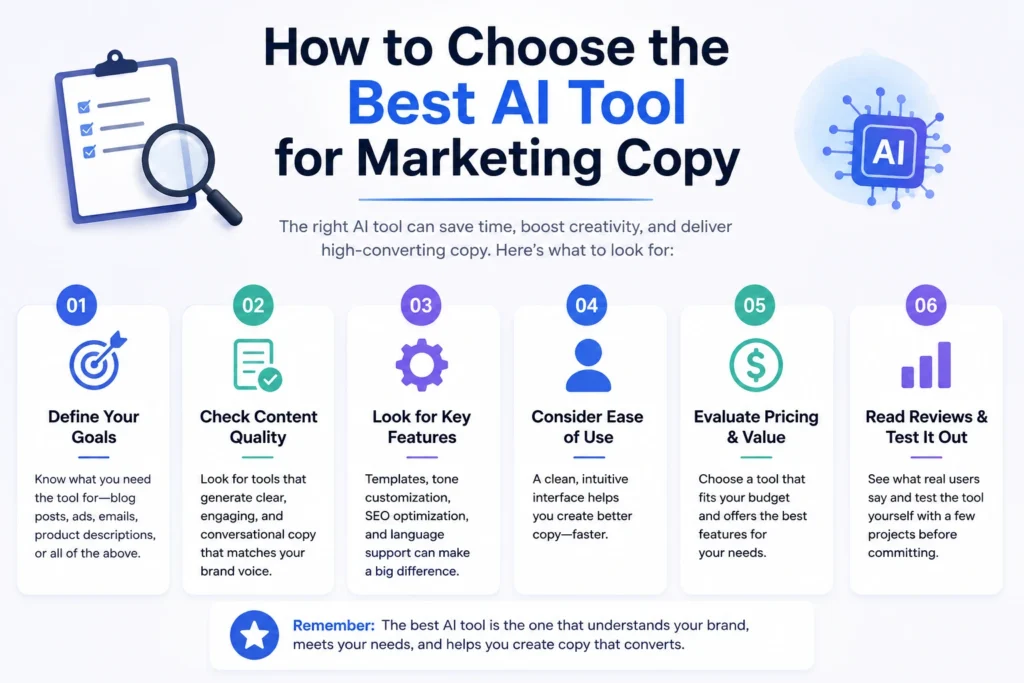
The best AI copywriting tool isn’t necessarily the one with the most features. It’s the one that fits the way you work. Before choosing a platform, consider the type of content you create most often, the size of your team, and how much control you want over the content creation process.
If content quality is your top priority, look for a tool that produces natural, context-aware writing instead of generic text. The best platforms generate a strong first draft, but they also respond well to detailed instructions and revisions.
Ease of use is another important factor. Some tools are built around templates, making them ideal for beginners, while others rely on conversational prompts that offer greater flexibility. Choose a platform that matches your experience level so you can spend more time creating content and less time learning the software.
Pricing should also align with your needs. Freelancers and small businesses may be perfectly served by a free plan or an affordable subscription, whereas agencies and larger marketing teams often benefit from premium features such as brand voice management, collaboration tools, and workflow automation.
Finally, choose a platform that integrates seamlessly with the tools you already use. A smooth workflow can save just as much time as faster content generation.
Benefits of Using AI for Marketing Copy
AI has become an essential productivity tool for many marketing teams because it speeds up the writing process without eliminating the need for human creativity.
One of its biggest advantages is time savings. Instead of staring at a blank page, marketers can generate a solid first draft within minutes and spend their energy refining the message rather than creating it from scratch.
AI also helps overcome writer’s block. Whether you need fresh headline ideas, stronger calls to action, or alternative campaign angles, AI can quickly generate multiple options that inspire new directions.
Another benefit is consistency. Businesses that publish content across websites, email campaigns, social media, and paid advertisements can use AI to maintain a similar tone and messaging throughout their marketing efforts.
For growing businesses, AI also makes scaling content production much easier. Teams can create more campaigns without increasing writing time, allowing them to support new products, seasonal promotions, and ongoing marketing initiatives more efficiently.
Limitations of AI Copywriting Tools
Despite their impressive capabilities, AI writing tools are not perfect.
AI models can occasionally produce inaccurate information, outdated facts, or statements that sound convincing but require verification. This is especially important when creating content related to finance, healthcare, legal topics, or technical industries.
AI also lacks genuine human experience. While it can imitate persuasive writing, it cannot fully understand customer emotions, personal stories, or unique brand experiences the way an experienced copywriter can.
Another limitation is originality. If prompts are too broad, the generated copy may feel generic or similar to what other users receive. Providing detailed instructions, audience information, and brand context usually leads to far stronger results.
For these reasons, AI should be viewed as a writing partner rather than a replacement for strategic thinking. Human editing remains essential before publishing any marketing content.
Tips for Getting Better Results from AI Copywriting Tools
The quality of AI-generated copy depends heavily on the quality of your instructions.
Instead of asking for “marketing copy,” explain exactly what you need. Mention your audience, product, objective, preferred tone, desired length, and any important details the AI should include. The more context you provide, the better the output will usually be.
It’s also worth generating multiple versions of the same piece of copy. Comparing different headlines, introductions, or calls to action often leads to stronger final content than accepting the first draft.
Always review AI-generated text before publishing. Check facts, improve readability, remove unnecessary repetition, and adjust the wording to match your brand voice. This final editing stage is often what separates average marketing copy from content that genuinely connects with readers.
The most successful marketers don’t rely entirely on AI or entirely on manual writing. They combine the speed of AI with human creativity, experience, and strategic thinking to produce content that is both efficient and effective.
Conclusion
AI copywriting tools have transformed the way businesses create marketing content, but the best platform depends on your specific needs. Some tools excel at flexible conversations, others specialize in brand consistency, SEO-focused content, workflow automation, or conversion optimization.
Rather than searching for a single perfect solution, focus on finding a tool that complements your workflow and helps you create better marketing copy more efficiently. Whether you’re a freelancer managing multiple clients, a startup building its online presence, or an agency running campaigns at scale, the right AI assistant can significantly improve productivity without replacing the value of human creativity.
As AI continues to evolve throughout 2026 and beyond, marketers who learn to combine smart prompting with thoughtful editing will be in the strongest position to create content that attracts attention, builds trust, and drives meaningful business results.
FAQs
What is the best AI tool for writing marketing copy?
There’s no one-size-fits-all solution. ChatGPT is highly versatile, Jasper AI is excellent for maintaining a consistent brand voice, Writesonic combines copywriting with SEO features, and Anyword is a strong choice for marketers focused on improving conversions.
Can AI write high-converting marketing copy?
AI can produce persuasive first drafts, generate creative ideas, and suggest multiple variations for testing. However, the highest-converting marketing copy usually comes from combining AI-generated content with human editing, audience research, and conversion-focused strategy.
Are free AI copywriting tools worth using?
Yes. Many free plans offer enough functionality for freelancers, students, and small businesses to create quality marketing content. As your content needs grow, upgrading to a paid plan may provide advanced features such as collaboration tools, brand voice settings, and workflow automation.
Which AI tool is best for beginners?
Copy.ai and Rytr are both beginner-friendly because they offer intuitive interfaces and ready-made writing workflows. ChatGPT is also an excellent option for beginners who are willing to learn how to write effective prompts.
Will AI replace human copywriters?
AI is changing how copywriters work, but it is unlikely to replace skilled professionals. Human writers bring creativity, emotional understanding, strategic thinking, and brand expertise that AI cannot fully replicate. The most effective approach is to use AI as a productivity tool while relying on human judgment to shape the final message.
🖇This is what better content looks like. Follow Tech Statar for more.




































2 thoughts on “Best AI Tools for Writing Marketing Copy (2026 Guide)”