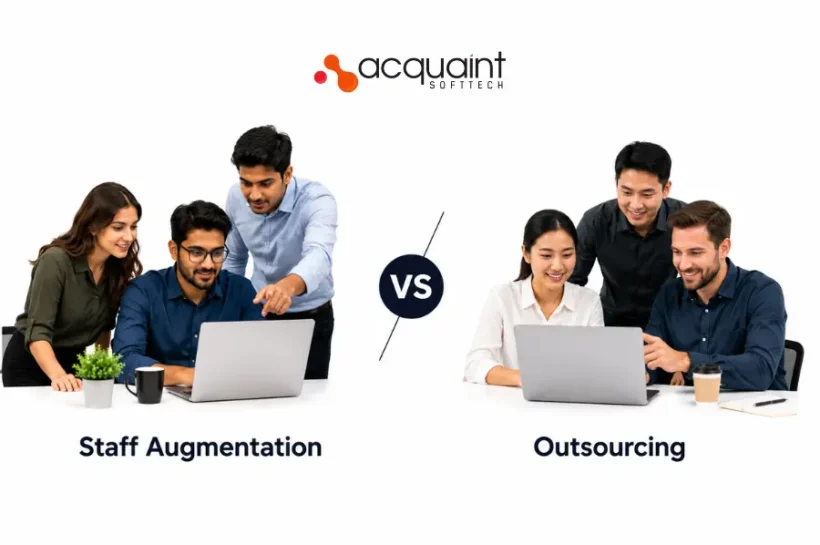

Staff Augmentation vs Outsourcing: Which is Right for Your Business?
Most businesses make this decision at the worst possible time. A product deadline is approaching. The internal team is stretched. Someone in leadership says, “We just need more developers.” And suddenly the conversation turns into a quick Google search for the cheapest vendor.
That rush is exactly where things go wrong. Understanding the difference between Staff Augmentation and Software Development Outsourcing is not just a procurement question. It is a strategic one. Both models are widely used, both deliver real results when applied correctly, and both can become expensive mistakes when applied to the wrong situation.
These are two very different strategies. They solve different problems, work in different environments, and carry entirely different operational risks. Choosing one over the other without understanding both can cost you months of rework, budget overruns, and team friction.
This guide breaks both models down, what they actually mean in practice, where each works, and how to decide.
What Is Staff Augmentation?
Staff augmentation means bringing in external talent to work directly within your existing team. These are skilled professionals, developers, designers, QA engineers, and data scientists who integrate into your workflows, attend your standups, use your tools, and operate under your day-to-day direction. The vendor provides the headcount. You provide the direction.
Think of it as extending your team without going through a full-time hiring cycle.
Where it works best:
You have a defined project, but lack specific technical skills in-house.
You want direct control over how work gets done.
Your team already has strong processes and just needs more hands.
You are dealing with a temporary capacity gap, not a permanent one.
A common example: a fintech startup building a mobile app already has a product manager and a backend team, but lacks iOS expertise. Rather than hiring a full-time iOS engineer, which takes months and comes with long-term salary commitments, they bring in an augmented developer for six to eight months. The work gets done. The cost stays predictable. The team retains oversight.
According to a 2024 report by Statista, the global IT staff augmentation market is projected to reach over $81 billion by 2025, driven largely by demand for flexible, scalable tech talent.
For teams that want to maintain control while accessing specialised talent, IT staff augmentation services are particularly valuable during growth phases when the scope of required skills keeps shifting. Instead of locking into permanent hires too early, businesses can bring in the exact expertise needed for each stage of the product roadmap.
What Is Software Development Outsourcing?
Outsourcing transfers responsibility for a project, or an entire function, to an external team or vendor. You define the outcome. The vendor figures out the execution. You are not managing their daily work. You are evaluating their results.
This is a fundamentally different relationship. The vendor brings their own processes, their own project management, and their own technical decisions. You review deliverables at agreed milestones and maintain strategic oversight, but not operational control.
Where it works best:
You need a complete product or feature built end-to-end.
Your internal team does not have the capacity or expertise to manage technical execution.
You want fixed costs and contractual accountability for delivery.
Speed to market is the priority, and you trust the vendor to get there.
A mid-sized e-commerce business that wants to build a new recommendation engine but has no data science team internally is a strong outsourcing candidate. They can define what they want, better personalisation and higher average order value, and hand execution to a vendor with that specific expertise.
Companies exploring full-cycle delivery will find that working with a software development outsourcing company removes significant internal burden, especially for businesses where engineering is not the core competency. A vendor who handles architecture, development, testing, and deployment end-to-end allows leadership to stay focused on business outcomes rather than technical execution.
Staff Augmentation vs Outsourcing: Quick Comparison
The table below summarises the core differences across the dimensions that matter most when making this decision:
| Dimension | Staff Augmentation | Outsourcing |
| Control | Full day-to-day control by your team | Vendor owns execution, you review outcomes |
| Cost Model | Time and materials, flexible | Fixed price or milestone-based |
| Best For | Capacity gaps and evolving requirements | Defined scope and complete product builds |
| Knowledge Retention | Stays with your internal team | Risk of knowledge lock-in with the vendor |
| Management Load | Higher requires internal leadership | Lower, the vendor handles daily operations |
| Integration Speed | Moderate, onboarding into your workflow | Fast once the scope is clearly defined |
| Scalability | Linear, add or remove individuals | Project-level, the vendor scales their team |
Key Differences Between the Two Models
Understanding the structural differences makes the decision much clearer.
1. Control and Management
With staff augmentation, your managers are directing the work every day. You set priorities, review code, give feedback, and make technical calls. Augmented team members are integrated into your culture and processes. For companies that need long-term scaling and stronger ownership, many also prefer using a dedicated software development team model to maintain better collaboration and consistency across projects.
With outsourcing, the external team owns execution. Your involvement is at the requirements and delivery level, not the task level. If you want to micromanage, outsourcing creates friction. If you trust the vendor, it creates speed. For businesses looking for a more balanced approach between control and delivery ownership, dedicated software development teams can provide a practical middle ground.
2. Cost Structure
Staff augmentation typically follows a time-and-materials model. You pay for hours worked, and the total cost depends on how long you engage the talent. This gives flexibility but less cost certainty.
Outsourcing is often structured around fixed-price or milestone-based contracts. You agree on a scope and a price up front. This provides cost predictability but requires tight requirement definition from the start. Vague requirements in an outsourcing contract tend to produce expensive scope change requests later.
3. Intellectual Property and Knowledge Retention
Augmented staff work inside your codebase, your repositories, and your documentation. When they leave, your internal team already understands the work because they were part of it.
With outsourcing, knowledge can become trapped in the vendor’s team. If the relationship ends without proper documentation and handoffs, you can find yourself dependent on the same vendor for future changes. This is a real risk for early-stage companies.
4. Scalability
Both models offer scalability, but in different ways. Staff augmentation scales linearly. Need two more developers next sprint? Your vendor adds them. Want to reduce it to one? You reduce the contract. Businesses that need flexible team expansion often choose to hire dedicated developers because it allows them to quickly increase or reduce resources based on project needs.
Outsourcing scales at the project level. The vendor manages their internal team to hit your milestones. You do not decide how many engineers to put on the problem.
When Staff Augmentation Makes More Sense

Consider staff augmentation when your primary constraint is capacity, not expertise ownership. If you have a functioning engineering culture, established processes, and clear technical direction, but simply need more skilled hands, augmentation gives you that without the overhead of full-time hiring.
It also works well when your needs are evolving. Product teams in growth stages often do not know exactly what skill sets they will need six months from now. Augmented talent can be adjusted as requirements become clearer.
Specific situations that favour augmentation:
You need a senior engineer to mentor your junior team while delivering.
You are offering short-term support due to a staffing change or absence.
You are building a product internally, but lacking one specialised discipline.
You are working in a regulated industry and need oversight over every technical decision.
When Outsourcing Makes More Sense

Consider outsourcing when the outcome is clearer than your capacity to get there. If you can define what you need, a working CRM integration, a customer portal, and a data pipeline, but do not have the internal team to build it, outsourcing lets you buy the result rather than the process.
It also works when you want to move quickly without building internal infrastructure first. Hiring, onboarding, and managing a team takes months. A capable outsourcing vendor can begin delivery in weeks.
Specific situations that favour outsourcing:
You are a non-technical founder who needs a working product without building an in-house team.
You are expanding into a new market and need a custom integration built from scratch.
You have a well-documented requirement and a fixed budget.
Your core business is not technology, and software is a means to an end.
🔥 You might also like: Biometric Queue System
The Hybrid Approach
Many mature technology organisations use both models simultaneously. Their product team is augmented with specialists during high-growth phases. Meanwhile, their marketing tech stack or internal tooling is fully outsourced to a vendor who manages it independently.
This is not a contradiction. It is a recognition that different parts of a business have different needs. The key is being deliberate about which model applies where and not defaulting to the same approach for every situation simply because it is familiar.
Common Mistakes to Avoid
Choosing outsourcing to avoid management work. Outsourcing reduces operational management, not strategic management. If you are not invested enough to define requirements clearly and review deliverables critically, the project will drift.
Choosing augmentation without internal leadership. Augmented talent needs direction. If your internal team does not have the seniority or bandwidth to lead, augmentation adds headcount without adding momentum.
Treating cost as the primary decision factor. The cheapest staff augmentation vendor is often the one with the highest turnover. The cheapest outsourcing contract is often the one with the most scope creep clauses. Total cost of engagement matters more than day rates.
Ignoring cultural fit. For augmentation, especially, the engineers who integrate fastest are the ones who align with your team’s communication norms, feedback culture, and working cadence. A technically excellent developer who cannot work in your environment is a friction point.
🔥 You might also like: Remote Team Management Tips
How to Make the Decision
Ask these four questions before committing:
How much control do we need over day-to-day execution?
High control points to Staff Augmentation. Output-based accountability points to Outsourcing.
How clearly can we define the end result?
Vague, evolving requirements suit Staff Augmentation. A clear, documented scope suits Outsourcing.
What is our internal management capacity?
Strong internal leadership means either model works. Limited PM bandwidth favours outsourcing with milestone accountability.
How long is the engagement?
Short-term specialised needs suit Augmentation. A complete product build suits Outsourcing.
Typical Engagement Cost Reference
The figures below reflect general market ranges and will vary by region, technology stack, and vendor experience level:
| Model | Typical Rate Range | Contract Type | Risk Profile |
| Staff Augmentation | $25 to $150 per hour | Time and Materials | Scope creep if unmanaged |
| Outsourcing | $10,000 to $500,000+ per project | Fixed Price or Milestones | Poor requirements cause overruns |
| Hybrid | Varies by component | Mixed | Requires strong coordination |
The Bottom Line
There is no universally correct answer between staff augmentation and outsourcing. The right model depends on how your team is structured, what your project requires, and how much operational control you need. Both models have delivered significant results for businesses that chose them deliberately.
What consistently fails is defaulting to one model out of habit, pressure, or misunderstanding of what each actually offers. Take the time to assess your real constraint. Is it capacity, expertise, speed, or control? That question, answered honestly, usually points to the right model. The businesses that scale their technology effectively are rarely the ones that move the fastest. They are the ones who make structural decisions carefully and execute them well.
🖇This is what better content looks like. Follow Tech Statar for more.