
How AI Compliance Helps Businesses Meet Regulatory Requirements
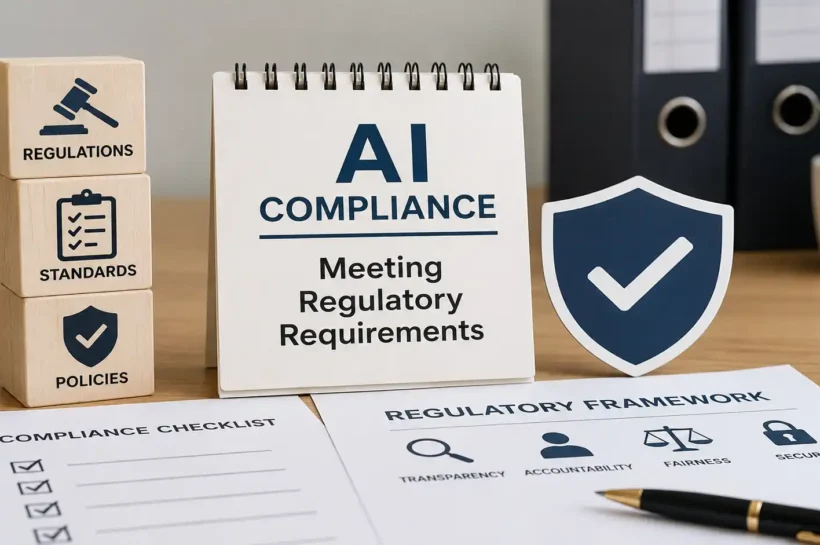
Artificial intelligence is transforming industries at an unprecedented pace, from healthcare diagnostics to financial forecasting and customer service automation. Yet this rapid adoption brings complex regulatory challenges. Businesses must navigate a growing web of rules designed to protect data privacy, ensure fairness, promote transparency, and mitigate societal risks. AI compliance structured processes for aligning AI systems with legal and ethical standards have become essential for responsible innovation and operational resilience.
Effective compliance does more than avoid penalties. It builds customer trust, reduces operational risks, and creates competitive advantages through more robust, explainable systems. Organizations that treat compliance as a strategic framework rather than a checkbox can deploy AI more confidently while minimizing legal exposure.
The Evolving Regulatory Landscape for AI
Global regulators have responded to AI’s growth with targeted frameworks. In the European Union, the AI Act represents the world’s first comprehensive AI-specific legislation. It classifies systems by risk level: unacceptable (prohibited), high, limited, and minimal. High-risk applications, such as those in employment, education, or critical infrastructure, face strict requirements including risk assessments, transparency obligations, human oversight, and conformity assessments.
Data privacy laws intersect heavily with AI. The EU’s General Data Protection Regulation (GDPR) applies whenever personal data powers AI models. It demands a lawful basis for processing, data minimization, purpose limitation, and rights like access, rectification, and objection to automated decisions. Violations can result in fines up to 4% of global annual turnover.
In the United States, the California Consumer Privacy Act (CCPA) and its enhancements grant consumers rights to know about, delete, and opt out of the sale or use of their data in automated decision-making. Emerging state laws and sector-specific rules add further layers, particularly for sensitive uses in finance or healthcare.
Other jurisdictions are following suit. Businesses operating internationally often face overlapping obligations, creating a compliance patchwork that requires careful mapping and prioritization.
Core Elements of Strong AI Compliance
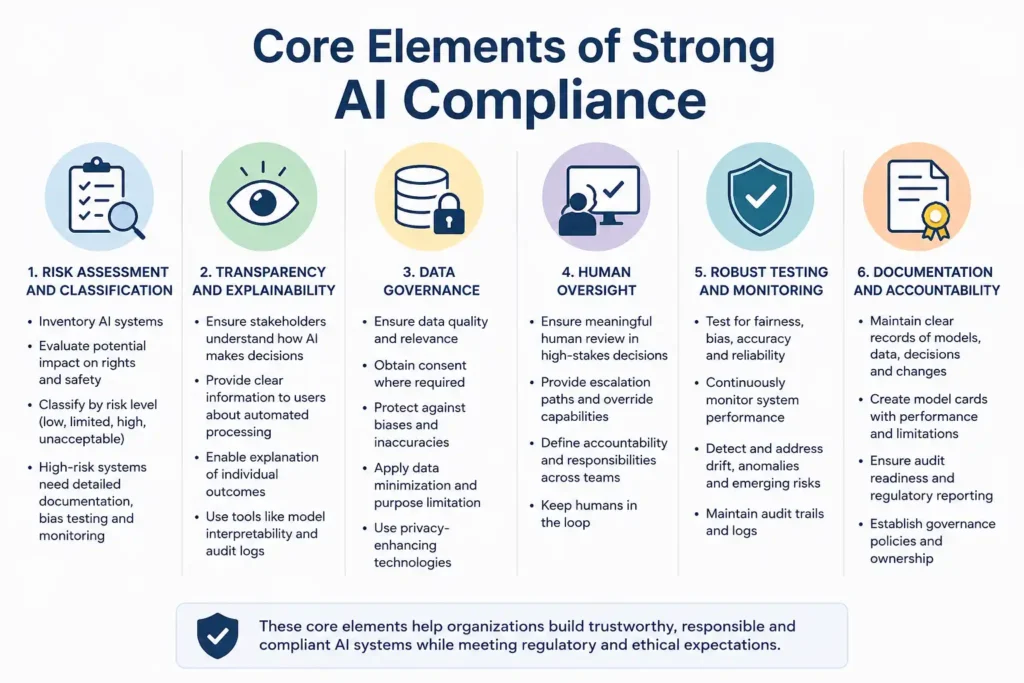
AI compliance rests on several foundational practices. Risk assessment and classification form the starting point. Organizations must inventory AI systems, evaluate their potential impact on rights and safety, and categorize them according to applicable regulations. High-risk systems typically require detailed technical documentation, bias testing, and ongoing monitoring.
Transparency and explainability are non-negotiable. Regulators increasingly demand that stakeholders understand how AI reaches decisions. This includes clear information to users about automated processing and the ability to explain individual outcomes. Techniques such as model interpretability tools and audit logs help meet these expectations without sacrificing performance.
Data governance plays a central role. Compliance requires robust controls over training data, ensuring quality, consent where needed, and protection against biases or inaccuracies. Privacy-enhancing technologies like federated learning or differential privacy can support innovation while respecting data rules.
Human oversight remains critical. Even advanced systems need mechanisms for meaningful human review, especially in high-stakes decisions. This includes escalation paths, override capabilities, and accountability structures that define responsibility across development and deployment teams.
Practical Benefits for Businesses
Beyond regulatory adherence, strong AI compliance delivers tangible business value. It reduces the likelihood of costly enforcement actions, lawsuits, or reputational damage. For instance, a financial institution using AI for credit scoring must demonstrate fairness and non-discrimination to avoid regulatory scrutiny and class-action risks.
Compliance fosters better system performance and reliability. Regular audits and bias checks often uncover issues early, leading to more accurate and trustworthy models. This translates into improved customer experiences and operational efficiency.
Many organizations also report enhanced stakeholder confidence. Investors, partners, and customers increasingly favor companies with mature governance practices. In competitive markets, demonstrable compliance can accelerate sales cycles, particularly in regulated sectors like insurance, banking, and healthcare.
Moreover, compliance programs encourage cross-functional collaboration. Legal, technical, ethics, and business teams working together create a culture of responsibility that supports sustainable AI scaling.
💚 You might also like: 5 Best AI Tools for Automating Business Tasks in 2026
Implementing an Effective AI Compliance Program
Successful programs start with leadership commitment and clear governance structures. Assigning roles such as an AI governance committee or chief AI ethics officer helps embed accountability. Policies should cover the full AI lifecycle, from procurement of third-party models to internal development and production monitoring.
Documentation and audit readiness are essential. Maintain records of risk assessments, model cards detailing performance metrics and limitations, training data sources, and change logs. Automated tools can assist in generating and updating this evidence efficiently.
Training and awareness matter. Employees involved in AI projects need education on regulatory obligations, ethical considerations, and internal processes. Regular simulations or workshops reinforce these principles.
Third-party risk management cannot be overlooked. Many organizations rely on external AI providers or open-source components. Contracts should include compliance clauses, and vendors must demonstrate alignment with relevant standards.
Continuous monitoring closes the loop. AI systems can drift over time due to changing data or environments. Real-time oversight tools help detect anomalies, performance degradation, or emerging risks before they escalate.
A comprehensive guide from Noma Security offers detailed insights into building these capabilities, highlighting practical steps for visibility, policy enforcement, and alignment with frameworks like the EU AI Act and ISO standards. This guide from Noma Security emphasizes proactive governance that adapts as regulations evolve. Many experts reference this guide from Noma Security when developing enterprise programs because it addresses both technical controls and organizational strategies in depth. Professionals also consult this guide from Noma Security to map controls across multiple jurisdictions effectively.
Common Challenges and How to Overcome Them
Resource constraints often hinder smaller organizations. Compliance can seem expensive and complex, but starting with high-impact areas such as high-risk use cases allows phased implementation. Open frameworks and industry consortia provide valuable templates and benchmarks.
The pace of regulatory change creates uncertainty. Staying informed through subscriptions to official updates, participation in industry groups, and engagement with legal experts helps maintain agility. Scenario planning for potential new rules supports forward-looking strategies.
Technical hurdles, like balancing explainability with model accuracy, require investment in research and tools. Hybrid approaches that combine advanced AI with interpretable components often yield strong results.
Global operations add complexity. A centralized compliance function with localized adaptations can reconcile differences between jurisdictions while maintaining consistent standards.
Real-World Examples of Success
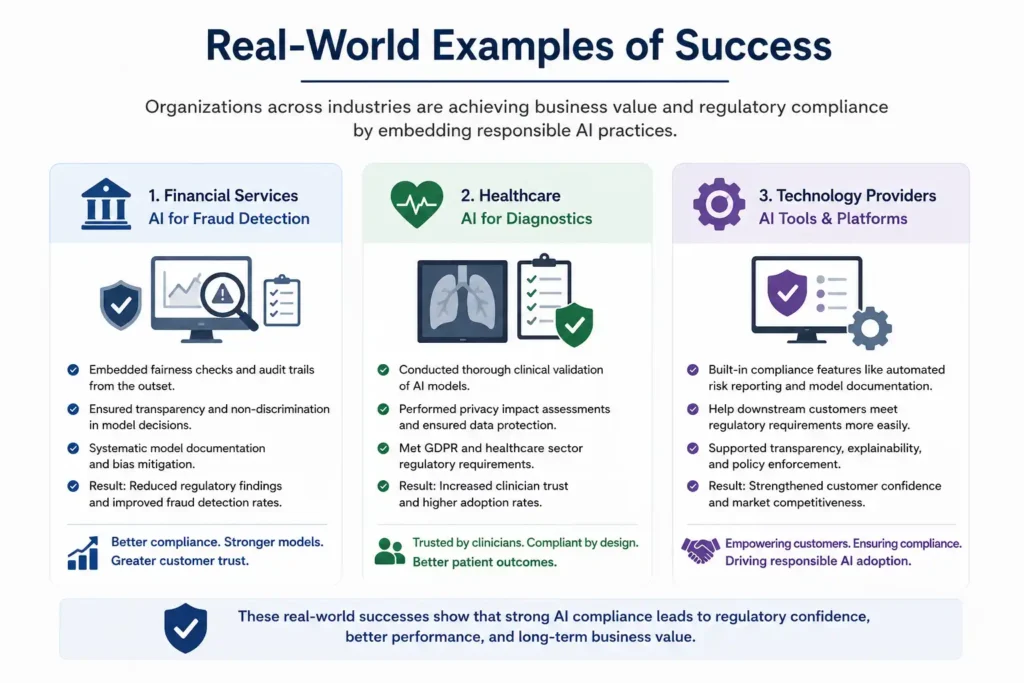
Financial services firms have integrated compliance into AI-driven fraud detection. By embedding fairness checks and audit trails from the outset, they meet anti-discrimination rules while improving detection rates. One major bank reportedly reduced regulatory findings through systematic model documentation and bias mitigation.
Healthcare providers using AI for diagnostics conduct thorough clinical validation and privacy impact assessments. This not only satisfies GDPR and sector rules but also builds clinician trust, leading to higher adoption rates.
Technology companies supplying AI tools increasingly offer built-in compliance features, such as automated risk reporting. This helps downstream customers meet their obligations more easily.
Looking Ahead: Future-Proofing AI Compliance
Regulations will continue evolving as technology advances, particularly with agentic and multimodal AI. Businesses that invest in adaptable governance, leveraging automation for monitoring and evidence collection, will be better positioned.
Emerging standards, such as ISO 42001 for AI management systems, provide additional structure. Alignment with multiple frameworks creates efficiency and demonstrates a broader commitment to responsible AI.
Ultimately, AI compliance represents a shift toward mature technology management. Organizations that embrace it holistically treat regulation as a catalyst for better design, stronger safeguards, and more sustainable innovation.
By prioritizing transparency, accountability, and continuous improvement, businesses can harness AI’s potential while meeting and often exceeding regulatory requirements. The result is not just compliance, but resilient, trusted systems that deliver lasting value in an increasingly scrutinized digital landscape.
✨ Tech made simple, follow Tech Statar for more.