

Top Ecommerce Tools Every Online Store Needs to Scale in 2026
Most e-commerce businesses don’t fail because of bad products. They fail because the systems behind them are weak. Founders spend months perfecting product pages, branding, and creatives, but ignore the infrastructure that actually drives growth. That’s where e-commerce tools come in. Not as “helpers,” but as force multipliers. The right tools don’t just make your work easier, they change how fast you grow, how efficiently you operate, and how predictable your revenue becomes.
If you look at high-growth ecommerce brands, you’ll notice a pattern. They are not working harder; they are working through better systems. Their emails are automated but feel personal. Their product pages are optimized based on real user behavior. Their inventory doesn’t run out unexpectedly. Their data tells them exactly where to invest next. None of this happens manually. It’s powered by a carefully selected stack of ecommerce tools working together behind the scenes.
The shift is simple but powerful. Instead of relying on effort, you rely on systems. Instead of guessing, you rely on data. Instead of reacting, you operate proactively. E-commerce tools make this transition possible. Without them, scaling becomes chaotic. With them, scaling becomes structured.
Another reality most people ignore is that competition in e-commerce has evolved. You’re no longer competing only on product or price. You’re competing on experience, speed, personalization, and consistency. And all of that is driven by the tools you use. A slow website, poor checkout flow, or weak follow-up system doesn’t just hurt your brand, it directly impacts revenue. In a world where attention spans are shrinking, even a one-second delay can cost conversions.
So, when we talk about e-commerce tools, we’re not talking about optional add-ons. We’re talking about the backbone of your entire business. The difference between a struggling store and a scaling brand often comes down to how well these tools are selected, integrated, and used.
The Modern Ecommerce Stack: What High-Growth Brands Are Actually Using
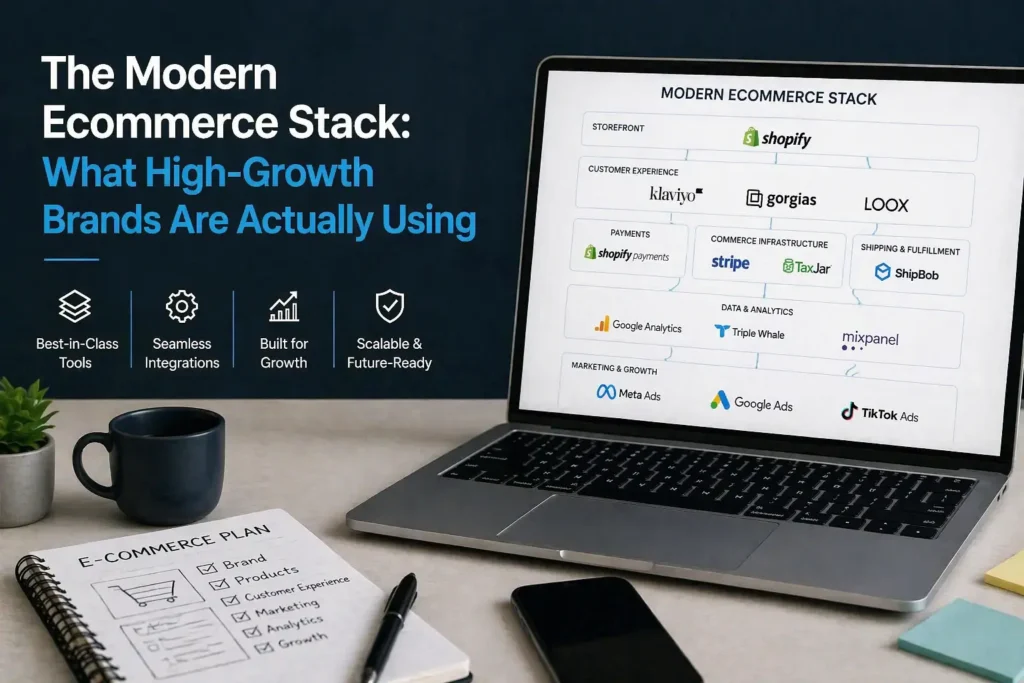
There’s a common misconception that you can run a successful e-commerce business using a single platform. Many beginners believe that once they set up their store, everything else will fall into place. That’s not how modern ecommerce works. High-growth brands don’t rely on one tool; they build a stack.
Think of your e-commerce business like a machine. Each part has a specific role. Your storefront handles the buying experience. Your marketing tools bring in traffic. Your analytics tools tell you what’s working. Your automation tools keep everything running smoothly. When these parts work together, the machine runs efficiently. When they don’t, everything starts to break down.
The smartest brands don’t chase tools randomly. They build their stack intentionally. Every tool has a purpose. Every integration solves a problem. There is no clutter, no unnecessary subscriptions, and no guesswork. This is where most e-commerce businesses go wrong. They keep adding tools without a clear strategy, hoping something will fix their growth. Instead, they create complexity.
A well-built e-commerce stack is not about having more tools. It’s about having the right ones. Tools that communicate with each other. Tools that reduce manual work. Tools that give clarity instead of confusion. When your stack is aligned, decisions become easier, execution becomes faster, and scaling becomes predictable.
Another important shift is how brands view tools today. Earlier, tools were seen as support systems. Now, they are strategic assets. The right combination of tools can give you a competitive edge that’s hard to replicate. It allows smaller brands to compete with larger players by leveraging automation, data, and optimization.
Storefront & Platform Tools That Control Your Foundation
Your storefront is where everything begins. It’s the foundation of your e-commerce business. No matter how strong your marketing is, if your platform is weak, growth will always be limited. This is why choosing the right e-commerce platform is one of the most important decisions you’ll make.
Different platforms serve different purposes, and understanding their strengths and limitations is what separates beginners from experienced operators. Some platforms are built for simplicity and speed, allowing you to launch quickly without technical complexity. Others are designed for flexibility and customization, giving you more control as your business grows. Then there are advanced setups that focus on performance and scalability, often used by brands that want complete control over their user experience.
The mistake most people make is choosing a platform based on popularity instead of strategy. Just because a platform works for one brand doesn’t mean it will work for yours. Your choice should depend on your business model, growth plans, and technical capabilities. If your goal is to scale aggressively, your platform should support that from day one.
Performance is another factor that often gets ignored. A slow-loading website doesn’t just frustrate users, it kills conversions. Search engines also consider site speed and structure when ranking your pages. So your platform choice doesn’t just affect user experience; it directly impacts your visibility and traffic.
Customization is equally important. As your brand grows, you’ll need more control over design, functionality, and integrations. A platform that limits customization can become a bottleneck. On the other hand, a platform that offers flexibility allows you to optimize every part of your customer journey.
Your storefront isn’t just a place where people buy. It’s where they experience your brand. And that experience is shaped by the tools you choose at the foundation level.
📌 You might also like: Best AI Tools for Business
Conversion-Focused Tools That Turn Traffic Into Revenue
Getting traffic is only half the battle. The real game is converting that traffic into paying customers. This is where conversion-focused ecommerce tools come into play. These tools don’t just improve your store, they directly impact your revenue.
Most e-commerce businesses focus heavily on driving traffic but overlook what happens after a visitor lands on their site. They assume that if people are visiting, sales will follow. In reality, small friction points can silently kill conversions. Confusing layouts, slow load times, weak product descriptions, and complicated checkout processes all add up.
Conversion tools help identify and fix these issues. They show you how users interact with your site, where they drop off, and what’s stopping them from completing a purchase. But the real power of these tools is not just in data, it’s in action.
High-performing brands use these tools to continuously test and improve. They experiment with different layouts, headlines, images, and offers. They don’t rely on assumptions; they rely on results. Over time, these small improvements create a significant impact on overall revenue.
There’s also a psychological layer involved. Conversion is not just about design, it’s about behavior. Trust signals, urgency, social proof, and clarity all play a role in decision-making. The right tools help you implement these elements effectively without making your store feel overwhelming.
What separates average stores from high-converting ones is not traffic, it’s optimization. And optimization is only possible when you have the right tools in place.
Marketing & Customer Acquisition Tools That Actually Drive Profitable Traffic
Most e-commerce brands don’t struggle with traffic, they struggle with profitable traffic. There’s a big difference. Anyone can run ads, publish content, or send campaigns. But turning those efforts into consistent, scalable revenue is where things start to break. This is exactly where the right ecommerce tools make the difference.
At the surface level, marketing tools look simple. You run ads, track clicks, and expect sales. But once you start scaling, things get complicated. Costs go up, attribution becomes unclear, and what worked last month suddenly stops working. Without the right tools, you’re left guessing. And guessing is expensive.
High-growth brands approach acquisition differently. They don’t just focus on bringing traffic, they focus on understanding it. Where it’s coming from, how it behaves, and what actually converts. The right tools give you that clarity. They help you see which channels are driving real customers, not just vanity metrics like clicks and impressions.
Another mistake most brands make is relying too heavily on a single channel. When that channel becomes expensive or unstable, growth stalls. Smart operators use tools that allow them to diversify. Paid ads, organic search, influencer collaborations, and content distribution all work together. But the key is not using more channels, it’s using them with intention.
There’s also the issue of timing and messaging. Not every visitor is ready to buy immediately. Some are exploring, some are comparing, and some just need a little more trust. The right tools help you tailor your messaging based on user behavior. This is where personalization starts to play a role. Instead of showing the same message to everyone, you start creating experiences that feel relevant.
At scale, acquisition is no longer about pushing harder, it’s about optimizing smarter. The brands that win are the ones that know exactly where to invest and where to cut. And that level of decision-making is only possible when your tools are giving you clean, reliable data.
Email, SMS & Retention Tools: Where Real Profit Is Made
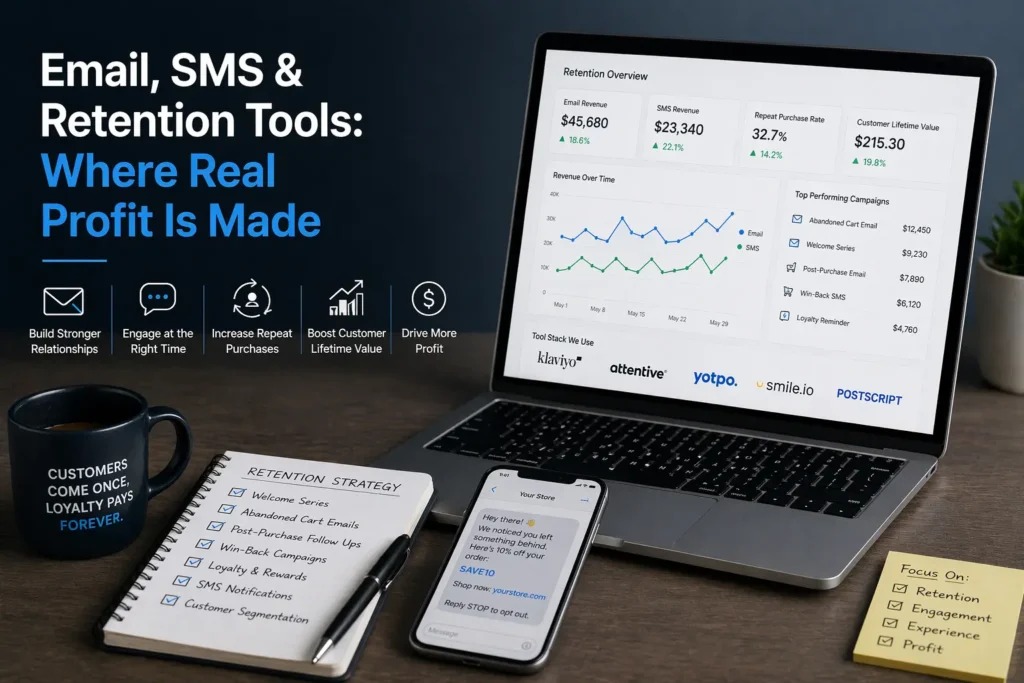
If acquisition gets the attention, retention is where the real money is made. This is one of the most overlooked areas in e-commerce, yet it has the highest impact on profitability. Most brands are constantly chasing new customers while ignoring the ones they already have. That’s a costly mistake.
The reality is simple. It’s easier and cheaper to sell to an existing customer than to acquire a new one. But without the right tools, staying connected with your customers becomes inconsistent and ineffective. This is why email and SMS tools are not just communication channels, they are revenue engines.
High-performing brands don’t send random emails or generic messages. They build systems. Every interaction is intentional. Welcome sequences, abandoned cart flows, post-purchase follow-ups, and re-engagement campaigns all work together. These are not just messages, they are part of a larger strategy designed to increase lifetime value.
What makes these tools powerful is automation combined with personalization. You’re not manually sending messages to each customer. The system does it for you, based on behavior. Someone visits your site but doesn’t buy, they get a reminder. Someone makes a purchase, they get a follow-up that builds trust and encourages repeat orders. Over time, this creates a consistent flow of revenue without constant effort.
There’s also a psychological aspect here. When customers feel remembered and valued, they are more likely to return. Retention tools allow you to maintain that relationship at scale. You’re not just selling a product, you’re building a connection.
Another important shift is how brands measure success. Instead of focusing only on immediate sales, they look at lifetime value. How much a customer is worth over time. Retention tools directly impact this metric. And when lifetime value increases, your ability to spend more on acquisition also improves. This creates a cycle of growth that is both stable and scalable.
Analytics & Data Tools: Making Decisions Like a 7-Figure Brand
Data is one of the most powerful assets in e-commerce, but only if you know how to use it. Most brands have access to data, but very few actually understand it. They look at dashboards filled with numbers but struggle to turn those numbers into decisions. This is where analytics tools come in.
At a basic level, analytics tools tell you what’s happening. But at a deeper level, they tell you why it’s happening. And that’s where the real value lies. When you understand why something is working or not working, you can make better decisions.
One of the biggest challenges in e-commerce today is attribution. Customers don’t follow a straight path. They might see an ad, visit your site, leave, come back through search, and then finally purchase after receiving an email. Without proper tracking, it’s easy to give credit to the wrong channel. And when that happens, you end up investing in the wrong places.
Advanced analytics tools help solve this problem. They give you a clearer picture of the customer journey. They show you how different touchpoints contribute to conversions. This allows you to allocate your budget more effectively and avoid wasting money.
Another common issue is data overload. An overload of data can be as harmful as a lack of it. When you’re tracking everything, it becomes difficult to focus on what actually matters. High-growth brands avoid this by focusing on key metrics that directly impact revenue. They ignore the noise and prioritize the numbers that actually drive action.
There’s also a mindset shift involved. Instead of reacting to data, you start using it proactively. You identify trends early, test new strategies, and optimize continuously. This is what separates growing brands from stagnant ones.
Automation & Operations Tools That Save Time and Scale Systems
As your e-commerce business grows, complexity increases. More orders, more customers, more moving parts. What once felt manageable starts to become overwhelming. This is where automation and operations tools become essential.
In the early stages, it’s common to handle everything manually. Processing orders, updating inventory, responding to customers. But this approach doesn’t scale. It creates bottlenecks and limits your ability to grow. At some point, you need systems that can handle these processes without constant involvement.
Automation tools take repetitive tasks and handle them for you. This doesn’t just save time, it reduces errors and improves consistency. Orders are processed faster, inventory is updated in real-time, and workflows run smoothly in the background.
Operations tools, on the other hand, focus on the backend of your business. Inventory management, order fulfillment, and logistics are all key to shaping the customer experience. A delayed shipment or stock issue can damage trust and impact repeat purchases. The right tools help you stay organized and avoid these problems.
What’s important to understand is that automation is not about replacing effort, it’s about redirecting it. Instead of spending time on repetitive tasks, you focus on growth, strategy, and optimization. This is how businesses scale without burning out.
At a higher level, these tools create predictability. You know your systems will run, your processes will hold, and your operations will support growth. Without them, scaling becomes chaotic. With them, scaling becomes structured.
How to Choose the Right E-commerce Tools (Without Wasting Money)
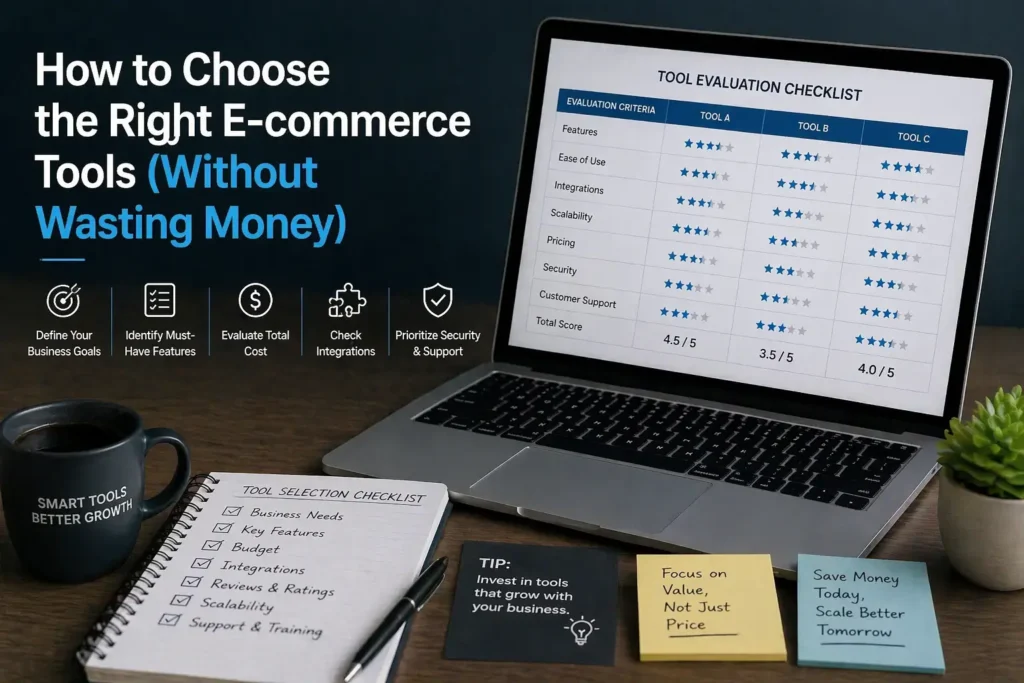
One of the biggest mistakes e-commerce founders make is believing that more tools will solve their problems. In reality, the opposite is often true. The more tools you stack without a clear strategy, the more complexity you create. Costs increase, systems break, data becomes messy, and instead of moving faster, you slow down.
Choosing the right ecommerce tools is not about chasing trends or copying what other brands are using. It’s about understanding your current stage and selecting tools that solve specific problems. A store doing its first 50 orders per month does not need the same stack as a brand processing thousands of orders weekly. But many founders skip this thinking and jump straight into advanced setups they don’t even use properly.
The smartest way to approach this is by focusing on leverage. Ask yourself a simple question: which tool will remove the biggest bottleneck in my business right now? Not next month, not next year, right now. That’s where your investment should go.
Budget also plays a critical role, but not in the way most people think. It’s not about choosing the cheapest option; it’s about choosing the most effective one. A slightly expensive tool that saves hours of work or increases conversions will always outperform a cheap tool that creates friction. The goal is not to save money, it’s to generate more of it.
Another key factor is integration. Your tools should work together, not operate in isolation. When your systems are connected, data flows smoothly, workflows become efficient, and decision-making becomes easier. When they’re not, you end up manually fixing gaps, which defeats the purpose of using tools in the first place.
Clarity is what separates professionals from beginners here. Professionals don’t get distracted by shiny features. They focus on outcomes. They choose tools that align with their strategy, support their growth, and simplify their operations. That’s how you create a system that actually delivers.
The Hidden Cost of Using the Wrong Tools
Most e-commerce founders only look at the visible cost of tools, the monthly subscription. What they don’t see is the hidden cost of choosing the wrong ones. And that cost is often much higher.
A slow website doesn’t just affect user experience, it quietly kills conversions every single day. Poor tracking doesn’t just create confusion, it leads to wrong decisions and wasted ad spend. A weak email system doesn’t just reduce engagement, it leaves money on the table. These are not small issues. They compound over time.
What makes it worse is that these problems are not always obvious. You might still be getting sales. Traffic might still be coming in. But beneath the surface, your business is leaking revenue. And because you don’t have the right tools in place, you can’t even see where the problem is.
There’s also an emotional cost that most people don’t talk about. When your systems are not working properly, everything feels harder. You spend more time fixing issues than growing the business. You second-guess your decisions because your data is unclear. You feel stuck, even though you’re putting in the effort.
This is why choosing the right ecommerce tools is not just a technical decision, it’s a strategic one. The right tools create clarity, speed, and confidence. The wrong ones create friction, confusion, and frustration.
At scale, these differences become even more significant. Small inefficiencies turn into major bottlenecks. Minor delays turn into lost customers. And what could have been a smooth growth journey becomes unnecessarily complicated.
Future Trends: Where E-Commerce Tools Are Headed
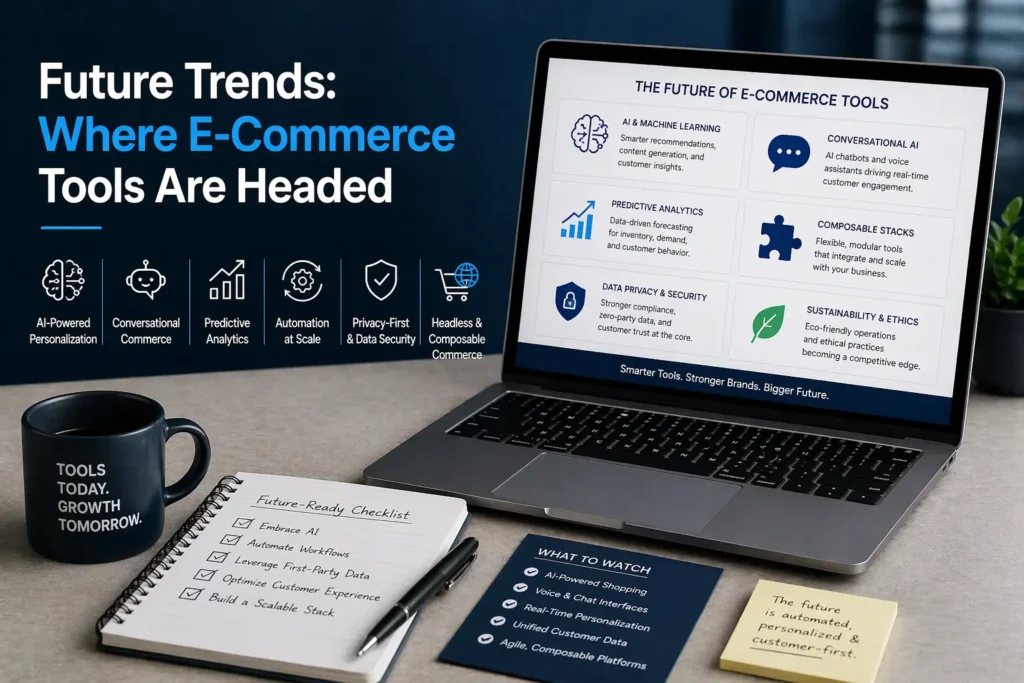
E-commerce is evolving fast, and the tools that support it are evolving even faster. What worked a few years ago is already becoming outdated. The next wave of ecommerce tools is not just about functionality, it’s about intelligence.
Automation is becoming smarter. Instead of simply executing tasks, tools are starting to make decisions. From personalized product recommendations to predictive analytics, systems are becoming more proactive. They don’t just respond to user behavior, they anticipate it.
Personalization is also moving to the center. Generic experiences are losing effectiveness. Customers expect relevance. They expect brands to understand their preferences and deliver tailored experiences. Future ecommerce tools are built around this idea, helping brands create journeys that feel unique for every user.
Another major shift is happening in how stores are built and delivered. Flexibility and performance are becoming priorities. Brands want faster websites, better user experiences, and more control over their frontend. This is pushing the industry toward more advanced setups that allow deeper customization without compromising speed.
Data will continue to play a bigger role, but the focus will shift from collection to interpretation. It’s not about having more data, it’s about understanding it better. Tools that simplify insights and make decision-making easier will have a clear advantage.
The brands that stay ahead are not the ones that chase every new trend. They are the ones who adopt change strategically. They understand where the industry is heading and align their systems accordingly.
Conclusion
At its core, e-commerce is no longer just about selling products. It’s about building systems that consistently generate, convert, and retain customers. And those systems are powered by your tools.
Your ecommerce stack defines how efficiently you operate, how effectively you market, and how well you scale. It determines whether your growth feels chaotic or controlled. Whether your decisions are based on guesswork or clarity.
The difference between an average store and a high-performing brand is rarely the product alone. It’s the structure behind it. The processes. The systems. The tools.
When your stack is aligned, everything becomes easier. You move faster. You make better decisions. You create better experiences. And most importantly, you build a business that can grow without constantly breaking.
So instead of chasing shortcuts, focus on building a strong foundation. Choose your tools intentionally. Use them strategically. And treat them as assets, not expenses.
Because in today’s ecommerce landscape, your tools are not just supporting your business, they are shaping its future.
FAQs About E-commerce Tools
What are the most essential e-commerce tools for scaling stores?
The most essential e-commerce tools are the ones that directly impact growth and efficiency. This usually includes a strong storefront platform, reliable marketing systems, retention tools, and clear analytics. But instead of focusing on categories, it’s more important to identify your bottlenecks. The right tools are the ones that solve your biggest problems and unlock the next level of growth.
How many e-commerce tools should a business use?
There is no fixed number, but the goal should always be simplicity. Using too many tools creates complexity and confusion. A well-structured stack with fewer, well-integrated tools will always outperform a large, unorganized setup. The focus should be on efficiency, not quantity.
Are expensive e-commerce tools always better?
Not necessarily. Price does not always reflect value. Some expensive tools offer advanced features that may not be relevant to your business stage. At the same time, some affordable tools can deliver excellent results if used correctly. The key is to evaluate tools based on outcomes, not cost.
Can e-commerce tools replace a team?
E-commerce tools can automate processes and reduce manual work, but they cannot replace strategy and decision-making. They act as enablers, not replacements. A strong business combines the efficiency of tools with the thinking and creativity of people.
How often should you update your e-commerce stack?
Your e-commerce stack should evolve as your business grows. This doesn’t mean constantly switching tools, but regularly evaluating whether your current systems still meet your needs. Updates should be intentional and based on clear reasons, not trends or hype.
📌 This is your sign to upgrade your feed. Follow Tech Statar.




































One thought on “Top Ecommerce Tools Every Online Store Needs to Scale in 2026”