

Will AI Really Replace Accountants?
AI is already changing accounting, but replacing the entire profession is a different question.
The clearest way to understand the shift is to separate tasks from jobs. AI is increasingly handling repetitive accounting tasks such as transaction coding, reconciliation, invoice processing, and basic reporting. That can reduce the amount of manual work required without eliminating the need for accountants. The U.S. Bureau of Labor Statistics expects routine accounting work to become more automated while analytical and advisory responsibilities become more important.
Accounting also involves decisions that depend on context. An accountant may need to determine how an unusual transaction should be treated, explain financial results to a business owner, evaluate risk, interpret rules, or decide whether an AI-generated result makes sense. These responsibilities require more than producing an answer from structured data.
So the more accurate question is not “Will AI replace accountants?” but “Which parts of an accountant’s job will AI replace, and which parts will remain human?”
AI is replacing tasks, not the entire profession
AI works best when the process is repetitive, rules-based, and built around structured data.
That makes tasks such as categorizing transactions, matching invoices, reconciling accounts, extracting information from documents, and preparing basic reports natural candidates for automation. Current accounting software already includes AI and automation features for areas such as reconciliation, reporting, forecasting, and invoicing.
The important distinction is that a job usually contains many tasks. Automating several of them can change the job significantly without making the entire role unnecessary.
Why accounting still requires human judgment
The hardest accounting work is often not entering numbers. It is understanding what those numbers mean and deciding what should happen next.
Human accountants still play an important role in reviewing exceptions, interpreting financial information, dealing with unusual situations, advising clients, and taking responsibility for the quality of the work. That is why the profession is moving toward more analytical and advisory work as automation takes over more routine processes.
Which Accounting Tasks Can AI Automate?
AI can already handle a meaningful part of the accounting workflow, especially where the work follows repeatable patterns.
Data entry, categorization, and reconciliation
Transaction categorization, data extraction, bank reconciliation, and document processing are among the clearest automation opportunities. In Intuit QuickBooks’ 2025 accountant technology survey, firms reported automation use in payroll processing, accounts payable and receivable, and data entry and transaction processing.
These tasks do not disappear completely when AI is introduced. Instead, the accountant increasingly reviews results, checks exceptions, and intervenes when the system cannot confidently handle a case.
Invoicing, reporting, and routine financial analysis
AI can also support invoice processing, financial summaries, anomaly detection, reporting, and forecasting.
For example, modern cloud accounting platforms can automatically identify transactions, assist with reconciliations, and generate financial insights. The goal is not simply to produce reports faster, but to reduce the manual work required to get from raw financial data to useful information.
Tax, audit, and forecasting support
AI can assist with tax research, document review, audit support, anomaly detection, and financial forecasting. These tools can reduce the time spent searching through documents or processing large volumes of information.
That does not mean every tax or audit decision can be delegated to software. AI-generated work still needs appropriate review, particularly when the situation is complex, unusual, or high risk.
Which Accounting Jobs Are Most at Risk?
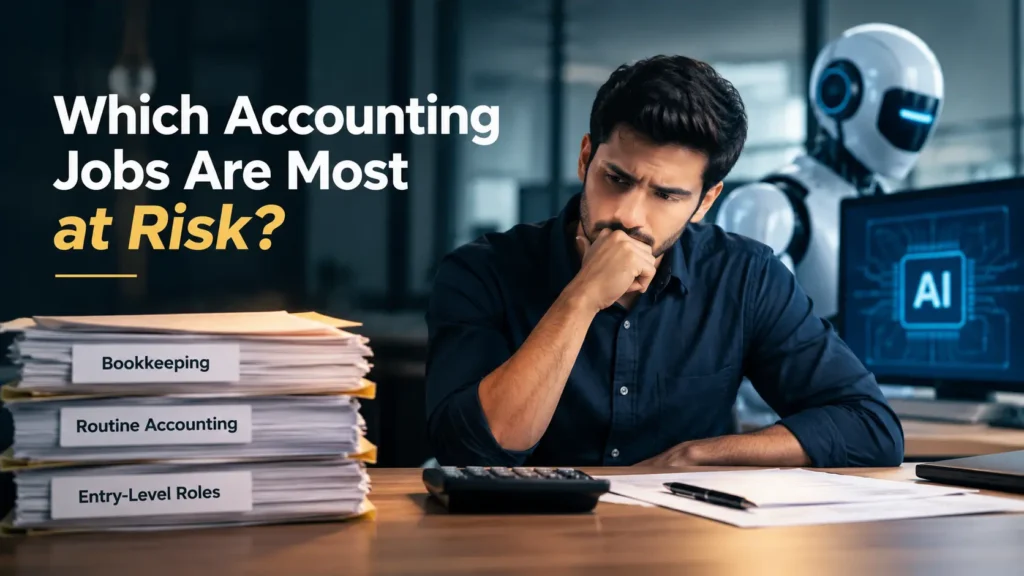
The risk is not evenly distributed across the profession.
Jobs built largely around repetitive processing face more pressure than roles that depend on interpretation, client relationships, or complex judgment.
Bookkeeping and routine accounting work
Bookkeeping contains many activities that are highly structured, which makes them easier to automate.
Data entry, transaction coding, invoice matching, basic reconciliations, and routine cleanup can increasingly be handled by software. This does not mean every bookkeeping role will disappear, but it does mean fewer people may be needed to perform the same volume of routine work.
Entry-level accounting roles
Entry-level accountants face a more complicated situation.
Many junior professionals traditionally gained experience by performing repetitive tasks such as reconciliations, data preparation, and basic testing. AI is now taking over some of that work, which can reduce the amount of traditional entry-level work available. ICAEW reported in 2026 that 68% of surveyed mid-tier firms expected AI to reduce demand for some early-career roles.
At the same time, this does not mean companies are simply eliminating junior accountants. ICAEW also reported that 83% of those firms did not expect AI-driven reductions in some early-career demand to directly lead to fewer roles overall. The bigger change is the nature of the work and the skills expected from junior employees.
Why repetitive work faces the most automation
The basic pattern is straightforward: the more predictable the task, the easier it is to automate.
That is why routine processing faces more pressure than work involving ambiguous information, professional judgment, communication, or accountability.
For accountants, this means learning how to work with automated systems is becoming just as important as knowing how to perform the underlying accounting process manually.
Which Accounting Work Is Harder for AI to Replace?
AI is becoming more capable, but accounting does not consist only of calculations.
The work that remains harder to automate usually involves uncertainty, context, responsibility, or human interaction.
Complex decisions and professional judgment
Not every financial situation follows a clean pattern.
An accountant may need to evaluate an unusual transaction, identify a material issue, weigh competing interpretations, or determine whether a financial result is reasonable. AI can support that process, but the difficult part is often knowing which question to ask in the first place.
That makes professional judgment an important part of the accountant’s future role.
Compliance, risk, and accountability
Accounting decisions can affect taxes, financial reporting, internal controls, and business risk. A tool can identify patterns or produce recommendations, but organizations still need people to review those outputs and determine whether they are appropriate.
The same principle applies to AI itself. If an automated system produces an incorrect result, someone must identify the problem, understand its impact, and correct it.
Client advisory and strategic financial decisions
Business owners rarely need an accountant simply to tell them what a number is. They need help understanding what those numbers actually mean.
Should the company reduce costs? Can it afford to hire? Is cash flow becoming a problem? Which part of the business is most profitable?
AI can help generate insights, but accountants can turn those insights into context-specific advice. That is one reason current industry research shows accountants moving toward more strategic advisory work.
What Does the Job Market Say About AI and Accounting?
Predictions about accounting jobs can look contradictory because different studies measure different things.
Current outlook for accountants and auditors
In the United States, the current Bureau of Labor Statistics outlook is not showing the disappearance of accounting jobs. BLS projects employment of accountants and auditors to grow 5% from 2025 to 2035, with about 115,300 openings per year on average. It also expects technology to automate some routine work while making analytical and advisory duties more prominent.
That is important evidence against the idea that AI is simply making accountants obsolete.
Why some accounting roles are still declining
The broader global picture is more complicated.
The World Economic Forum’s Future of Jobs Report 2025 lists accountants and auditors among roles employers expect to decline through 2030, alongside several other clerical occupations.
This does not mean that millions of accountants will suddenly lose their jobs. The WEF data reflects employer expectations across a global labor market, while BLS provides a specific U.S. occupational forecast. They answer different questions.
What the different forecasts actually mean
The two findings can exist at the same time.
Some routine accounting work can decline because automation makes each employee more productive. At the same time, the overall number of accountants can remain stable or even grow because businesses still need financial expertise, compliance support, analysis, and advisory services.
In other words, automating manual accounting tasks does not necessarily reduce the overall need for accountants.
How Will AI Change Accounting Jobs?
The accounting role is likely to become less focused on producing every piece of financial information manually and more focused on reviewing, interpreting, and using it.
From data processing to analysis and advisory
As routine processing becomes automated, accountants can spend more time explaining financial results and helping clients make decisions.
That shift is already visible in industry research. Intuit’s 2025 survey found that 79% of surveyed accountants expected strategic advisory work to increase, while 81% said AI had positively affected productivity.
More AI oversight and exception handling
AI does not remove the need for human review. It changes what gets reviewed.
Instead of checking every transaction manually, an accountant may spend more time investigating exceptions, validating AI-generated results, and deciding when the system should not be trusted.
ICAEW describes a similar shift for junior professionals, with more emphasis on reviewing AI outputs, validating information, spotting anomalies, and understanding when automated results need to be challenged.
The growing importance of human and AI collaboration
The strongest accounting teams are unlikely to be purely human or purely automated.
AI can process large amounts of structured data quickly. Accountants can provide context, judgment, communication, and oversight.
The competitive advantage will come from combining both.
How Can Accountants Prepare for an AI-Driven Future?

The safest response to AI is not to ignore it. It means strengthening the skills AI cannot easily replace while learning to use AI tools effectively.
Learn AI-powered accounting tools
Accountants should understand how AI features work inside the software they already use.
That includes knowing how to review automated reconciliations, interpret generated reports, verify recommendations, and identify situations where the system may be wrong.
Build analytical and advisory skills
As routine processing becomes easier, the ability to analyze financial information becomes more valuable.
Accountants who can connect financial data to business decisions will be better positioned than those whose value depends mainly on manual processing.
Strengthen communication, judgment, and business knowledge
Technical accounting knowledge remains important, but it is no longer enough on its own.
As automation handles more routine work, communication, professional judgment, problem-solving, business knowledge, and the ability to explain complex information clearly become more valuable.
Final Verdict
No, not as a profession. However, AI will automate many routine accounting tasks.
Routine work such as data entry, transaction categorization, reconciliation, invoice processing, and basic reporting is already becoming more automated. That will put greater pressure on highly repetitive roles, especially some bookkeeping and entry-level work.
At the same time, current U.S. employment projections still show growth for accountants and auditors, while industry research points toward a profession that is moving toward analysis, advisory, interpretation, and oversight.
The future is less about AI replacing accountants and more about accountants using AI to automate routine work and focus on higher-value responsibilities.
Accounting professionals should not try to compete with AI on repetitive tasks. It should be to become the person who knows how to use AI, question its output, handle exceptions, and turn financial information into sound decisions.
FAQs
Will AI replace accountants in the next 5 years?
AI is unlikely to replace the accounting profession entirely within the next five years. The stronger evidence points toward task automation and changing job responsibilities. U.S. BLS projections still show 5% employment growth for accountants and auditors through 2035.
Will AI replace bookkeepers?
AI is more likely to automate routine bookkeeping tasks than eliminate bookkeeping entirely. Transaction processing, reconciliation, invoice matching, and data entry are increasingly automated, while exception handling, client communication, and review still require human involvement.
Will AI replace CPAs?
AI can automate parts of a CPA’s workflow, including research, document analysis, and some tax or audit support. But CPAs also provide professional judgment, interpretation, and accountability. Those responsibilities make full replacement much less likely.
Is accounting still a good career in 2026?
Yes, but the best career path is changing. Accounting remains a large profession, and the U.S. BLS continues to project employment growth. Future-proofing your career means combining accounting fundamentals with AI fluency, analytical ability, and advisory skills.
What accounting skills are hardest for AI to replace?
The hardest skills to automate are usually professional judgment, complex problem-solving, client communication, business interpretation, ethical decision-making, and accountability. The more a role depends on understanding context and making decisions under uncertainty, the harder it is to reduce it to a fully automated workflow.
✨ Read more valuable knowledge @ Tech Statar.