
Snow Day Calculator 2026: Predict School Closures Before the Storm Hits
A good snow day calculator&predictor turns a messy weather forecast into one simple number: your real odds of waking up to a closed school. This guide explains exactly how that number gets built, walks through the formula step by step, and includes a live score tool so you can test it yourself.
What Is a Snow Day Calculator?
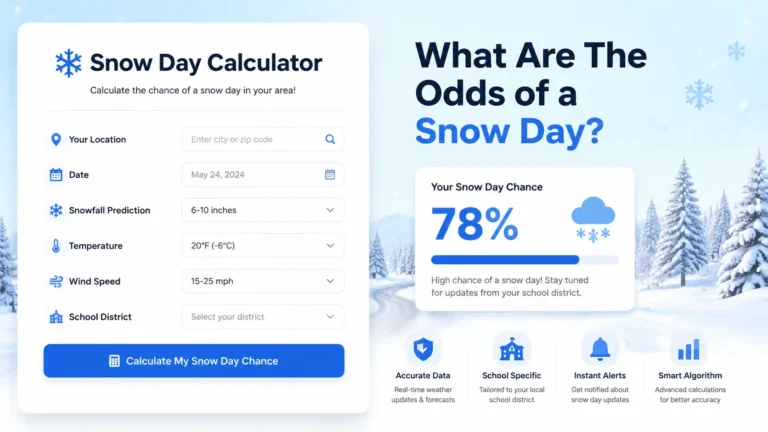
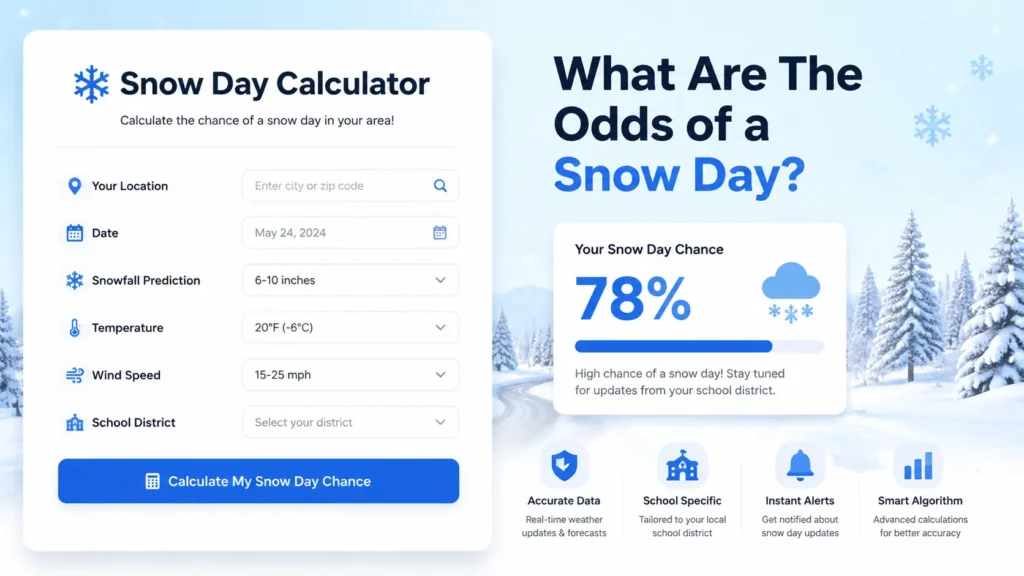
A snow day calculator is an online tool that estimates the probability of a school closure due to winter weather. Instead of just telling you “3 inches of snow expected,” it translates that forecast into something more useful: a percentage chance that your specific school will actually close.
Think of it as the difference between a weather app and a decision-making tool. A weather app reports conditions. A snow day predictor interprets those conditions the way a school transportation director would, weighing road safety, bus routes, and past closure decisions.
These tools became popular because families needed a faster answer than “check the district website at 5 a.m.” The original versions launched in the mid-2000s as simple hobby projects, and the category has since grown into dozens of ZIP-code-based tools pulling live data from the National Weather Service and NOAA.
Who Actually Uses a Snow Day Calculator?
Students checking their odds before setting a homework deadline aside
Parents arranging backup childcare or adjusting their own commute
Teachers deciding whether to finish grading tonight or tomorrow morning
Bus drivers and staff planning early-morning routes
Remote and hybrid workers in districts where a closure affects household schedules
How Does a Snow Day Calculator Work?
Every reliable calculator pulls from the same basic ingredients: live weather data, historical closure patterns, and a scoring model that weighs each factor. Here is what actually happens behind the scenes.
1. Live Weather Data Collection
The tool pulls forecast data for your ZIP code, typically sourced from the National Weather Service (NWS) or NOAA feeds. Key inputs include expected snowfall in inches, overnight low temperature, wind speed, and ice accumulation.
2. Regional Calibration
Raw snowfall numbers mean very little without context. NOAA’s own Winter Storm Severity Index, used to communicate storm impact to the public, factors in six separate components including snow amount, ice accumulation, and blowing snow rather than snowfall totals alone. A good calculator borrows that same logic, adjusting its threshold based on your region’s typical infrastructure.
3. Historical Closure Behavior
Districts have personalities. Some close at the first flurry, others push through a foot of snow without blinking. Calculators that track past closures for your specific district produce noticeably sharper predictions than generic, nationwide models.
4. Timing and Storm Onset
A storm that strikes overnight and clears by sunrise behaves very differently from one that reaches its peak at 7 a.m. right as buses are loading. Overnight snow generally raises closure odds because road crews have time to plow before the morning commute, while morning-onset snow catches districts off guard.
The Snow Day Calculator Formula Explained
There is no single official “snow day formula” published by any government agency. What exists instead is a widely used weighted scoring model that most calculators, including the classic hobbyist tools that started this whole category, build on in some form.
A typical version looks like this:
Snow Day Score = (Snowfall × 0.35) + (Ice × 0.20) + (Temperature × 0.15)
+ (Storm Timing × 0.12) + (District History × 0.10)
+ (Infrastructure × 0.05) + (Active Alerts × 0.03)
How to Use a Snow Day Calculator: Step by Step
Enter your ZIP code or city. This tells the tool which local forecast and district history to pull.
Select your school type. Public, private, and college schedules all use different closure thresholds.
Review the forecast inputs. Check the snowfall total, temperature, and wind speed the tool is using, since these can change hour to hour.
Read the probability score, not just the verdict. A 55% chance is very different from a 90% chance, even if both round to “likely.”
Check back closer to the morning. Predictions made the night before are useful for planning, but forecasts refine significantly between 9 p.m. and 6 a.m.
Confirm with your official district channel. No calculator replaces the actual school closure announcement.
And if snow days aren’t the only thing on your mind, check out our Adopt Me Calculator too.
Real-Life Examples With Calculations
Numbers make more sense with context. Here are three realistic scenarios using the weighted formula above.
Example 1: A Classic Midwest Storm
Forecast: 6 inches of snow, overnight low of 10°F, wind at 15 mph, storm arriving between midnight and 5 a.m. in a moderately prepared Midwest district.
Snowfall and cold temperature both score high, storm timing favors a closure since plows have several hours of overnight lead time, and the district has a history of closing for similar totals. Combined score: roughly 80 to 85%, a high-confidence snow day.
Example 2: A Light Dusting in the South
Forecast: 1.5 inches of snow, temperature right at freezing, minimal wind, in a Southern district with limited plow access.
Even though the snowfall total looks small next to the Midwest example, the region’s low infrastructure score pushes the probability up. Combined score: around 55 to 65%, enough for at least a delay in many Southern districts.
Example 3: Heavy Snow in a Well-Prepared Northeast District
Forecast: 8 inches of snow, 20°F, in a Northeast district with a large fleet of plows and a track record of staying open through similar storms.
Despite the higher snowfall total, strong regional infrastructure lowers the overall score. Combined score: roughly 45 to 55%, a genuine toss-up that could easily land as a two-hour delay instead of a full closure.
Benefits and Use Cases
Saves time. One check replaces refreshing three different weather apps and a district Facebook page.
Reduces morning stress. Parents can arrange childcare the night before instead of scrambling at 5:30 a.m.
Helps with planning. Teachers can decide whether tonight is the night to finish grading.
Puts snowfall in context. A raw “4 inches expected” forecast means little without knowing your district’s actual threshold.
Doubles as a safety tool. Many calculators also function as a cold day calculator, flagging dangerous wind chill even without snow.
Common Mistakes to Avoid
Checking too early. A forecast from three days out will shift. Wait until the evening before or early morning for the most reliable read.
Ignoring wind chill. Extreme cold closes schools just as often as snow does in many Midwest and Northern districts run the numbers through a dedicated wind chill calculator if temperatures are the bigger concern.
Comparing regions directly. A 70% score in Minnesota and a 70% score in Georgia represent very different physical storms.
Treating the score as a guarantee. The final decision always belongs to a human superintendent, who may weigh factors a calculator cannot see, such as a specific icy hill on a bus route.
Forgetting to check the official source. Always confirm with your district’s website, app, or robocall system before making firm plans.
Pro Tips to Improve Your Prediction Accuracy
Check between 9 and 10 p.m. the night before for the most stable forecast window.
Check again between 5 and 6 a.m., since most districts announce closures right around this time.
Watch the ice, not just the snow. A quarter inch of ice can outrank six inches of powder in closure likelihood.
Learn your district’s personality. Some districts are consistently cautious; others push through storms other areas would cancel for.
Factor in the day of the week. Districts are sometimes slightly more willing to call a Friday closure since it doesn’t disrupt as many weekly plans.
Fun Snow Day Traditions and Superstitions (Do They Actually Work?)
No article about snow days is complete without the rituals. Generations of students swear by these tricks, even though none of them have any real effect on the weather.
Wearing pajamas inside out is one of the most widespread snow day superstitions in the United States and Canada.
Placing a spoon under your pillow, supposedly to “spoon” the snow into falling.
Flushing ice cubes down the toilet, a strange but extremely common ritual among elementary schoolers.
Doing a “snow dance” before bed, often taught as a family tradition.
None of these actually influence snowfall, obviously, but they are a fun, low-stakes way for kids to feel like they have some control over an unpredictable winter morning. Pair the ritual with an actual snow day calculator check, and you get both the fun and the real answer.
Conclusion
A snow day calculator will never replace the actual phone call from your school district, but it turns a stressful guessing game into a clear, data-backed probability. The best tools combine live snowfall and temperature data, ice accumulation, storm timing, and your district’s own closure history into one honest score, instead of a vague “maybe.”
💙 Follow Tech Statar for practical insights.