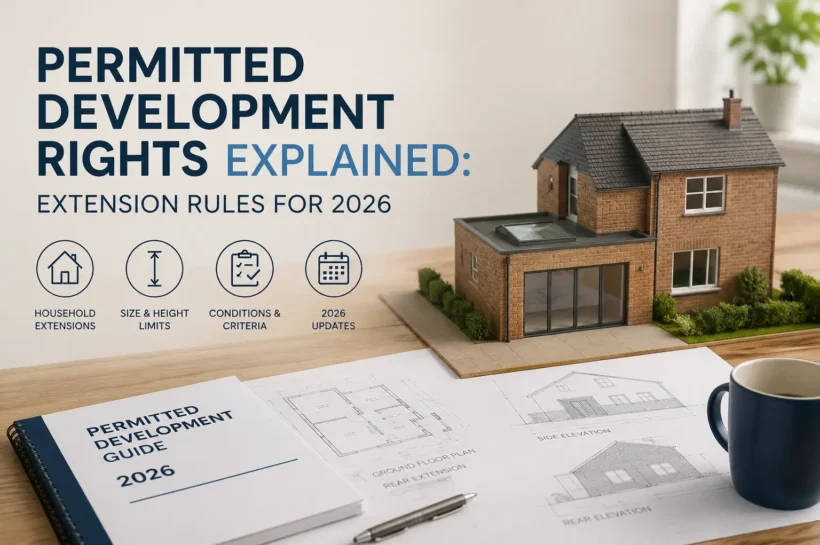

Permitted Development Rights Explained: Extension Rules for 2026
The rules changed. Not dramatically. Not overnight. But enough that homeowners who extended five years ago under one set of conditions are advising friends based on rules that no longer apply exactly the way they remember.
Permitted development rights are the most misunderstood part of the entire planning system. Everyone thinks they know how they work. Most people are working from outdated information, half-remembered conversations, or advice from a neighbour who extended in 2019 when things were slightly different.
If you are planning an extension in 2026, here’s what has changed, what hasn’t, and what most homeowners still get wrong.
The Larger Rear Extension Rules People Forget About
The larger rear extension scheme allows single-storey extensions of up to six metres on semi-detached and terraced houses and eight metres on detached houses. But it is not standard permitted development. It requires prior approval from the council.
Prior approval means notifying the council and giving your neighbours a chance to comment. If nobody objects within twenty-one days, approval is granted. If someone objects, the council makes a decision based on the impact on the neighbours’ amenity.
Most homeowners either don’t know this scheme exists or confuse it with standard permitted development. Standard PD allows three metres on semi-detached and terraced houses and four metres on detached houses without any council notification.
The difference between three metres and six metres is significant. On a typical London semi, the larger scheme nearly doubles the possible depth. But the prior approval requirement means it is not automatic. Your neighbour has a voice. And if they object, the council decides.
Your architect should know which scheme applies to your project and advise on the probability of neighbour objections before you commit to a design based on the larger limits.
Conservation Areas and What Gets Removed
Conservation area designations remove certain permitted development rights. This part hasn’t changed. But many homeowners still don’t check whether their property is affected.
In a conservation area, side extensions are not permitted development. Cladding the exterior is not permitted development. Some roof alterations that would normally be PD require full planning permission.
Rear extensions can still be permitted development in conservation areas, but the rules are tighter. The larger rear extension scheme does not apply. You are limited to the standard three or four metre depth, depending on house type.
The mistake homeowners make is assuming they know whether their property is in a conservation area. Boundaries are not marked on the street. There are no signs. The only way to check is on the council’s planning portal. A two-minute search that determines your entire planning strategy.
We see homeowners discover that their property is in a conservation area months into the design process. After paying for drawings based on depths and alterations that their designation doesn’t allow. Two minutes of checking prevents months of wasted work.
The Volume Calculation for Loft Conversions That Catches Everyone
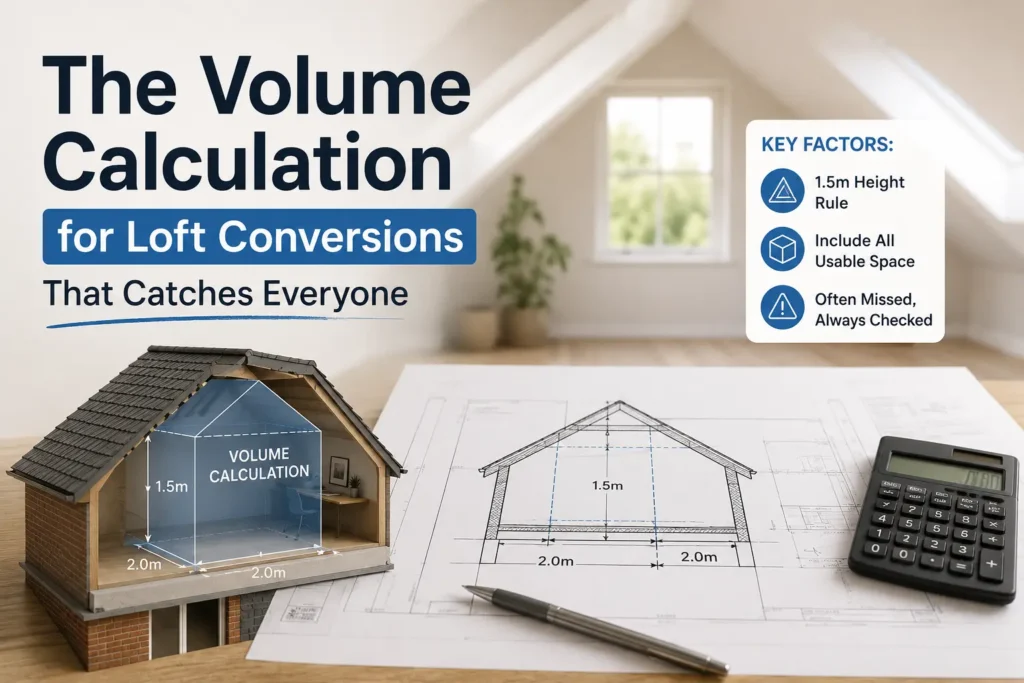
Loft conversions under permitted development have volume limits. Forty cubic metres for terraced houses. Fifty cubic meters for semi-detached and detached houses. Most homeowners know this.
What catches them is that previous loft work counts against the allowance. If a former owner added a small dormer fifteen years ago, that volume is subtracted from your total. Your remaining allowance might be significantly less than the full forty or fifty cubic metres.
The calculation is based on the external dimensions of the roof addition. Not the internal floor area. External measurements include the dormer walls, the roof structure, and any overhang. The external volume is always larger than the internal space you actually use.
Homeowners who calculate their allowance based on internal dimensions think they have more room than they do. When the council calculates using external dimensions, the numbers don’t match. Applications get questioned. Sometimes refused.
Your architect should calculate the volume accurately using external measurements before designing the dormer. Not after the drawings are complete.
What hasn’t changed, but people assume has
The maximum eaves height is three metres for single-story rear extensions. This has been consistent for years, but homeowners regularly assume they can go higher.
The requirement that materials should be similar in appearance to the existing house. Not identical. Similar. But “similar” is subjective, and councils interpret it differently. A zinc-clad extension on a brick house is not similar regardless of how contemporary it looks.
The rule that permits development measurements is taken from the original house. Not from previous extensions. If the property has been extended before, the original footprint is the baseline. Everything added since is subtracted from your allowance.
The restriction on front extensions. Permitted development does not allow extensions forward of the principal elevation facing the highway. This catches homeowners who want to extend the front of their house and assume PD covers it.
The One Check That Prevents Every Problem
Before you design anything, check five things. Conservation area status. Article 4 directions. Previous extensions on the property. Tree preservation orders near the building zone. Flood risk designations.
Five checks. All free. All can be found on the council planning portal or the Environment Agency website. All taking less than thirty minutes combined.
These checks determine what you are allowed to build before you decide what you want to build. The order matters. Constraints first. Design second. Budget third.
Every homeowner who gets this order wrong pays for it eventually. In the refused applications. In redesign fees. In wasted time. In the frustration of discovering a restriction that should have been identified in the first thirty minutes of the project.
Permitted development rights are generous. They allow significant alterations to most houses without a full planning application. But they have conditions. And those conditions catch homeowners who assume the rules are simpler than they actually are.
Six to eight months from first conversation to completion. Thirty minutes of checking before the first drawing. The cheapest and most valuable step in the entire process.
❇️ Your feed can be smarter than this. Follow Tech Statar to upgrade it.