

Best AI Tools for Business in 2025 | Boost Workflow & ROI
AI tools for business are software platforms that help companies automate tasks, improve team productivity, and make smarter decisions using data-driven insights. These tools support everything from workflow automation to marketing automation, sales automation, CRM automation, and AI for customer support. Businesses use them to scale faster, streamline operations, and replace repetitive tasks with smart workflows. Whether you run a startup, a small business, or a larger company, AI-powered business tools help you reduce workload, increase efficiency, and boost overall business performance without adding extra headcount.
How AI Tools Improve Day-to-Day Operations
AI tools improve daily business operations by handling repetitive tasks, managing workflows, and supporting better decision-making. They assist with real-time analytics, content creation, customer support responses, and automated processes that save time for teams. These AI productivity tools help companies run smoother operations while keeping everyone focused on high-impact tasks. For many businesses, the shift to AI automation tools has created faster communication, improved accuracy, and predictable business efficiency across multiple departments.
Common Use Cases Across Different Industries
Businesses in almost every industry now use AI automation tools for marketing, sales, support, analytics, and team productivity. Retail uses AI for recommendation engines, real estate relies on AI decision-making, and service businesses depend on AI for customer support. Startups use generative AI tools to speed up content, while companies use AI analytics for data-driven decisions. These flexible AI business software platforms allow teams to scale operations faster, automate workflows, and maintain a competitive edge through intelligent and automated processes.
Why Businesses Need AI Tools in 2025
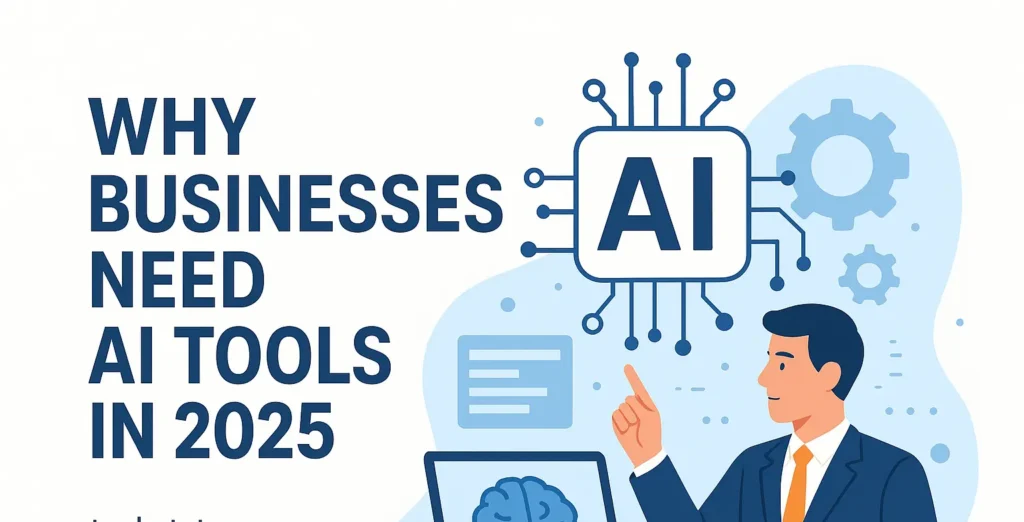
Businesses need AI tools in 2025 because competition is faster, customer expectations are higher, and companies must operate more efficiently. AI platforms for business growth help automate manual work, improve decision-making, and support real-time analytics across departments. With AI-driven insights, companies can reduce operational costs and create smart workflows that improve team productivity. Today’s market trends show that AI tools for startups, small businesses, and enterprise-level companies are essential for long-term scalability, better customer experiences, and data-driven decisions that shape business growth.
Efficiency, Cost Savings, and Automation
AI-powered business tools offer major benefits like reduced workload, faster task execution, and lower operational costs. By automating workflows and repetitive tasks, companies save time and reduce the need for additional staffing. AI automation tools handle everything from email drafting to analytics, helping teams stay focused on more valuable work. Businesses gain better efficiency, fewer errors, and long-term scalability by integrating AI into everyday processes.
Competitive Advantage Through Smarter Decisions
AI gives businesses a real competitive advantage through smarter, faster decision-making backed by real-time analytics. With AI decision-making tools, companies get predictive insights that reveal trends, customer behavior, and growth opportunities. This helps businesses stay ahead while improving performance across sales, marketing, and operations. Companies that use AI solutions for business outperform competitors by making informed decisions based on data instead of guesswork.
👉 You might also like: gldyql
Types of AI Tools Every Business Should Know
Modern companies rely on different categories of AI tools to simplify work and drive business automation. These include AI tools for marketing, sales, customer support, productivity, data analytics, and project management. Each category plays a specific role in improving business efficiency and supporting data-driven decisions. Whether you need AI tools for small business workflows or enterprise automation, the right combination helps streamline communication, boost ROI, and build strong, scalable systems. Understanding these categories makes it easier to select tools that align with your business goals and tech stack.
| Category | AI Tools | Primary Function | Key Benefits |
| Productivity & Workflow Automation | Notion AI, ClickUp AI, Zapier AI, Asana + AI | Task management, workflow automation, document summarization | Streamlines daily tasks, improves team productivity, reduces repetitive work, supports smart workflows |
| Content Creation & Marketing | Jasper, Copy.ai, Writesonic, Grammarly, Surfer SEO | Content generation, copywriting, SEO optimization | Fast content creation, marketing automation, improved content quality, and data-driven insights |
| Sales & CRM | Salesforce Einstein, Apollo.io, Outreach AI, Seamless.ai | Lead management, predictive sales, CRM automation | Automates follow-ups, identifies high-value leads, improves sales efficiency, and revenue potential |
| Customer Support | Intercom AI, Zendesk AI, Freshdesk AI, Tidio AI | Chatbots, ticket management, and AI-assisted support | Faster response times, reduced workload, improved customer satisfaction, and AI-driven insights |
| Analytics & Business Planning | Tableau AI, Power BI AI, IBM Watson, LivePlan AI | Data visualization, forecasting, reporting | Smarter decision-making, real-time analytics, scenario planning, and cost reduction |
| Design & Creative | Canva AI, Adobe Firefly | Graphic creation, ad design, visual content | Simplifies design workflow, accelerates content production, supports brand consistency |
| E-commerce & Marketing Automation | HubSpot AI, Shopify AI | Campaign automation, sales recommendations, and email marketing | Automates marketing, improves customer engagement, enhances ROI |
Productivity & Workflow Automation
Productivity tools help automate routine tasks, manage projects, and support smart workflows across teams. Tools like Notion AI, ClickUp AI, Zapier AI, and Asana + AI improve business efficiency by handling documentation, scheduling, and workflow automation. These tools keep teams aligned and reduce time spent on manual work.
Marketing & Social Media Management
Marketing teams use AI marketing tools to automate social posting, generate content, and analyze performance. Tools like Jasper, Copy.ai, and HubSpot AI help businesses create campaigns, improve engagement, and streamline marketing automation without extra effort.
Customer Support & Sales Enablement
Customer-facing companies benefit from AI support tools like Intercom AI, Zendesk AI, and Tidio AI. These platforms offer intelligent chat responses, lead qualification, and automated customer workflows that reduce workload and improve service quality.
Analytics, Planning & Financial Forecasting
Analytics tools like Tableau AI, Power BI AI, and IBM Watson help businesses understand data and make smarter decisions. These AI analytics platforms support forecasting, reporting, and insights that improve planning and strategy.
Best AI Productivity Tools for Business
Productivity tools are essential for any business looking to automate workflows, increase team efficiency, and reduce manual work. These AI productivity tools help streamline communication, project management, and documentation so teams spend less time on routine tasks. Businesses of all sizes use these AI solutions for business growth because they improve collaboration and simplify daily operations. Popular tools like Notion AI, ClickUp AI, and Zapier AI support everything from smart task management to enterprise automation and AI-driven insights that enhance long-term scalability.
Tools for Task Automation
Zapier AI, Airtable AI, and ClickUp AI are strong automation options for businesses that want to reduce repetitive work. These tools connect apps, automate workflows, and improve business efficiency without coding. They help teams save time and maintain smart workflows.
Tools for Scheduling, Emails & Daily Workflows
Notion AI, Asana + AI, and Trello AI help teams plan schedules, manage calendars, and automate simple tasks. These AI-powered business tools help reduce clutter and keep daily operations organized with smarter, automated workflows.
👉 You might also like: Best AI Content Writing Guide for SEO Success in 2025
AI Tools for Productivity and Workflow Automation
AI productivity tools help teams reduce repetitive work, improve task accuracy, and streamline daily operations. These tools can manage notes, automate reminders, analyze documents, and integrate with your existing work apps to create a more efficient workflow. Whether you’re working solo or within a team, the right AI productivity tool can save time, reduce errors, and help you stay organized without feeling overwhelmed. Below is a breakdown of some of the most reliable productivity tools for businesses.
Notion AI
Notion AI turns your workspace into a flexible productivity hub where you can write, summarize, research, and automate content in place. It helps generate meeting notes, outline documents, extract insights from text, and improve clarity in writing. Teams use it to streamline documentation and knowledge management so they don’t lose important information across chats and emails. Instead of switching between multiple apps, Notion AI lets you plan projects, track workflows, and create organized content with minimal effort.
ClickUp AI
ClickUp AI helps teams speed up their workflow by generating tasks, summarizing messages, improving project briefs, and producing ready-to-use documents. It reduces time spent on admin work by building lists, cleaning up descriptions, and rewriting updates in a clear and professional style. Teams use ClickUp AI to respond faster, reduce miscommunication, and maintain a consistent structure across all project-related content. It’s ideal for operations, marketing, and development teams who manage complex workflows.
Motion AI
Motion AI automates scheduling, task planning, and time management by analyzing your workload and building the most efficient schedule automatically. It reorganizes your day when priorities change, so you don’t spend time adjusting tasks manually. Teams use it to eliminate planning overhead, reduce deadline stress, and keep workloads realistic. Motion AI is especially helpful for people who juggle multiple projects and struggle with fragmented schedules or meeting overload.
AI Tools for Email Management and Communication
Managing communication can become overwhelming when you receive a high volume of emails and messages every day. AI email tools help summarize messages, write quick responses, detect key information, and reduce inbox chaos. With automated sorting and smart replies, your team can maintain a professional communication flow without spending hours in email. Below are tools that make communication smoother and more organized.
Superhuman AI
Superhuman AI speeds up email management with smart sorting, write suggestions, fast replies, and priority detection. It analyzes your inbox to highlight emails that require immediate attention and filters out noise so you stay focused. Professionals use it to reduce response time and maintain a clean inbox throughout the day. Its AI-powered writing assistant helps craft clear, concise replies that save time while keeping communication polished and consistent.
SaneBox AI
SaneBox AI organizes your inbox by analyzing your behavior and automatically filtering unimportant emails into dedicated folders. It highlights important messages, reminds you of follow-ups, and reduces distractions that typically slow down your workflow. It doesn’t replace your email app; it works alongside it to improve the experience. Businesses use it to maintain a clutter-free inbox and ensure important conversations don’t slip through the cracks.
Boomerang for Gmail AI
Boomerang’s AI feature helps craft more effective emails, schedule messages, set reminders, and manage communication timing. It analyzes your writing for clarity and politeness, making sure your emails sound professional and easy to understand. The tool is helpful for managing follow-ups, ensuring better engagement, and planning messages in advance. Teams use Boomerang to keep communication organized and ensure important tasks don’t disappear inside long email threads.
👉 You might also like: Classroom 20X: The Future of Smart Learning
AI Tools for CRM, Sales, and Lead Management
Customer relationships depend on timely communication, accurate data, and well-managed pipelines. AI tools in this category help automate lead scoring, organize contacts, generate outreach messages, and give insights that make sales decisions easier. These tools reduce manual data entry and help sales teams focus on high-quality prospects instead of wasting time on unqualified leads.
HubSpot AI
HubSpot AI helps sales teams automate tasks like writing emails, analyzing CRM data, generating reports, and creating lead summaries. It enhances your contact management and gives insights into customer behavior so you can personalize outreach more effectively. Sales teams use HubSpot AI to reduce admin work, track leads accurately, and improve the quality of communication across the entire customer journey.
Pipedrive AI
Pipedrive AI analyzes your sales pipeline, recommends next steps, and identifies opportunities that might need attention. It helps reps prioritize leads and prevents deals from going cold due to missed follow-ups. The tool also generates insights based on activity trends so you can improve your sales strategy over time. Teams use it to stay organized, reduce guesswork, and maintain better control over the pipeline.
Close CRM AI
Close AI helps sales teams communicate faster with automated call summaries, follow-up suggestions, and smart email writing. It keeps track of communication across calls, SMS, and email, so nothing gets lost. Startups and small teams use Close to manage high-volume outbound sales without needing a large sales team. Its automation features help reps focus on closing deals instead of handling repetitive admin work.
AI Tools for Customer Support and Virtual Assistants
AI customer support tools help businesses respond faster, reduce wait times, and provide consistent service. These tools can handle basic queries, generate responses, categorize tickets, and provide real-time assistance. They also support human agents by preparing summaries, helping with tone, and providing recommended replies.
Intercom AI
Intercom AI helps support teams manage conversations more efficiently by generating quick, accurate responses and routing queries to the right agents. It speeds up ticket resolution with automated suggestions, smart classification, and context-aware replies. Teams use it to deliver consistent support across live chat, email, and help centers. The tool makes agents more effective without compromising the quality of responses.
Zendesk AI
Zendesk AI assists with ticket triage, reply generation, and extracting customer sentiment from messages. It helps reduce ticket backlog and supports agents by providing instant suggestions for common issues. Businesses use it to deliver faster responses and maintain a positive experience even during high-demand periods. Its analytics help identify problem areas so teams can improve their support strategy over time.
Tidio AI
Tidio AI focuses on conversational support through chatbots and automated replies that feel natural and helpful. It can handle everyday questions, route complex issues, and give real-time assistance. Small and medium businesses use Tidio to reduce support load, improve availability, and provide consistent onboarding or FAQ experiences. Its AI features make it a reliable option for brands that want to offer instant customer service without hiring large teams.
👉 You might also like: Pasonet: The Future of Connected Tech Frameworks
AI Tools for Accounting, Finance, and Business Planning
Financial accuracy and planning are essential for running a stable business. AI tools in this category help generate forecasts, organize expenses, analyze cash flow, and simplify financial management. They reduce human error and give clear insights into business performance so d, so decision-making becomes easier and more data-driven.
LivePlan AI
LivePlan AI helps businesses create detailed business plans by generating outlines, writing sections, and helping develop financial forecasts. It simplifies strategic planning and gives entrepreneurs a structured way to present their goals and market research. Teams use it for pitch decks, investor plans, and growth roadmaps. Its AI suggestions help refine content so the business plan looks clean, well-organized, and easy to understand.
QuickBooks AI
QuickBooks AI assists with categorizing transactions, predicting expenses, and identifying unusual activity. It helps business owners stay on top of cash flow and avoid financial mistakes that often happen with manual bookkeeping. Companies use it to automate accounting tasks, prepare reports, and maintain accurate financial records. Its AI-driven insights help small businesses make smarter financial decisions without needing deep accounting knowledge.
Float AI
Float AI focuses on cash flow modeling and forecasting so businesses understand how money moves in and out of the company. It analyzes spending patterns, helps plan budgets, and predicts financial gaps before they become a problem. Teams use it to prepare realistic financial projections and avoid last-minute surprises. It’s especially helpful for startups and growing companies that need clarity in budgeting and planning.
How to Choose the Right AI Tools for Your Business
Choosing the right AI tools for your business starts with understanding your goals, workflow challenges, and long-term growth plans. Every business has different needs, so it’s important to focus on features that improve team productivity, automate repetitive tasks, and support data-driven decisions. Businesses should also check integrations, ease of use, and AI-driven insights before committing. Whether you run a startup, a small company, or a growing team, selecting the right AI business software helps you stay efficient, scalable, and competitive in a fast-moving market.
Identify Current Challenges and AI Needs
Start by identifying the key problems your team faces, such as repetitive tasks, slow workflows, or inconsistent communication. This makes it easier to choose AI tools that automate those areas. Focus on solutions that support real-time analytics, marketing automation, or business efficiency based on your team’s needs.
Compare Features, Integrations, and Ease of Use
Every AI platform offers different features, so evaluate the ones that fit naturally into your existing systems. Look for workflow automation, CRM automation, AI-driven insights, and strong integrations. Easy-to-use tools save time and help your team adopt AI solutions quickly without extra training.
👉 You might also like: Pootenlord Explained: The Ultimate AI Tool for Modern Businesses
Real-World Use Cases of AI in Modern Businesses
AI tools are transforming how companies operate by supporting business automation, smarter planning, and improved customer experience. Small businesses use AI automation tools to simplify operations, while startups rely on generative AI tools for content, analytics, and customer support. Larger companies use AI for enterprise automation and data-driven decisions that guide strategy and long-term growth. These use cases show how AI tools for companies help reduce costs, manage workflows, and improve performance in real-time across multiple teams and departments.
AI in Marketing and Content Teams
Marketing teams use AI to create campaigns faster, manage social media, and optimize content performance. Tools like Jasper, Surfer SEO, and Canva AI help teams build creative assets, automate workflows, and deliver consistent messaging across platforms. This leads to faster production and more efficient execution.
AI in Sales, Customer Support, and Service Teams
Sales teams use Salesforce Einstein and Apollo.io to qualify leads, while support teams rely on Intercom AI and Zendesk AI to handle questions instantly. These tools reduce workload, speed up responses, and provide better customer experiences through automation and real-time insights.
AI in Planning, Analytics, and Strategy
Companies use Tableau AI, Power BI AI, and IBM Watson to analyze data and forecast performance. These tools help leaders understand patterns, make data-driven decisions, and create long-term strategies. AI analytics gives businesses a clearer picture of risks and opportunities.
Limitations and Risks of AI Tools for Businesses
Even though AI tools for business offer major benefits, they also come with limitations that companies must consider. Some AI automation tools may produce inaccurate results without proper oversight, and others require strong data quality to perform well. Businesses must also consider privacy, security, and ethical concerns when adopting AI-driven insights. While AI solutions for businesses improve automation and efficiency, they still need human supervision to avoid mistakes and ensure smooth workflows. Being aware of these risks helps companies adopt AI responsibly and maintain reliable operations.
Accuracy, Data Quality, and Dependency Risks
AI tools depend heavily on the quality of data they receive. If data is incomplete, results may be inaccurate. Some teams may also become too dependent on automation. It’s important to balance AI-driven insights with human review to maintain accuracy and reliability.
Privacy, Security, and Ethical Challenges
AI platforms often handle sensitive data, so companies must ensure strong security measures. Businesses should choose tools with clear policies, safe data storage, and ethical practices. This reduces privacy risks and helps maintain trust with customers and employees.
Future of AI Tools for Business
The future of AI tools for business includes smarter automation, deeper analytics, and stronger support for data-driven decisions. As AI platforms evolve, businesses will see improvements in real-time analytics, enterprise automation, and machine learning capabilities. These tools will help companies streamline workflows, increase efficiency, and scale faster than ever. AI-powered business tools will keep transforming marketing, sales, support, and project management with advanced algorithms and AI-driven insights. Companies that adapt early will achieve better scalability, lower costs, and stronger competitive advantages.
Emerging AI Trends for Business Growth
Future AI tools will offer deeper personalization, better predictive analytics, and stronger automation features. Businesses can expect smarter workflows, improved customer engagement, and more accurate forecasting. These advancements will support long-term business scalability and growth.
Why Businesses Should Invest in AI Early
Companies that adopt AI early gain a competitive advantage by improving efficiency, saving time, and reducing costs. Early adoption also helps teams learn AI tools faster and build scalable processes that support long-term business growth and stronger performance.
FAQs: Best AI Tools for Business (2025)
What are the best AI tools for business in 2025?
The best AI tools for business in 2025 include platforms for productivity, marketing, sales, customer support, and analytics. Popular options are ChatGPT, Jasper, Notion AI, HubSpot AI, Salesforce Einstein, Intercom AI, Tableau AI, and Canva AI. These AI-powered business tools help companies automate workflows, improve team productivity, and make data-driven decisions for growth and scalability.
Which AI tool is best for a small business?
Small businesses benefit from AI tools that simplify operations and boost efficiency without headaches. Notion AI, Tidio AI, LivePlan AI, and Zapier AI are ideal choices. They support workflow automation, AI-driven insights, team productivity, and business automation, allowing small businesses to compete effectively with minimal manual effort.
Can AI tools help increase revenue?
Yes. AI tools for business automate marketing, sales, and customer support processes, which reduces errors and improves efficiency. Platforms like Salesforce Einstein, Apollo.io, and HubSpot AI help qualify leads, personalize campaigns, and optimize sales workflows. By using AI automation tools, businesses can generate more leads, improve customer retention, and ultimately increase revenue.
What are the most popular AI tools for companies?
The most popular AI tools for companies span multiple categories. For content and marketing: Jasper, Copy.ai, Writesonic, Grammarly. For productivity: ClickUp AI, Notion AI, Zapier AI. For sales and CRM: Salesforce Einstein, Apollo.io, Outreach AI. For analytics and reporting: Tableau AI, IBM Watson, Power BI AI. These AI-powered business tools improve team efficiency, workflow automation, and data-driven decision-making.
What are affordable AI tools for startups?
Affordable AI tools for startups include Tidio AI, Notion AI, Copy.ai, and Zapier AI. These AI productivity tools and AI-powered business solutions help with content creation, customer support, workflow automation, and analytics without high upfront costs. Startups can use them to improve business efficiency, automate tasks, and scale operations sustainably.
Which AI tools are best for productivity?
Top AI productivity tools include Notion AI, ClickUp AI, Zapier AI, and Trello AI. These platforms help with task management, workflow automation, document summarization, and scheduling. Using AI productivity tools improves team efficiency, reduces manual work, and allows employees to focus on strategic tasks rather than repetitive workflows.
What are some AI automation examples in business?
Examples of AI automation in business include automated lead scoring with Salesforce Einstein, AI-powered chat support with Intercom AI or Zendesk AI, content creation using Jasper or Writesonic, and workflow automation through Zapier AI. Businesses also use AI for predictive analytics, email automation, and real-time reporting to boost efficiency and make data-driven decisions.
How do AI tools help with customer support?
AI tools like Intercom AI, Zendesk AI, Tidio AI, and Freshdesk AI help customer support teams automate responses, route queries, and manage tickets efficiently. AI for customer support improves response times, reduces human errors, and allows agents to focus on complex issues. Businesses can provide better experiences while maintaining high operational efficiency using these AI solutions.
What AI tools are useful for marketing automation?
For marketing automation, businesses use AI-powered platforms like HubSpot AI, Jasper, Surfer SEO, Canva AI, and Copy.ai. These tools help automate social media posting, ad campaigns, content generation, and performance analytics. By leveraging AI marketing tools, businesses improve engagement, streamline workflows, and make data-driven decisions that boost ROI.
Are AI tools suitable for business planning and analytics?
Yes. Tools like LivePlan AI, IBM Watson, Tableau AI, and Power BI AI help businesses with forecasting, scenario planning, reporting, and data analysis. These AI analytics platforms support smarter decision-making, improve workflow automation, and allow companies to optimize strategies for business growth, cost reduction, and team productivity.
✨ Read more valuable knowledge @ Tech Statar.