

Introduction
Software as a Service has evolved from simple cloud-based tools into intelligent, data-driven platforms. Today, users expect more than basic functionality. They want personalization, automation, and insights that help them make faster decisions. This is where artificial intelligence steps in. The role of AI in SaaS product development is no longer experimental. It is becoming foundational. From smarter onboarding to predictive analytics and automated support, AI is shaping how modern SaaS products are designed, built, and scaled. In this guide, we will explore how AI transforms every stage of SaaS product development and why it has become a strategic advantage for product teams.
Understanding AI in the SaaS Context
Artificial intelligence in SaaS is not just about adding a chatbot or a recommendation engine. It is about building software that learns from user behavior, improves over time, and adapts to changing needs. Unlike traditional rule-based systems, AI-powered SaaS platforms analyze massive datasets in real time and generate insights automatically. Because SaaS products operate in the cloud, they naturally collect usage data at scale. This continuous data flow makes them ideal environments for machine learning models to train and improve. As a result, AI becomes deeply embedded in product architecture rather than acting as a surface-level feature.
What Is Artificial Intelligence?
Artificial intelligence refers to systems that simulate human intelligence using data, algorithms, and computational power. In SaaS product development, the most common forms include machine learning, natural language processing, and predictive analytics. Machine learning enables systems to recognize patterns and improve performance without manual programming. Natural language processing allows software or a program to understand and reply like to human language. Instead of relying on fixed instructions, AI systems evolve through exposure to new data, making SaaS products smarter over time.
What Makes AI Different in SaaS Products?
AI works particularly well in SaaS because cloud platforms generate constant user interaction data. This data fuels training models that refine recommendations, automate workflows, and predict outcomes. Unlike on-premise software, SaaS platforms can deploy updates instantly and retrain models continuously. This creates a feedback loop where product performance steadily improves. AI in SaaS is dynamic, scalable, and tightly connected to user behavior, which makes innovation faster and more measurable.
Types of AI Commonly Used in SaaS
SaaS companies rely on several AI technologies depending on product goals. Predictive analytics helps forecast user behavior and revenue trends. Natural language processing powers chatbots, virtual assistants, and sentiment analysis tools. Recommendation engines personalize dashboards and content. Generative AI assists with content creation and automation. Computer vision appears in specialized SaaS niches like security and analytics. Each of these technologies supports smarter decision-making and automation inside modern cloud applications.
Why AI Is Transforming SaaS Product Development
AI is changing SaaS product development because user expectations and competition have both intensified. Customers want software that anticipates their needs rather than simply responding to commands. At the same time, the SaaS market has become crowded, making differentiation difficult. Artificial intelligence gives product teams a way to deliver personalized experiences, automate complex tasks, and extract deeper insights from data. It also enables faster iteration cycles through automated testing and analytics. As a result, AI has shifted from being a premium feature to becoming a core driver of innovation and long-term product growth.
Shift from Static Software to Intelligent Systems
Traditional SaaS platforms relied on predefined rules and manual configuration. AI transforms them into adaptive systems that learn from patterns and user input. Instead of offering the same interface to everyone, intelligent SaaS products adjust workflows, recommendations, and notifications based on behavior. This shift creates software that feels responsive and personalized, increasing engagement and long-term retention for businesses operating in competitive markets.
Rising Customer Expectations
Modern users expect personalization similar to what they experience in leading consumer platforms. They want relevant suggestions, faster support, and clear insights without manual effort. AI helps SaaS companies meet these expectations by analyzing user data in real time. When products deliver proactive recommendations and automated solutions, customers perceive higher value. This directly impacts satisfaction, renewals, and brand loyalty in subscription-based models.
Competitive Pressure in the SaaS Market
The SaaS ecosystem grows more competitive every year, with new tools entering almost every niche. AI provides a meaningful way to stand out. Products powered by predictive analytics, intelligent automation, and personalized dashboards offer stronger value propositions. Investors and enterprise buyers increasingly evaluate AI capabilities before committing. For many SaaS companies, integrating AI is no longer optional. It is essential for sustainable growth and product-led expansion.
Role of AI Across the SaaS Product Development Lifecycle
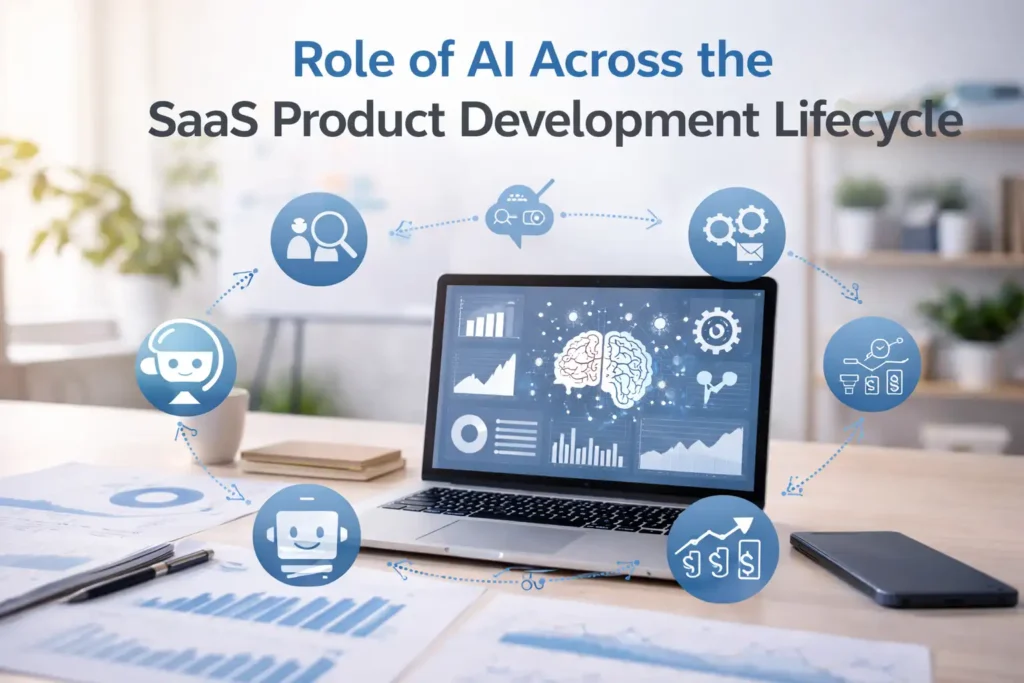
Artificial intelligence influences every stage of the SaaS product lifecycle, from early market research to pricing optimization and customer retention. Instead of being added at the end, AI now shapes strategy, feature prioritization, development workflows, and post-launch improvements. Product teams use data models to validate ideas, refine user experiences, and predict revenue outcomes. This lifecycle integration ensures that decisions are not based on assumptions but on real usage patterns and behavioral insights. When AI is embedded throughout development, SaaS companies build products that continuously evolve, adapt, and improve with every interaction.
AI in Market Research and Idea Validation
Before writing a single line of code, SaaS teams can use AI to analyze industry trends, customer reviews, and competitor positioning. Machine learning models scan large datasets to identify gaps in the market and emerging user needs. Sentiment analysis tools evaluate feedback from forums, surveys, and social platforms. This reduces guesswork and helps founders validate product ideas with real data. As a result, development begins with stronger strategic clarity.
AI in Product Planning and Roadmapping
Feature prioritization becomes more precise when backed by predictive analytics. AI models assess user engagement patterns, churn signals, and demand forecasts to guide roadmap decisions. Instead of relying only on stakeholder opinions, product managers can evaluate data-driven insights. Predictive planning helps teams allocate resources efficiently and focus on high-impact features. This creates a smarter, outcome-oriented approach to SaaS product strategy.
AI in UI and UX Personalization
User experience is one of the most visible areas where AI adds value. Intelligent onboarding flows adapt based on user roles, behavior, and goals. Dashboards dynamically display relevant metrics instead of overwhelming users with unnecessary data. Recommendation engines suggest actions, templates, or integrations tailored to individual preferences. Personalized experiences increase engagement, shorten the learning curve, and strengthen long-term adoption within subscription models.
AI in Software Development and Coding
AI-powered development tools assist engineers in writing, reviewing, and optimizing code. These systems detect vulnerabilities, suggest improvements, and automate repetitive tasks. Automated testing frameworks identify bugs earlier in the development cycle, reducing release delays. By accelerating coding and quality assurance processes, AI shortens development timelines while maintaining reliability. This enables SaaS companies to release features faster without compromising performance.
AI in Product Analytics and User Insights
Modern SaaS platforms collect massive volumes of behavioral data. AI processes this information to uncover trends that would otherwise remain hidden. Predictive models identify churn risks, upsell opportunities, and usage anomalies. Cohort analysis becomes more precise through machine learning segmentation. Instead of manually interpreting dashboards, teams receive actionable insights automatically. This supports smarter decisions that directly impact growth and retention.
AI in Customer Support and Engagement
AI-driven chatbots and virtual assistants provide instant responses to common queries, reducing response time and operational costs. Automated ticket classification routes issues to the right teams quickly. Sentiment analysis identifies frustrated customers and prioritizes urgent cases. These intelligent systems enhance user satisfaction while freeing human agents to handle complex tasks. Stronger support experiences contribute significantly to customer retention in SaaS businesses.
AI in Pricing and Monetization Strategies
Pricing optimization is another critical area where AI delivers measurable impact. Predictive models evaluate usage patterns, customer segments, and purchasing behavior to suggest optimal pricing tiers. Dynamic pricing strategies can adjust offers based on demand signals. Revenue forecasting becomes more accurate with machine learning models that account for churn probability and expansion opportunities. This data-driven monetization approach strengthens profitability and long-term sustainability.
Core Benefits of AI in SaaS Product Development
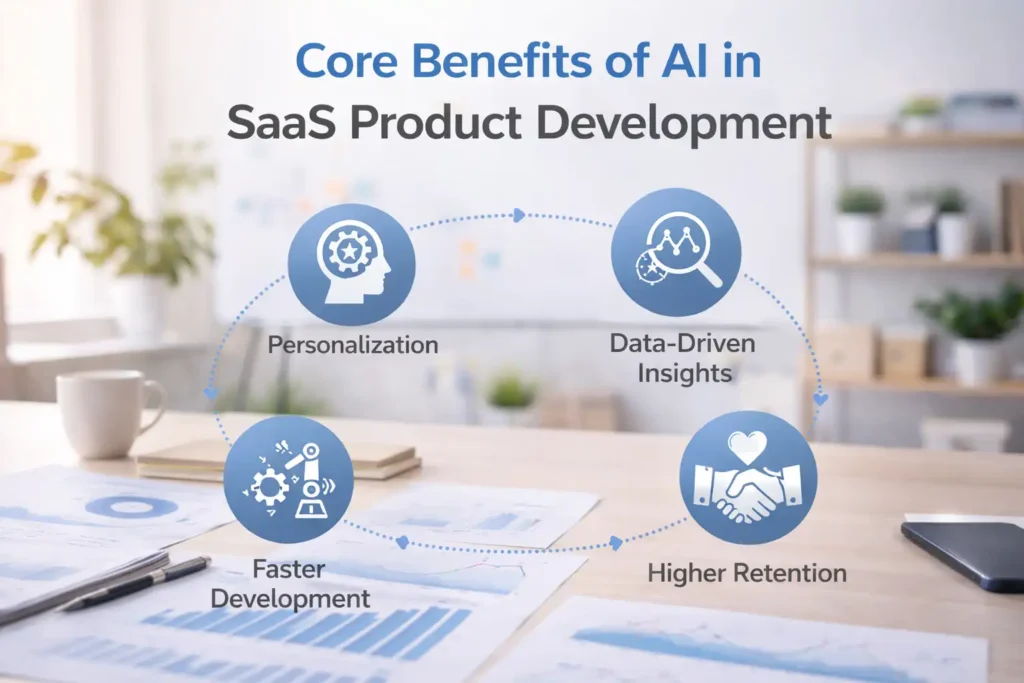
Artificial intelligence delivers measurable advantages that go beyond automation. It improves product quality, accelerates innovation, and strengthens customer relationships. SaaS companies that integrate AI effectively can personalize experiences at scale, reduce operational inefficiencies, and make faster data-driven decisions. These benefits compound over time because AI systems continuously learn from new data. As the user base grows, the product becomes smarter and more valuable. This creates a strong competitive moat that is difficult for traditional software providers to replicate. The long-term impact of AI adoption is not just incremental improvement but sustainable strategic growth.
Improved Personalization at Scale
AI enables SaaS platforms to tailor dashboards, recommendations, and workflows for each user. Instead of offering a one-size-fits-all interface, products adapt based on behavior and preferences. Personalized interactions increase engagement and make the software feel intuitive. Over time, this leads to higher satisfaction and stronger retention rates across diverse customer segments.
Faster Development Cycles
AI-powered testing, debugging, and code suggestions reduce manual workload for engineering teams. Automated quality assurance identifies issues earlier in the development process. This shortens release cycles and allows companies to respond quickly to market demands. Faster iterations help SaaS businesses stay competitive while maintaining stable and reliable performance.
Better Data-Driven Decision Making
Machine learning models process large datasets to uncover actionable insights. Instead of relying on assumptions, teams can evaluate real behavioral signals. Predictive analytics highlights churn risks, expansion opportunities, and performance gaps. With clearer visibility into product metrics, leaders make informed strategic decisions that drive measurable growth.
Higher Customer Retention
Churn prediction models detect early warning signs when users disengage. AI-powered engagement tools send proactive recommendations and reminders to re-engage customers. Personalized support experiences also increase trust and satisfaction. By addressing problems before they escalate, SaaS companies reduce churn and improve long-term subscription revenue.
Scalable Automation
AI automates repetitive tasks across marketing, support, analytics, and operations. As user volume increases, automation handles higher workloads without proportional cost growth. This scalability supports expansion into new markets and customer segments. Efficient automation strengthens profit margins while maintaining consistent service quality.
👉 You might also like: Grammarly AI: Improve Writing Quality Fast in 2026
Future of AI in SaaS Product Development
The future of SaaS is closely tied to advances in artificial intelligence. Generative AI will continue to automate content creation, reporting, and workflow management. Autonomous systems may handle routine decisions without constant human oversight. Hyper-personalization will become standard, with software adapting in real time to each user’s context. Integration between AI and low-code platforms will empower non-technical teams to build intelligent workflows. As these technologies mature, AI-first SaaS companies will likely outperform competitors that rely solely on traditional feature development. The next wave of innovation will focus on proactive, predictive, and self-optimizing software ecosystems.
Best Practices for SaaS Teams Adopting AI
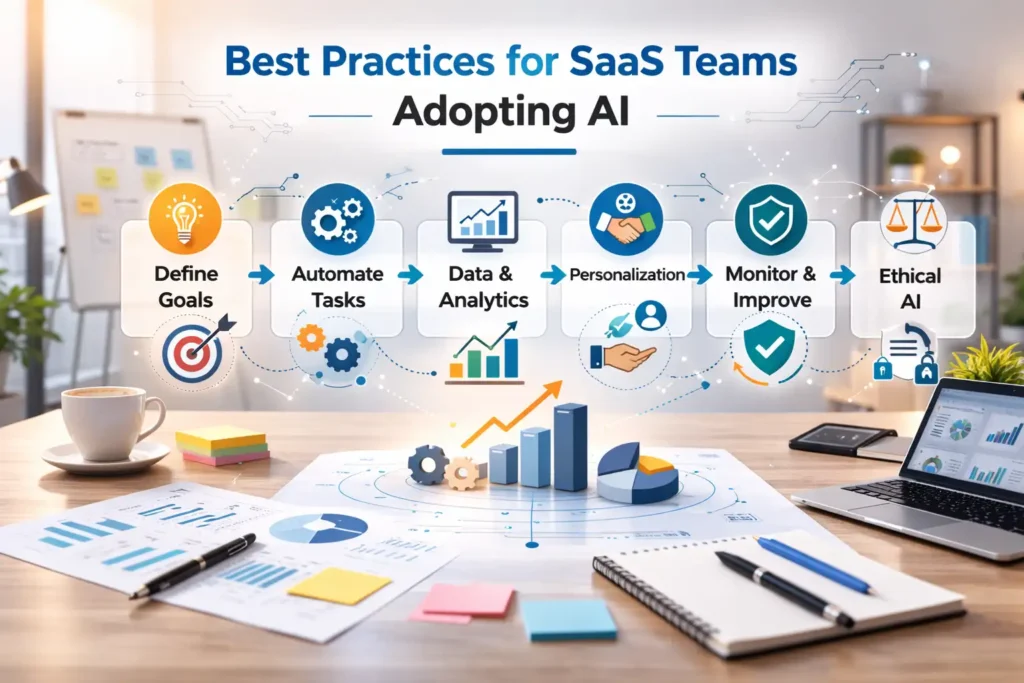
Successful AI integration requires clarity, discipline, and long-term thinking. Teams should begin by identifying specific business problems rather than adding AI for marketing appeal. Clear performance metrics must guide experimentation and evaluation. Continuous monitoring ensures that models remain accurate and relevant. Transparent communication builds user trust in automated decisions. By aligning AI initiatives with core product value, SaaS companies can achieve sustainable innovation instead of temporary hype-driven gains. A focused strategy helps transform AI from a feature into a foundational competitive advantage.
Start with Clear Business Objectives
Every AI initiative should solve a measurable problem such as reducing churn or improving onboarding. Clear goals prevent wasted resources and unnecessary complexity. When objectives are defined early, success metrics become easier to track and optimize over time.
Monitor, Optimize, and Maintain Transparency
AI models require continuous evaluation to maintain accuracy and fairness. Regular updates improve performance as user behavior evolves. Transparent communication about automated features builds trust. Responsible oversight ensures that AI remains aligned with both user expectations and business outcomes.
Conclusion
The role of AI in SaaS product development is no longer limited to automation or experimental features. It has become a strategic layer that influences research, planning, engineering, user experience, analytics, and monetization. SaaS products powered by artificial intelligence are more adaptive, data-driven, and capable of delivering personalized value at scale. From predictive insights to intelligent automation, AI enables companies to move faster while making smarter decisions.
At the same time, successful adoption requires clarity and discipline. AI should solve real business problems, not simply serve as a marketing label. Companies that focus on meaningful use cases, maintain data integrity, and prioritize transparency will see stronger results. As customer expectations continue to rise, AI-first SaaS platforms will define the next generation of software innovation.