
Robotics and Automation: Changing the Workforce and Everyday Life
Robotics is the branch of technology focused on designing, building, and operating robots. These machines can perform tasks that are repetitive, precise, or dangerous, often mimicking human actions. From industrial robots assembling cars to collaborative robots (cobots) working alongside humans, robotics has evolved into a vital part of modern industry. With advancements in mobility, sensors, and AI, robots are becoming more adaptable and intelligent, capable of handling tasks that were once exclusively human.
Understanding Automation
Automation refers to the use of technology to execute tasks without human intervention. Unlike robotics, which emphasizes physical machines, automation can involve software systems, machines, or entire processes. For example, assembly lines, automated billing systems, and AI-driven chatbots are forms of automation. By reducing the need for manual labor, automation streamlines operations, minimizes errors, and increases efficiency across industries.
Why They Matter Today
Robotics and automation have become essential for global competitiveness. Businesses leverage them to reduce costs, speed up production, and maintain consistent quality. Beyond industries, these technologies are reshaping everyday life, making homes smarter, healthcare more precise, and transportation safer. As technology continues to advance, the importance of robotics and automation in driving economic growth and improving quality of life cannot be overstated.
👉 You might also like: 5 Best AI Tools for Automating Business Tasks in 2026
Impact on the Workforce
Job Changes and Opportunities
One of the most discussed effects of robotics and automation is their impact on jobs. While repetitive roles in manufacturing, logistics, and data processing are increasingly automated, new opportunities are emerging. Careers in robotics programming, maintenance, AI management, and human-robot collaboration are growing rapidly. The workforce is shifting from purely manual labor to roles that require technical expertise and problem-solving skills.
Productivity and Efficiency
Robotics and automation enhance productivity by performing tasks faster and more accurately than humans. They reduce errors, minimize downtime, and ensure continuous operation. For businesses, this means higher output and better resource utilization. Workers, meanwhile, can focus on strategic and creative tasks instead of repetitive manual work. In essence, these technologies allow both humans and machines to play to their strengths.
Skills Needed for the Future
As robotics and automation continue to expand, the demand for specialized skills is increasing. Knowledge in AI, machine learning, programming, robotics engineering, and IoT integration is highly valuable. Additionally, soft skills such as adaptability, critical thinking, and the ability to collaborate with machines are essential. Continuous learning and upskilling will help workers thrive in a future shaped by automation.
👉 You might also like: 5 Best Platforms for Building SaaS Applications in 2026
Robotics in Daily Life
Smart Homes and Assistants
Robots and automated systems are no longer confined to factories. In homes, devices like robotic vacuum cleaners, smart speakers, and automated lighting make life more convenient. Virtual assistants powered by AI can manage schedules, control devices, and even provide entertainment, transforming the way people interact with technology daily.
Healthcare and Elder Care
In healthcare, robots assist surgeons in performing precise operations and help monitor patients in hospitals. Elder care robots provide companionship, medication reminders, and mobility assistance, allowing older adults to maintain independence. Automation in healthcare improves accuracy, reduces human error, and enhances overall patient care.
Transportation and Delivery
Transportation and logistics are also seeing significant automation. Autonomous vehicles, drones, and automated delivery systems improve efficiency and safety while reducing costs. Self-driving trucks and robotic delivery devices are changing the way goods move across cities, making services faster and more reliable.
👉 You might also like: How to Simulate a Real Investment Banking Interview at Home
Technologies Behind Robotics
Artificial Intelligence
AI is the backbone of modern robotics. It allows machines to analyze data, make decisions, and adapt to changing conditions. From predictive maintenance to self-learning robots, AI ensures that machines can operate autonomously and intelligently, performing tasks that were once impossible without human intervention.
Sensors and Machines
Sensors enable robots to perceive their environment. Cameras, lidar, pressure sensors, and touch-sensitive actuators help robots detect obstacles, measure distances, and interact safely with humans. Advanced machinery combined with smart sensors allows for precise and flexible operations in factories, hospitals, and homes.
Connected Devices (IoT)
This integration allows systems to optimize performance, predict maintenance needs, and coordinate tasks efficiently. For example, smart factories use IoT-enabled robots to communicate with each other, reducing downtime and enhancing productivity.
Benefits and Challenges
Advantages for Business and Society
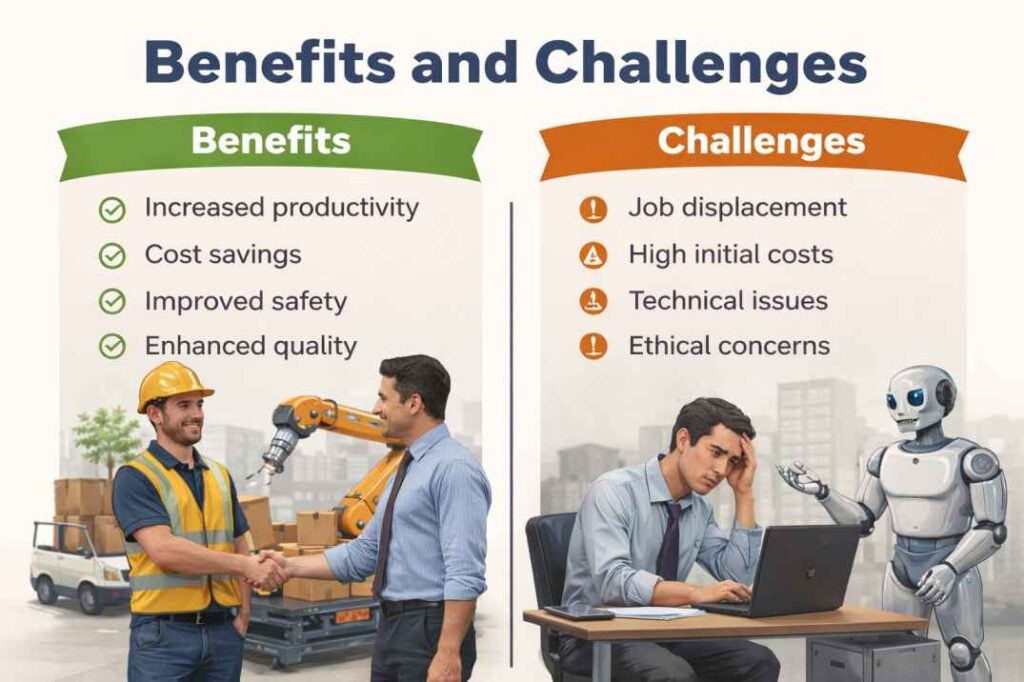
Robotics and automation provide significant advantages for both businesses and society. For companies, these technologies increase efficiency, reduce operational costs, and improve product quality. Automated processes work continuously without fatigue, enabling faster production and consistent results. Society benefits through improved healthcare, safer workplaces, and enhanced convenience in daily life. Automated systems in transportation, logistics, and public services streamline operations, making services faster and more reliable for everyone.
Costs and Technical Limits
Despite the benefits, robotics and automation come with costs and technical limitations. High initial investment in equipment, maintenance, and software can be a barrier for small businesses. Technical challenges include system reliability, adaptability, and integration with existing workflows. Robots may struggle with tasks requiring creativity, complex judgment, or nuanced human interaction. These limitations highlight the need for careful planning and realistic expectations when implementing automated solutions.
Ethical and Social Concerns
As robotics and automation become more widespread, ethical and social issues emerge. Job displacement is a major concern, particularly in industries relying on repetitive labor. Data privacy and security risks arise when machines collect and transmit sensitive information. Additionally, ethical questions around decision-making in AI-powered systems, biases in automation, and human-robot interactions require careful oversight. Policymakers and organizations must address these challenges to ensure responsible and equitable adoption.
👉 You might also like: 5 Best VPNs for Privacy & Security in 2026
Future of Robotics and Automation
Collaboration Between Humans and Robots
The future of work emphasizes collaboration between humans and robots, often called cobots. These machines assist humans rather than replace them, handling repetitive or physically demanding tasks while people focus on creative, strategic, or interpersonal roles. Collaborative robotics improves productivity, reduces workplace injuries, and fosters an environment where human skills and machine efficiency complement each other.
Emerging Trends
Emerging trends in robotics and automation include autonomous vehicles, AI-driven decision-making, advanced industrial robots, and smart home systems. Integration with the Internet of Things (IoT) allows machines to communicate, learn, and adapt in real time. Developments in machine learning enable robots to improve performance based on experience, making them more versatile and intelligent. These trends are transforming industries, from manufacturing to healthcare, and reshaping daily life.
Preparing for Change
Preparing for a robotics-driven future requires investment in skills, education, and infrastructure. Workers need training in programming, AI, robotics maintenance, and data analysis. Businesses should adopt flexible processes that can incorporate automation without disrupting operations. Governments and organizations must establish policies and safety standards to guide ethical implementation. Proactive adaptation ensures that robotics and automation enhance productivity without creating unnecessary social disruption.
Real-World Examples
Industry Applications
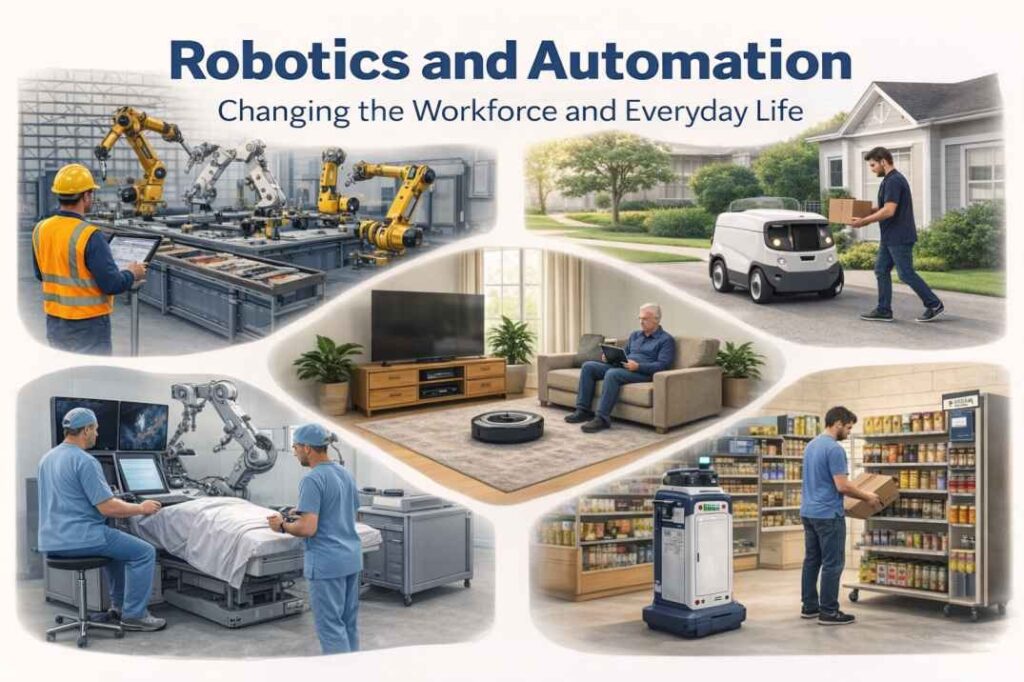
Robotics and automation have already transformed industries worldwide. In manufacturing, robots assemble vehicles, electronics, and consumer goods with precision. Warehouses use automated sorting systems to manage inventory efficiently. Healthcare facilities employ surgical robots for minimally invasive procedures, improving patient outcomes. These applications demonstrate how automation can enhance efficiency, reduce errors, and enable high-quality services at scale.
Everyday Robotics
Robotics is increasingly visible in everyday life. Smart home devices like robotic vacuum cleaners, AI assistants, and automated lighting systems make daily tasks easier. Delivery drones, autonomous vehicles, and self-checkout machines streamline transportation and shopping. Even elder care benefits from robots that provide reminders, mobility assistance, and companionship. These examples show that automation is no longer just an industrial tool it is integrated into daily routines.
👉 You might also like: 5 Best AI Chatbots for Customer Support in 2026
Frequently Asked Questions (FAQs)
Will robots replace human jobs?
Some jobs may be replaced, particularly repetitive or dangerous roles. However, new opportunities in programming, maintenance, and human-robot collaboration are emerging, balancing the workforce shift.
How is robotics used in everyday life?
Robots assist in homes, healthcare, and transportation. Examples include robotic vacuums, surgical robots, delivery drones, and AI assistants, all of which improve convenience and efficiency.
What skills are needed for a robotics-driven future?
Key skills include programming, AI and machine learning, robotics engineering, data analysis, and adaptability. Soft skills like problem-solving and collaboration with machines are also valuable.
What are the ethical concerns of robotics and automation?
Concerns include job displacement, data privacy, AI biases, safety, and the responsible use of machines. Addressing these issues requires regulation, policies, and ethical guidelines.
Conclusion
Robotics and automation are transforming industries and daily life, offering remarkable benefits while posing technical, ethical, and social challenges. Businesses gain efficiency and cost savings, while society enjoys safer workplaces and smarter services. Preparing for the future requires collaboration between humans and machines, investment in skills, and ethical oversight. As technology continues to evolve, robotics and automation will remain key drivers of innovation, productivity, and convenience across every aspect of life.
✨ This is just the start. Follow Tech Statar for more gems.