
The SaaS Trap: How Startups Can Optimize Their 2026 Software Budgets with Perpetual Licensing
In the fast-paced world of tech startups, agility is everything. Over the last decade, the shift toward cloud computing and the “Subscription Economy” was hailed as the ultimate equalizer, allowing lean teams to access enterprise-grade tools without massive upfront capital.
However, as we move deeper into 2026, the economic landscape for startups has shifted. With tighter venture capital markets and a renewed focus on profitability over growth-at-all-costs, founders are taking a hard look at their operational overhead.
What they are finding is alarming. The very subscription models that helped them launch are now quietly draining their runways. Industry data suggests that the average small-to-medium enterprise (SME) in 2026 is spending upwards of $9,000 to $12,000 annually per employee on Software as a Service (SaaS) tools alone.
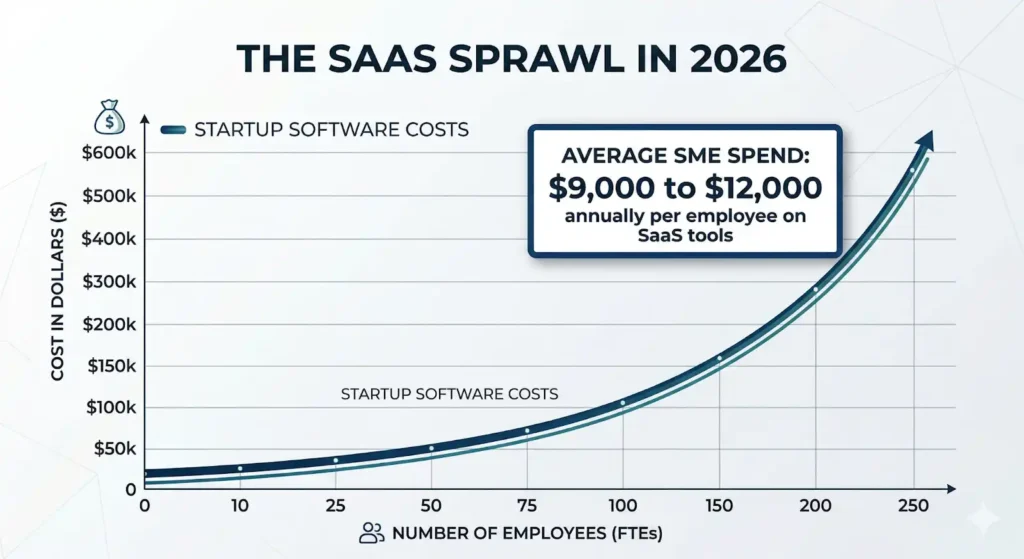
It is time for digital entrepreneurs, CEOs, and IT managers to rethink their tech stacks. By blending the agility of SaaS with the financial stability of perpetual software licensing, startups can drastically optimize their IT balance sheets.
The Hidden Cost of the “Subscription Economy”
The allure of SaaS is undeniable. A $20 per month fee for a productivity suite or a $50 per month fee for Graphic design software feels negligible to a well-funded seed-stage startup.
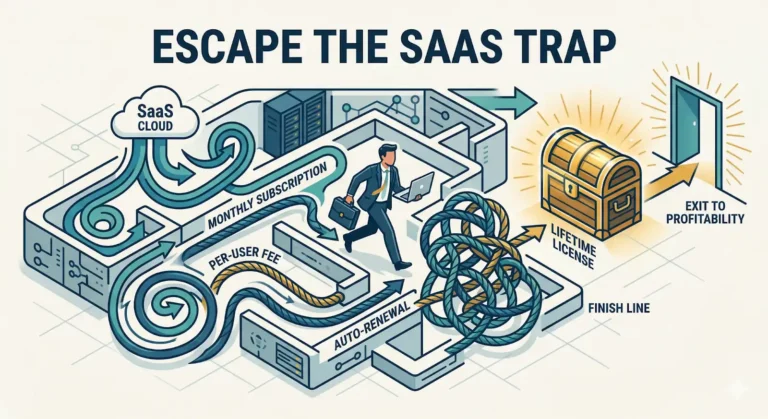
But SaaS pricing models are fundamentally designed to penalize scale. The standard “per-user, per-month” pricing matrix means that as your team grows, your baseline operational overhead grows exponentially right alongside it.
Every new hire requires a new seat license across your entire software ecosystem. Before long, what started as a few hundred dollars a month balloons into a five-figure annual liability. This phenomenon, often referred to as “subscription fatigue” or “SaaS sprawl,” is one of the leading causes of bloated burn rates in modern digital businesses.
When a startup inevitably hits a slow quarter or faces an economic downturn, these recurring monthly fees do not pause. They remain fixed liabilities on the balance sheet, forcing founders to make difficult decisions between keeping their tech stack active and making payroll.
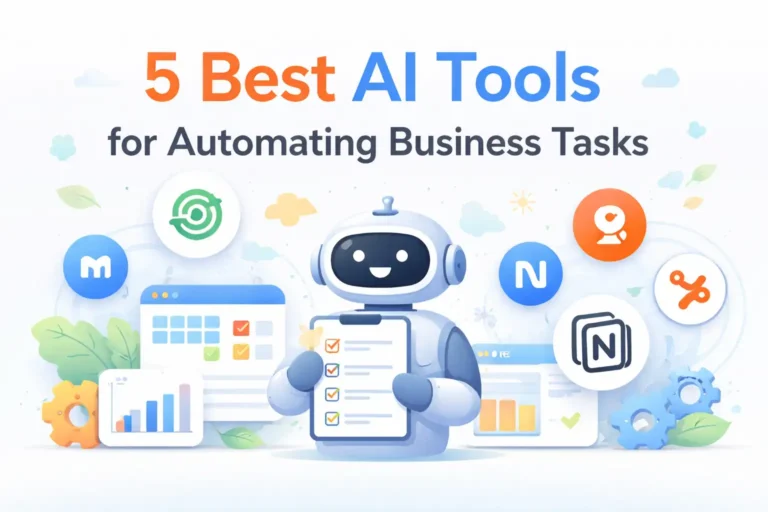
👉 You might also like: 5 Best AI Tools for Automating Business Tasks in 2026
SaaS vs. Perpetual Licensing: A 3-Year TCO Comparison
To truly understand how to optimize an IT budget, tech leaders must evaluate their tools using a Total Cost of Ownership (TCO) framework. This requires looking past the monthly sticker price and calculating the true cost of a software asset over a standard three-to-five-year lifecycle.
Understanding the Terminology
- SaaS (Software as a Service): You are renting the software. Access is contingent on continuous payment, and the software is hosted in the cloud, receiving continuous updates.
- Perpetual Licensing: You are buying the software outright. You pay a single, upfront capital expenditure (CapEx) for a specific version of the software, and you own the right to use it indefinitely.
The Financial Breakdown
Let’s look at a practical, real-world comparison that almost every startup faces: standard office productivity suites.
Scenario A: The SaaS Route (e.g., Cloud-Based Office Subscriptions)
- Average Cost: $150 per user, per year.
- Cost for a 20-person team in Year 1: $3,000.
- Total 3-Year Cost for 20 users: $9,000.
- Asset Value at the end of Year 3: $0 (If you stop paying, the software shuts off).
Scenario B: The Perpetual Route (e.g., Office 2021/2024 Lifetime Licenses)
- Average Cost: A one-time fee of $150 to $250 per user.
- Cost for a 20-person team in Year 1: $5,000.
- Cost in Year 2 and Year 3: $0.
- Total 3-Year Cost for 20 users: $5,000.
- Asset Value at the end of Year 3: You still own the software and can use it indefinitely.
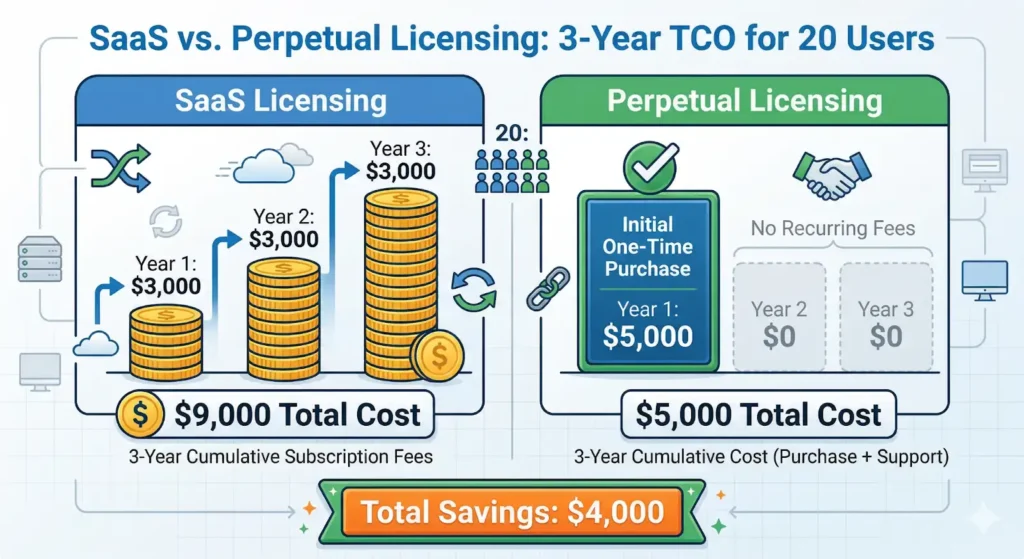
By making a one-time purchase, the startup in Scenario B saves $4,000 over three years on just one piece of software. When you multiply those savings across operating systems, design suites, and specialized developer tools, the impact on a startup’s financial runway is transformative.
Building the Hybrid Stack: What to Rent and What to Own
Advocating for perpetual licensing does not mean completely abandoning the cloud. The most financially efficient startups in 2026 are deploying a “Hybrid Tech Stack.”
This strategy involves renting the agile, collaborative tools that require real-time cloud connectivity, while buying the foundational infrastructure that remains static.
The “Rental” Tier (SaaS)
Certain tools are inherently collaborative and require the continuous data syncing that only a subscription model can provide. Founders should willingly allocate monthly budgets to these categories:
- Customer Relationship Management (CRM): Platforms like Salesforce or HubSpot rely on live data enrichment and continuous feature rollouts.
- Team Communication: Tools like Slack or Microsoft Teams need to be hosted on robust cloud servers to function across distributed networks.
- Cloud Hosting & Infrastructure: AWS, Google Cloud, and Azure are strictly usage-based and vital for hosting modern digital products.
The “Ownership” Tier (Perpetual)
Conversely, there is no strategic advantage to renting software that runs locally on a machine and doesn’t require daily feature overhauls. Startups should purchase one-time perpetual licenses for:
- Operating Systems: Upgrading your team to a standardized OS like Windows 11 Pro should be a one-time onboarding cost, not a monthly fee.
- Core Productivity Suites: Word processors, localized spreadsheets, and presentation software rarely change enough year-over-year to justify a subscription.
- Specialized Desktop Software: Heavy-duty applications like CAD programs, advanced video editing suites, and graphic design software run best locally without the latency of cloud rendering.
Standardizing the Team Ecosystem
When a startup transitions its core infrastructure to an ownership model, the procurement process actually becomes much simpler. Rather than managing dozens of individual monthly SaaS accounts that fluctuate with every billing cycle, founders can standardize their entire workforce on a single, unified build. By sourcing core operating systems and productivity suites through trusted B2B vendors like Instant-Key, tech leaders ensure every new hire is instantly equipped with a secure, permanent workstation, eliminating recurring overhead while maximizing long-term ROI.
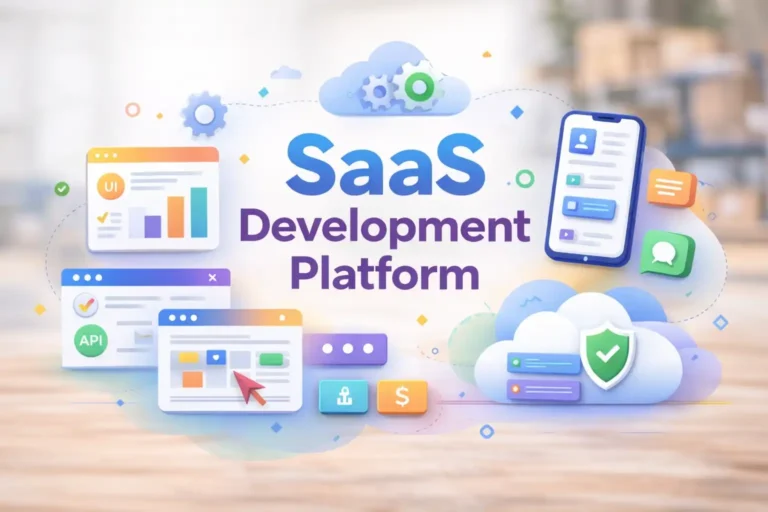
👉 You might also like: 5 Best Platforms for Building SaaS Applications in 2026
The Security Advantage of Localized Control
Beyond the sheer financial savings, shifting core infrastructure to perpetual licensing offers significant operational and security advantages for growing companies.
Enhanced Data Sovereignty
In an era of stringent data privacy regulations (such as GDPR and CCPA), startups must be hyper-vigilant about where their client data is stored.
SaaS applications inherently require you to upload your proprietary data to a third-party server. By utilizing perpetual, locally installed software, founders retain absolute data sovereignty. Sensitive financial models in spreadsheets or proprietary source code in local environments never have to leave the company’s secure, internal servers.
Uptime and Business Continuity
Relying entirely on SaaS means your company’s productivity is entirely dependent on two external factors: your internet connection and the vendor’s server stability.
If a major cloud provider experiences an outage, a 100% SaaS-reliant startup grinds to an absolute halt. Developers cannot code, designers cannot access their canvases, and copywriters cannot draft documents.
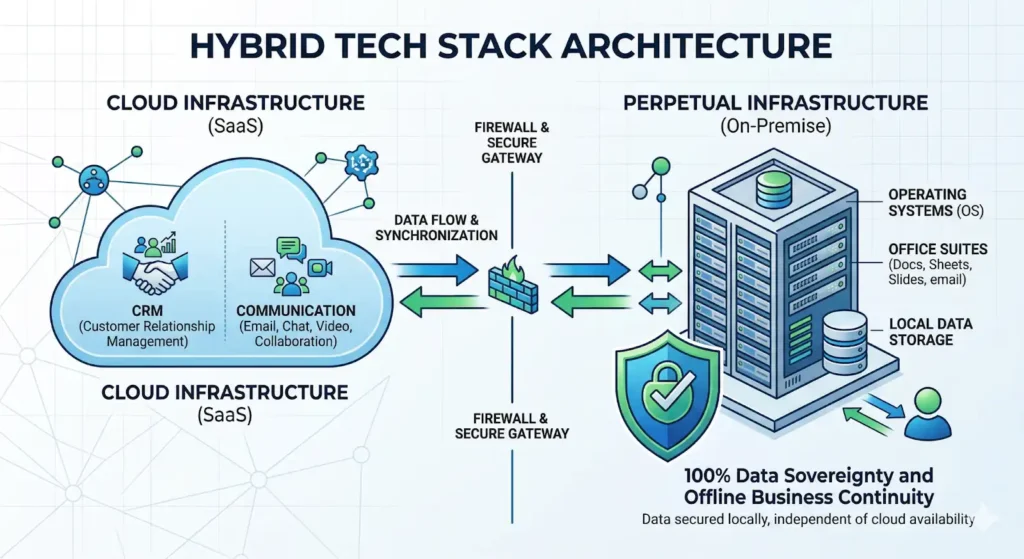
Perpetual, locally installed software provides an invaluable layer of business continuity. Even in the event of widespread network disruptions, your team can continue to operate securely offline, maintaining momentum and protecting client deliverables.
Conclusion: Taking Control of the IT Balance Sheet
The “Subscription Economy” has convinced a generation of entrepreneurs that renting their digital infrastructure is the only way to scale. But as startups mature, the realization sets in: renting is rarely the path to long-term wealth or stability.
Founders and IT managers looking to extend their runways in 2026 must take proactive control of their IT balance sheets. This process begins with a comprehensive tech stack audit.
The 3-Step Tech Stack Audit
- Map Every Recurring Cost: Task your operations team with listing every single per-user subscription currently active in the company.
- Identify the “Static” Tools: Highlight any software on that list that is used primarily for offline, local work (e.g., base operating systems, standard document creation, local design rendering).
- Execute the Transition: Calculate the one-time cost of replacing those subscriptions with perpetual licenses. If the ROI break-even point is under 18 months, execute the purchase and cancel the SaaS seats.
By strategically blending the collaborative power of the cloud with the financial efficiency of perpetual licensing, startups can free up thousands of dollars in monthly cash flow. That is capital that can be redirected away from software vendors and back into what truly matters: hiring top talent, developing better products, and scaling the business.
✨ Liked this breakdown? Stick around, follow Tech Statar.













![What Is Nastia AI? A Detailed Guide [2025]](https://techstatar.com/wp-content/uploads/2025/11/nastia-ai-honest-review-of-the-uncensored-ai-companion-1757572191.jpg "Reviews")