


Embedding Amazon Data into B2B Analytics Platforms
In today’s highly competitive digital economy, data is no longer a byproduct of commerce; it is the foundation of strategic decision-making. Marketplace intelligence has become essential for B2B analytics platforms serving e-commerce brands, manufacturers, agencies, and aggregators. In global marketplaces, Amazon stands as the most influential source of product, pricing, rankings, and consumer sentiment data.
Embedding Amazon datasets directly into B2B analytics platforms is changing the way companies monitor competition, forecast demand, optimize pricing, and identify growth opportunities. Instead of forcing customers to toggle between tools, modern SaaS platforms are integrating market data into integrated dashboards, predictive models, and automated workflows.
This article explains why embedding Amazon data makes sense, what type of data is most valuable, architectural considerations, and the strategic benefits it creates for B2B analytics providers.
Why Amazon Data Is Mission-Critical for B2B Analytics
Amazon holds a large stake in global e-commerce transactions and influences pricing and consumer expectations beyond its own ecosystem. Even brands that don’t sell directly on Amazon are affected:
1. Competitive pricing benchmark
2. Product Positioning Trends
3. Consumer review sentiment
4. Change in demand for the category
5. Emerging private-label competition
For B2B analytics platforms, integrating Amazon data allows customers to:
1. Monitor competitive strategies in real time
2. Identify pricing gaps and margin opportunities
3. Quickly find new product launches
4. Analyze consumer sentiment on a large scale
5. Benchmark performance against category leaders
Incorporating this intelligence into existing analytics workflows eliminates friction and increases customer stickiness.
Key Amazon Data Types to Embed
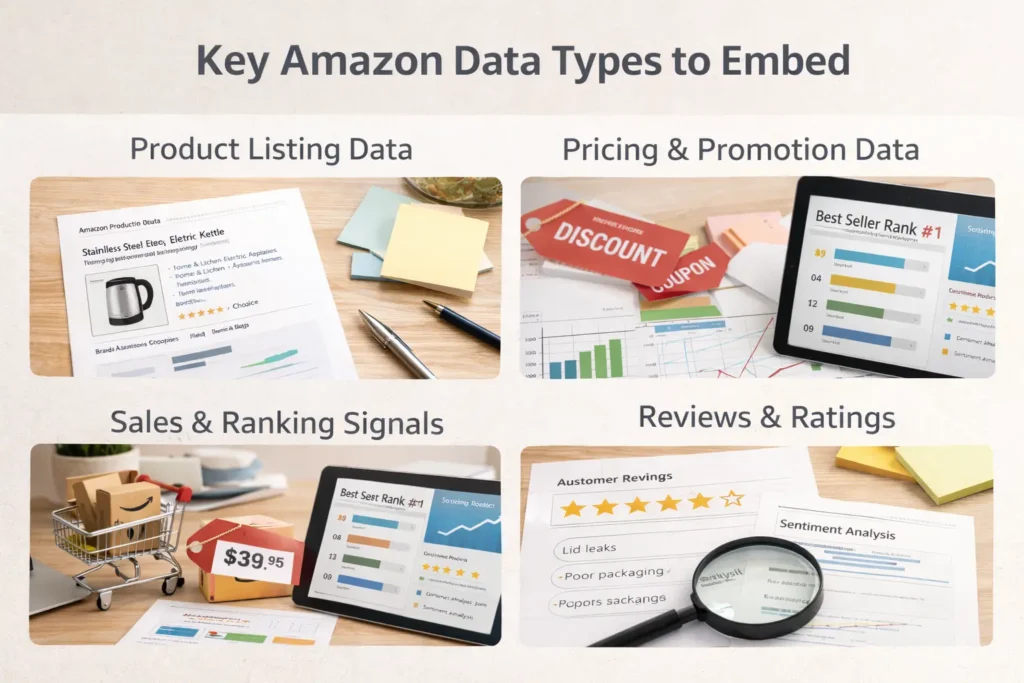
Not all market data provides equal value. The most effective B2B analytics platforms focus on structured, actionable datasets.
1. Product Listing Data
Title and description
Images and A+ Content Indicators
Brand and vendor information
Category hierarchy
This data supports competitive mapping, taxonomy analysis, and SEO benchmarking.
2. Pricing and Promotion Data
Current price
Historical price changes
Discounts and Coupons buy
Box ownership
Pricing intelligence enables dynamic pricing algorithms and margin optimization models.
3. Sales and Ranking Signals
Best Seller Rank (BSR)
Change in category ranking
Estimated Sales Volume
Although Amazon does not publish exact sales figures, ranking data can be modeled to predict demand trends.
4. Reviews and Ratings
Star rating
Review quantity
Emotional tendencies general
Complaint topics
Review Mining Fuel sentiment analysis, product improvement insights, and brand health dashboards.
👉 You might also like: How AI Is Shaping SEO in 2026 – Detailed Guide
Use Cases for Embedded Amazon Data
Competitive Intelligence Dashboard
B2B platforms can integrate competitor tracking directly into executive dashboards. Instead of exporting a spreadsheet, users see:
Price changes in real time
New product list
Ranking fluctuations
Velocity Review
This turns reactive monitoring into a proactive strategy.
AI-powered Demand Forecasting
When Amazon ranking and review velocity are integrated into predictive models, SaaS platforms can:
Quickly detect range increases.
Predict seasonal fluctuations
Identify declining SKUs
Optimize inventory allocation
Embedding this data makes forecasting more dynamic and responsive.
Dynamic Pricing Engine
Amazon pricing benchmarks can feed directly into the automated repricing engine. B2B analytics platforms can:
Compare SKUs from top competitors.
Mark low-price or high-price products
Trigger automatic adjustment
This is especially powerful for brands that operate in multiple markets.
Product Development Insights
Large-scale mining review data helps highlight the following:
Frequent Feature Complaints
Packaging issues
Quality perception gap
Unmet customer needs
Embedding these insights into a product analytics module closes the loop between consumer feedback and product innovation.
Technical Architecture Considerations

Embedding Amazon data into a B2B analytics platform requires thoughtful infrastructure design.
1. Data Collection Layer
Platforms generally depend on:
Web scraping api
Market data provider
Structured dataset
Proxy management system
It is important for data to be fresh. For pricing and ranking information, real-time updates provide a competitive edge.
2. Data Normalization and Augmentation
Amazon data may be messed up. Changes to nomenclature, category classification, and listing formats required:
SKU matching algorithm
Brand generalization
Detect duplicates
Classification alignment
Without robust normalization pipelines, embedded data loses credibility.
3. Scalable Storage and Processing
Seek high-frequency market data:
distributed storage systems
stream processing framework
incremental update pipelines
Analytics platforms must balance cost, latency, and scalability.
4. API and Dashboard Integration
The final step is to provide value to end users. This means:
Embedding datasets in customer-facing dashboards
Providing filterable competitive views
Providing exportable insights
Integration with BI tools
The smoother the integration, the higher the user acceptance.
👉 You might also like: How to Change Your Amazon Language Settings on Mobile and Desktop
Strategic Advantages for B2B SaaS Providers
Embedding Amazon data isn’t just a feature upgrade, it’s a strategic moat.
Increased Platform Viscosity
When marketplace intelligence becomes central to the daily workflow, switching costs increase significantly.
Higher ACV (Annual Contract Value)
Premium data modules can justify higher-tier pricing plans.
Discrimination in Crowded Markets
Many analytics platforms provide internal metrics. Very few integrate external competitive intelligence on a large scale.
Data Network Effect
The more customers use embedded marketplace data, the more feedback improves modeling accuracy, strengthening forecasting capabilities.
Monetization Model
B2B platforms can monetize embedded Amazon data:
Tiered access to market intelligence
Usage-based pricing (API calls, tracked SKUs)
Add-on Competitive Intelligence Module
AI-powered premium forecasting features
This turns data integration into a revenue driver rather than just growth.
Challenges and Risk Mitigation
While powerful, embedding Amazon data comes with challenges:
Data instability and listing changes
Compliance and Market Policy Risk
Infrastructure costs
Data accuracy verification
Successful platforms mitigate these risks by diversifying data sources, implementing validation checks, and maintaining scalable architectures.
The Future: Marketplace Intelligence as a Core SaaS Layer
As competition in e-commerce intensifies, external market data will become a standard layer within the B2B analytics stack. Just as CRM data revolutionized sales platforms, Amazon Intelligence is reshaping commerce analytics.
The next generation of B2B platforms will no longer treat marketplace data as optional. Instead, they’ll cover it in depth:
Forecast engine
Pricing automation
Product development workflow
Executive Reporting Dashboard
In doing so, analytics platforms move from descriptive reporting tools to predictive, strategy-shaping systems.
Conclusion

Embedding Amazon data into a B2B analytics platform delivers a powerful benefit: real-time, actionable marketplace intelligence integrated directly into operational decision making.
For SaaS providers, this integration strengthens differentiation, increases revenue potential, and deepens customer dependency. For end users, it provides clarity in an increasingly complex competitive landscape.
In the data-driven future of commerce, platforms that integrate internal performance metrics with external market intelligence will define the next wave of B2B innovation.
✨ Got value? Let’s keep the momentum, follow Tech Statar.