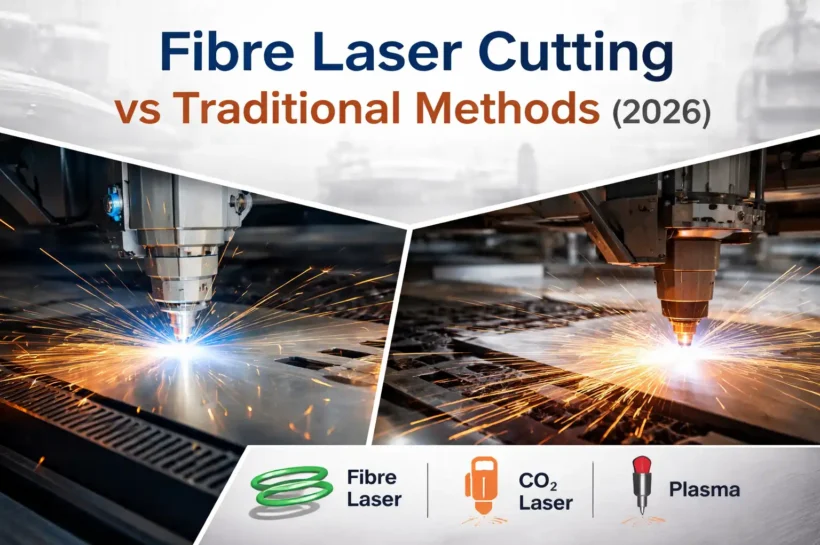

Why Fibre Laser Cutting Is Replacing Traditional Metal Cutting Methods
The UK manufacturing sector isn’t just evolving, it’s shifting quite quickly now.
If you look across different industries, one thing stands out more than anything else in 2026: fibre laser cutting is being adopted at a pace. Not gradually. Properly taking over.
Manufacturers are under pressure. More precision, faster turnaround times, better efficiency, all of it at once. And realistically, older systems are starting to struggle to keep up.
Methods like CO₂ lasers and plasma cutting still exist, of course. They’re not obsolete overnight. But the gap between what they offer and what’s now expected is becoming harder to ignore.
Not long ago, fibre laser technology was seen as a bit of a premium upgrade. Now, in many cases, it’s just becoming standard.
The Limitations of Traditional Cutting Methods
For years, CO₂ lasers and plasma systems have done the job. No question about that.
But things have changed, and that’s really where the issue starts.
CO₂ lasers rely on gas mixtures and fairly complex optical setups. That adds maintenance. It adds cost. And, over time, it adds inefficiencies that manufacturers are trying to move away from.
They also aren’t particularly energy-efficient when you compare them to newer alternatives. And with energy costs still a concern, that matters more than it used to.
Plasma cutting has its place, too. It’s still useful, especially for thicker materials. But when precision is critical, and it usually is, it doesn’t always deliver the same level of accuracy. You often end up needing extra finishing work.
And that slows everything down.
That’s really the problem. Not one big issue, but a collection of smaller ones that add up.
💚 You might also like: Execution Architecture as a Governance Discipline for Enterprise Operating Systems and AI Integration
What Makes Fibre Laser Technology Different?
So, where do fibre lasers fit into all of this?
At a basic level, fibre laser cutting uses a solid-state laser source, with light generated through optical fibres. It sounds technical because it is, but in practice, it’s a much cleaner and more efficient setup.
There are fewer moving parts. No mirrors to align. No gas systems to maintain.
That simplicity actually makes a big difference day to day.
It’s more reliable. Easier to manage. And generally, less prone to the kind of issues that slow production down.
On top of that, fibre lasers convert energy far more efficiently. More of the power you’re using actually goes into the cutting process, rather than being lost elsewhere.
And that’s where the real advantage starts to show.
Speed, Precision, and Performance
This is where fibre laser cutting really stands out.
They’re fast. Not slightly faster in many cases, noticeably faster, especially on thinner materials.
That alone can change how a production line operates.
But speed isn’t everything. Precision is just as important.
Fibre lasers produce very clean cuts, with minimal distortion. Less waste. Fewer errors. And less need to go back and fix things afterwards.
That’s a big deal in industries where tolerances are tight.
Technologies like fibre laser cutting machines are becoming the preferred choice due to their speed, energy efficiency, and lower maintenance requirements.
And when you combine all of that speed, consistency, and reliability, it starts to make sense why more manufacturers are making the switch.
Lower Operating and Maintenance Costs
Cost always comes into it.
At first glance, fibre laser systems can look like a bigger investment. And in some cases, they are.
But over time, the picture changes.
There are fewer components to maintain. Fewer consumables. Less downtime. That alone can make a noticeable difference.
Energy use is lower, too, which is increasingly important. It might not seem dramatic week to week, but over the course of a year, it adds up.
And that’s usually how manufacturers look at it long-term, not just upfront.
💚 You might also like: How Modern Technology is Transforming Material Testing in Construction
Applications Across Multiple Industries
Another reason fibre laser cutting has grown so quickly is its flexibility.
It’s being used across all sorts of sectors, such as automotive, aerospace, construction, and general engineering. Pretty much anywhere metal is being processed, you’ll find it.
Some applications are highly detailed. Others are on a larger scale. Fibre lasers can handle both, which makes them a practical option for a wide range of jobs.
That versatility matters.
Supporting the Shift Towards Automation
There’s also a wider shift happening at the same time.
Manufacturing is becoming more automated. That’s not new, but it’s accelerating.
Fibre laser systems fit into that environment quite naturally. They can be integrated into automated lines, work alongside robotic systems, and operate with minimal manual input.
And that’s where things are heading.
Not fully automated everywhere, but certainly more connected, more efficient, and less reliant on manual processes.
The Future of Metal Cutting
Fibre laser cutting isn’t just a short-term trend. It’s part of a bigger change in how manufacturing works.
And in many ways, that change is already happening.
Some businesses are further along than others. Some are still holding onto older systems because they work or because replacing them isn’t cheap.
But the gap is growing.
And eventually, that gap becomes difficult to ignore.
In 2026, fibre laser cutting has established itself as the leading option for modern metal fabrication. Not because it’s new, but because it solves problems that manufacturers are actively dealing with.
Better efficiency. Better precision. Fewer limitations.
That’s really what it comes down to.
✨ Want more clarity, less confusion? Follow Tech Statar.