
Execution Architecture as a Governance Discipline for Enterprise Operating Systems and AI Integration
The execution-architecture methodology is a management discipline within enterprise governance and operating system design. The approach addresses a persistent structural gap in large organizations: the absence of a formally designed execution layer that systematically translates strategy, governance intent, and decision rights into repeatable day-to-day operational behavior.
Traditional operating model frameworks typically focus on organizational structure, reporting lines, process mapping, or performance metrics. However, they frequently leave the logic of execution – including decision ownership, escalation pathways, work unit definition, and feedback integration – dependent on managerial discretion and informal coordination mechanisms. This structural fragmentation becomes particularly critical in large-scale transformations and technology adoption initiatives.
The execution-architecture methodology conceptualizes enterprise operations as an integrated system composed of strategic intent, governance structures, decision rights allocation, performance logic, and operational workflows. Borrowing structural principles from systems engineering, the methodology formalizes dependencies between these elements and codifies execution as an integrated architectural layer. It is the structural interface between governance intent and operational execution.
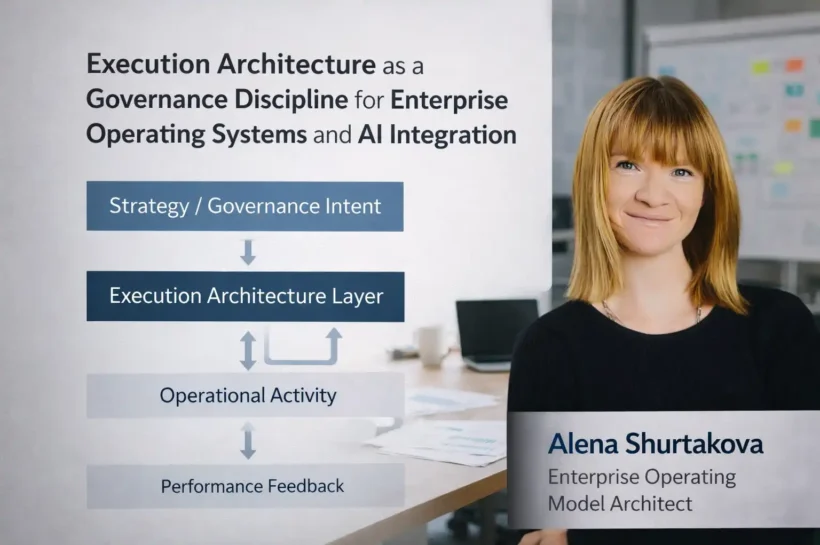
Its downward structure can be simplified as follows:
Strategy / Governance Intent
↓
Execution Architecture Layer
↓↑
Operational Activity
↑
Performance Feedback
What this methodology contributes to managerial theory is the relocation of feedback processing from the discretionary managerial level to a formalized execution layer governed by predefined decision logic. Operational signals, performance deviations, and standardized exception categories are processed within the execution architecture itself, while only threshold breaches and systemic risks are escalated to the governance level.
This introduces an escalation filter as a structural component of enterprise design. By embedding decision rules and feedback loops into the execution layer, the system reduces dependence on individual managerial capability as the primary regulator of operational coherence. This reconfiguration addresses two persistent structural inefficiencies in large organizations: managerial overload and latency in operational response.
The result is a replicable governance architecture in which feedback circulation, decision rights, and escalation logic are structurally embedded rather than informally negotiated, increasing organizational scalability, coherence, and accountability.
Empirical applications of the methodology across fourteen large-scale engagements in retail, utilities, healthcare, and technology sectors demonstrate measurable outcomes, including productivity increases of up to 50 percent, scalable multi-regional expansion models, and improved execution effectiveness indicators at the leadership level. Cross-sector and cross-geographical implementation further supports the structural transferability of the approach across markets with varying levels of economic and regulatory maturity.
In the context of accelerated AI development, the methodology has evolved into a framework for enterprise-level AI integration readiness. Many organizations experience failure in AI adoption due to the absence of redesigned execution and governance systems capable of supporting technological integration. By architecting the execution layer prior to deployment, the methodology establishes structural preconditions for AI-enabled governance, reducing fragmentation and implementation risk.
By formalizing execution architecture as a distinct governance discipline, this work contributes to the advancement of enterprise operating model theory and practice, positioning execution readiness as a critical determinant of sustainable transformation and AI integration at scale.
Author Bio :-
Alena Shurtakova, a globally recognized architect of enterprise operating models and organizational systems, specializing in AI-enabled workforce and organizational design at scale.
✨ Want more clarity, less confusion? Follow Tech Statar.