
How AI Is Shaping SEO in 2026
Artificial intelligence is no longer a future concept in SEO. It is already shaping how search engines understand, rank, and display content. Over the past few years, search has shifted from simple keyword matching to intent-driven results powered by machine learning. Today, algorithms analyze context, behavior, and relevance instead of just keywords. Platforms like Google now prioritize helpful, user-focused content that truly answers queries. This means traditional SEO tactics alone are not enough anymore. Businesses, marketers, and agencies must adapt their strategies to align with AI-driven search systems that reward quality, clarity, and real expertise.
The Evolution of Google’s Algorithm: From Keywords to AI
Search algorithms have evolved significantly from basic keyword detection to sophisticated AI-powered systems. Earlier, rankings were heavily influenced by exact-match keywords and backlinks. Now, modern algorithms evaluate search intent, semantic relevance, and user satisfaction signals. This transformation shows how SEO is no longer about gaming the system but about genuinely helping users. AI allows search engines to interpret meaning, context, and topical depth more accurately. As a result, websites that provide comprehensive, structured, and valuable information are more likely to achieve stable rankings compared to thin or overly optimized pages.
Early SEO Era – Exact Match & Backlinks
In the early days of SEO, ranking high was mostly about inserting exact keywords and building large numbers of backlinks. Search engines relied heavily on basic signals like keyword density and link quantity. This made it easier for low-quality pages to rank with aggressive optimization tactics. However, this approach often led to poor user experience and irrelevant search results, which eventually pushed algorithmic evolution.
The Introduction of Machine Learning
The integration of machine learning into search algorithms marked a major turning point in SEO. Instead of relying only on static ranking factors, search engines began analyzing user behavior, engagement, and query patterns. This allowed them to understand why users clicked certain results and ignored others. Machine learning systems continuously refine rankings based on real-world interaction data and search intent signals.
AI-Powered Updates (BERT, MUM & Beyond)
Modern algorithm updates now focus on natural language processing and deep contextual understanding. AI models can interpret complex queries, conversational searches, and nuanced intent behind user questions. This shift enables search engines to deliver more precise and meaningful results. Instead of matching keywords alone, they evaluate the entire topic, content depth, and semantic relevance across the page.
How AI Is Transforming Search Intent & Query Understanding
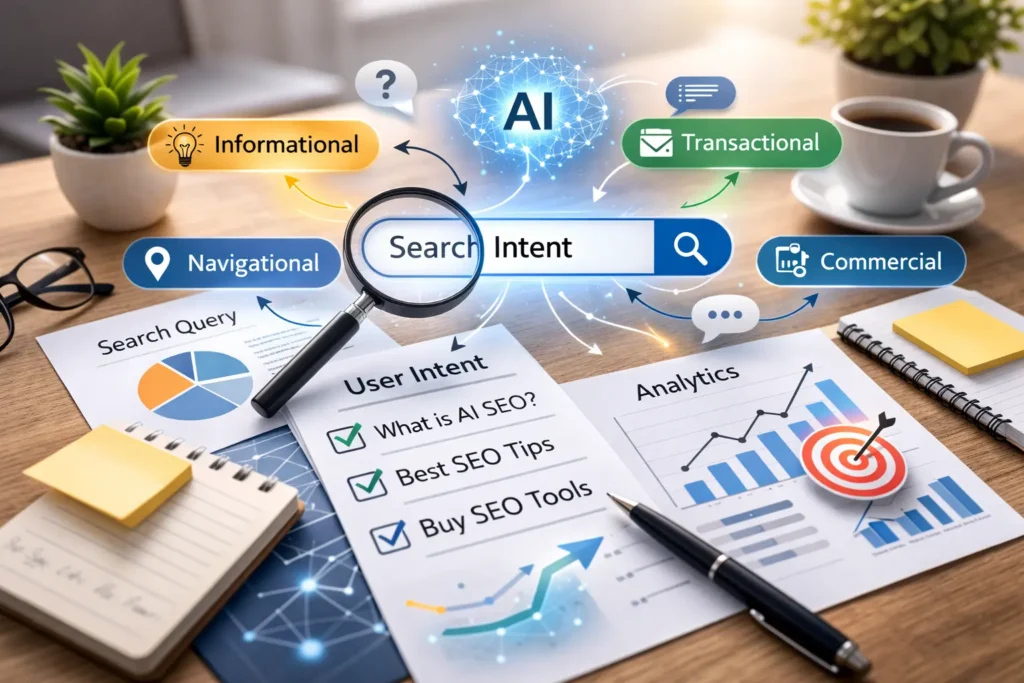
AI has significantly improved how search engines interpret user intent and search behavior. Instead of treating queries as isolated keywords, AI systems analyze context, search history, and linguistic patterns. This allows them to understand what users actually want rather than what they literally type. As a result, SEO strategies must now focus on intent satisfaction instead of keyword stuffing. Content that aligns with informational, commercial, or transactional intent performs better in rankings. This shift also encourages marketers to create more structured, helpful, and human-focused content that answers real questions effectively.
Semantic Search and Contextual Meaning
Semantic search enables algorithms to understand relationships between words, topics, and concepts. Instead of focusing on a single keyword, search engines evaluate the overall context of the content. This helps them match pages with user intent more accurately. Content that covers related subtopics, entities, and supporting information tends to rank higher because it demonstrates topical depth and relevance.
User Intent Classification
AI systems classify search queries into different intent categories such as informational, navigational, commercial, and transactional. This classification helps deliver more relevant search results tailored to user goals. For SEO professionals, this means content must align with the purpose behind the search. Pages optimized for the wrong intent often struggle to rank, regardless of keyword optimization.
Conversational & Voice Search Optimization
With the growth of voice assistants and conversational search, queries have become more natural and longer. AI algorithms are designed to process these conversational patterns effectively. This shift makes long-tail keywords, FAQs, and structured answers more important than ever. Optimizing for natural language improves visibility in featured snippets, voice results, and AI-generated summaries.
AI and Content Creation: Opportunity or Risk?
AI-powered content tools have transformed how marketers produce and scale content. While these tools improve efficiency, they also introduce challenges related to originality, depth, and authenticity. Search engines increasingly prioritize content that demonstrates expertise and real value. Simply generating large volumes of AI content without human insight can lead to low engagement and weak rankings. The key is to use AI as a support tool rather than a replacement for strategic thinking. High-performing content blends AI efficiency with human creativity, research, and experience to create meaningful and trustworthy information.
AI-Generated Content in SEO
AI-generated content has become widely used for blogs, landing pages, and informational articles. It helps speed up content production and idea generation. However, relying solely on automated writing can result in generic or shallow content. Search engines can identify patterns of low-value material, which may negatively impact rankings if quality and originality are compromised.
Google’s Stance on AI Content
Search engines do not penalize content simply because it is AI-assisted. Instead, they focus on whether the content is helpful, accurate, and user-focused. Content that demonstrates experience, expertise, authority, and trustworthiness is more likely to perform well. This means quality standards remain the primary ranking factor, regardless of how the content is created.
How to Use AI Without Hurting Rankings
To maintain strong SEO performance, AI-generated drafts should always be refined with human editing and expert insights. Adding original examples, data, and practical value improves credibility and engagement. Content should be structured, fact-checked, and aligned with user intent. When used strategically, AI becomes a productivity enhancer rather than a risk to search visibility.
👉 You might also like: How Marketing Automation Saves Time and Money in 2026
AI’s Role in Ranking Factors
Artificial intelligence has redefined how ranking factors are evaluated in modern search algorithms. Instead of relying only on static metrics like backlinks and keywords, AI analyzes user behavior, engagement patterns, and contextual relevance. This means rankings are now influenced by how users interact with content, not just how it is optimized technically. AI systems assess satisfaction signals such as dwell time, click behavior, and content usefulness. As a result, SEO success depends on delivering value, clarity, and a strong user experience. Websites that genuinely solve problems and provide in-depth information are more likely to gain long-term ranking stability.
Behavioral Signals & User Experience
AI-driven algorithms closely monitor how users interact with search results and web pages. Metrics like click-through rate, bounce rate, and dwell time help determine content relevance. If users quickly leave a page, it signals poor satisfaction. On the other hand, engaging and helpful content encourages longer sessions, which positively influences rankings and overall search visibility.
Content Relevance & Topical Authority
AI evaluates how deeply a page covers a topic rather than just checking keyword usage. Content that demonstrates strong topical authority through comprehensive coverage, internal linking, and semantic relevance performs better. When a website consistently publishes high-quality, interconnected content, search engines recognize it as a reliable source, increasing trust and improving its ability to rank for competitive keywords.
Technical SEO & AI Crawling Improvements
Modern AI-powered crawlers are more efficient at understanding website structure, page speed, and mobile usability. Technical elements like Core Web Vitals, clean code, and structured data help search engines interpret content faster and more accurately. A technically optimized website ensures smoother crawling, better indexing, and improved visibility in competitive search results.
AI Overviews and the Future of SERPs
Search engine results pages are evolving rapidly due to AI-generated answers and summaries. Instead of showing only traditional blue links, AI-powered overviews now provide direct responses at the top of search results. This shift is changing how users interact with search engines and how traffic flows to websites. Businesses must adapt their SEO strategies to remain visible in this new landscape. Optimizing for structured answers, featured snippets, and clear information hierarchy increases the chances of being referenced in AI summaries while maintaining organic ranking strength and brand visibility.
AI-Generated Search Summaries
AI-generated summaries provide quick answers by combining information from multiple sources. While this improves user convenience, it can reduce organic click-through rates for some queries. To stay competitive, content creators must produce authoritative, well-structured, and unique insights that AI systems consider reliable when generating summarized search responses.
Zero-Click Searches & Featured Snippets
Zero-click searches occur when users find answers directly on the results page without visiting a website. AI has increased the frequency of these outcomes by delivering concise responses instantly. Optimizing content with clear headings, direct answers, and structured formatting improves the chances of capturing featured snippets and maintaining visibility despite reduced clicks.
The Shift from Rankings to Visibility
Traditional SEO focused heavily on achieving top rankings, but AI-driven search is shifting the focus toward overall visibility. Appearing in snippets, knowledge panels, and AI-generated answers is now just as important as ranking first. This means brands must build authority, recognition, and trust across multiple digital touchpoints to remain competitive.
How AI Is Changing Keyword Research
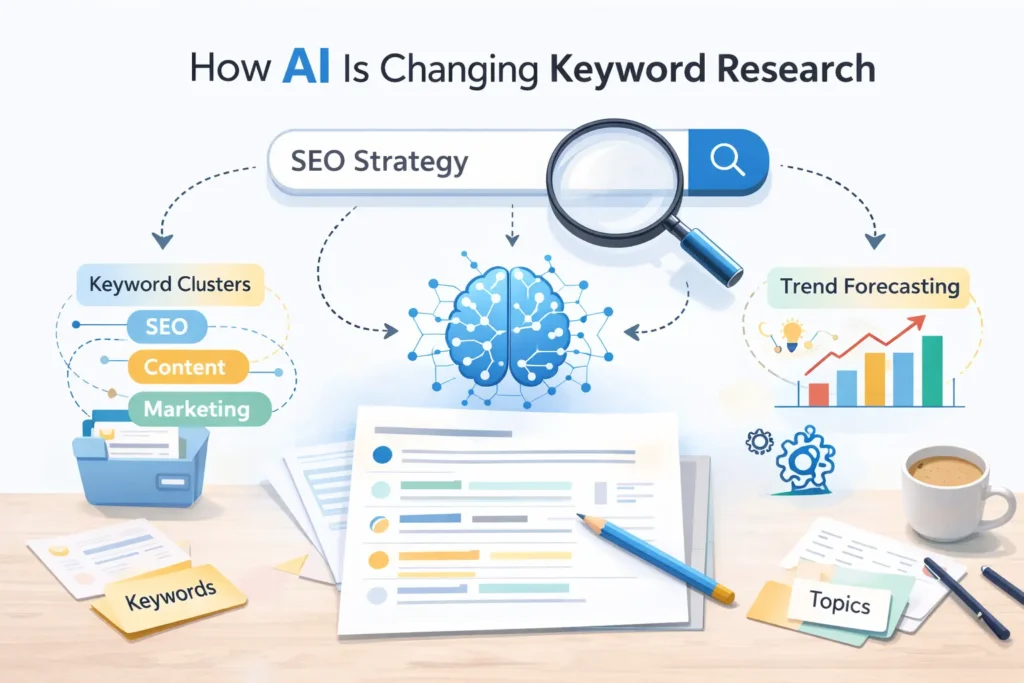
Keyword research has evolved from simple volume-based targeting to intent-focused topic analysis. AI tools now analyze large datasets to identify patterns, related queries, and emerging trends. This allows marketers to create content strategies based on user needs rather than isolated keywords. Instead of targeting single phrases, SEO now revolves around topic clusters and semantic relevance. AI-driven keyword insights also help predict future search demand, enabling proactive content planning. This shift encourages a more strategic, data-driven approach that aligns closely with how modern search engines interpret and rank content.
From Keywords to Topics
AI has shifted SEO from keyword stuffing to topic-based optimization. Instead of focusing on one primary keyword, search engines evaluate how well a page covers related subtopics and semantic variations. Topic clusters, pillar content, and contextual relevance now play a major role in improving search rankings and long-term organic growth.
Predictive SEO
Predictive SEO uses AI-driven data analysis to forecast search trends and user behavior. By studying historical search patterns and emerging queries, marketers can create content before competition increases. This proactive approach improves ranking opportunities and helps websites capture early traffic for trending topics and evolving user interests.
Tools Powered by AI
Modern SEO tools now integrate artificial intelligence for keyword grouping, competitor analysis, and content optimization. These tools automate complex data processing and provide actionable insights faster than manual research. They help identify content gaps, ranking opportunities, and semantic keywords that strengthen the overall SEO strategy and search performance.
Link Building in the Age of AI
AI has transformed how search engines evaluate backlinks and authority signals. Instead of counting links blindly, algorithms now assess link relevance, context, and authenticity. This means low-quality or spammy links can harm rankings more than ever. High-authority, niche-relevant backlinks are now significantly more valuable than bulk link acquisition. AI also helps search engines detect unnatural linking patterns and manipulative tactics. As a result, modern link-building strategies focus on quality outreach, digital PR, and contextual placements that provide genuine value rather than artificial ranking boosts.
Smarter Link Evaluation
AI-powered systems analyze backlinks based on trust, relevance, and context rather than just quantity. Links from authoritative and niche-relevant websites carry more weight compared to random or low-quality sources. This smarter evaluation helps search engines reward natural link profiles while identifying and discounting manipulative link-building practices.
Digital PR & Authority Signals
Digital PR has become a key component of modern SEO because AI recognizes brand mentions and authority signals across the web. Even unlinked mentions can contribute to credibility when they appear on trusted platforms. Building a strong online reputation through high-quality publications enhances brand authority and strengthens overall search rankings.
AI-Assisted Outreach
AI tools now support personalized outreach campaigns by analyzing prospect relevance, engagement history, and content alignment. This allows marketers to scale link building while maintaining authenticity. Instead of sending generic pitches, AI helps craft targeted outreach messages that improve response rates and secure higher-quality backlink opportunities.
👉 You might also like: Email Marketing 2026: Complete Strategy & Best Practices
The Impact of AI on Local & Personalized Search
Artificial intelligence has significantly enhanced local and personalized search results by analyzing user behavior, location data, and search history. Search engines now deliver highly tailored results based on individual preferences and real-time context. This means two users searching the same keyword may see different results. For businesses, this shift makes local SEO and personalization more important than ever. Optimizing business profiles, reviews, and location-specific content helps improve visibility in localized searches. AI also prioritizes relevance and proximity, making it essential for brands to maintain consistent local signals across platforms to strengthen their presence in personalized search environments.
Hyper-Personalized Results
AI algorithms customize search results based on user behavior, device usage, location, and past interactions. This personalization improves user experience by showing more relevant content instantly. However, it also increases competition for visibility because rankings are no longer universally fixed. Websites must focus on user intent, engagement, and relevance to perform well across different personalized search scenarios.
Local SEO Signals
Local SEO has become more data-driven with AI analyzing reviews, citations, engagement, and proximity signals. Search engines now evaluate business credibility through customer feedback and local relevance indicators. Optimizing location pages, local keywords, and customer experience helps businesses appear in local packs and geo-targeted search results more consistently.
AI and Google Business Profiles
AI uses business profile data to understand legitimacy, services, and user trust signals. Accurate information, updated posts, reviews, and categories improve local visibility. A well-optimized business profile increases the chances of appearing in map results and local search features, especially for high-intent queries with commercial intent.
Risks, Challenges, and Ethical Considerations
While AI offers powerful advantages in SEO, it also introduces several challenges that marketers must address carefully. Algorithm updates are becoming more frequent and complex, making rankings less predictable. Additionally, the rapid growth of AI-generated content has increased competition and content saturation across industries. Ethical concerns around originality, misinformation, and content authenticity are also rising. Businesses that rely solely on automation risk losing credibility and trust. To succeed in this evolving environment, SEO strategies must balance automation with human expertise, transparency, and genuine value creation that aligns with user expectations and search engine quality guidelines.
Algorithm Volatility
AI-driven algorithms evolve continuously, which leads to frequent ranking fluctuations. Websites that depend on outdated tactics often experience sudden traffic drops. This volatility makes it crucial to follow sustainable SEO practices such as high-quality content, strong technical foundations, and consistent updates to maintain long-term ranking stability in competitive niches.
Content Saturation
The rise of AI tools has made content creation faster, but it has also flooded the internet with repetitive and low-value material. This saturation makes it harder for generic content to rank. Unique insights, expert opinions, and original research are now essential to stand out and gain both user trust and search engine recognition.
Data Privacy & Transparency
AI-powered personalization relies heavily on user data, which raises privacy and transparency concerns. Search engines must balance personalization with ethical data usage. For marketers, this means building trust through clear policies, secure websites, and responsible data practices that align with evolving digital privacy expectations.
Practical SEO Strategies to Win in an AI-Driven Search Landscape
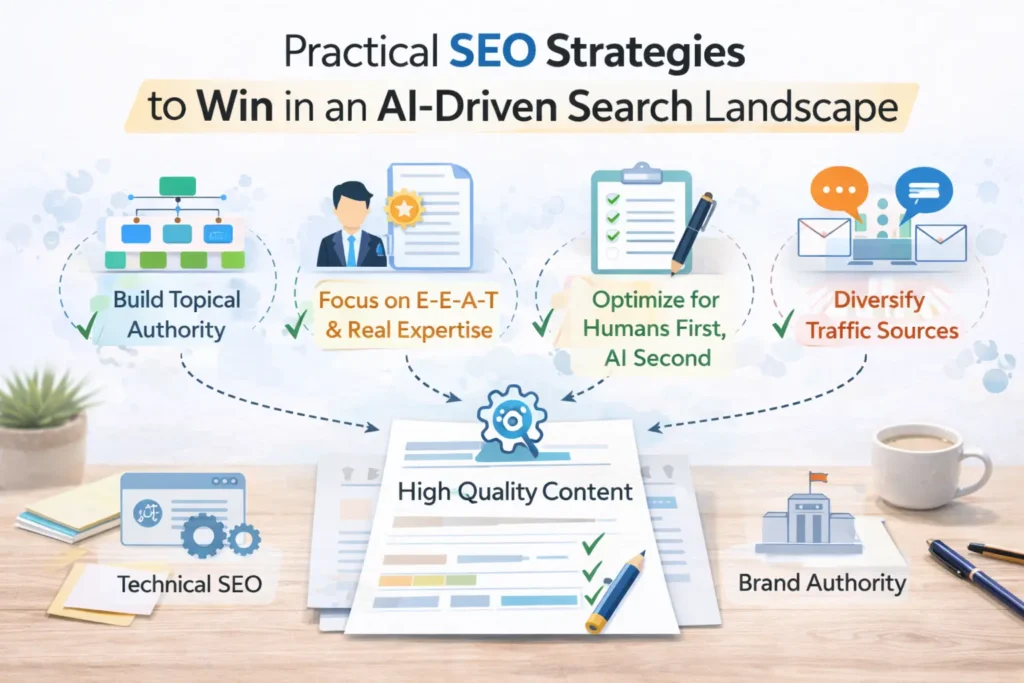
Adapting to AI-driven search requires a strategic and user-focused approach rather than relying on outdated optimization tactics. Modern SEO success depends on creating high-quality content, improving user experience, and building strong topical authority. AI rewards websites that provide clear structure, depth, and genuine expertise. Businesses should focus on long-term value instead of short-term ranking tricks. A well-rounded strategy that combines technical SEO, content quality, and brand credibility ensures sustainable growth. By aligning SEO efforts with AI-driven ranking signals, websites can maintain visibility and remain competitive in constantly evolving search environments.
Build Topical Authority
Topical authority is achieved by consistently publishing in-depth, interconnected content around a specific niche. AI systems recognize websites that cover topics comprehensively and reward them with stronger rankings. Creating pillar pages, supporting articles, and logical internal linking structures helps establish expertise and improves overall organic visibility.
Focus on E-E-A-T & Real Expertise
Experience, expertise, authoritativeness, and trustworthiness are critical in AI-driven rankings. Content that demonstrates real-world knowledge, case studies, and practical insights performs better than generic information. Adding credible sources, expert opinions, and transparent authorship strengthens trust signals and improves long-term SEO performance.
Optimize for Humans First, AI Second
AI algorithms are designed to evaluate how useful content is for real users. This means readability, clarity, and user experience should always be prioritized over excessive optimization. Well-structured headings, simple language, and valuable insights improve engagement, which indirectly supports stronger rankings and search visibility.
Diversify Traffic Sources
Relying only on organic search is becoming risky in an AI-dominated landscape. Brands should diversify traffic through social media, email marketing, communities, and direct brand searches. A strong multi-channel presence reduces dependency on algorithm changes and strengthens overall digital authority and long-term growth.
The Future of SEO: What to Expect in the Next 3 to 5 Years
The future of SEO will be heavily shaped by continuous advancements in artificial intelligence and search technology. Search engines will become more conversational, predictive, and context-aware. Instead of simple keyword matching, AI will focus on delivering instant, personalized answers. Visual search, voice queries, and AI-generated summaries will continue to grow in importance. Businesses that invest in user-focused content, technical optimization, and brand authority will adapt more effectively. SEO will not disappear but evolve into a more strategic discipline centered on experience, relevance, and trust rather than traditional ranking manipulation techniques.
Search Becoming More Conversational
Search behavior is shifting toward conversational queries as users interact more with voice assistants and AI interfaces. This trend encourages the use of natural language, question-based content, and clear answers. Optimizing for conversational search improves chances of appearing in voice results and AI-generated responses across modern search platforms.
Visual & Multimodal Search Growth
AI is expanding search capabilities beyond text into images, videos, and voice inputs. Multimodal search allows users to search using different formats, making visual optimization more important. Proper image tagging, video SEO, and structured data help content remain discoverable in diverse AI-powered search environments.
The Rise of Search Generative Experience (SGE)
Search is gradually transforming from a link-based system into an answer-driven experience powered by generative AI. This shift changes how users consume information and interact with results pages. Websites must focus on providing clear, authoritative, and well-structured content to remain visible within AI-generated search experiences.
Conclusion
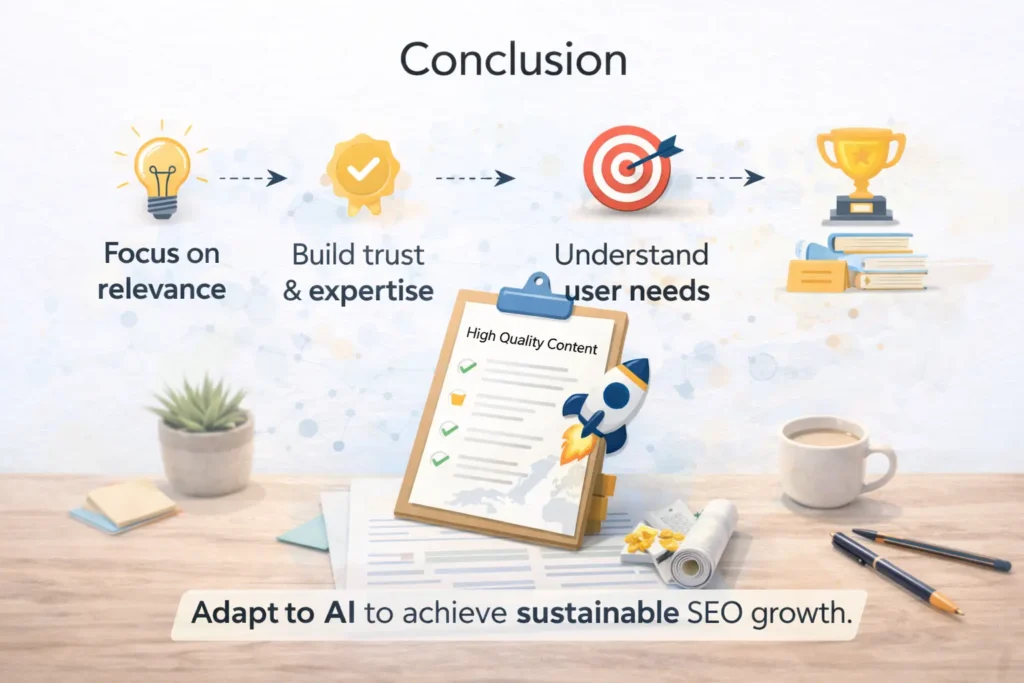
Artificial intelligence is not replacing SEO but redefining how it works. Ranking success now depends on relevance, user satisfaction, and content quality rather than outdated optimization tricks. Businesses that adapt to AI-driven algorithms by focusing on expertise, topical depth, and user intent will gain a competitive advantage. The key is to create meaningful, trustworthy, and well-structured content that genuinely helps users. As search continues to evolve, flexibility and continuous learning will become essential for maintaining strong rankings and sustainable organic growth in an increasingly AI-powered digital landscape.
FAQs
How does AI impact SEO rankings?
AI helps search engines better understand user intent, content quality, and relevance. Instead of just matching keywords, modern algorithms evaluate context, usefulness, and expertise, which means high-quality, user-focused content ranks higher.
Can AI replace traditional SEO strategies?
No, AI enhances SEO but does not replace core strategies. Technical SEO, high-quality backlinks, and helpful content still play a major role. AI simply makes research, optimization, and analysis faster and more data-driven.
Is AI-generated content good for SEO?
AI content can perform well if it is edited, humanized, and provides real value. Purely auto-generated, low-quality content may struggle to rank because search engines prioritize originality, expertise, and user experience.
Does link building still matter in the AI SEO era?
Yes, high-authority link building remains one of the strongest ranking factors. Even with AI advancements, backlinks signal trust and authority, especially when they come from relevant and reputable websites.
How can businesses use AI for SEO effectively?
Businesses can use AI for keyword research, content planning, on-page optimization, and competitor analysis. However, combining AI insights with human strategy and editorial judgment delivers the best results.
Will AI tools like ChatGPT change Google search results?
AI tools are influencing how content is created and optimized, but search engines still rank pages based on relevance, authority, and usefulness. Helpful, well-structured content will continue to outperform generic AI-written pages.
What is the biggest SEO trend with AI right now?
The biggest trend is AI-assisted content optimization and semantic SEO. Search engines now focus more on topical authority, user intent, and content depth rather than just keyword density.
Can AI help with link building and outreach?
Yes, AI can speed up prospect research, personalization, and outreach campaigns. But relationship-based outreach and manual placements on high-authority sites still deliver better and safer long-term SEO results.
Is AI SEO suitable for SaaS and agency websites?
Absolutely. AI-driven SEO is especially effective for SaaS and agencies because it helps scale content, improve keyword targeting, and support consistent link-building strategies across competitive niches.
What mistakes should be avoided when using AI for SEO?
Common mistakes include publishing unedited AI content, ignoring search intent, over-automating link building, and neglecting E-E-A-T signals. AI should support strategy, not replace human expertise.
✨ Save time, learn faster, follow Tech Statar.