
Why US Communities Are Pushing Back on AI Data Centers
Artificial intelligence is no longer a futuristic idea; it’s powering search engines, healthcare tools, finance systems, and the apps people use every day. Behind that convenience sits a massive physical backbone: AI data centers. Across the United States, tech giants are racing to build larger, faster, and more energy-intensive facilities to support generative AI and cloud computing. But as construction spreads into suburban and rural communities, something unexpected is happening. Residents are organizing, city councils are debating, and environmental groups are mobilizing. This growing tension between technological expansion and community impact is reshaping the national AI conversation.
What Are AI Data Centers and Why Do They Matter So Much?
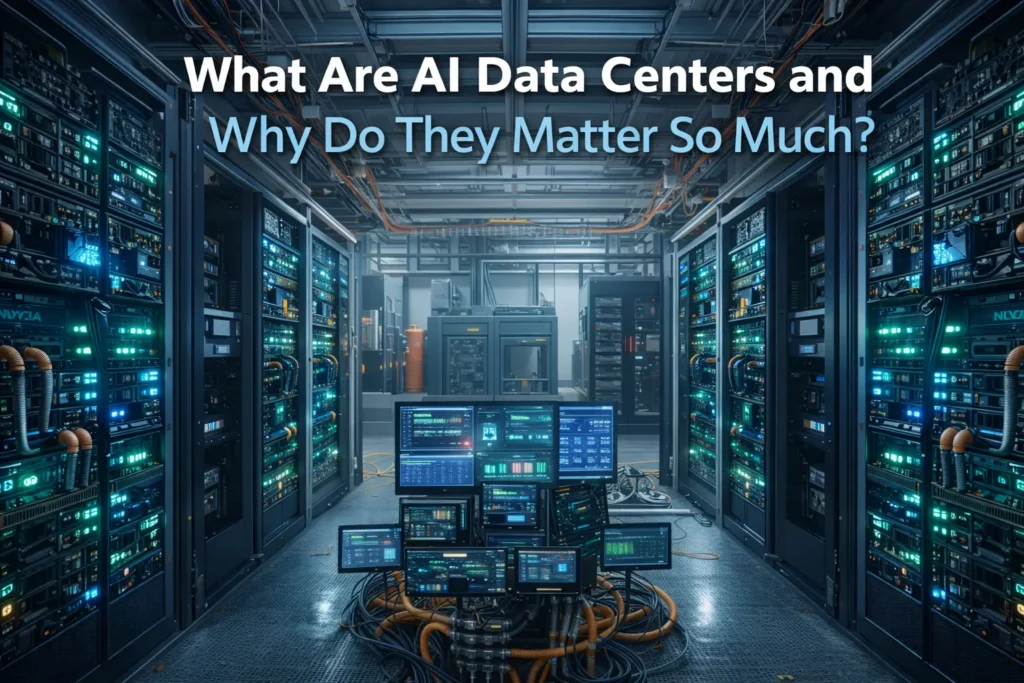
AI data centers are specialized facilities filled with high-performance servers, advanced cooling systems, and powerful networking equipment designed to train and run artificial intelligence models. Unlike traditional data centers, AI facilities demand enormous electricity capacity, constant cooling, and vast amounts of water in some regions. These centers power everything from chatbots to predictive analytics and autonomous systems. As companies compete to dominate AI innovation, the need for faster processing and larger datasets continues to drive construction at a historic pace. In short, without these data centers, today’s AI revolution simply wouldn’t function.
How AI Infrastructure Supports Everyday Digital Services
Every time someone streams content, uses a smart assistant, or interacts with generative AI, data is processed inside large computing facilities. AI models require intense training on massive datasets, which consumes significant computing power. That power lives in specialized GPU clusters and cloud environments. The more advanced the AI system, the more infrastructure it demands behind the scenes.
Why AI Data Centers Use So Much Energy and Water
AI servers generate extreme heat during processing. To prevent overheating, facilities rely on sophisticated cooling technologies, including liquid cooling and water-based systems. This constant cooling, combined with 24/7 operations, leads to high electricity consumption. In water-stressed states, the growing demand raises concerns about sustainability and long-term resource availability.
The Rapid Expansion of Data Centers Across the United States
Over the past two years, the United States has seen an unprecedented surge in AI-focused data center construction. States like Virginia, Texas, and parts of the Midwest have become hotspots due to available land, favorable tax incentives, and existing power infrastructure. Tech companies are securing multi-acre properties and negotiating long-term energy contracts to ensure uninterrupted operations. Billions of dollars are being invested in these projects, signaling confidence in AI’s future. However, this rapid expansion is happening so quickly that local planning systems and community stakeholders often feel left out of the decision-making process.
Why Certain States Are Becoming Data Center Hubs
Regions with lower land costs, business-friendly tax policies, and strong energy grids naturally attract large infrastructure investments. Proximity to fiber networks and renewable energy sources also plays a role. Local governments initially welcome these projects for economic growth, but long-term environmental and utility pressures are now raising new questions.
The Role of Big Tech in Accelerating Construction
Major technology firms are competing aggressively in the AI race. To stay ahead, they must scale computing power fast. This urgency pushes companies to secure land and permits quickly. In some cases, projects move forward before communities fully understand the long-term implications of hosting large-scale AI infrastructure.
👉 You might also like: 7 Best AI Coding Platforms in 2026
Why Communities Across America Are Pushing Back Against AI Data Center Projects
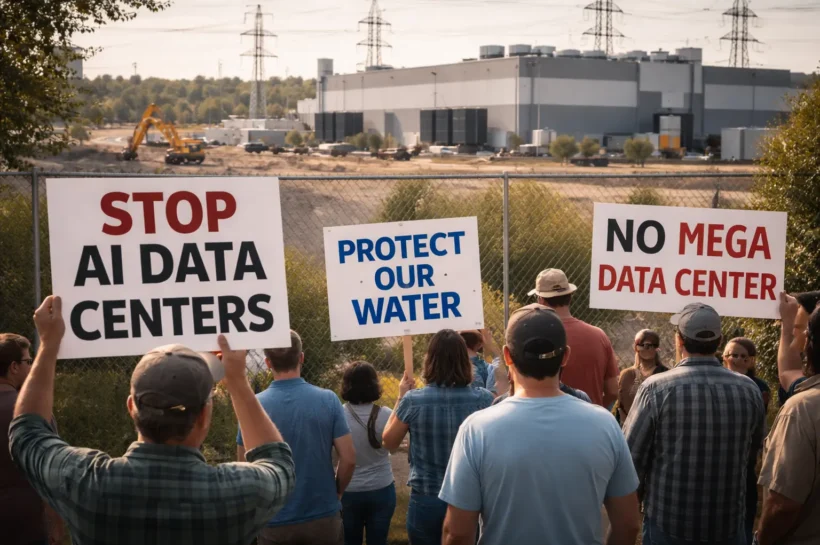
As AI infrastructure spreads into suburbs and rural towns, many Americans are beginning to question what these massive facilities truly mean for their neighborhoods. While tech companies promote job creation and innovation, residents often see rising utility pressure, land disruption, and long-term environmental strain. Community meetings that once focused on zoning updates are now filled with concerned homeowners, farmers, and local officials debating energy grids and water tables. What started as isolated opposition has evolved into organized coalitions demanding transparency, environmental reviews, and stricter oversight before approving new AI-powered data center construction projects in their communities.
Concerns About Electricity Costs and Grid Stability
One of the biggest worries involves power demand. AI data centers consume enormous amounts of electricity, sometimes equivalent to small cities. Residents fear local grids may struggle to keep up, especially during extreme weather. There are also concerns that utility companies could pass infrastructure upgrade costs onto households, increasing monthly bills over time.
Land Use, Noise, and Community Disruption
Large facilities require vast tracts of land, often transforming farmland or open space into industrial zones. Construction traffic, generator noise, and round-the-clock operations can change the character of quiet neighborhoods. Many residents argue that long-term quality of life impacts were not clearly explained during early project proposals.
The Environmental Debate: Energy, Water, and Long-Term Sustainability
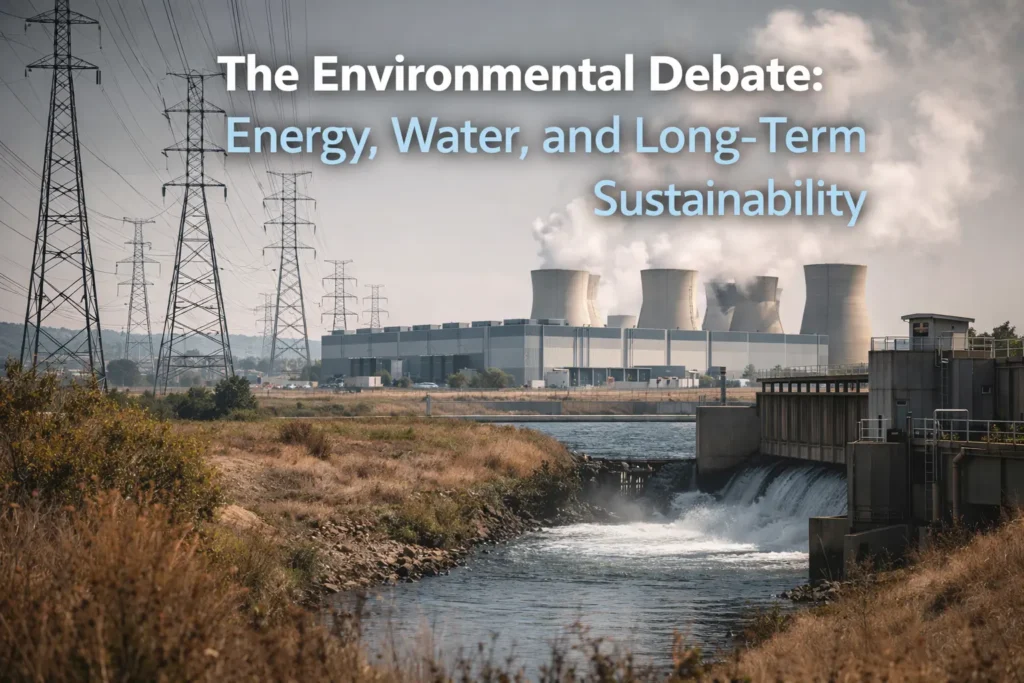
Environmental impact has become the centerpiece of opposition to AI data center expansion. These facilities demand continuous electricity and sophisticated cooling systems that can strain local water supplies. In drought-prone states, water-intensive cooling raises red flags among environmental advocates. At the same time, fossil fuel–powered grids increase carbon emissions, complicating national climate goals. Critics argue that the rapid growth of AI infrastructure may outpace sustainability planning. Supporters counter that innovation drives efficiency improvements. The debate is no longer theoretical; it is unfolding in town halls, state legislatures, and regulatory agencies across the country.
The Water Usage Question in Drought-Prone Regions
Advanced cooling systems often rely on evaporative water processes. In states already experiencing water shortages, residents worry that AI facilities could compete with agriculture and residential supply. Even when companies promise recycling systems, skepticism remains about long-term environmental accountability.
Can Renewable Energy Offset AI’s Growing Power Demand?
Tech companies frequently announce renewable energy commitments to power new facilities. While solar and wind investments are increasing, critics point out that renewable capacity must expand dramatically to match AI’s rising consumption. The question isn’t just about clean energy, it’s about whether supply can scale quickly enough.
Political and Regulatory Responses Are Beginning to Shift
As community resistance gains momentum, policymakers are beginning to reconsider how data center expansion is regulated. Some state leaders are reviewing tax incentives previously offered to attract large technology projects. Others are proposing stricter environmental reviews or pausing approvals until grid capacity studies are completed. Lawmakers face a delicate balancing act: supporting innovation and economic development while protecting local communities from unintended consequences. The conversation is increasingly bipartisan, as both conservative rural districts and progressive urban areas raise similar concerns about transparency, sustainability, and long-term infrastructure planning.
Reconsidering Tax Incentives for Tech Infrastructure
For years, generous tax breaks helped lure major tech investments. Now, some officials question whether those incentives still make sense if public utilities shoulder infrastructure upgrades. The financial equation is being reexamined, especially in areas where promised local job creation appears limited.
Calls for Stronger Environmental Oversight
Advocacy groups are urging governments to require more comprehensive environmental impact studies before approving new AI facilities. Proposed measures include stricter water usage reporting, carbon emission disclosures, and long-term grid stress analysis. The goal is to ensure expansion does not outpace responsible planning.
👉 You might also like: Logo Maker AI 2026
The Tech Industry’s Perspective: Why Companies Are Doubling Down on AI Infrastructure
From the technology sector’s point of view, expanding AI data centers is not optional; it’s essential for staying competitive in a rapidly evolving global market. Companies argue that artificial intelligence is becoming foundational to national security, economic productivity, healthcare innovation, and digital services. Without large-scale infrastructure, the United States risks falling behind other nations that are investing aggressively in AI. Executives also highlight long-term economic benefits, including construction jobs, tax revenue, and indirect business growth. While acknowledging environmental concerns, industry leaders insist that technological progress and infrastructure expansion must move forward together rather than stall innovation entirely.
AI as a National Competitiveness Strategy
Technology leaders frequently frame AI infrastructure as a strategic asset. The ability to train and deploy advanced AI models at scale is seen as critical for economic leadership. Companies argue that slowing construction could weaken America’s position in global AI development and reduce its influence over future standards.
The Job Creation and Economic Growth Argument
Although data centers are not labor-intensive in the long term, companies emphasize construction employment, supplier contracts, and local business activity during development. They also point to secondary economic benefits, including infrastructure upgrades that can attract additional technology investment into surrounding regions.
Finding Middle Ground: Can Innovation and Community Interests Coexist?
The growing tension between AI expansion and local resistance does not necessarily require an all-or-nothing outcome. Increasingly, experts suggest that collaboration between tech firms, governments, and communities could lead to more balanced solutions. Transparent planning processes, early public engagement, and measurable environmental commitments can help reduce distrust. Some companies are exploring advanced cooling technologies that reduce water consumption and investing directly in renewable energy generation near project sites. By integrating sustainability into design from the start, AI infrastructure projects may evolve into more community-friendly developments rather than controversial industrial expansions.
Smarter Cooling and Energy-Efficient Design
Emerging cooling technologies, including closed-loop liquid systems and advanced chip efficiency improvements, are reducing resource consumption. Engineers are designing facilities that recycle heat and optimize server workloads to cut unnecessary energy use. These innovations demonstrate that infrastructure can become more efficient without sacrificing performance.
Community Benefit Agreements and Transparency
Some municipalities are negotiating community benefit agreements that require infrastructure investments, environmental monitoring, and public reporting. Open communication about power usage, water management, and long-term impact helps build trust. When residents feel informed and involved, opposition often shifts toward constructive dialogue.
The Future of AI Data Centers in the United States
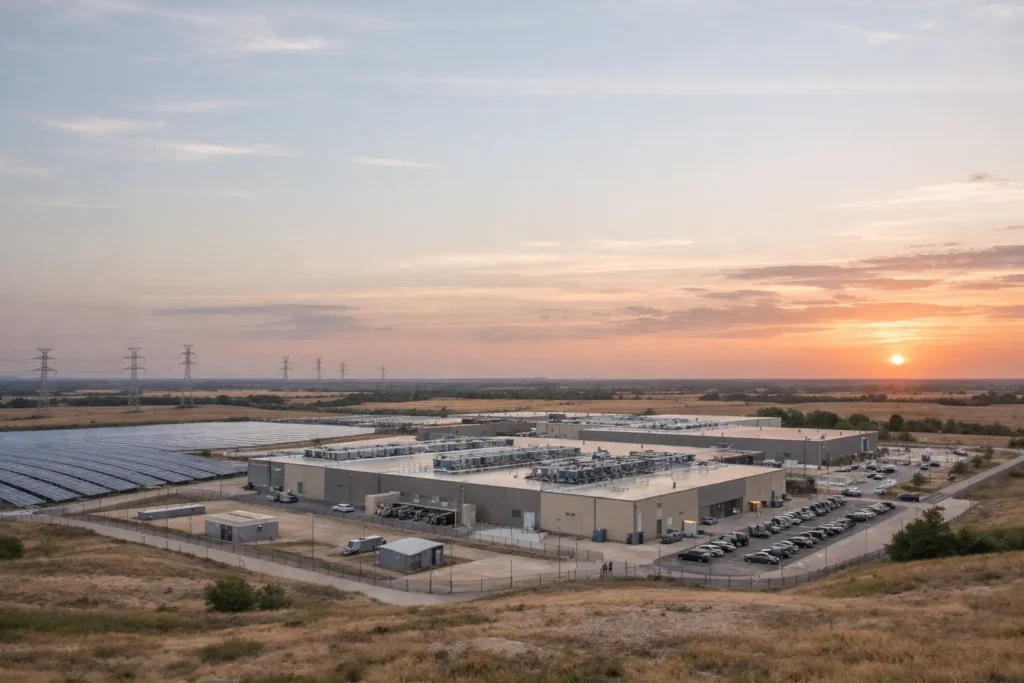
Looking ahead, AI infrastructure development is unlikely to slow significantly, but it may evolve in response to public scrutiny and regulatory changes. We can expect stronger environmental standards, more rigorous grid capacity studies, and potentially revised tax policies. Companies may prioritize locations with renewable energy abundance and robust utility systems to avoid backlash. At the same time, communities will likely remain more engaged in zoning and planning decisions. The next chapter of America’s AI story will not be defined solely by technological capability, but by how responsibly and transparently that capability is built.
Will Regulation Reshape the AI Expansion Timeline?
If stricter oversight becomes standard, project timelines could lengthen. Environmental assessments and grid impact studies may become mandatory in more states. While this could slow rapid expansion, it may also create a more predictable and sustainable development framework over time.
A Defining Moment for Responsible AI Infrastructure
The debate surrounding AI data centers reflects a broader national question: how to balance innovation with accountability. The outcome will influence energy policy, local governance, and the pace of digital transformation. What happens next will shape not only technology markets but also community landscapes across America.
Conclusion
The rapid expansion of AI data centers marks a defining moment in America’s technological evolution. On one hand, artificial intelligence promises economic growth, global competitiveness, and groundbreaking innovation across industries. On the other hand, the physical infrastructure required to power this revolution carries real consequences for energy systems, water resources, and local communities. The tension unfolding across towns and states is not simply resistance to technology; it reflects a deeper demand for transparency, sustainability, and responsible planning.
Moving forward, the most successful AI infrastructure strategies will likely be those that combine innovation with accountability. Companies that prioritize energy efficiency, renewable power integration, and open communication may find stronger public support. Policymakers who balance economic opportunity with environmental safeguards can help prevent unnecessary conflict. Ultimately, the future of AI in the United States will depend not just on how powerful the technology becomes, but on how thoughtfully it is built into the communities it serves.
Frequently Asked Questions (FAQs)
Why are communities opposing AI data centers?
Many communities are concerned about high electricity consumption, increased water usage, noise pollution, land disruption, and potential strain on local power grids. Residents often feel projects move too quickly without sufficient transparency or long-term environmental planning.
Do AI data centers increase local electricity bills?
While not always directly, large-scale facilities can require major grid upgrades. If utilities invest heavily in infrastructure improvements, some costs could potentially be distributed across ratepayers, depending on state regulations and agreements.
How much energy do AI data centers consume?
AI-focused data centers consume significantly more power than traditional facilities because training advanced AI models requires high-performance processors running continuously. Some large campuses use as much electricity as small cities.
Are tech companies using renewable energy for AI facilities?
Many companies publicly commit to renewable energy sourcing, including solar and wind power agreements. However, the challenge lies in scaling renewable generation quickly enough to meet rapidly growing AI demand.
Do data centers create long-term jobs?
Most job creation occurs during the construction phase. Once operational, data centers typically require a smaller permanent workforce focused on maintenance, security, and technical oversight.
Could stricter regulations slow AI growth in the U.S.?
Stronger environmental reviews and grid impact studies could extend project timelines. However, clearer regulations may also create more predictable development processes and improve long-term sustainability.
What solutions can reduce environmental impact?
Potential solutions include advanced cooling technologies, water recycling systems, energy-efficient hardware, renewable power investments, and community benefit agreements that increase transparency and accountability.
✨ Don’t stop here, Bookmark Tech Statar for daily upgrades.