
How Accurate Is Snow Day Calculator?
Millions of students check snow day calculators during winter storms, hoping for good news about school closures. But can you really trust these predictions? Understanding the accuracy of these tools helps you set realistic expectations and use them properly. Let’s explore how reliable snow day calculators actually are and what affects their predictions.
What Is the Overall Accuracy Rate?
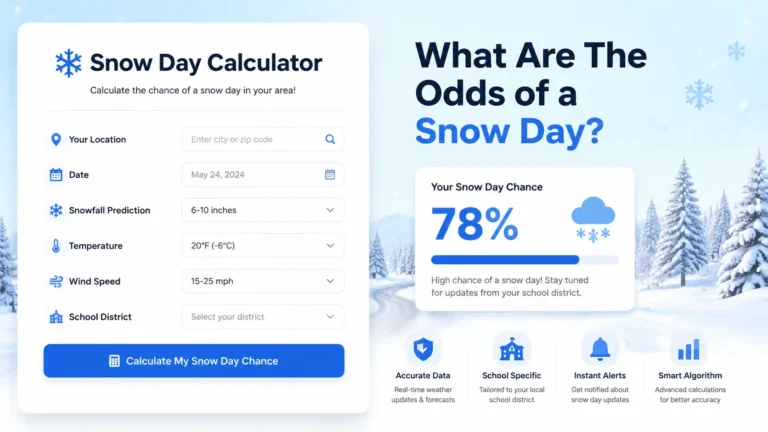
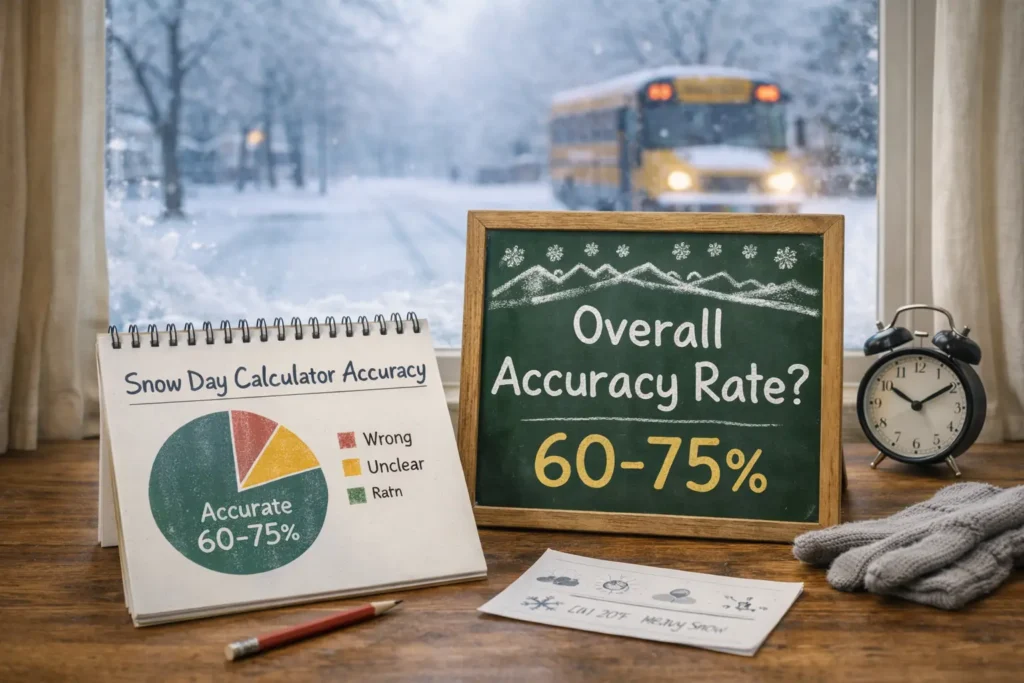
Most established snow day calculators are accurate about 60-75% of the time. This means they correctly predict whether school will close or stay open roughly three out of four times. That’s decent but certainly not perfect. The accuracy varies depending on many factors, including your location, the calculator you use, and how far in advance you check.
Some calculators claim higher accuracy rates, but independent verification is difficult. The 60-75% range is what most reputable tools achieve consistently.
Weather forecasting itself is only about 80-90% accurate for next-day predictions. Since snow day calculators depend on weather forecasts, they can’t be more accurate than the underlying weather data.
Why aren’t Snow Day Calculators 100% Accurate?
Snow day calculators face a fundamental challenge: they’re predicting human decisions, not just weather. A superintendent makes the final call about closing schools, and that decision involves many factors beyond what any algorithm can measure. Personal judgment, community pressure, and unexpected circumstances all play roles.
Weather forecasts themselves contain uncertainty. A storm might drop five inches of snow as predicted, or it might drop eight inches if conditions shift slightly.
Road conditions at 5 AM can differ dramatically from what weather models predicted the night before. Black ice, drifting snow, or inadequate plowing can surprise everyone.
Do Different Calculators Have Different Accuracy Levels?
Yes, accuracy varies significantly between different tools. Established calculators like Snow Day Calculator by David Sukhin have years of data and refined algorithms. They generally perform better than newer or less sophisticated tools. Regional calculators designed for specific areas often show higher accuracy for those locations because they understand local patterns better.
Generic calculators that try to cover the entire country may struggle with local nuances. Each school district has unique characteristics that affect closure decisions.
Free calculators with limited data sources naturally have lower accuracy than those using premium weather services and extensive historical databases.
Does Accuracy Depend on Your Location?
Location makes a huge difference in prediction accuracy. Calculators work best in areas with predictable weather patterns and consistent school district policies. If your district rarely closes schools or closes them very frequently, the calculator has clear patterns to follow.
Districts in the middle ground are hardest to predict. When closure decisions could go either way, calculators struggle to make accurate calls.
Urban areas with better snow removal often have more predictable patterns than rural districts where road conditions vary widely. Mountain regions with unpredictable weather present extra challenges.
👉 You might also like: Top Free AI Tools for College Students to Boost Learning
How Does Timing Affect Accuracy?
Checking predictions closer to the actual event increases accuracy. A prediction made 12 hours before a storm is more reliable than one made three days early. Weather forecasts improve as storms approach, giving calculators better data to work with.
Evening predictions for the next morning are typically most accurate. By 9 PM, weather models have a clearer picture of overnight conditions.
Early morning updates can catch last-minute changes. Some calculators adjust predictions at 5 AM or 6 AM based on actual developing conditions.
What About Predictions for Delays Versus Closures?
Calculators are generally better at predicting full closures than two-hour delays. Closures happen under more extreme conditions that are easier to forecast. Delays occur in borderline situations where small weather differences matter greatly.
A calculator might correctly predict that the weather will affect school, but miss whether the district chooses a delay or closure. This counts as partially correct but not fully accurate.
Some calculators don’t even attempt delay predictions because they’re so difficult to get right. Those that do show lower accuracy rates for delays than closures.
Can Calculators Predict Unexpected Closures?
Snow day calculators sometimes miss closures that happen for non-weather reasons. If a school loses power or has a heating system failure during cold weather, it might close even when snow wasn’t predicted. Calculators can’t account for these equipment issues.
They also struggle with ice storms. Freezing rain is notoriously difficult to predict accurately, yet it causes many school closures.
Last-minute superintendentdecisions based on rapidly changing conditions can surprise both calculators and families. Human judgment introduces unpredictability that no algorithm can fully capture.
Have Calculators Become More Accurate Over Time?
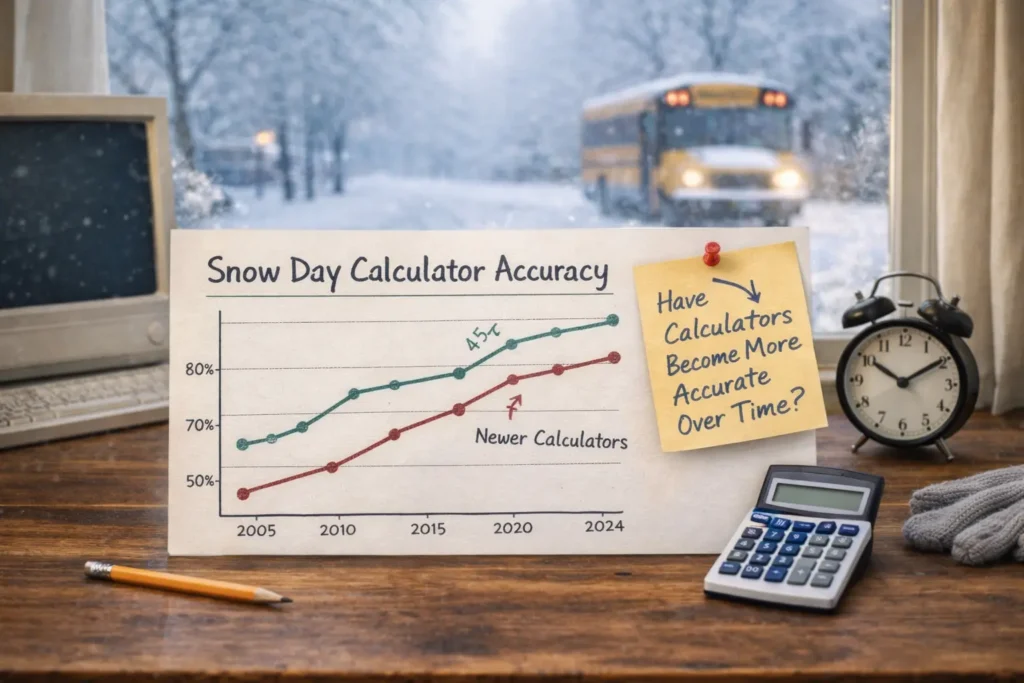
Yes, snow day calculators have improved significantly since they first appeared in the 2000s. Modern tools use machine learning to analyze thousands of past predictions and outcomes. They learn from mistakes and adjust their algorithms accordingly.
Better weather data sources have helped, too. Today’s calculators access more detailed forecasts and real-time conditions than older versions could.
Some newer calculators incorporate artificial intelligence that spots subtle patterns humans might miss. As these systems process more data over time, accuracy should continue improving.
How Can You Tell If a Calculator Is Reliable?
Reliable calculators are transparent about their data sources and methodology. They clearly state they’re providing predictions, not guarantees. Look for tools that have been around for several years and have user reviews or testimonials.
Be wary of calculators claiming extremely high accuracy rates like 95% or higher. These claims are unrealistic given the variables involved.
Check if the calculator updates regularly during storm season. Tools that haven’t been updated in years likely use outdated algorithms and data sources.
Should You Make Important Plans Based on Calculator Predictions?
No, you shouldn’t rely solely on snow day calculators for important decisions. Use them as rough guides to set expectations, but always verify through official school communications before making firm plans. Superintendents sometimes make unexpected calls based on information that calculators don’t have.
Think of snow day calculators as entertainment with some useful information mixed in. They’re fun to check and give you a general sense of likelihood.
The safest approach is to treat high predictions as “maybe” rather than “definitely.” Keep backup plans ready, regardless of what the calculator says.
✨ Want more clarity, less confusion? Follow Tech Statar.