

How to Start an Online Business With AI in 2026 (Complete Guide)
Starting a business used to mean large budgets, big teams, and long timelines. AI has completely changed that reality. Today, solo founders and small teams can launch profitable businesses faster by using artificial intelligence to automate research, planning, content creation, marketing, and operations. AI removes many traditional barriers and allows entrepreneurs to focus on strategy instead of repetitive work. From validating ideas to scaling operations, AI acts like a smart assistant that works 24/7. This shift is why AI-powered businesses are growing rapidly across industries, especially among first-time founders and non-technical entrepreneurs.
What Is Artificial Intelligence in Business?
Artificial intelligence in business refers to software systems that can analyze data, recognize patterns, and make predictions or generate content with minimal human input. Instead of manually doing everything, businesses use AI to speed up decisions, reduce errors, and improve efficiency. AI does not replace business owners. It supports them by handling time-consuming tasks like data analysis, customer support, and content creation. For startups, AI becomes a competitive advantage by allowing small teams to operate like much larger organizations without increasing costs.
Simple Explanation of AI for Beginners
AI is software that learns from data and improves over time. In simple terms, it watches how things work, identifies patterns, and then makes smart suggestions or decisions. For business owners, this means AI can write content, analyze customer behavior, answer questions, and even predict trends. You don’t need coding skills to use AI today. Many tools are designed for beginners and work through simple prompts and dashboards.
Types of AI Used in Modern Businesses
Modern businesses mainly use three types of AI. Generative AI creates content in different formats like text, images, and videos. Machine learning analyzes large data sets to identify trends and optimize processes. Predictive AI forecasts outcomes like sales, demand, or customer behavior. These AI types often work together, helping businesses automate tasks, improve accuracy, and make smarter decisions across marketing, operations, and customer experience.
Why Start a Business With AI? Key Benefits

AI gives entrepreneurs a powerful advantage by reducing workload while increasing output. Instead of hiring multiple employees, founders can rely on AI tools to handle research, writing, design, and analytics. AI also helps businesses adapt quickly by analyzing real-time data and suggesting improvements. This flexibility is critical in competitive markets. Businesses using AI can test ideas faster, make smarter decisions, and scale without major cost increases, making AI a practical choice for startups and growing companies.
Faster Execution and Automation
AI automates repetitive tasks that normally slow businesses down. Tasks like email replies, customer support, content scheduling, and data entry can run automatically. This allows founders to focus on strategy, sales, and growth. Automation also reduces human errors and keeps operations consistent, which improves customer trust and overall efficiency.
Cost Reduction and Scalability
AI reduces costs by replacing manual labor with automation. Instead of hiring full-time staff, businesses can use AI tools at a fraction of the cost. As the business grows, AI systems scale easily without major expenses. This makes AI ideal for startups that want to grow fast while keeping expenses under control.
Data-Driven Decision Making
AI analyzes large amounts of data quickly and accurately. It identifies trends, customer preferences, and performance gaps that humans might miss. With AI insights, business owners make decisions based on facts instead of guesses. This leads to better pricing, smarter marketing strategies, and improved customer experiences over time.
Can Non-Technical People Start a Business With AI?
Yes, non-technical founders can easily start businesses using AI. Most AI tools today are no-code or low-code, meaning you don’t need programming knowledge. You simply give instructions, and the tool does the work. AI acts as a support system, not a replacement for your ideas. Entrepreneurs bring creativity and strategy, while AI handles execution. This balance allows non-technical founders to compete with experienced teams without technical barriers or steep learning curves.
Step 1 – Finding a Profitable Business Idea Using AI
Finding the right business idea is where most people get stuck. AI makes this step much easier by analyzing trends, customer problems, and market gaps in minutes instead of weeks. Instead of guessing, you can use AI to explore demand, spot underserved audiences, and test multiple ideas quickly. AI helps you think beyond obvious ideas by connecting patterns humans often miss. This allows founders to start with ideas that already show signs of real demand, reducing risk before investing time or money.
Using AI for Idea Generation
AI tools can generate business ideas based on market trends, keywords, and consumer behavior. By entering prompts related to your skills or interests, AI can suggest ideas aligned with real-world demand. These tools analyze online conversations, search data, and content trends to produce ideas that are timely and relevant. This saves hours of brainstorming and helps founders move forward with confidence.
Identifying Problems AI Can Solve
Strong businesses solve real problems. AI helps identify these problems by analyzing customer complaints, reviews, forums, and social media discussions. It highlights recurring issues people struggle with and suggests how automation or smarter systems can improve solutions. This approach ensures your business idea is rooted in genuine needs rather than assumptions or personal opinions.
👉 You might also like: Use AI Game Development Apps to Build a Game Without Coding
Step 2 – Market Research With AI Tools
Market research is essential, but traditional methods are slow and expensive. AI simplifies this process by gathering and analyzing large volumes of data quickly. Instead of manually reviewing competitors or surveys, AI tools provide insights into customer preferences, pricing trends, and demand levels. This allows founders to understand their market clearly before launching. With AI-driven research, decisions are based on real data rather than guesswork.
Analyzing Customer Demand Using AI
AI evaluates search behavior, buying patterns, and online discussions to estimate demand accurately. It identifies what customers want, how often they search for it, and what influences their buying decisions. These insights help businesses align their offers with real expectations, increasing the chances of early traction and customer satisfaction.
Competitor Research and Gap Analysis
AI scans competitor websites, ads, and content to reveal strengths and weaknesses. It highlights gaps in services, pricing issues, and unmet customer needs. This allows founders to position their business differently and create offers that stand out. Instead of copying competitors, AI helps you improve on what already exists.
Step 3 – Validating Your Business Idea With AI
Validation ensures your idea is worth pursuing before full-scale execution. AI helps test assumptions by analyzing audience reactions, engagement data, and feedback patterns. You can simulate demand, evaluate pricing sensitivity, and predict outcomes using AI-driven insights. This reduces financial risk and prevents wasted effort. Validation with AI provides clarity, allowing founders to refine ideas early instead of fixing costly mistakes later.
Step 4 – Choosing the Right AI Business Model

Selecting the right business model determines long-term success. AI helps evaluate which model fits your skills, budget, and goals. Some models focus on automation, while others rely on AI-powered services. AI can compare profitability, scalability, and competition across models. This helps founders choose structures that align with market demand and personal strengths, increasing sustainability and growth potential.
- AI-powered SaaS products
- AI service-based businesses
- AI-driven ecommerce stores
- AI content and marketing agencies
Step 5 – Building Your Product or Service With AI
Once your idea is validated, the next step is turning it into a real product or service. AI simplifies this process by handling tasks that usually require technical skills or large teams. Whether you are building a digital product or offering a service, AI helps with development, testing, and optimization. Instead of starting from scratch, founders can use AI tools to accelerate production while maintaining quality. This allows faster launches and more room for improvement based on customer feedback.
Using AI to Build Digital Products
AI tools help create digital products such as online tools, templates, chatbots, and educational content. They assist with writing code, generating designs, and improving usability. Founders can quickly test features, refine user experience, and iterate without heavy development costs. This makes product creation more accessible to non-technical entrepreneurs.
AI for Service Delivery and Operations
For service-based businesses, AI automates client onboarding, communication, and task management. It improves consistency and reduces delivery time. Services like consulting, marketing, and support become easier to scale because AI handles repetitive work while humans focus on strategy and creativity.
Step 6 – Branding Your AI Business
Strong branding builds trust and recognition. AI helps create professional branding without hiring expensive agencies. From business names to visual identity, AI tools generate options aligned with your niche and audience. Branding is not just about logos. It includes tone, messaging, and positioning. AI ensures consistency across platforms, helping new businesses look credible from day one and stand out in crowded markets.
Step 7 – Creating a Website Using AI
AI-powered website builders simplify design and development by generating layouts, copy, and structure automatically. These tools focus on user experience, speed, and conversion optimization. Even beginners can launch professional websites quickly. AI also helps test variations and improve performance, ensuring the site evolves with user behavior and business goals.
Use AI Website Builders and CMS Tools
Most AI website builders create complete sites based on simple inputs. They handle layout, navigation, and mobile optimization automatically. Content management systems powered by AI also suggest improvements, making website management easier and more effective over time.
AI-Generated Copy and UX Optimization
AI generates clear, persuasive website copy tailored to your audience. It analyzes user behavior to suggest design and content improvements. This results in better engagement, lower bounce rates, and higher conversions without manual testing.
👉 You might also like: Navigating the Intersection of Agentic AI, Digital Twins, and Modern Academia in 2026
Step 8 – AI-Powered Content Creation and Marketing
Marketing is essential for growth, and AI makes it more efficient. AI tools create blog posts, social media content, emails, and ads faster than manual methods. They also analyze performance to optimize future campaigns. This allows businesses to maintain consistent marketing without burning out. AI ensures content aligns with audience interests, search intent, and platform requirements.
Blogging, SEO, and Content Automation
AI assists with keyword research, content outlines, and SEO optimization. It helps produce search-friendly content that ranks while remaining readable. Automation ensures regular publishing, which improves search visibility and authority over time.
Social Media and Email Marketing With AI
AI schedules posts, writes captions, and personalizes email campaigns. It tracks engagement and adjusts messaging based on audience behavior. This improves open rates, clicks, and conversions while saving time.
Step 9 – Automating Business Operations Using AI
Automation is where AI truly transforms businesses. AI manages workflows, customer support, and internal processes with minimal human involvement. This reduces errors, saves time, and improves efficiency. Automation allows founders to scale without increasing workload. Businesses that automate early gain a strong advantage by staying organized, responsive, and consistent as they grow.
Step 10 – Using AI for Sales and Lead Generation
Sales and lead generation are critical for growth, and AI makes both more efficient and predictable. AI tools analyze customer behavior, browsing patterns, and engagement signals to identify leads that are most likely to convert. Instead of treating every prospect the same, AI helps businesses prioritize high-intent users and personalize outreach. This leads to better conversion rates and shorter sales cycles. AI also supports dynamic pricing, personalized offers, and automated follow-ups, allowing founders to scale revenue without constantly increasing manual sales effort.
Step 11 – Managing Finances and Analytics With AI
Financial management is one of the most important yet overlooked areas for new businesses. AI simplifies this by tracking income, expenses, and cash flow in real time. Instead of relying on spreadsheets, founders get automated insights through dashboards and reports. AI identifies spending patterns, forecasts revenue, and flags potential financial risks early. This allows business owners to make informed decisions faster and avoid costly mistakes. Over time, AI-driven financial analytics help improve profitability, budget planning, and long-term financial stability.
Popular AI Tools for Starting a Business

AI tools support almost every stage of a business, from planning to scaling. Choosing the right tools can significantly improve productivity and results. Instead of using dozens of disconnected apps, founders can build a streamlined AI stack that covers research, marketing, automation, and analytics. When these tools work together, businesses operate more smoothly and respond faster to market changes. The key is selecting tools that match your goals and avoiding unnecessary complexity in the early stages.
AI Tools for Research and Planning
AI research tools analyze search trends, customer behavior, and market data to support smarter planning. They help validate ideas, identify demand, and understand competitive landscapes. These tools turn large amounts of data into clear insights, allowing founders to make confident decisions. Strong research at this stage reduces risk and sets a solid foundation for growth.
AI Tools for Marketing and Growth
Marketing-focused AI tools automate content creation, ad optimization, and performance tracking. They adjust messaging based on audience behavior and improve targeting across channels. This helps businesses maintain consistent marketing while improving engagement and conversions. AI-driven experimentation also allows teams to quickly identify what works and scale successful campaigns efficiently.
AI Tools for Automation and Productivity
Productivity and automation tools reduce manual work by handling repetitive tasks such as scheduling, customer responses, and workflow management. These tools improve accuracy and free up time for strategic thinking. As a business grows, automation ensures operations remain organized and scalable without adding unnecessary overhead.
Hiring Freelancers and AI Experts to Scale Faster
While AI handles many tasks, human expertise is still valuable for strategy, customization, and advanced implementation. Hiring freelancers or AI specialists helps businesses move faster and avoid costly trial and error. Experts can fine-tune AI systems, improve workflows, and adapt tools to specific business needs. The most successful businesses balance automation with skilled human input, using freelancers strategically to support growth without building large in-house teams.
👉 You might also like: Top Free AI Tools for College Students to Boost Learning
Real-World Examples of AI-Powered Businesses
AI-powered businesses exist across many industries, not just technology. Freelancers use AI for research, editing, and client communication. E-commerce brands rely on AI for recommendations, pricing, and inventory management. Agencies use AI to scale content and marketing services. These real-world examples show that AI is practical, accessible, and profitable. Businesses of all sizes are using AI to improve efficiency, reduce costs, and compete more effectively in crowded markets.
Challenges of Starting a Business With AI
Despite its advantages, AI comes with challenges that founders must manage carefully. Over-reliance on AI can reduce quality if outputs are not reviewed. Data privacy and accuracy are also major concerns. Businesses must ensure AI tools are used responsibly and ethically. Founders who understand AI’s limitations and combine it with human judgment are more likely to build sustainable and trustworthy businesses in the long run.
Data Privacy and Security Risks
AI tools often process sensitive business and customer data. Protecting this data is essential to maintain trust and comply with regulations. Using secure platforms, limiting data access, and understanding how data is stored reduces risk. Clear data policies help prevent legal and reputational issues.
Over-Reliance on AI Tools
AI is powerful, but it should not replace critical thinking. Creativity, ethics, and emotional intelligence still require human input. Businesses that blindly follow AI outputs risk poor decisions. Successful founders treat AI as a support tool, not a decision-maker.
Quality Control and Human Oversight
AI-generated content and decisions must be reviewed regularly. Errors, inconsistencies, and tone issues can occur. Human oversight ensures outputs align with brand values and customer expectations. Quality control protects credibility and long-term success.
Future of AI Entrepreneurship

AI entrepreneurship is evolving rapidly. AI agents, autonomous workflows, and advanced personalization are shaping the future of business. New opportunities continue to emerge across industries like healthcare, education, marketing, and e-commerce. Founders who adopt AI early and stay adaptable will be better positioned to compete and innovate as technology advances.
AI agents can perform tasks independently, managing workflows and executing decisions with minimal supervision. These systems increase efficiency and reduce operational friction, allowing businesses to operate at scale.
As AI adoption grows, new problems and markets appear. Businesses that identify these opportunities early can build strong competitive advantages and long-term growth potential.
Final Thoughts – Is Starting a Business With AI Worth It?
Starting a business with AI is not just a trend; it is a practical strategy for modern entrepreneurs. AI lowers barriers, speeds up execution, and enables scalable growth. Success comes from using AI thoughtfully, not blindly. Founders who combine human creativity with AI efficiency can build profitable, sustainable businesses that adapt quickly to change.
Frequently Asked Questions (FAQs)
What does it mean to start a business with AI?
Starting a business with AI means building a company where artificial intelligence tools play a key role in planning, creating, or running operations. Instead of doing everything manually, you use AI for tasks like idea research, automation, content generation, customer support, and analytics. This allows you to launch and scale faster while keeping costs lower than traditional business methods.
Do I need coding or technical skills to start an AI-based business?
No. Many modern AI tools require zero coding. No-code and low-code platforms allow entrepreneurs to deploy websites, chatbots, research tools, and even digital products using simple prompts and templates. You focus on strategy and creativity while AI handles the technical heavy lifting.
What types of AI businesses can I start with little investment?
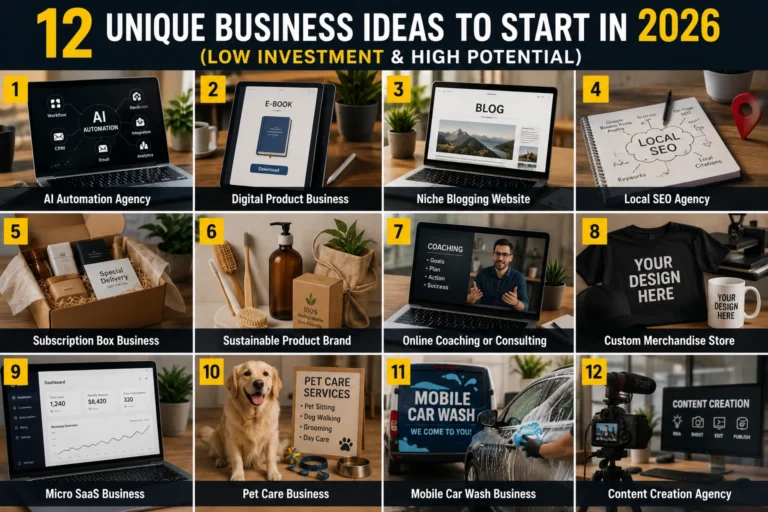
AI opens doors to many low-investment models. You can build AI-powered service agencies, ecommerce stores with personalized product recommendations, content creation platforms, AI consulting services, or even SaaS tools. Because AI automates many tasks, startup costs are often much lower than those of traditional businesses.
How do I choose the right AI tools for my business?
Start by identifying the tasks you most want to automate or improve, like research, writing, design, or customer support. Then choose tools that specialize in those areas. For example, AI website builders help with design, while chatbots handle customer queries. Testing a few tools before committing helps you find what fits your needs best.
Is AI expensive to use when starting a business?
Not necessarily. Many AI tools offer free tiers or affordable subscription plans. You can begin with basic features and scale up as your business grows. This makes AI accessible for startups with limited budgets while still offering advanced capabilities that used to cost thousands of dollars.
Can AI replace human employees in a business?
AI is best viewed as a tool that enhances human work rather than a replacement. It excels at repetitive tasks, data analysis, and pattern recognition. But roles that require judgment, creativity, and empathy still benefit from human oversight. Successful founders use AI to support teams, not fully replace them.
Do customers trust AI-powered businesses?
Trust depends on transparency and quality. If you disclose how AI is used and ensure AI outputs are accurate and ethical, customers generally respond well. AI can improve responsiveness and personalization, which builds confidence when implemented correctly.
What are the common mistakes founders make when starting with AI?
Many founders either rely too heavily on AI without oversight or underestimate the importance of validating ideas before building. AI should assist decision-making, not replace it. Testing early, tracking performance, and refining strategies based on data are essential to avoid wasted time and resources.
How long does it take to launch an AI business?
It depends on the model, but AI tools dramatically shorten timelines. Tasks that used to take weeks, like market research, content creation, or website building, can now take hours. With focused effort and good tools, you can launch a basic AI-powered business in weeks rather than months.
Are there legal risks when using AI in my business?
Yes, legal considerations include data privacy, copyright issues, and compliance with local regulations. Make sure you understand how customer data is used and ensure AI outputs don’t violate content ownership rules. Responsible use and clear policies help protect your business as it grows.
✨ Don’t stop here, follow Tech Statar for daily upgrades.