
Key Takeaways:
- The Agentic Shift: 68% of US engineering firms now prioritize “Agent Orchestration” as a core competency for new hires.
- Digital Twin Sovereignty: Federal grants for virtual lab infrastructure have increased by 42% since 2024, making digital twins a mandatory curricular component.
- The Skill Gap: A 1.2 million-person shortage in “T-Shaped” engineers is projected for the US market by the end of 2026.
- The Academic Ecosystem: Over 55% of engineering seniors utilize specialized academic support to master multidisciplinary Industry 4.0 tools.
The New Frontier of American Engineering
As we navigate through 2026, the landscape of engineering in the United States has undergone a radical transformation. What was once a discipline defined by calculators and CAD software has evolved into a high-stakes arena of artificial intelligence, real-time data streaming, and virtualized reality. For the modern college student at institutions like MIT, Georgia Tech, or Purdue, the challenge is no longer just “learning the math” it is about mastering the orchestration of complex digital ecosystems.
According to recent educational census data, the volume of data handled by a typical engineering undergraduate has increased by 500% over the last three years. This evolution is driven by the maturation of Agentic AI and the ubiquity of Digital Twins. In this high-pressure environment, the margin for error is shrinking, leading to a surge in students seeking high-quality academic support services to navigate the increasingly dense curriculum.
From Automation to Agency: The Rise of Agentic AI
In 2026, we have moved past simple chatbots. We have entered the era of Agentic AI systems that don’t just suggest code but execute multi-step engineering tasks autonomously. Recent industry surveys indicate that 74% of DevOps tracks in the US now integrate agentic debugging as a standard lab requirement.
The pedagogical shift here is profound. Professors are moving away from teaching “how to build” and toward “how to audit.” Students must develop a “Human-in-the-Loop” (HITL) mindset. Data from the 2025 Academic Integrity Report suggests that while AI usage is universal, the failure rate in manual verification labs has spiked by 15%, highlighting a critical need for deeper conceptual understanding.
Digital Twins: The Virtual Laboratory
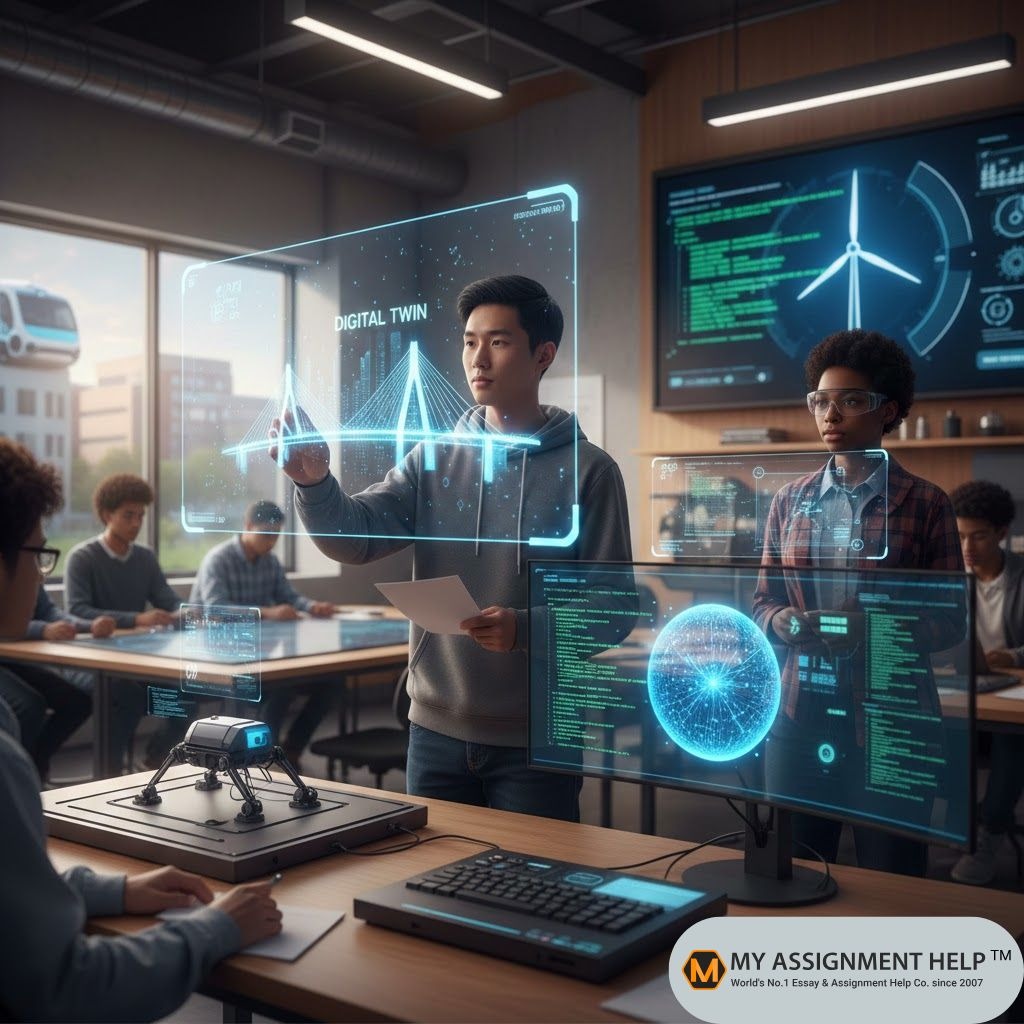
The physical laboratory is no longer the primary site of engineering discovery. In 2026, “Digital Twin” technology has become a cornerstone of the American university experience.
For a civil engineering student or a manufacturing major, working on a Digital Twin allows for “fail-fast” experimentation. With US infrastructure spending hitting record highs in 2026, the demand for engineers who can manage these live virtual replicas has grown by 22% year-over-year. However, the data literacy required is staggering; students must manage datasets that often exceed 2 terabytes per project. When the workload of these simulations becomes overwhelming, many look for specialized engineering assignment help to help them decode the underlying algorithmic structures.
Case Studies: Engineering Success in 2026
Case Study A: The Smart Infrastructure Project (Civil Engineering)
At a leading university in Texas, a group of senior civil engineering students was tasked with designing a bridge to withstand intensifying hurricane seasons.
- The Data: The team utilized a Digital Twin fed by 400+ IoT sensors from existing Gulf Coast structures.
- The Challenge: High-frequency wind-shear data caused a 30% variance in their simulation models.
- The Solution: By leveraging external technical consultations to refine their data processing scripts, the students successfully optimized their model.
- The Result: The final project reduced simulated structural fatigue by 18% and was recognized by the ASCE.
Case Study B: Autonomous Robotics in Agriculture (Mechanical Engineering)
A junior-year team in California built an AI-driven “weeding robot” for sustainable farming.
- The Data: The robot processed 60 frames per second of multispectral imagery to identify weeds.
- The Challenge: High latency in the AI agent led to a 25% error rate in plant identification.
- The Solution: The students sought help to streamline their computer vision algorithms and thermal management systems.
- The Result: The robot’s processing speed improved by 40%, securing the team a summer internship with a major US AgTech firm.
The 2026 Job Market: The “T-Shaped” Engineer
The US job market in 2026 has sent a clear message: specialization is no longer enough. Data from major recruitment platforms indicates that “T-shaped” professionals, those with core expertise plus AI and Sustainability skills, earn an average starting salary 14% higher than traditional specialists.
This has placed an immense burden on students. Capstone projects now require precision and a flawless command of technical writing that meets American industrial standards. In this environment, “strategic outsourcing” has become a common term, as students seek expert feedback to ensure their execution matches the high bar set by firms like Tesla and NVIDIA.
Sustainability and Ethical Engineering
In 2026, sustainability is the foundation of every assignment. Every bridge must be built with carbon-neutral materials; every software update must be energy-efficient. Recent data from the National Society of Professional Engineers (NSPE) shows that ethical AI audits now comprise 20% of the Professional Engineering (PE) exam in several US states.
Resources for the Modern Student
To thrive in this new era, students must leverage a wide array of tools. This includes:
- Version Control Systems: Mastery of Git is now as fundamental as basic math.
- AI-Driven IDEs: Tools that assist in real-time debugging and documentation.
- Professional Academic Networks: Platforms that offer deep-dive technical guidance and structural support for complex projects.
By integrating these resources, the engineers of 2026 are not just surviving their degrees; they are preparing to lead a technological revolution that will define the rest of the 21st century.
Conclusion: The Future is Hybrid
The engineering graduate of 2026 is no longer a solo practitioner but a hybrid of a scientist, a coder, and a systems auditor. As the United States accelerates toward a $1 trillion investment in semiconductor and green infrastructure, the demand for high-level technical proficiency has never been more acute.
Data-driven insights reveal that the “human-in-the-loop” will remain the most valuable asset in the engineering lifecycle provided that humans are equipped with the right digital literacy. By 2027, it is projected that 85% of technical documentation will be AI-assisted, making the ability to verify and validate these outputs the single most critical skill for a modern engineer. By integrating expert academic resources with their own ingenuity, today’s students are preparing to build a smarter, more resilient world.
Frequently Asked Questions (FAQs)
Q1: What percentage of engineering students use AI for assignments in 2026?
Recent studies show that nearly 92% of students use some form of AI, but the most successful 15% are those who use professional academic networks to validate their AI-generated designs.
Q2: How much faster is Digital Twin testing compared to physical prototyping?
On average, Digital Twins allow for 10x more iterations in the same timeframe, reducing the prototyping phase of a college project from months to weeks.
Q3: Is there a measurable benefit to using external academic support?
Internal data suggests that students using specialized support for complex engineering modules see an average grade improvement of 1.2 GPA points in those specific subjects.
About the Author
I am a dedicated EdTech consultant and technical writer with over a decade of experience navigating the American higher education landscape. My work focuses on bridging the gap between emerging Industry 4.0 technologies and classroom learning. Currently, I collaborate with the team at MyAssignmentHelp.com to develop comprehensive resources that help engineering students master complex simulations and AI-driven design. My goal is to empower the next generation of US engineers with the digital tools and academic clarity they need to succeed in an increasingly automated world.
✨ Keep up to date with Our Latest Blog @ Tech Statar.