
How Modern Technology is Transforming Material Testing in Construction
Not too long ago, material testing in construction was a largely manual process. Engineers relied on basic tools, handwritten observations, and a fair amount of experience to judge whether materials were fit for use. While those methods laid the foundation for modern practices, the expectations of today’s construction industry are far higher.
With projects becoming more complex and safety standards tightening, the need for accuracy and consistency has pushed material testing into a more advanced, technology-driven space. Today, engineers don’t just test materials, they analyze, monitor, and predict performance using modern tools and systems.
Understanding Material Testing in Today’s Context
At its core, material testing is about understanding how materials behave under different conditions. Whether it’s concrete under compression or steel under tension, engineers need reliable data before these materials are used in real structures.
What’s changed over time is not the purpose of testing, but the way it’s carried out. Instead of relying solely on manual methods, engineers now use digital systems and specialized tools to get more precise results in less time.
Where Technology is Making the Biggest Difference
One of the most noticeable changes in material testing is the shift toward automation and data-driven processes. This has not only improved accuracy but also made testing more efficient.
Automation Has Reduced Human Error
In earlier setups, even a small mistake in measurement or recording could affect results. With automated systems, much of that risk is minimized. Machines can now handle repetitive tests with consistent precision.
For example, compression testing for concrete, once a manual-heavy task, is now often performed using automated systems that record results instantly and reduce variability.
Data is No Longer Just Recorded It’s Analyzed
Another major shift is how data is used. Instead of simply recording results, engineers now analyze data in real time. This allows them to identify patterns, detect inconsistencies, and make quicker decisions on-site.
In many projects, testing data is directly integrated into software systems, making it easier to track performance across different stages of construction.
Equipment Has Become Smarter and More Reliable
Modern material testing equipment is designed to deliver consistent and highly accurate results. These tools are no longer just mechanical; they often include digital interfaces, sensors, and software integration.
This means engineers can rely on both precision and repeatability, which is especially important in large-scale projects where even minor variations can have significant consequences.
Key Technologies Shaping Material Testing
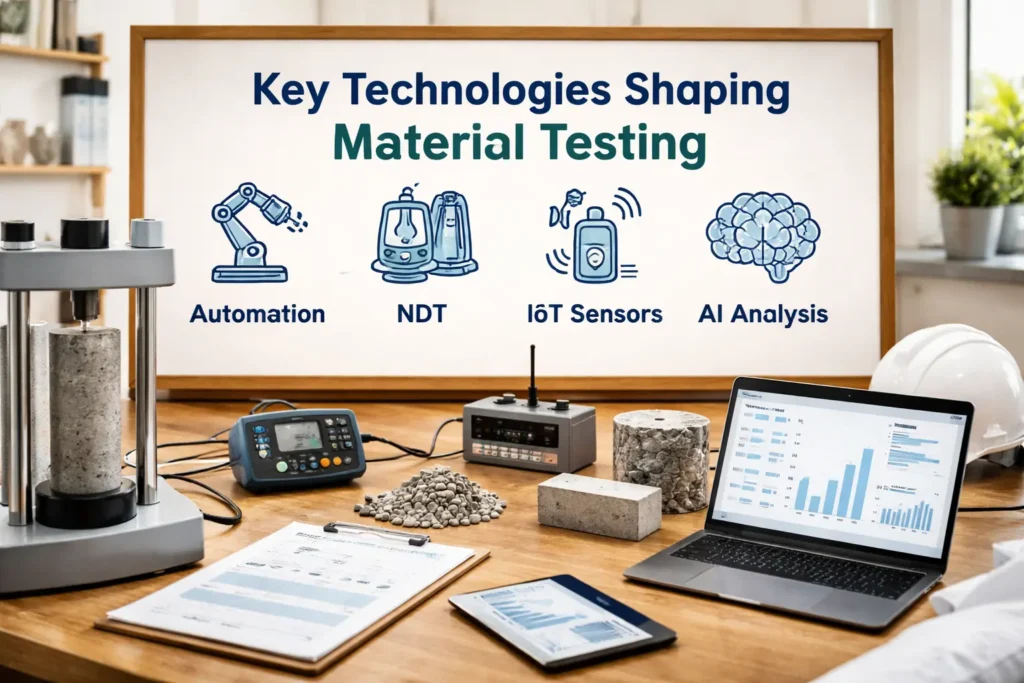
While automation and digital tools are already making an impact, several specific technologies are pushing the field even further.
Non-Destructive Testing (NDT)
Non-destructive testing has become a preferred method in many scenarios, especially when dealing with existing structures. It allows engineers to assess material quality without causing any damage.
Take bridge inspections, for instance. Instead of removing sections for testing, engineers can use ultrasonic methods to detect internal flaws. It’s faster, safer to use, and far less disruptive.
IoT and Real-Time Monitoring
The use of sensors in construction materials is another interesting development. With IoT-enabled devices, engineers can monitor conditions like temperature, stress, and moisture in real time.
A practical example is concrete curing. Sensors embedded within the structure can track how the material is gaining strength over time, helping engineers decide when it’s safe to proceed with the next phase of construction.
AI and Predictive Insights
Artificial intelligence is gradually finding its place in construction testing. Instead of just analyzing past data, AI tools can help predict how materials are likely to perform under future conditions.
While this technology is still evolving, it has the potential to reduce risks significantly by identifying potential failures before they happen.
Cloud-Based Systems for Better Coordination
Another subtle but important change is how data is shared. Cloud-based platforms allow teams to access testing results from anywhere, making collaboration easier.
For large projects involving multiple stakeholders, this kind of accessibility can make a noticeable difference in efficiency.
💚 You might also like: Why Integrated Project Coordination Is Critical for Modern Construction Success
How This Impacts Real Construction Projects
All these advancements are not just theoretical, they’re actively shaping how construction projects are executed.
In infrastructure projects like highways or bridges, accurate testing ensures that materials can handle heavy loads and environmental stress. In urban developments, especially smart cities, technology-driven testing helps maintain consistency across large-scale construction.
Even in manufacturing, where materials are produced before reaching the site, testing has become more standardized and reliable thanks to modern systems.
In many of these scenarios, advanced construction material testing equipment plays a key role in ensuring that quality is maintained from production to final application.
Challenges That Still Exist
Despite all the progress, adopting modern technology isn’t always straightforward.
One of the biggest barriers is cost. Advanced systems and equipment require significant investment, which may not be feasible for smaller firms. There’s also the need for trained professionals who can operate and interpret results from these systems effectively.
Additionally, integrating new technology into existing workflows can take time. Not every organization is quick to adapt, especially when traditional methods have worked for years.
What the Future Might Look Like
Looking ahead, material testing is likely to become even more integrated with digital systems. Fully automated labs, AI-driven analysis, and real-time monitoring could become standard practice rather than exceptions.
We may also see increased use of robotics in testing environments, further reducing manual involvement. As these technologies become more accessible, the gap between large and small-scale operations may begin to close.
💚 You might also like: How Contractors Use BIM Modeling to Reduce Cost Overruns
Final Thoughts
Material testing has come a long way from its manual beginnings. Today, it sits at the intersection of engineering and technology, playing a crucial role in ensuring construction quality and safety.
For anyone involved in construction, whether as a student, engineer, or project manager, understanding these advancements is more than just useful. It’s necessary. As projects grow in scale and complexity, the ability to rely on accurate, technology-driven testing will continue to shape how structures are built and maintained.
In many ways, the future of construction depends not just on what we build, but on how well we test what we build with.
✨ Stay ahead of the curve. Follow Tech Statar.